Merged "Iron-rich spheres" - scienctific explanation?

Here's how this works, Java Man.

You see, when I include a hyperlink like so, that indicates that this is something you click on.

It then takes you to a new page, where you can learn more about the topic of discussion.

Had you taken some of the three minutes between my post and your response to actually click through to the articles I mentioned, and actually read them (the evidence indicates you are a poor speed reader), then you would have had the answer to your question already.

So, let's try again.

Here is something for you to click on. It will take you to a new Tab or Window.

VVVVV CLICK HERE VVVVV
The Towers' Collapse: Fast, But Not Freefall
^^^^^ CLICK HERE ^^^^^

On this new page, you will see images like this one:
[qimg]http://www.nmsr.org/96thmomentum.jpg[/qimg]

This is for the first impact. For this (particular) impact, my simple model indicates that the reduction in speed was from 8.63 m/s to 8.05 m/s, or a reduction of some 6 %.

This works out to a loss of 1/15th of the initial speed.

But that's just one floor.

The next floors will be different (and you will actually need to read the article to see why.) The percentage of reduction is less for each subsequent floor.

When you look at the first few dozen floors, the results of my model match Chandler's measurements very well.

When you look at the complete collapse, the overall times match observed collapse times very well.

In summary, the answer to your question is
"About 14/15".

But's that's the first impact only.

I should add you are not being a very effective spokesperson for the Truth Movement.

But, I appreciate the Comedy Gold! Who would have thought we'd have someone who makes even Ergo look smart?

I read all that. I just asked the question how much longer does it take. A free falling object would take what? 8 seconds to drop from floor 98? It increases the time by 50%. So momentum, contrary to what GlennB would have us believe with his 5% and 2% does have an influence.

On top of that the calculations you linked to do not take into consideration deformation and energy spent on breaking up the stuff below. By that I mean dislodging the beams and floor panels, pulverizing them and blowing stuff out the side. Which by the way takes momentum from the crushing roller ball. The more stuff that gets spewed to the sides and falls overboard the less mass there is to crush downward. The analysis although correct does not take into consideration these internal deformation nor the loss of mass. He clearly states that it is inelastic.

We already went up 50% on the total time and we are a) not taking air resistance into consideration and b) energy loss due to structural resistance and internal deformation and c) lateral components in momentum vectors pointing outwards and not downwards.

Now how much does that add up?
 
So momentum, contrary to what GlennB would have us believe with his 5% and 2% does have an influence.

wtf? I was clearly and explicitly agreeing with you (in terms of your example), just pointing out that as the mass accumulates the conservation of momentum issue reduces.
 
I read all that. I just asked the question how much longer does it take. A free falling object would take what? 8 seconds to drop from floor 98? It increases the time by 50%. So momentum, contrary to what GlennB would have us believe with his 5% and 2% does have an influence.

On top of that the calculations you linked to do not take into consideration deformation and energy spent on breaking up the stuff below. By that I mean dislodging the beams and floor panels, pulverizing them and blowing stuff out the side. Which by the way takes momentum from the crushing roller ball. The more stuff that gets spewed to the sides and falls overboard the less mass there is to crush downward. The analysis although correct does not take into consideration these internal deformation nor the loss of mass. He clearly states that it is inelastic.

We already went up 50% on the total time and we are a) not taking air resistance into consideration and b) energy loss due to structural resistance and internal deformation and c) lateral components in momentum vectors pointing outwards and not downwards.

Now how much does that add up?

I am assuming inelastic collisions. Yes, momentum is conserved, but kinetic energy by itself will not be conserved. My model allows for energy to go into crushing, breaking, and heating of contents.

How much does it add up?

You really need me to hold your hand through this?

Here's my answer. Had you actually read my article, perhaps you would have noticed this.

results.jpg
 
Here's my answer. Had you actually read my article, perhaps you would have noticed this.

[qimg]http://www.nmsr.org/results.jpg[/qimg]

I did, that's why I said a 50% increase to reach your value. Did you miss that?

Now your calculation does not take into consideration the loss of mass or energy in deformation. The video you show on your page clearly shows how wide the crush front gets. That's a lot of mass going out the sides, a lot of energy spent to put it there and a lot less mass pushing down on the floors below.

Thus Mn (n being a floor at any given time) is not the sum of the mass of the n floors.

Your equation M1*v1 = M2*v2 could be stated as Mn*v1 = M(n+1)*v2. But Mn is not an exact multiple of floors because there is mass being lost to the sides. To state it differently:

Mn < M(n-1)+dM(n)

That is the mass of Mn is less than the mass on the previous floor (n-1) plus the mass of the nth floor (n). Because M(n-1) lost mass on the way down to n. How much? Just look at the cloud and tell me.

This in turn should increase the time in your calculations and to that you'd have to add other energy losses.
 
I did, that's why I said a 50% increase to reach your value. Did you miss that?

Didn't miss it, I just couldn't tell what your point was. Still not sure about that.

Now your calculation does not take into consideration the loss of mass or energy in deformation. The video you show on your page clearly shows how wide the crush front gets. That's a lot of mass going out the sides, a lot of energy spent to put it there and a lot less mass pushing down on the floors below.

Thus Mn (n being a floor at any given time) is not the sum of the mass of the n floors.

Your equation M1*v1 = M2*v2 could be stated as Mn*v1 = M(n+1)*v2. But Mn is not an exact multiple of floors because there is mass being lost to the sides. To state it differently:

Mn < M(n-1)+dM(n)

That is the mass of Mn is less than the mass on the previous floor (n-1) plus the mass of the nth floor (n). Because M(n-1) lost mass on the way down to n. How much? Just look at the cloud and tell me.

This in turn should increase the time in your calculations and to that you'd have to add other energy losses.

Since the mass of the initial upper section is more than enough to break the first impacted floor, we know that that mass (say, 14 floors' worth) is enough to do the job.

It's pretty obvious that 15, 16, 17, ... floors will be enough to continue the destruction.

Let's say that half the mass of each floor is ejected sideways, and doesn't contribute to the downward collapse any more: then ...

  • The 2nd floor to be impacted receives the brunt of 14.5 floors instead of 15.0
  • The 3rd floor to be impacted receives the brunt of 15.0 floors instead of 16.0
  • The 4th floor to be impacted receives the brunt of 15.5 floors instead of 17.0
  • and so on...

If 14 floors was enough to collapse a floor section, so will 14.5, 15.0, 15.5, etc.

The collapse is still INEVITABLE once begun.

Sorry, no controlled demolition here! Planes, fires and gravity explain the Twin Towers' fall.

No explosives, or thermite, or thermate, or nanothermite, or nanu-nanu* are needed.

* Today's obscure Mork from Ork reference
 
The collapse is still INEVITABLE once begun.

I don't question that. The french demolition technique shows that quite well. What I'm questioning is the fall time once it has begun. What happens to your times if each floor losses mass at say 10%, 20% and 30% per floor drop? If the mass decreases so does its momentum, thus the floor just arrived at slows it down more than had the mass been more massive. In other words Ma*v1 < M1*v1 if M1 looses mass on the way down and becomes Ma.
 
I don't question that. The french demolition technique shows that quite well. What I'm questioning is the fall time once it has begun. What happens to your times if each floor losses mass at say 10%, 20% and 30% per floor drop? If the mass decreases so does its momentum, thus the floor just arrived at slows it down more than had the mass been more massive. In other words Ma*v1 < M1*v1 if M1 looses mass on the way down and becomes Ma.

I can consider this later, perhaps tonight on the vanpool commute home.

Check back tomorrow.

My gut feeling is that total collapse time will not be affected very much.
 
I don't question that. The french demolition technique shows that quite well. What I'm questioning is the fall time once it has begun. What happens to your times if each floor losses mass at say 10%, 20% and 30% per floor drop? If the mass decreases so does its momentum, thus the floor just arrived at slows it down more than had the mass been more massive. In other words Ma*v1 < M1*v1 if M1 looses mass on the way down and becomes Ma.
The speed change per floor never exceeds 8 percent and goes to 1 percent by the bottom of the tower. Simple momentum model. You could do it, use excel.

10 percent of the new floor mass? Or 10 percent of the entire mass? The dust, is light weight ceiling tile, wallboard, and some concrete floors, the dust cloud is not a lot of mass lost, or the smoke.

The mass of the floors is enough, and the junk being ejected is mainly the exterior sections.
 
Last edited:
On top of that the calculations you linked to do not take into consideration deformation and energy spent on breaking up the stuff below. By that I mean dislodging the beams and floor panels, pulverizing them and blowing stuff out the side. Which by the way takes momentum from the crushing roller ball. The more stuff that gets spewed to the sides and falls overboard the less mass there is to crush downward. The analysis although correct does not take into consideration these internal deformation nor the loss of mass. He clearly states that it is inelastic.


The collisions being inelastic means the energy of internal deformation and energy of mass ejection ARE taken into account. It's those deformations that make the collision inelastic, and the kinetic energy that's lost in inelastic collisions is lost to just such deformations (while momentum is conserved, as always).

By overlooking that, you've the same mistake Gordon Ross made in his 2006 paper, which completely invalidates its conclusions.

Those facts about inelastic collision also make the terms of your earlier "brick strikes another brick halfway down" scenario physically impossible. You specify that the collision is inelastic (so both bricks just after the collision are falling at half the velocity of the initial brick, conserving momentum), and you also specify that no kinetic energy is lost in the collision. That's a direct contradiction, since if both bricks just after the collision are falling at half the velocity of the initial brick, half the kinetic energy from just before the collision has been lost.

If no kinetic energy were lost as you specified, then the collision would have to be perfectly elastic. In that case, the second brick after the collision would be moving at the same velocity as the first brick, leaving the first brick (momentarily) motionless (but not delaying the time to first ground impact at all, since the second brick continues the trajectory of the first). Of course, neither bricks nor building floors collide elastically very well, so there's not much use in analyzing that case.

Seems you should already know all that. Don't EE courses have any prerequisites at all? Not even high school level physics?

Oh wait, let me guess, you were just "testing" the rest of us. To see how well we reason. Right? :rolleyes:

Respectfully,
Myriad
 
Must have missed those pics of neighbouring buildings on fire and crumbling down. Could you post them again?

Nice shift of the goalposts.

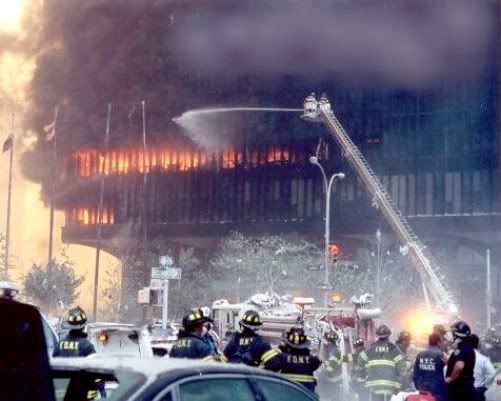
NYFDWTCfire.jpg


Fire. Lots of it. On every floor. This building was a total loss.

This building was DESTROYED by fire. Imagine that. Completely gutted.

But hey, you're welcome to shift the goalposts again.
 
I might if I can find thermite that burns in vacuums. ;)
You don't know what your fantasy uses?

?

Chemistry and 911 truth, not talking.

Fe2O3(s) + 2Al(s) → Al2O3(s) + 2Fe(l): ΔH = -851.5 kJ/mol

Do you see any air in this chemical reaction? 911 truth chemistry results in crazy claims of thermite, and much more.
 
Dave thank you for your response it was clear and non offensive and had numbers unlike Mr 37 Years.

Now getting back to the point of impacts. I totally agree with you that the floors and not air pose the greatest resistance. So if you'll allow me to get back to the brick example I'll drop it again from the roof top disregarding air resistance, but adding another brick half way down.

The brick would take 9.2 seconds to drop the full height. But halfway down in smashes into the other brick which is at stand still. Now supposing there is no energy lost in dislodging the second brick and that there is no energy lost in deformation of the bricks the bricks continue travelling at half the speed the first brick had upon hitting the second. We are conserving momentum. Thus it is impossible for the first brick to reach the ground in 9.2 seconds. Since it slows down to half its speed and then keeps accelerating under the same acceleration and not twice the acceleration. Thank you Glen for that comment and thank you all for making a prank out of my response.

We can repeat the process by adding more bricks until we have one for each floor and we'll realize that the amount of time it takes just by gaining mass is greater than what we see in the videos. And we are assuming it takes no energy to break the lower bricks free. Which it would in real life and thus slow down the fall even further.
Wrong.

One brick dropping halfway, hits brick, they impact the ground at 10.422 seconds, 1kg bricks. By itself, impacts 9.11 seconds. Ignore air resistance.
What did you get?

Take 12 bricks and drop on 1 brick for each floor. 12.081 second to impact ground. 110 bricks hit the ground at 12.081 seconds. Ignore air resistance.

What is your point? You were wrong? You can't do physics? What is your point? To troll, is that the goal?


... Since it slows down ... and not twice the acceleration. ...
??? twice as heavy
 
Cool, thanks for your input. See you tomorrow.

I added mass ejections to my calculation, and, as I expected, the net change on collapse time was minimal. As the ratio of ejected mass rose from 0 to 0.1 to 0.2 to 0.3, the collapse time was shortened by ten milliseconds or so.

That seems a little paradoxical, but actually makes sense. The dynamic force ( = √(mK)v, where m = mass, K = tower stiffness parameter, and v=velocity of falling upper section) is less for the smaller masses (due to mass shedding), by an amount proportional to the square root of the impinging mass.

The accelerations during the impacts go as dynamic force divided by mass m (so that F=ma, as usual), and these will be proportional to the square root of mass, dived by the same mass, or -- equivalently -- inversely proportional to the square root of the mass.

As mass decreases, then (via shedding to the sides), the accelerations as each floor is overwhelmed increase. Since this governs the brief time due to collisions only (and not the falling times as each newly-broken floor section falls 12 feet to the floor below), the total effect is minimal - a dozen milliseconds, or so.

At some point, if enough mass is ejected to the sides, there wouldn't be enough to continue the collapse. But that's way more than the 30% considered here.

OK?
 
That is the mass of Mn is less than the mass on the previous floor (n-1) plus the mass of the nth floor (n). Because M(n-1) lost mass on the way down to n. How much? Just look at the cloud and tell me.

Stupid question. There is no means of measuring the weight of dusat suspended in mid-air, on video tape made miles away.

This in turn should increase the time in your calculations and to that you'd have to add other energy losses.

No, since your values are mostly pulled out of your underwear, or Hoffman's, or where ever.
 
Nice shift of the goalposts.

[qimg]http://i286.photobucket.com/albums/ll116/tjkb/NYFDWTCfire.jpg[/qimg]

Fire. Lots of it. On every floor. This building was a total loss.

{twooftard}B-b-b-but the smoke is black! The fire is oxygen-starved and about to go out!{/twooftard}
 
I found a nice, free paper with lots of SEM images and XEDS spectra of various spheres from coal plant fly ash:

Barbara G. Kutchko, Ann G. Kim: Fly ash characterization by SEM–EDS
Fuel 85 (2006) 2537–2544


(@ Rational posters: Don't jump to conclusions too soon! These spheres are from "pulverized coal (PC) fired boiler, the furnace operating temperatures
are typically in excess of 1400 C (2500 F)". I don't believe that such conditions prevailed for a significant time over a significant volume of the WTC fires - if at all.)


(oh and no reply from RJ Lee :()
 

Back
Top Bottom