
Ivan Kminek
Muse
- Joined
- Jun 15, 2011
- Messages
- 906
I agree that you, Oystein and others should work on analyzing all of Millette's new data. Make sure Almond and Sunstealer get the email with the higher-resolution images, and I will ask Millette to post a high-res pdf as well.
I am still taking on the DSC question, for one more reason too: Steven Jones proclaimed awhile back that no replication of the Bentham paper experiments would be complete without them. This is not an endless stream of test after test, it's one test.
What's funny tho is that even I can see that Tillotson did the DSC analysis to delineate some of the properties of known nanothermite, and Harrit et al used the test to try to prove thermitic material.
Millette is much more interested in further research on the iron microspheres right now. If someone is actually willing to commit $1500+ to a thorough DSC study, I'm sure it can be arranged, but Millette has told me at least twice no more new knowledge will be gained from DSC. So far no one has commented on my idea of getting an independent analysis of the Farrer/Harrit DSC data though, which I think would be more affordable.
Chris, as for DSC, try to consider how to perform this "one test" to be somehow meaningful.
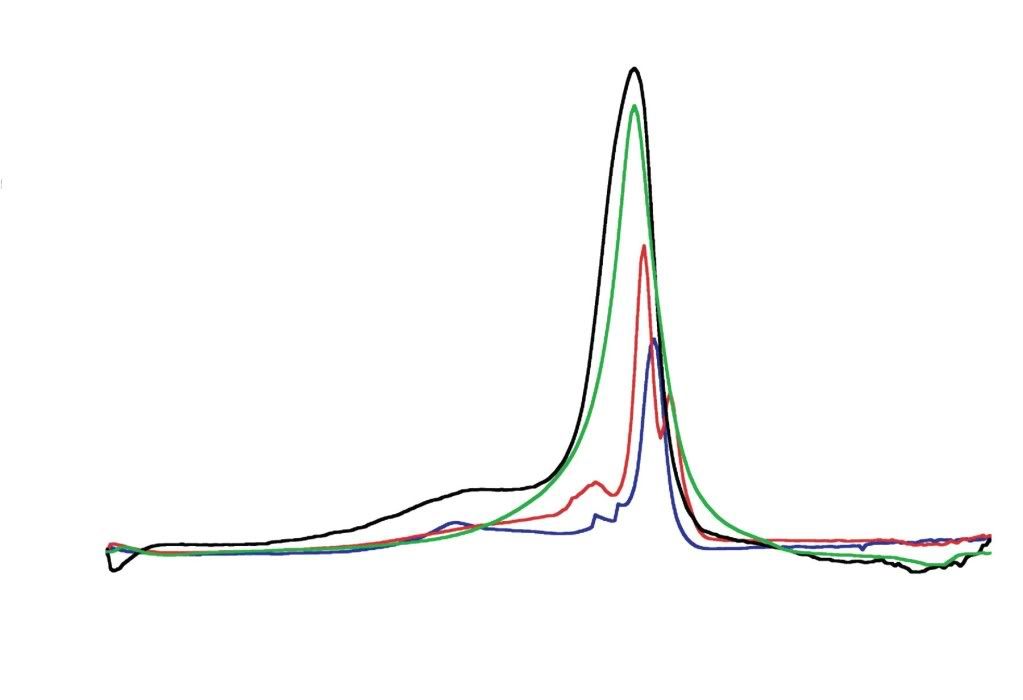
We do not know what Farrer burned in his DSC machine. Nobody knows it, including Farrer. I expect that in all 4 cases it was one material (one paint), since curves are basically similar in character and they seem to differ e.g. because of the varying portion of attached inactive oxidized steel. But, what kind of paint was really burned? We can only judge that it was one of the most abundant paints in the dust, i.e. Laclede or Tnemec paint, since it was probably easy to find these chips for burning. But, we can still be wrong (although it is not very probable), since it could be some paint (e.g.) from WTC7.
So, for any DSC measurements, several red chips with the composition corresponding to both Laclede and Tnemec paint must be carefully selected (and the portion of gray layer should be estimated, to calculate released energy per mass unit of reactive material). All chips must be burned in the machine to get some representative set of results for comparison with "Bentham curves".
So far for DSC under air, which can only prove that any polymer binder in the red chips indeed burns.
Now, for DSC under inert, which is necessary to exclude oxidation reactions. We know that two polymeric binders were present in the most abundant red primer paints: epoxy resin in Laclede paint and alkyd-linseed based resin in Tnemec paint. In the case of the second binder I am not sure, but for epoxy binder I found a reliable data that even under inert, this polymer can be massively degraded at temperatures ca 350-450 degrees C with exothermic effect! So such measurements under inert on Laclede paint could easily lead to the little "debunking disaster", since truthers will cry (not knowing absolutely anything about the thermal behavior of polymers): "hey, thermite finally proven by debunkers scientists!"
What I'm trying is to say that "one DSC test" and its evaluation could be a quite complicated, lengthy and expensive matter.
Therefore, isn't it better to conclude again: "According to XEDS measurements, carbon based/polymer binder strongly prevails in red-gray chips studied both by Harrit et al and Millette. Such material in principle CANNOT BE THERMITE of any kind, not speaking about the absence of elemental aluminum. Period".
Well, we have still to "face up" to the guys like Senenmut, who tries to suggest: "Could it be so that there are two kinds of very, very similar red-gray chips in the dust, one is some paints and one is nanothermite?"
Actually, we expected such silly reactions several week ago, but the answer is still the same. No, it could not be so. Anything with several tens of polymer binder in it cannot be intentionally prepared evil thermite; the "nanothermite game is over"

As for the interest of Jim Millette on the "microsphere matter" it sounds interesting and I'm again suggesting the same very simple experiment: let's try to crush some WTC concrete and look if it contains iron rich (or any other microspheres), coming from the fly ash. If yes, it could end this endless and tiring debate. Btw, I do not see clearly any microspheres in the nice microphotos of the WTC dust taken by Jim Millette
Last edited:


 )
)



 ) so that we can at least find out how it compares to the Millette samples.