BasqueArch
Graduate Poster

- Joined
- Jan 11, 2009
- Messages
- 1,871
Yes, nanoiron at office fire temperatures.
......
It’s been shown that office fires can reach 1254C.
And that ferrospheres and volatile (vapor) lead are created at <1200C temperatures, less than the melting point of bulk iron (1535C) and bulk lead boiling point (1740C)- Melting point of bulk lead (327C) So Jones and C7 are wrong that iron temperatures need to be 1535C to produce ferrospheres and that lead has to boil to vaporize.http://suwic.group.shef.ac.uk/posters/p-ash.pdf
Due to the “melting point depression” phenomena.
http://en.wikipedia.org/wiki/Melting-point_depression
First come to grips with the scientifically verified fact that ferrospheres and volatile (vapor) lead are created at less than the melting point of bulk iron (1535C) and bulk lead boiling point (1740C)
???We are talking about the melting of iron and there is NO evidence that temperatures in the TT exceeded 1100oC. NIST said that temperatures of 1000-1100oC only lasted for about 15 min in any location.
ETA: What nano-iron? Read my post again:
Note they clearly said that Iron melted producing spherical metallic particles, not office furnishings burned producing spherical metallic particles.
Which part of nano sized iron is not iron. Which office furnishings do not contain iron nano sized particles.
You answered the wrong question.
The question was this:
First come to grips with the scientifically verified fact that ferrospheres and volatile (vapor) lead are created at less than the melting point of bulk iron (1535C) and bulk lead boiling point (1740C)
Because Steven Jones is wrong.
http://www.journalof911studies.com/articles/WTCHighTemp2.pdfThe temperatures required for the observed spherule-formation and evaporation of materials observed in the WTC dust (table 1) are significantly higher than temperatures reachable by the burning of jet fuel and office materials in the WTC buildings (table 2). The temperatures required to melt iron (1,538 °C) and molybdenum (2,623 °C), and to vaporize lead (1,740 °C) and aluminosilicates (~2,760°C), are completely out of reach of the fires in the WTC buildings (maximum 1,100 °C ).
And also you are wrong.
My italics for F>C temperatures
Again you have it backwards. You are obsessed with the word "expected" and I have countered that several times.
I'm taking RJ Lee's statements at face value.
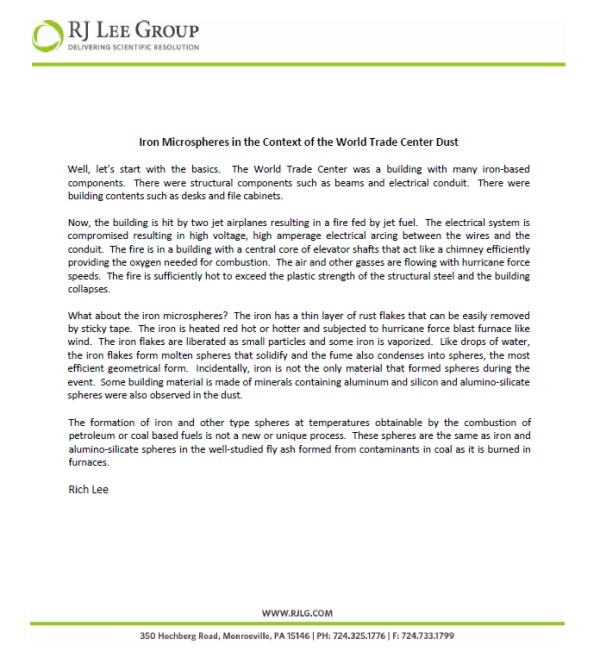
"iron melted during the WTC event producing spherical metallic particles."
and
"The presence of lead oxide on the surface of mineral wool indicate the existence of extremely high temperatures during the collapse which caused metallic lead to volatilize, oxidize, and finally condense on the surface of the mineral wool.
I don't have to prove that iron melts at 2800oF (1537C)and lead volatilizes at 3100oF, (1704C)those facts are known. If you want to claim that the iron spheres were created and lead volatilized at a lower temperatures in the TT fires, you must show proof.
Proof shown.
Iron is heavy and fell out of the dust faster than anything else. The amount of iron in the dust gets proportionately less in more distant locations, hence the discrepancy.
Source?
Lead paint has been banned from New York for more than 40 years.
http://www.keoghcrispi.com/Practice-Areas/Lead-Paint-Poisoning.shtml
You are missing the point: Iron melted [at 2800oF] (1537C) during the WTC event producing spherical metallic particles.
These particles were deposited by the dust cloud.
Particles that either were formed as a consequence of high temperature or were modified by exposure to high temperature are important WTC Dust Markers for WTC Dust. Fires that were a part of the WTC Event produced combustion-modified products that traveled with other components of WTC Dust. Considering the high temperatures reached during the destruction of the WTC [2800oF], (1537C)the following three types of combustion products would be expected to be present in WTC Dust.
These products are:
• Iron-rich spheres from iron-bearing building components or contents
C7 and Jones are wrong. Proof shown.
You are being obstinate
Last edited: