• Quick note - the problem with Youtube videos not embedding on the forum appears to have been fixed, thanks to ZiprHead. If you do still see problems let me know.

Origin of the paint that was found as red-gray chips - any ideas?

Why don't you all leave the guy alone to do his job?
I didn't intend for Chris to relay my brainstorm to Jim :o

Wow guys, I had no idea my comments would provoke this outpouring of support for Dvorak!! Amazing.
...
I want to have it on record that I did not support Dvorak! :D
I praised Mozart for his Bohemian inspiration, but prefer Smetana over Dvorak any day :p
 
Wow guys, I had no idea my comments would provoke this outpouring of support for Dvorak!! Amazing.
I'm coaching and performing with a production at a major university. Long work but some absolutely beautiful things in it.

Chris, all I can say about your Realm is ... WOW!! You are a man of many talents, kudos!! So we can thank you for a number of contributions, not least which is your excellent video series on 9/11 Myths.

Frankly I'd much rather spend a bit of time reading this thread than debating the same old truther myths. I think there is merit in this investigation of the chips even though I do share the sentiments of ozeco41 regarding the actual possibility of thermXte being responsible for the tower collapses.

I am hoping this inquiry will result in a kind of 'kill shot' for the myth of the nanothermite chips. But I await the results as does everyone else.

cheers and goodnight
Alien I'll send you a 2-CD copy of my opera if you'd like it. Just give me an address privately. Now about that paint...
 
@ Chris, Ivan,

look what I found only today:
http://the911forum.freeforums.org/dust-available-looking-for-analysts-t596.html
Dust Available. Looking For Analysts

Post by kawika » Sat Oct 22, 2011 1:39 am
I have several samples of dust, SFRM and other materials that were obtained from WTC steel wreckage.

If you are interested in joining a group of independent analysts for a coordinated series of tests, please let me know.

There has been interest in doing a red/gray chip analysis in argon and free air.

Please PM me with your email address so i can forward a Draft Cooperation Agreement to you for comments and suggestions.
and
Post by Dan » Thu Jan 12, 2012 2:26 pm
Have you seen this?
http://www.internationalskeptics.com/forums/showthread.php?t=214739&page=35
They also have samples and will be testing very soon. Maybe you can contact the same scientist or try to raise money? I think it will be about $1000. Or speak to Chris Mohr?

I just posted a reply where I opined that this sample won't help Jim's study along. However, if there is some floor joist steel in that debris that this guy has access to, that would be ultra cool.
 
Oystein: yes, I have spotted this thread just yesterday:cool:

And I also noticed your new contributions to the old thread Active Thermitic Material in WTC Dust in The911Forum about a week ago:rolleyes:
Your posts are so elaborate (and comprehensive) that probably nobody is going to react there now. Perhaps you should be rather "simpler" for the "starters" in The911Forum, as regards the new development in the "nanothermite" (or paint) matter... Perhaps too many new informations at once for them, although some of them are apparently educated and smart...
Perhaps you should ask guys in this thread what is unclear for them etc., it might be some useful "feedback" for us. But, perhaps those guys simply don't care about this matter so much (?)
 
Last edited:
Ivan,
there are not many active members over there, and they are by and large not so much interested in that nanothermite issue. I find that AE911T and their closer peers are not well respected there, for very good reasons. So I am neither surprised nor disappointed that no one replied.
 
Oystein: yes, I have spotted this thread just yesterday:cool:

And I also noticed your new contributions to the old thread Active Thermitic Material in WTC Dust in The911Forum about a week ago:rolleyes:
Your posts are so elaborate (and comprehensive) that probably nobody is going to react there now. Perhaps you should be rather "simpler" for the "starters" in The911Forum, as regards the new development in the "nanothermite" (or paint) matter... Perhaps too many new informations at once for them, although some of them are apparently educated and smart...
Perhaps you should ask guys in this thread what is unclear for them etc., it might be some useful "feedback" for us. But, perhaps those guys simply don't care about this matter so much (?)

Ivan,
there are not many active members over there, and they are by and large not so much interested in that nanothermite issue. I find that AE911T and their closer peers are not well respected there, for very good reasons. So I am neither surprised nor disappointed that no one replied.
Well Snowcrash is showing as being online over there yet he has not replied to your Jan 29 post yet
 
@ Chris, Ivan,

look what I found only today:
http://the911forum.freeforums.org/dust-available-looking-for-analysts-t596.html

and


I just posted a reply where I opined that this sample won't help Jim's study along. However, if there is some floor joist steel in that debris that this guy has access to, that would be ultra cool.

in your post said:
I found another "major safety hazard": Humans! Did you know that humans, despite their consisting to 2/3 of inert water, have an energy density of 8-10 MJ/kg - more than Jones's chips according to their published DSC results? Take overweight Americans, and they equal the combustible heat of all the truss paint on one floor.

Do I detect a possible bit of prejudice here? Are Americans the only ones with this problem?

Considering requesting more flogging!

:D

(couldn't resist, nice posts)

:boxedin:
 
Last edited:
Well Snowcrash is showing as being online over there yet he has not replied to your Jan 29 post yet

Maybe he's still wrapping his head around what I told him ;)

Do I detect a possible bit of prejudice here? Are Americans the only ones with this problem?

Considering requesting more flogging!

:D

(couldn't resist, nice posts)

:boxedin:
Hehe

You need to read better. I wasn't talking about Americans being (generally) overweight. I was talking about overweight Americans - a group disjoined from normal weight and underweight Americans, which also exist. We know that there were around 25,000 people in the towers on this tuesday morning; or 120 per occupied floor. I said that 50 per floor may be overweight - is that unreasonable? I meant to write (but the number is actually missing) that 2 overweight Americans equal the combustion energy of all the LaClede paint on one floor. I needed overweight to makje it an even number. It would alternatively have taken 2.5 average Americans.

:D
 
@ Chris, Ivan,

look what I found only today:
http://the911forum.freeforums.org/dust-available-looking-for-analysts-t596.html

and


I just posted a reply where I opined that this sample won't help Jim's study along. However, if there is some floor joist steel in that debris that this guy has access to, that would be ultra cool.
Kawika offered me his dust six weeks ago but I said no thanks. It looks like at least two, maybe three studies are in the pipeline now. When it rains it pours...
 
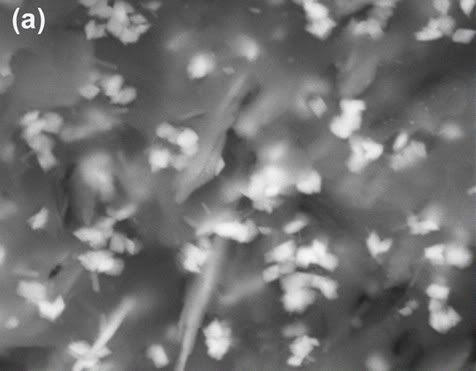
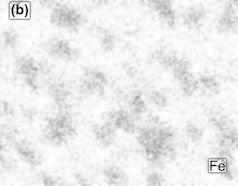
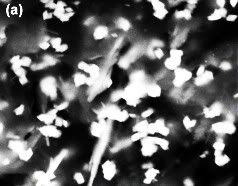
I took a very close look at Figure 10 of the Harrit paper - the XEDS-map of 5 elements along with a BSE image of the same region of one chip. My goal originally was to make it more visually clear which pigments are Al-Si-oxides and which are Fe-oxides (that indeed Al+Si map with greyish platelets and Fe with whitish grains), and to my surprise I think I stumbled on two crystal structures that seem to be neither Al-Si nor Fe, but contain elements heavier than Si. I propose that I found the so-far elusive Strontium Chromate!

But I now need your help to confirm (or refute) this: I haven't found any good reference on what the crystal structure and typical particel size of Sr-Chromate in paint would be. Plus, if y'all could review critically my work, maybe repeat the image manipulations that I did and tell me if what I did is valid to begin with, or if you converge on similar results.


Here it goes. First, a link to the original Figure 10 (too large to display on this forum):
http://i1088.photobucket.com/albums...terial/ActiveThermiticMaterial_Fig10_orig.jpg

Fig 10a is a BSE image of a region in the the red layer of chip (a), showing an area of about 5µm by 3,5µm. In BSE imaging, the brightness of an obhect depends on the atomic number or mass of its constituent elements. Very light elements such as hydrogen don't show at all (black), light elements such as C or O (atomic numbers 6 and 8) may be dark grey or also be close to invisible, medium elements such as Al or Si (atomic numbers 13 and 14) appear greyish, heavier elements such as Cr, Fe and Sr (atomic numbers 24, 26 and 38) would appear whitish.

Fig 10a:
ActiveThermiticMaterial_Fig10a.jpg


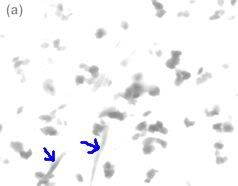
Now, all six parts of Fig 10 contain many shades of gray (or whatever color they are colored in), and it is easy for the human eye to be fooled by varying contrasts and, conversely, difficult to identify areas of equal grey intensity. In other words, it is hard to tell where "greyish" ends and "whitish" begins. I figured a remedy would be to adjust brightness and contrast of the images such that areas below or above a certain intensity would vanish into pure white (or black), so I could see only those area with a minimum signal intensity. I decides to first convert the five colored images to grayscale, then to invert them all, as I am more used to looking at white as a neutral background. Then I increased the brightness of the images, and sometimes played with contrast also, such that areas already close to white would fade to 100% white while areas with a sufficiently string signal stood out clearly as darker shades of gray.


And this is the result for 10a:
ActiveThermiticMaterial_Fig10a_inverted.jpg

Most of the particles are rathe "compact", their lenght:width ratio hardly exceeds 2:1, with those that are longer usually showing a waist or other discontinuites that seem to indicate they are really two particles lumped together. But two structures stand out as being long, thin and straight. Previously, I had seen them as greyish platelets (kaolinite) seen edge-on, but all the other kaolinite platelets, including some that are shown edge-on, have disappeared after my image adjustment - they were simply a darker shade of grey than these two.

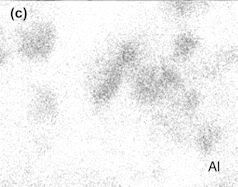
So next I tried to see if these "needles" map with Al or Si, or maybe Fe, by looking at the three element maps next to the altered BSE image:

1. BSE and Al:
ActiveThermiticMaterial_Fig10a_inverted.jpg
ActiveThermiticMaterial_Fig10c_inverted.jpg

No match

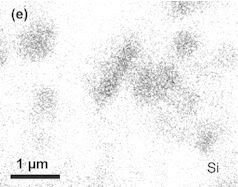
2. BSE and Si:
ActiveThermiticMaterial_Fig10a_inverted.jpg
ActiveThermiticMaterial_Fig10e_inverted.jpg

No match

3. BSE and Fe:
ActiveThermiticMaterial_Fig10a_inverted.jpg
ActiveThermiticMaterial_Fig10b_inverted.jpg

Fe matches the compact grains, but not the "needles"


On the other hand, Al and Si match each other wonderfully:
ActiveThermiticMaterial_Fig10c_inverted.jpg
ActiveThermiticMaterial_Fig10e_inverted.jpg


It is not easy to make the greyish kaolinite stand out, but I tried by increasing contrast greatly and adjusting gamma only slightly. In the adjusted BSE, take both white and black as neutral background of other stuff and look at the grey areas, when you compare with the distribution of Al and Si:
ActiveThermiticMaterial_Fig10c_inverted.jpg
ActiveThermiticMaterial_Fig10a_contrastMax.jpg
ActiveThermiticMaterial_Fig10e_inverted.jpg


It is my contention that the two needles show too little signal for Si and Al, compared to the other platelets, and are thus not kaolinite. They are not Hematite, either.

The only other possibility I see for our LaClede paint is Strontium Chromate.
Big question: Does Strontium Chromate form "needles" like this?


I have one more image (direct link again because of size) that may show Sr-Chromate pigments - simply because these particles are larger than, and more slender, than the many hematite grains - I labelled them with the letter C:
http://i1088.photobucket.com/albums...ede/ActiveThermiticMaterial_Fig05-labeled.jpg


# oysteinbookmark

 
Excellent work Oystein. I'm impressed. There was some talk earlier in the thread regarding acicular (needle shaped) Strontium Chromate and Ivan linked to a couple of sources. Here is a couple of pictures of Strontium Chromate for you.

picture.php
 
I posted this link in another thread, but with another focus. Some of the earliest (and thus maybe least "censored" and raw) information from Jones about the chips, from december 22, 2007:

Announcing a discovery: Red/gray bi-layered chips in the WTC dust

This links to a video from a presentation a week earlier with some data. The video is low quality, many slides are not really readable, but still maybe we can extract this or that:
Dr. Steven E. Jones Boston 911 Conference 12-15-07 Red chips Thermite.mov

For example:
  • At 1:31, a nice image of both layers with a scale that allows us to determine that thed red layer is up to 30µm thick
  • At 1:49, XEDS of two red layers from McKinlay (sample 1) and Delessio (Brooklyn Bridge, sample 2). They differ significantly from each other (1 has very high C-peak, 2 hardly any C at all) and from Fig 7 in Harrit e.al. (both have Fe-K-alpha much higher than Al and Si, in Harrit e.al. Fe-K-alpha is only around 2/3 of Si)
  • At 2:30, the second red layer is compared to "commercial thermite" . indeed a fair fit :p
  • At 5:02 he says: "I 've provided red chip samples now to an independent laboratory for testing" - does anyone which, and if any results have come about anywhere?
  • At 5:20 he says "Justin Keogh [IT student, staffer at AE911T] and his team - I know he's working with Richard Gage - is now also looking at the WTC dust spheres, and red chips also. ... Richard called up, Justin last night ... 'oh yeah, we saw some of that red stuff, we tried it in a [? can't understand, sounds like "rawmahn"] spectrograph system, analysis, and we hit it with a laser: *poogh*' [hands imitate explosion] Now this stuff is behaving like thermite, folks!"

Interesting stuff :D
What most gets me chuckling is how he describes that every chip and every sphere has different spectrum - all contain more or less C, O, Al, Si, K, Fe, other stuff - which means he is almost guaranteed to find some spheres that match some chips, if only by concidence. He basically admits that there is no one high-tech laboratory type substance throughout.
 
Oystein: : Hehe, you are studying now such tiny details in Bentham paper, that I'm not sure if it is really necessary, when we quite soon expect some results of the real WTC dust/paint/(nanothermite) study.
But I understand your admirable effort quite well, it's simply kind of fun (sometimes even rather bizzare):cool:

Anyway, concerning strontium chromate crystals: in your post No. 1184 you linked a book The pigment compendium: optical microscopy of historical pigments. I wrote you that on page 180, strontium chromate crystals are depicted and they are mostly needles. So, judging from this one reference, objects you found can be indeed strontium chromate.

But, I'm not sure enough and perhaps these two objects still can be aluminosilicate (kaolinite) platelets photographed from the direction exactly parallel to their "plane" (sorry for not correct terminology)...?

Anyway, all this indirect internet research is still interesting (for me).
 
Last edited:
Sunstealer: sorry, our posts came here at almost the same time. Thanks for the posting these pictures.
 
Last edited:
Excellent work Oystein. I'm impressed. There was some talk earlier in the thread regarding acicular (needle shaped) Strontium Chromate and Ivan linked to a couple of sources. Here is a couple of pictures of Strontium Chromate for you.

[qimg]http://www.internationalskeptics.com/forums/picture.php?albumid=181&pictureid=5557[/qimg]

Wow - this is almost too good to be true!! I swear I had completely forgotten about that long-ago post by Ivan, because I couldn't tie it to anything I saw at the time!

Do you have a proper citation for that image, and a higher-res version of that image, both to use for my (still chaotic but growing) paper draft? (I'll search for Ivan's post right after submitting this reply and see if the citation is already there)
 
Oystein: : Hehe, you are studying now such tiny details in Bentham paper, that I'm not sure if it is really necessary, when we quite soon expect some results of the real WTC dust/paint/(nanothermite) study.
But I understand your effort quite well, it's simply kind of fun (sometimes even rather bizzare):cool:

Anyway, concerning strontium chromate crystals: in your post No. 1184 you linked a book The pigment compendium: optical microscopy of historical pigments. I wrote you that on page 180, strontium chromate crystals are depicted and they are mostly needles. So, judging from this one reference, objects you found can be indeed strontium chromate.

But, I'm not sure enough and perhaps these two objects still can be aluminosilicate (kaolinite) platelets photographed from the direction exactly parallel to their "plane" (sorry for not correct terminology)...?

Anyway, all this indirect internet research is still interesting (for me).

Wait - I posted that?? I must be growing old LOL

I again find that I know too little about these electron/X-ray methods, so maybe what I am about to say is simply erroneous, but I'll say it anyway, knowing that Sunstealer is reading: I figured that if we are looking at the edge of a kaolinite plate and that this concentrates the Al-Si so much that in the BSE image it appears whitish instead of greyish, then the same ought to be true at least to some extent for the XEDS maps of Al and Si - but it isn't, and that's why I conclude the needles are not Al-silicate. (The error could be that BSE imaging penetrates deeper into that particle than XEDS)

ETA: Yep, I am doing this out of vanity, I want to have my draft out before Jim comes along with new data :D
 
Oystein - see Ivan's post above for source.

Infact identifying Strontium Chromate particles in the samples that Jim Millette has will confirm paint as the source of these red/gray chips.

So he'd actually have to locate a suspected particle for EDX examination. As The Almond has shown it's difficult for EDX to show Sr in a "bulk" spectra due to EDX limitations so pinpointing a particle should give better results.
 
Wait - I posted that?? I must be growing old LOL

I again find that I know too little about these electron/X-ray methods, so maybe what I am about to say is simply erroneous, but I'll say it anyway, knowing that Sunstealer is reading: I figured that if we are looking at the edge of a kaolinite plate and that this concentrates the Al-Si so much that in the BSE image it appears whitish instead of greyish, then the same ought to be true at least to some extent for the XEDS maps of Al and Si - but it isn't, and that's why I conclude the needles are not Al-silicate. (The error could be that BSE imaging penetrates deeper into that particle than XEDS)

ETA: Yep, I am doing this out of vanity, I want to have my draft out before Jim comes along with new data :D

I forgot for the moment that you are preparing a kind of "white paper" about our findings here in the paint thread, sorry. And I'm still one of those who is awaiting this noble document:cool:

I think you can add your new analysis as a kind of indirect proof that this red chip was Laclede paint, but perhaps, you have done too many "graphic manipulations" with this Fig. from Bentham paper (?).
A detection of strontium chromate in red chips is quite important for us (as regards proofs of Laclede paint as a material of red chips). But can we expect a (difficult) detection of strontium and chromium (at anticipated low levels) from Jim Millette, when he has a rather "fuzzy" task (like: looking for the composition/structure of all red chips attracted by magnet from the dust or so)? Probably not (?)

And, by the way, does Jim know the composition of Laclede primer paint, as was published in NIST report, Chris?
 
Last edited:
A request for help @ The Almond:

1. Could you describe the method / algorithm / assumptions / whatever it takes that you use to do your MC-Sims of XEDS graphs, such that I could copy&paste it into a paper as a footnote or similar?

2. Could you run another XEDS MC-sim for a bulk of A242-steel that has the following composition:
Fe: 71.7%
O: 27.3%
Mn: 0.58%
Cu: 0.22%
C: 0.15%
Cr: 0.07%
This would be oxidized steel with on average the iron oxidation state being Fe3O4, and 0.8% Manganese etc in the original steel that get diluted by the extra O. If I assume Fe2O3 all the way through, these percentages wouldn't change significantly for my purposes.
I want to check the relative pealk heights of Fe:O, and see if Mn has a chance to rise above noise, Cu and Cr to disappear in noise. The big question mark I have is on Carbon. Figure 6 in Harrit e.al. has small C-peaks, but they appear larger than I would think with C being only a small trace in the steel. But perhaps these lighter elements get real excited? :o


@ All: I'd love for you to find links and perhaps abstracts or conclusions of essays, papers, blog entries on the web that reviewed Harrit e.al. and found that there was paint, not thermite.


Thanks!
 

Back
Top Bottom