
You are using an out of date browser. It may not display this or other websites correctly.
You should upgrade or use an alternative browser.
You should upgrade or use an alternative browser.
Stray Cat
Philosopher

- Joined
- Sep 6, 2006
- Messages
- 6,829
His Wiki page also credits him with being the person who initiated the building of Groom Lake base (Area 51).
Sorry, I was only looking for an exact address for his ranch to more accurately pin point his position... So far, no mention of his UFO experience or his Lindero Ranch in any of the biography sites.
Sorry, I was only looking for an exact address for his ranch to more accurately pin point his position... So far, no mention of his UFO experience or his Lindero Ranch in any of the biography sites.
ufology
Master Poster

- Joined
- Jun 30, 2011
- Messages
- 2,681
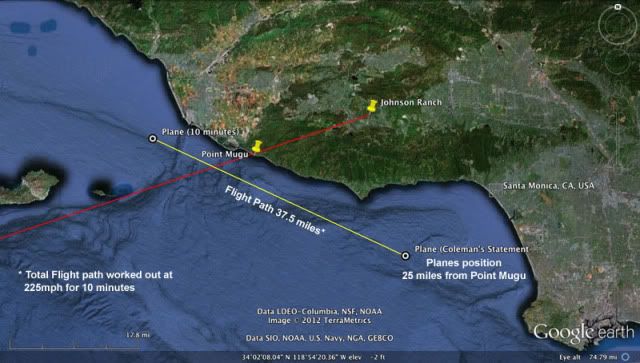
Any questions?
Stray,
OK ... it looks like your basic coordinates are within tolerances, so let's work it a bit. Remember that the WV-2 Warning Star changed heading toward what looked like a large flying wing aircraft. As this object departed the area, both it and the WV-2 were on a near due west heading. To quote:
"After about five minutes I suddenly realized it was moving away from us heading straight west."
So in the diagram you need to take the projected intercept point and compensate. The projected intercept point would be about where the ground observer saw it through binoculars, and then as it moved off to the west we can extrapolate a speed equal to or greater than the WV-2 ( because the WV-2 never caught it ), so by the time the WV-2 reached the intercept point the object would be farther out to sea, and the WV-2 would have been making a long slow arc toward the west to end up directly behind it at some distance.
So the straight line for the WV-2 doesn't represent an accurate picture except at one point in time earlier during the incident. By the time the wing was heading away from the WV-2 nearly due west ... both aircraft would have been moving along a heading almost exactly horizontal with the lower edge of the map from a starting point at the projected intercept point ... indicating a heading change for the wing at the projected intercept point of about 15 degrees north ( slightly away from the approaching WV-2 )
When you extrapolate out the speeds and distances, you'll see how the wing would have departed west until it disappeared ( just as the ground observer stated ) and how the WV-2 ended up coming in behind it in a long shallow curve that from the WV-2 observers point of view would have looked like they were nearly directly behind it at all times until it sped off into the distance.
The only oddity is the apparent hovering motion of the wing before the WV-2 came in behind. However, once again, this can be explained by the wing making a turn away from the WV-2 at that time to head back out sea combined with the long shallow arc of the WV-2 coming up behind it.
The ground observer could have missed the wings initial turn because he went back inside to get the binoculars. Combine that with some other possible factors like the black exhaust the YB-49 was known for when it went into high power and you can add a bit of temporary black smoke to obscure the maneuver ... which is also what the ground observer said that he thought it was at first.
The above and everything else I've mentioned makes the YB-49 Flying Wing, a huge bomber for that time that is about the size of the wing reported, a much better candidate than merely a cloud ... IMNSHO

http://northrop.host.sk/images/Yb-49_01.jpg
Last edited:
GeeMack
Banned

- Joined
- Aug 21, 2007
- Messages
- 7,235
[* Desperate rationalizations to try to support a preconceived notion snipped. *]
The above and everything else I've mentioned makes the YB-49 Flying Wing, a huge bomber that is about the size of the wing reported, a much better candidate than merely a cloud ... IMNSHO
In your opinion custom fabricated to support a predetermined conclusion. Here's a constructive contribution: Your approach is the antithesis of skepticism and critical thinking. It's "ufology" in a nutshell, a dishonest attempt to confirm a preconceived notion without the slightest concern for objective reality. Willful ignorance of everything that contradicts the desired conclusion, shunning math, avoiding uncomfortable questions, making up definitions for terms, and outright rejecting any connection between truth and objective reality will result in failure when venturing to explain anything about the Universe we live in.
All of those highlighted descriptions would be equally true of a sharply defined lenticular cloud. A lenticular cloud would be very likely to hover in one place until conditions changed a little, when they might either shrink away to nothing, or expand until they cover durn near everything. Getting caught on top of a wave cloud is one of the things you need to be careful about when flying wave.Stray,
You mean they didn't say anything like these quotes from the report ... which I admit are "mental constructs" because I have the mental capacity to read ... something you seemed to have forgotten to do.Let's look at these other descriptions:
- "After studying it for several minutes, I deduced that it was not a cloud because it had too definite sharp edges and its appearance stayed constant. It looked to me like I was flying directly towards, and at about the same elevation as, a very large flying wing airplane." ( Airborne observers )
- "It had a definite shape which to me appeared to be like a crescent. Others on board describe it as a huge flying wing."( Airborne observers )
Now let's look at how the aircraft "disappearerd" ... to quote:
- My first thought is that it was a large airplane, possibly a C-124, but after looking more closely, it seemed to be a large object without wings with a maximum thickness in the middle tapering toward either side." ( Airborne observers )
Examining the above statement we again can see how although he says "no wings", he does use the word airplane and describes it as, "maximum thickness in the middle tapering toward either side" , exactly like what you would expect when viewing a YB-49 from head on or from directly behind. This is further strengthed by this statement:
- "The object appered as a thin black line, giving a first impression of a B-36 type airplane heading straight towrd us and sillhoutted against a bright background." ( Airborne observers )
A YB-49 would look exactly like the above but without the bulky feuselage if viewed from the side.
From the above description we can clearly see that the airborne observers had noticed the flying wing, made a turn to pursue it and ended up behind it as it sped away ... matching the ground oserver's story. The relative angles can be reconciled by a combination of margin of error, timing, and maneuvering. The Airborne observers say that, "While flying off the coast in the vicinty of Santa Monica." which is around 45Km south of Point Morgu, that they made a turn to pursue the object but after 5 minutes they had not gained on it even though they were going 225 MPH, which would put them about 30Km, closer to Point Morgu, and if the object was heading west, they would also have been making a constant slow west turn toward it until they were both heading west.
- "In 90 seconds from the time it started to move, the object had completely disappeared in a long shallow climb on the heading noted." ( Ground observer )
- "Flew directly toward it for about five minutes and from our relative position did not appear to change." ( Airborne observers )
- "After about five minutes I suddenly realized it was moving away from us heading straight west." ( Airborne observers )
So distances of hundreds of miles aren't necessary to explain this incident. Again, given that the airborne observer says, "It looked to me like I was flying directly towards, and at about the same elevation as, a very large flying wing airplane." and the YB-49 fits this description, and the distances when plotted on the map are about the right ( around 40 -50 Km ), and that other large aircraft were thought to be what the object was, the most logical explanation remains a YB-49.
http://www.youtube.com/watch?v=kuIFvNA1UgU
In addition to having seen many standing wave clouds, and the upwind wave system up at Point Sal, I've also seen a moving lenticular cloud out in the general vicinity of El Mirage Dry Lake. It came out of the southwest, went by north of me at about ten thousand feet, and seemed to turn about thirty degrees or so more north when it encountered the shear line extending out from Cajon Pass. Once it made the turn, it faded out pretty quickly. I don't know whether the traveling wave got absorbed by something, or the atmosphere just dried out enough that it didn't show up any more.
While it existed, though, it was quite sharp edged, and looked like a fairly high aspect ratio (say, 8 or 10) elliptical wing with little or no sweep.
I couldn't keep it under continuous observation, because I was thermaling, and that takes a certain amount of concentration. I was keeping an eye on it with the idea of going over and investigating the lift underneath it, but it was past me and disappeared before I got enough altitude to consider leaving the lift I had. It was probably fifteen minutes or less, all told. It was a really cool looking cloud, and certainly the most unusual behavior I've ever seen in a cloud. But it was definitely a cloud.
And the thing is, having personally observed the upwind wave and the traveling wave, it makes it much harder for me to believe in alien space ships. I can imagine someone seeing that traveling wave and saying "clouds just don't do that!" But I was there, and it was a cloud, and it sure did.
There's a lot of meteorological theory to explain a lot of things, but I've concluded after flying hang gliders and sailplanes for a long time that there's also a lot of meteorological stuff that just happens, and there isn't any formal theory explaining it because either it doesn't happen very often, or people don't notice it very often, or possibly both.
ufology
Master Poster
- Joined
- Jun 30, 2011
- Messages
- 2,681
All of those highlighted descriptions would be equally true of a sharply defined lenticular cloud. A lenticular cloud would be very likely to hover in one place until conditions changed a little, when they might either shrink away to nothing, or expand until they cover durn near everything. Getting caught on top of a wave cloud is one of the things you need to be careful about when flying wave.
In addition to having seen many standing wave clouds, and the upwind wave system up at Point Sal, I've also seen a moving lenticular cloud out in the general vicinity of El Mirage Dry Lake. It came out of the southwest, went by north of me at about ten thousand feet, and seemed to turn about thirty degrees or so more north when it encountered the shear line extending out from Cajon Pass. Once it made the turn, it faded out pretty quickly. I don't know whether the traveling wave got absorbed by something, or the atmosphere just dried out enough that it didn't show up any more.
While it existed, though, it was quite sharp edged, and looked like a fairly high aspect ratio (say, 8 or 10) elliptical wing with little or no sweep.
I couldn't keep it under continuous observation, because I was thermaling, and that takes a certain amount of concentration. I was keeping an eye on it with the idea of going over and investigating the lift underneath it, but it was past me and disappeared before I got enough altitude to consider leaving the lift I had. It was probably fifteen minutes or less, all told. It was a really cool looking cloud, and certainly the most unusual behavior I've ever seen in a cloud. But it was definitely a cloud.
And the thing is, having personally observed the upwind wave and the traveling wave, it makes it much harder for me to believe in alien space ships. I can imagine someone seeing that traveling wave and saying "clouds just don't do that!" But I was there, and it was a cloud, and it sure did.
There's a lot of meteorological theory to explain a lot of things, but I've concluded after flying hang gliders and sailplanes for a long time that there's also a lot of meteorological stuff that just happens, and there isn't any formal theory explaining it because either it doesn't happen very often, or people don't notice it very often, or possibly both.
TjW,
Maybe it was a cloud, and you are right that any one of "all those highlighted descriptions" I've posted might be enough to counter the YB-49 theory, but I've given numerous reasons from very qualified observers ... observers who would most probably be at least as knowledgeable as you are and with firsthand experience, and who rejected the cloud explanation after studying the object for several minutes and in the end saying it looked like a flying wing aircraft. So the YB-49 theory still makes more sense.
Last edited:
ufology
Master Poster
- Joined
- Jun 30, 2011
- Messages
- 2,681
In your opinion custom fabricated to support a predetermined conclusion. Here's a constructive contribution: Your approach is the antithesis of skepticism and critical thinking. It's "ufology" in a nutshell, a dishonest attempt to confirm a preconceived notion without the slightest concern for objective reality. Willful ignorance of everything that contradicts the desired conclusion, shunning math, avoiding uncomfortable questions, making up definitions for terms, and outright rejecting any connection between truth and objective reality will result in failure when venturing to explain anything about the Universe we live in.
GeeMack,
You seem to have lost your sidekick there ... what's his name ... maybe you should go look for him.
23_Tauri
Illuminator

- Joined
- Jan 24, 2010
- Messages
- 4,927
fixed that for youI don't need to have been in an airplane to know thatprecisionestimates of distant objects in the sky can be a challenge. Please just get to your point.
Forget 'precision' here, Ooly. It's almost impossible to judge estimates of how far away is an object where there are no or few points of reference. We're not talking about whether something is two miles away compared with two and a half miles but the difference between two miles and fifty miles, or two miles and a hundred miles, if you don't know the size of the object of you're looking at. And if you don't know what it is you have no idea of the size.
Krikkiter
Graduate Poster

- Joined
- Sep 28, 2011
- Messages
- 1,282
TjW,
Maybe it was a cloud, and you are right that any one of "all those highlighted descriptions" I've posted might be enough to counter the YB-49 theory, but I've given numerous reasons from very qualified observers ... observers who would most probably be at least as knowledgeable as you are and with firsthand experience, and who rejected the cloud explanation after studying the object for several minutes and in the end saying it looked like a flying wing aircraft. So the YB-49 theory still makes more sense.
What the hell does that even mean? I remember you saying a while ago that a quality observer was someone who was educated (that's ridiculous anyway), so were these observers all "educated"? What was their level of education? High school? University? Maybe they run a website about giant rabbits, fireflies and levitation?
Kaosium
Philosopher

- Joined
- Oct 12, 2010
- Messages
- 6,695
It is interesting that Pt. Mugu is the direction of observation. Is it possible they saw something being tested there? Pt. Mugu was where they were performing early missile testing. I will see if there is anything on that line to consider.
NAS Point Mugu is not only the Pacific Missile Test Center it also had VX-4 which was a test squadron which often would evaluate new birds and equipment before the rest of the fleet got them, if they ever did. It also had VAQ-34, the 'Red Star' Squadron, which would imitate Soviet equipment and practices and also may have received equipment unknown to others.
Krikkiter
Graduate Poster
- Joined
- Sep 28, 2011
- Messages
- 1,282
NAS Point Mugu is not only the Pacific Missile Test Center it also had VX-4 which was a test squadron which often would evaluate new birds and equipment before the rest of the fleet got them, if they ever did. It also had VAQ-34, the 'Red Star' Squadron, which would imitate Soviet equipment and practices and also may have received equipment unknown to others.
Interesting that a quality ufologist wasn't aware of this.
ufology
Master Poster
- Joined
- Jun 30, 2011
- Messages
- 2,681
fixed that for you
Forget 'precision' here, Ooly. It's almost impossible to judge estimates of how far away is an object where there are no or few points of reference. We're not talking about whether something is two miles away compared with two and a half miles but the difference between two miles and fifty miles, or two miles and a hundred miles, if you don't know the size of the object of you're looking at. And if you don't know what it is you have no idea of the size.
Tauri,
In the case we are discussing there are points of reference, two sets of observers in two different locations that indicate the object was in the direction of Point Mugu. This allows the position of the object to be determined as in the vicinity of Point Mugu ( just draw the lines from the observers positions to Point Mugu and you'll see that they intersect ).
Last edited:
Kaosium
Philosopher
- Joined
- Oct 12, 2010
- Messages
- 6,695
Interesting that a quality ufologist wasn't aware of this.
When did this happen? I was just skimming the thread and saw the reference to Pt. Mugu but now I see people talking about the YB-49, that was after WWII sometime, maybe fifties. VX-4 wasn't commissioned until the early fifties and I don't think VAQ-34 was up and running until the Eighties. This is a continuation so I think I missed the important posts about this event. Is there a link to a site or post which lays out the basics?
Akhenaten
Heretic Pharaoh

Tauri,
In the case we are discussing there are points of reference, two sets of observers in two different locations that indicate the object was in the direction of Point Mugu. This allows the position of the object to be determined as in the vicinity of Point Mugu ( just draw the lines from the observers positions to Point Mugu and you'll see that they intersect ).
Multiple witnesses reporting a range of directions, don't you mean?
Interesting plot Stray Cat. I find it intersting that none of the witnesses in the WV-2 can seem to agree exactly where the object was located.
Wimmer- East of Santa Cruz island
Thoren-Between Santa Barbara island and Point Mugu
Colman - in the vicnity of Point Mugu (interestingly he states they were off Santa Monica while the others seem to put the plane further south)
Ware-...to the west, over the water, possibly in the vicinity of Santa Barbara Island
The UFOlogists picked a point between Santa Cruz and point Mugu but I think that position is not very accurate and your position seems more correct (possibly a bit further north of Santa Barbara but that is quibbling). One would think these gentlemen could have written down headings of the aircraft and azimuths to provide more precise information.
Stray Cat
Philosopher
- Joined
- Sep 6, 2006
- Messages
- 6,829
No, let's not "work it a bit"OK ... it looks like your basic coordinates are within tolerances, so let's work it a bit.
I'm not making presumptions that are not included in the eye witness report.
OK, so you want to have your cake and eat it.Remember that the WV-2 Warning Star changed heading toward what looked like a large flying wing aircraft. As this object departed the area, both it and the WV-2 were on a near due west heading. To quote:
"After about five minutes I suddenly realized it was moving away from us heading straight west."
It wasn't Coleman who reported that. It was Wimmer.
Wimmer also says that the object was "at least 50 or 60 miles away and possibly much further"
That the plane was "in the vicinity of Long Beach (over 30 miles further south) and that the plane heading "due West" when they first spotted the object "east of Santa Cruz"
So are we just cherry picking the bits that seem to fit our pre-determined conclusion? Or are we going to systematically go through each report and see where it leads us?
No, I don't "need" to do anything.So in the diagram you need to take the projected intercept point and compensate.
If you're proposing an alternative based on cherry picked bits from here and there, you do it.
Only Coleman (who's testimony we are using) said they headed toward it for ten minutes watching it hover motionless before it moved away from them in the space of ten seconds. After about 8 minutes, they would have crashed into it (if they were as reported, heading directly towards it).The projected intercept point would be about where the ground observer saw it through binoculars, and then as it moved off to the west we can extrapolate a speed equal to or greater than the WV-2 ( because the WV-2 never caught it ), and by the time the WV-2 reached the intercept point the object would be farther out to sea, and the WV-2 would have been making a long slow arc toward the west to end up directly behind it at some distance.
It represents what Coleman reports. And he's the only one in the plane who says the object was over Point Mugu and that the plane was in the vicinity of Santa Monica.So the straight line for the WV-2 doesn't represent an accurate picture except at one point in time earlier during the incident.
You're just making this up as you go along.By the time the wing was heading away from the WV-2 nearly due west ... both aircraft would have been moving along a heading almost exactly horizontal with the lower edge of the map from a starting point at the projected intercept point ... indicating a heading change for the wing at the projected intercept point of about 15 degrees north ( slightly away from the approaching WV-2 )
None of this is remotely based on any of the information in the reports (let alone Coleman's report who we're using here because his report is closest to the conclusion you've jumped to. You're still having to make assumptions to crow bar it in.
I haven't seen a single calculation from you. What is this extrapolating business, you know it involves actual numbers and doing sums right?When you extrapolate out the speeds and distances, you'll see how the wing would have departed west until it disappeared ( just as the ground observer stated )
Not guess that it will "extrapolate" and then tell everyone else to do it, so you can tell them they did it wrong when it turns out it doesn't extrapolate at all.
But Coleman, nor any of the other crew members report making a left turn. In fact they all say they turned right towards the object. Also, if they were at the same altitude and directly behind it, with Johnson directly behind them. Why didn't Johnson report seeing the plane too? It would have been directly between him and the object.and how the WV-2 ended up coming in behind it in a long shallow curve that from the WV-2 observers point of view would looked like they were nearly directly behind it at all times until it sped off into the distance.
If the object (stop calling it a wing, you're just sounding silly) made any turn, why did neither Johnson nor the flight crew report seeing it turn? because for the majority of the time, they were seeing the object from differing angles of approximately 90°. Remembering that if you are saying the object was correctly reported to be moving West (away from Johnson the whole time), after 2 minutes at a typical cruise speed of 420mph, it would be a further 14 miles away. How much of an object 172' wide could Johnson see from a distance of at least 39 miles? (even with a pair of 8x binoculars). And yet you think he continued to watch it for a further 3 minutes until it disappeared from view?The only oddity is the apparent hovering motion of the wing before the WV-2 came in behind. However, once again, this can be explained by the wing making a turn away from the WV-2 at that time to head back out sea combined with the long shallow arc of the WV-2 coming up behind it.
Bearing in mind that he failed to get into the Air Training Corp. because he failed the eye sight test.
No he didn't according to his eye witness testimony.The ground observer could have missed the wings initial turn because he went back inside to get the binoculars.
He was looking at it from inside and he asked his wife to get his binoculars so he could keep his eye on it. Only after his wife had got his binoculars for him did he go outside to watch it get smaller and disappear.
So I'm waiting for you to provide some evidence of this YB-49.Combine that with some other possible factors like the black exhaust the YB-49 was known for when it went into high power and you can add a bit of temporary black smoke to obscure the maneuver ... which is also what the ground observer said that he thought it was at first.
The above and everything else I've mentioned makes the YB-49 Flying Wing, a huge bomber that is about the size of the wing reported, a much better candidate than merely a cloud ... IMNSHO
It would truly be a miracle if you could, because Northrop only made three of them.
One crashed in 1948 killing everyone aboard.
One was suspected to have been sabotaged on a publicity tour in 1948 causing an engine fire. (no information as to if it was fixed)
The USAF stopped the YB-49 programme in 1950.
On the same day the programme was cancelled, the other one failed during taxiing and was destroyed.
So there is only one possible (if it was fixed) YB-49 in existence and the USAF had cancelled the YB-49s over three years before this UFO sighting.
ufology
Master Poster
- Joined
- Jun 30, 2011
- Messages
- 2,681
Interesting that a quality ufologist wasn't aware of this.
You're assuming I wasn't aware of it. There is also Vandenburg to the north, Edwards AFB to the east over the mountains, and the Northrop plant at Hawethorne ( Makers of the YB-49 ).
Akhenaten
Heretic Pharaoh
You're assuming I wasn't aware of it. There is also Vandenburg to the north, Edwards AFB to the east over the mountains, and the Northrop plant at Hawethorne ( Makers of the YB-49 ).
On the basis of your not having mentioned it on the way to insisting you know what this giant witch's cape thingy is it seems a quite reasonable assumption.
Krikkiter
Graduate Poster
- Joined
- Sep 28, 2011
- Messages
- 1,282
You're assuming I wasn't aware of it. There is also Vandenburg to the north, Edwards AFB to the east over the mountains, and the Northrop plant at Hawethorne ( Makers of the YB-49 ).
Yes I am assuming that because I didn't and don't recall you mentioning it even though it would seem quite relevant to the conversation.
Tomtomkent
Philosopher

- Joined
- Jul 5, 2010
- Messages
- 8,607
So it would appear Ufology determines the accuracy of witnesses by how much their statements agree with his desired outcome.
And he even suggests changing googlemaps to compensate? All to familiar, are we going to see every aspect of the story "clarified" with ever changing distances?
And he even suggests changing googlemaps to compensate? All to familiar, are we going to see every aspect of the story "clarified" with ever changing distances?
Krikkiter
Graduate Poster
- Joined
- Sep 28, 2011
- Messages
- 1,282
So it would appear Ufology determines the accuracy of witnesses by how much their statements agree with his desired outcome.
And he even suggests changing googlemaps to compensate? All to familiar, are we going to see every aspect of the story "clarified" with ever changing distances?
I'm sure he'll "work it a bit."