Merged Apollo "hoax" discussion / Lick observatory laser saga

Status
Not open for further replies.
Don't let the main idea get lost. His overall point was that oxygen is so innocuous that hospitals use it freely without constantly worrying about explosions. That point is utter nonsense.

And let's not forget that according to Patrick1000 it wouldn't matter anyway because Teflon doesn't burn. I don;t think Patrick appreciates how many things will burn if you give them the right circumstances. For example coffee creamer in a jar in your kitchen, harmless. Coffee creamer plus the Mythbusters, carnage:

Creamer cannon

While that is a fairly amusing example it does illustrate that many ordinary materials will burn or explode if you create the right circumstances, especially if you expose them to high pressure pure Oxygen.
 
I agree Jay, it is a distraction, let's get back to the nuts and bolts of the scam...

Translation: what a fortunate distraction this point is; maybe everyone will forget how I lie on a daily basis and change my arguments.


No. I and many others have had first-person access to Apollo materials and people for quite some time. My experience with space engineering is personal and hands-on, not gleaned from popular summaries like yours.

Further, you continue to avoid having your own first-person access with the men you're libeling. Please explain why you haven't yet sent me your contact information.


Hm, let's see. First you say you're a doctor. Then when that blows up in your face, you say you aren't a doctor, and that you made all that up for "satire" value. Now you're back to saying you're a doctor again.

So obviously you're lying. The question remains which statement was the lie. Are you going to tell us, or do we get to guess?


I agree Jay, it is a distraction, let's get back to the nuts and bolts of the scam. Tomblvd I am sure will report in later. He is quite dependable.

From the National Archives, word for word transcription of the Gene Kranz Apollo 13 motivational speech below. This is the rah rah rah rally speech, given 15 minutes form the time of the, "Houston we've had a problem" call.

Kranz, word for word;
.
"OK now let's everybody keep cool. We got the LM still attached. The LM spacecraft's good so if we need to get back home we got a LM to do a good portion of it with. Ok let's make sure that we don't do anything that's going to blow our CSM electrical power with the batteries, or that will cause us to lose the main, or the fuel cell number two. OK we want to keep the O2 and that kinda' stuff working. We'd like to have RCS, but we got the command module system so we are in good shape if we need to get home. Let's solve the problem, but let's not make it any worse by guessing."

Kranz makes this statement 15 minutes into the drama. O2 tank two pressure reads zero. Fuel cells one and three do not seem to be functional. A loud bang was heard coincident with the trouble's starting. A minute prior to Kranz making this statement Lovell informed Houston that he noted a gas venting from the service module. He did not say what the gas looked like, how it was moving, how much there was, where it was apart from visible from that particular window. It could have been a small bit of gas wafting about or a powerful jet of gas, or any other morphology for that matter. Lovell is nonspecific. It is not for another 28 minutes or so per the Apollo 13 Mission Voice Transcript that the subject of low O2 pressure in tank one is even brought up by the crew.

Lovell/Kluger quote Kranz, quote the National Archive record(not very well) in their book APOLLO 13. They intentionally leave out many of the lines/words/terms in the speech's very core. Their Kranz quote is;

"OK let's everybody keep cool. Let's make sure that we don't do anything that's going to blow our electrical power or cause us to lose fuel cell two. Let's solve the problem, but let's not make anything worse by guessing".


Very different is it not? By the way, one need not access the National Archive, one can hear the Kranz quote in full in the popular film, HOUSTON WE HAVE A PROBLEM. It can be found about seven minutes in to the video.

So why do Lovell and Kluger not quote Kranz in full? They even leave out the dots.......You know, when there is a quote and a part is left out there are three dots...They left those out to imply that this was the quote in full, the short version above. They imply that was all there was to it. Pretty dang sneaky, no?

It is not as though they do not have access to the archival tapes, or even popular account recordings of the speech as just referenced in the HOUSTON WE HAVE A PROBLEM film. Kranz's words are in the public domain, no copyright issues, the words belong to us all. We paid Kranz and we all paid for Apollo 13. What gives here?

Well, 15 minutes in , when Kranz gives this speech, the EECOM still is not sure if it is or is not an instrumentation problem despite Lovell's comment about the venting. The failures are so widespread, some aspect could be instrumentational, some hardware. It by no means has been determined that this is a full fledged mechanical problem and only a mechanical problem. As such, the LM comment is very premature. Also, they do not know at this point if the LM is OK. One of the alleged considerations was that the bang reflected a meteor hit and even a hit on the LM. This is why the astronauts try and close the hatch between the LM and command module, unsuccessfully, but they try. They do this because it is not clear early on if the LM is OK, and that only makes sense because the problem is not understood. The LM "they think" in the pretend world of the Apollo 13 staged drama, may have been holed. this is why they say they try at first to close the hatch between the LM and CSM. Whatever has happened, could have damaged the LM too.

Another important point to make, a point I made previously is that Lovell and Kluger in their book imply that it was at this time that it became known O2 tank one was leaking. Again, this WAS NOT THE CASE. It was not until 28 minutes later that the astronauts call Houston and begin to discuss with them the O2 tank one problem. 28 minutes later.

There is much to say about this. Everyone has access to the archives and one can find the HOUSTON WE HAVE A PROBLEM film on YouTube. Most have the book by Lovell/Kluger, APOLLO 13. Everyone can easily check these facts and confirm Apollo 13's abject fraudulence.

 
Hospitals, on the other hand, must conform to NFPA 99, part 8 (IIRC) regarding labeling of oxygen-carrying plumbing, storage, distribution, and point-of-use equipment, and the certified training of those who care for them.

I found this regulation in roughly one minute of searching on Google at lunch today. Research is so much easier these days.

With that said, Patrick, have you had a chance to find out if Teflon will burn in the presence of liquid (i.e. cryogenic) oxygen?
 
I agree Jay, it is a distraction, let's get back to the nuts and bolts of the scam. Tomblvd I am sure will report in later. He is quite dependable.

From the National Archives, word for word transcription of the Gene Kranz Apollo 13 motivational speech below. This is the rah rah rah rally speech, given 15 minutes form the time of the, "Houston we've had a problem" call.

Kranz, word for word;
.
"OK now let's everybody keep cool. We got the LM still attached. The LM spacecraft's good so if we need to get back home we got a LM to do a good portion of it with. Ok let's make sure that we don't do anything that's going to blow our CSM electrical power with the batteries, or that will cause us to lose the main, or the fuel cell number two. OK we want to keep the O2 and that kinda' stuff working. We'd like to have RCS, but we got the command module system so we are in good shape if we need to get home. Let's solve the problem, but let's not make it any worse by guessing."

Kranz makes this statement 15 minutes into the drama. O2 tank two pressure reads zero. Fuel cells one and three do not seem to be functional. A loud bang was heard coincident with the trouble's starting. A minute prior to Kranz making this statement Lovell informed Houston that he noted a gas venting from the service module. He did not say what the gas looked like, how it was moving, how much there was, where it was apart from visible from that particular window. It could have been a small bit of gas wafting about or a powerful jet of gas, or any other morphology for that matter. Lovell is nonspecific. It is not for another 28 minutes or so per the Apollo 13 Mission Voice Transcript that the subject of low O2 pressure in tank one is even brought up by the crew.

Lovell/Kluger quote Kranz, quote the National Archive record(not very well) in their book APOLLO 13. They intentionally leave out many of the lines/words/terms in the speech's very core. Their Kranz quote is;

"OK let's everybody keep cool. Let's make sure that we don't do anything that's going to blow our electrical power or cause us to lose fuel cell two. Let's solve the problem, but let's not make anything worse by guessing".


Very different is it not? By the way, one need not access the National Archive, one can hear the Kranz quote in full in the popular film, HOUSTON WE HAVE A PROBLEM. It can be found about seven minutes in to the video.

So why do Lovell and Kluger not quote Kranz in full? They even leave out the dots.......You know, when there is a quote and a part is left out there are three dots...They left those out to imply that this was the quote in full, the short version above. They imply that was all there was to it. Pretty dang sneaky, no?

It is not as though they do not have access to the archival tapes, or even popular account recordings of the speech as just referenced in the HOUSTON WE HAVE A PROBLEM film. Kranz's words are in the public domain, no copyright issues, the words belong to us all. We paid Kranz and we all paid for Apollo 13. What gives here?

Well, 15 minutes in , when Kranz gives this speech, the EECOM still is not sure if it is or is not an instrumentation problem despite Lovell's comment about the venting. The failures are so widespread, some aspect could be instrumentational, some hardware. It by no means has been determined that this is a full fledged mechanical problem and only a mechanical problem. As such, the LM comment is very premature. Also, they do not know at this point if the LM is OK. One of the alleged considerations was that the bang reflected a meteor hit and even a hit on the LM. This is why the astronauts try and close the hatch between the LM and command module, unsuccessfully, but they try. They do this because it is not clear early on if the LM is OK, and that only makes sense because the problem is not understood. The LM "they think" in the pretend world of the Apollo 13 staged drama, may have been holed. this is why they say they try at first to close the hatch between the LM and CSM. Whatever has happened, could have damaged the LM too.

Another important point to make, a point I made previously is that Lovell and Kluger in their book imply that it was at this time that it became known O2 tank one was leaking. Again, this WAS NOT THE CASE. It was not until 28 minutes later that the astronauts call Houston and begin to discuss with them the O2 tank one problem. 28 minutes later.

There is much to say about this. Everyone has access to the archives and one can find the HOUSTON WE HAVE A PROBLEM film on YouTube. Most have the book by Lovell/Kluger, APOLLO 13. Everyone can easily check these facts and confirm Apollo 13's abject fraudulence.

Two problems, maybe three, Patrick:

1) In the quote from the transcript, Kranz is saying the exact right thing, at the right time. It is a reminder to everyone that options are available and to not rush into doing something stupid. A simple equivalent in flight training is this: when the engine fails, even at a sufficient altitude to troubleshoot the problem, the very first thing you do is find a place to put the aircraft. Then you work the problem.

2) I'll grant the quotes don't match perfectly - this is my "maybe". It's only a problem in that an editor or proofreader probably didn't notice a mistake on their part. The "problem" is that it gives people like you an inconsistency on which to build a false premise.

3) This is yet another derail on your part. Back to where we started: does PTFE burn in the presence of cryogenic oxygen?
 
Looks as though I am correct SUSpilot.....

I found this regulation in roughly one minute of searching on Google at lunch today. Research is so much easier these days.

With that said, Patrick, have you had a chance to find out if Teflon will burn in the presence of liquid (i.e. cryogenic) oxygen?

Looks as though I am correct SUSpilot, though at this point I am not absolutely positive.....As best I can tell from looking at the NPFA stuff, the warning mandates have to do with stored oxygen not with vents or wall feeds. At least looking through what I can find this is what I am coming up with so far. I'll take another read, look even a little closer, but I think that is where your error may be in all of this.

I do not know if the Teflon in an Apollo 13 cryogenic tank might be enticed to burn SUSpilot. I haven't gotten that far. Obviously, my view going in is somewhat biased to say the least. That said, and as mentioned, the first thing I have looked at was NASA's own papers regarding this and I accepted/accept at face value their basic thermodynamic claim that the reaction is exothermic. They'd have to be crazy to lie about that, so I accept that. Beyond that, I do not know at this point what my ultimate conclusions will be. Is there a 7 lb Teflon equivalent of TNT in the tank? NO, at least I doubt it very much. Was there enough Teflon in there plus/minus aluminum to heat things up to the point where it blew O2 tank 2 to the tune of a 7 lb TNT equivalent, NO, at least I doubt it very much.

But in a sense, even though I have introduced the subject, you guys are way ahead of me, at least with respect to your conclusions. I haven't even looked up the activation energy for the reaction or anything like that yet. I am still sort of picking on Gene Kranz. Well not really picking on him. He sort of has it coming doing what he did.

So you'll have to be patient. I suspect I will have much to say about the Teflon/aluminum thing, I am quite good at that sort of science. However, I am rather meticulous when it comes to chemical engineering issues as so it may be quite a while before I settle on a point of view. Regardless, I'll let you know what I think about this or that as I go along and examine NASA's claims. This sort of thing is rather up my alley.
 
Exploding Frying Pans, Wall Feeds and Vents

What an interesting point of contention the oxygen in hospitals thing is. Interesting because it can be so easily resolved given we all have first person access. This must without a doubt be a first for Apollo CT Threads.

I just took a spin through my own hospital to be sure of my facts. In a regular old every day med/surg room the oxygen feed reads "oxygen". Nothing else, there is no warning sign. I wandered up to the telemetry ward and took a look there at the wall O2 feed, again I found "oxygen" and no warning sign. I drifted through our intensive care unit, the wall oxygen feeds read "oxygen". Again, no warning labels. I took a look at our vents. They are made by the Puritan Bennett Company. Nothing written, no labeling on the vents in any obvious way warning sign wise, just the vent controls.

So it would seem that I must be correct, or our hospital is breaking the law. Cannot imagine the latter. Perhaps Tomblvd would be so kind as to do what I did, wander through his hospital and take a look at the O2 feeds and his medical center's ventilators and see if any of those are labeled in any way with a warning sign that alerts the user(and non users) to the dangers of O2. Perhaps he'll report back that they are labeled, "Danger, Astronauts On Duty".

If Tomblvd does find his feeds and vents are labeled with warnings about the dangers of O2, I would be more than happy to post photos of our feeds and one of our Puritan Bennett Vents, assuming Tomblvd does the same and posts images of these medical center weall feed and vent "O2 warnings".

Which hospital? I'd be happy to go up and look myself. With a camera.
 
It is not for another 28 minutes or so per the Apollo 13 Mission Voice Transcript that the subject of low O2 pressure in tank one is even brought up by the crew.

...

Another important point to make, a point I made previously is that Lovell and Kluger in their book imply that it was at this time that it became known O2 tank one was leaking. Again, this WAS NOT THE CASE. It was not until 28 minutes later that the astronauts call Houston and begin to discuss with them the O2 tank one problem.

As pointed out earlier, on the EECOM tape just before the Apollo crew report gas venting a voice reports oxygen tank 1 levels as 'fluctuating'. It was not a mystery surprise later.

As a world class surgeon, you will be aware of triage. If you are presented with multiple issues to deal with, you prioritise and deal with the things that are the most important first.

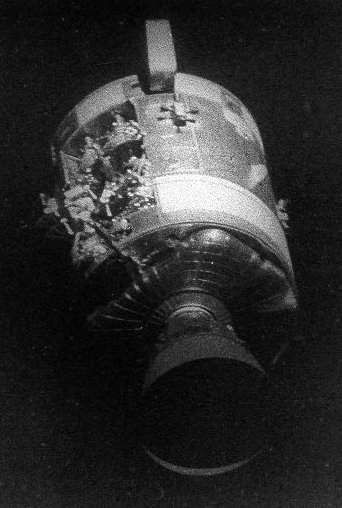
Apollo 13 happened. Look:

Apollo_13_damage.jpg


They went around the back of the Moon, took photos of it, and took photos of Earth too. Those photographs of Earth can only have been taken when and where they were claimed to be taken. Your obsession with whether someone said "and" instead of "but" is failing to prove anything other than a misplaced faith in a repeatedly discredited view of events.
 
A chart I found at http://history.nasa.gov/ap13rb/ch4pt.1.pdf
shows the different materials, quantities, and Btu of material in the O2 tank.
For Teflon, there was 1.1 lb and had a Btu of 2,400
while the Aluminum had only 0.8lbs, but a Btu of 20,500
the Stainless Steel at 2.4lbs, Btu at 15,000
and Iconel Alloys of 1.7lbs, Btu of 2,900
If I understand this correctly, the Teflon was the least of the worries (Maybe the Teflon was easier to ignite than the other material?) But wasn't the Aluminum and Stainless the real source of the heat which burst the O2 tank?

-LF
 
Patrick, you keep nagging away at this point about Krantz's speech, but it's a complete dead end. A bang, a power loss, an indicated loss of one O2 tank and something venting into space from the service module. They don't know what it is yet, but what can you think of that the service module was carrying that wasn't needed?

Then Kranz makes his speech reminding everyone they have a fallback position if it's required, so don't panic. Let me quote just the portion you seem consistently to have ignored: 'The LM spacecraft's good so if we need to get back home we got a LM to do a good portion of it with.'

In all the tediously longwinded waffle you have posted attempting to throw mud at Kranz, you have never made a logical case for Kranz saying anything he should not have said. As you plainly can't, then it's long past time you stopped insulting him. An apology would be in order.
 
It would seem your regulation has to do with stored oxygen.....

I found this regulation in roughly one minute of searching on Google at lunch today. Research is so much easier these days.

With that said, Patrick, have you had a chance to find out if Teflon will burn in the presence of liquid (i.e. cryogenic) oxygen?

It would seem your regulation has to do with stored oxygen and not vents and wall feeds that I referenced.
 
I have yet to look up the activation energy for the combustion of Teflon....

I found this regulation in roughly one minute of searching on Google at lunch today. Research is so much easier these days.

With that said, Patrick, have you had a chance to find out if Teflon will burn in the presence of liquid (i.e. cryogenic) oxygen?

I have yet to look up the activation energy for the combustion of Teflon, not to mention that of aluminum as well. You don't happen to know those off the top of your head SUSpilot, do you?
 
Last edited:
How interesting you think that way SUSpilot......

Two problems, maybe three, Patrick:

1) In the quote from the transcript, Kranz is saying the exact right thing, at the right time. It is a reminder to everyone that options are available and to not rush into doing something stupid. A simple equivalent in flight training is this: when the engine fails, even at a sufficient altitude to troubleshoot the problem, the very first thing you do is find a place to put the aircraft. Then you work the problem.

2) I'll grant the quotes don't match perfectly - this is my "maybe". It's only a problem in that an editor or proofreader probably didn't notice a mistake on their part. The "problem" is that it gives people like you an inconsistency on which to build a false premise.

3) This is yet another derail on your part. Back to where we started: does PTFE burn in the presence of cryogenic oxygen?

How interesting you think that way SUSpilot......Seems rather silly to leave out the most important part of the quote.

Hardly a derail SUSpilot, I believe I introduced the idea a while back as a point soundly incriminating Kranz. IT has only been a point of emphasis for me with regard to Kranz's solid effort at self incrimination. Do you honestly believe I am going to let him off the hook here? He is NAILED!

By the way, NASA refers to the oxygen in the Apollo service module tanks as "super critical" NOT cryogenic. So the question is more appropriately, "Was the activation energy achieved in any sense for the combustion of Teflon and aluminum in the presence of super critical oxygen, and if activation energy was achieved for the combustion of Teflon and or aluminum, how was it achieved?"

Once that question is answered, one can then move on to other questions such as; how much Teflon was present, how much aluminum was present, assuming the activation energy was achieved, would the reaction propagate given the circumstances, and assuming the reaction was sustained, would enough energy be released to account for the damage done?

You don't happen to know the answer to those questions yet, do you SUSpilot?
 
Last edited:
In the History Channel Film Apollo 13 Modern Marvel's....

Two problems, maybe three, Patrick:

1) In the quote from the transcript, Kranz is saying the exact right thing, at the right time. It is a reminder to everyone that options are available and to not rush into doing something stupid. A simple equivalent in flight training is this: when the engine fails, even at a sufficient altitude to troubleshoot the problem, the very first thing you do is find a place to put the aircraft. Then you work the problem.

2) I'll grant the quotes don't match perfectly - this is my "maybe". It's only a problem in that an editor or proofreader probably didn't notice a mistake on their part. The "problem" is that it gives people like you an inconsistency on which to build a false premise.

3) This is yet another derail on your part. Back to where we started: does PTFE burn in the presence of cryogenic oxygen?

In the History Channel Film, APOLLO 13 MODERN MARVELS, Gene Kranz is interviewed. 11 minutes and 30 seconds into the film Kranz makes a statement and claims that Lovell said when looking out the CM window that he thought they were venting their oxygen. This is not true. Lovell says a gaseous substance was venting, no more, no other details. The EECOM did not say it was oxygen. Liebergot made no statement to Kranz that what was venting was oxygen.

Why does Kranz lie here in the interview SUSpilot, why does he tell us Lovell said that he thought it was oxygen that was venting?

I have given you my reason, what is your alternative proposal?
 
11 minutes into the History Channel film APOLLO 13 MODERN MARVELS...

Two problems, maybe three, Patrick:

1) In the quote from the transcript, Kranz is saying the exact right thing, at the right time. It is a reminder to everyone that options are available and to not rush into doing something stupid. A simple equivalent in flight training is this: when the engine fails, even at a sufficient altitude to troubleshoot the problem, the very first thing you do is find a place to put the aircraft. Then you work the problem.

2) I'll grant the quotes don't match perfectly - this is my "maybe". It's only a problem in that an editor or proofreader probably didn't notice a mistake on their part. The "problem" is that it gives people like you an inconsistency on which to build a false premise.

3) This is yet another derail on your part. Back to where we started: does PTFE burn in the presence of cryogenic oxygen?

11 minutes into the History Channel film APOLLO 13 MODERN MARVELS one can hear Lovell deliver the line about venting gas. Then Kranz continues with his interview and claims preposterously that Lovell said he thought they may be venting oxygen and then even more preposterously, Kranz claims it was at that time he, Kranz, based on Lovell's venting OXYGEN statement, realized there had a been an explosion that caused the damage to Apollo 13. Of course if one reads the voice transcript, listens to the EECOM tapes and so forth, one recognizes nothing could be further from the truth here, no one knew at that time that there had been an explosion. Some were still thinking it was not even a hardware problem, that it was possibly primarily an instrumentation problem. Kranz is quite unbelievably making it it all up. Have a look and listen SUSpilot. It is all rather incredible.

16 minutes into the film, the Kranz interview continues and he finishes up, paraphrasing his lines about using the LM as a lifeboat, lines he delivered in real time, 15 minutes into the staged drama, just after Lovell's nonspecific comment about venting gas.

This is perhaps the most incriminating evidence I have looked at/seen so far in terms of its implicating one particular individual solidly as an Apollo Fraud perpetrator. It is hard evidence and Kranz has zero wiggle room here SUSpilot. Mr. Kranz is flat out big time NAILED!
 
Why does Kranz lie here in the interview SUSpilot, why does he tell us Lovell said that he thought it was oxygen that was venting?


Um ... it was thirty years later and his memory of what he knew at the time was corrupted by his memory of what he later learned?

He was telling an abbreviated version of the story to fit within the limits of the interview.

He told the story correctly and was later edited by the doccumentarian in a way that changed a bit of the meaning of what he said.

How many more likely reasons would you accept?
 
Patrick - your beliefs re gasesous Oxygen and the labelling requirements are most definitely flawed. I refer you to the Material Safety Data Sheet for oxygen (gas). Look at page 2.

If your hospital doesn't label it, the local Workplace Safety folks need to know...
 
I might buy some of it were it the case that......

Um ... it was thirty years later and his memory of what he knew at the time was corrupted by his memory of what he later learned?

He was telling an abbreviated version of the story to fit within the limits of the interview.

He told the story correctly and was later edited by the doccumentarian in a way that changed a bit of the meaning of what he said.

How many more likely reasons would you accept?

I might buy some of it Loss Leader were it not the case that the bit about the LM is so very consistently left out of the quote in contexts where it would be incriminating were it left in, as for example is the case in the Lovell book APOLLO 13, or as also is the case with the Ron Howard film APOLLO 13, or a dozen other presentations of this staged nonsense.

I might buy some of it Loss Leader if Lovell and others did not try to imply that they knew oxygen tank one was losing pressure at the time of Lovell's alleged identification of the venting. If you listened to the EECOM tapes Loss Leader which at this time I am presuming you have not done given your comments up until this point, you would have learned that the telemetry monitoring equipment the EECOMs use for following O2 tank one pressures was not operating early on. It is not until they turn it back on that they realize, Liebergot/Burton/the EECOMs, just how much O2 is being lost, how fast the pressure is going down. Kranz doesn't know this. When he makes that statement, his EECOMs don't know what is going on with O2 tank one at all.

I might buy some of it Loss Leader had Kranz not emphasized this bogus point in his book FAILURE IS NOT AN OPTION, and then in the commentary section of the film by the same name, was then challenged with regard to the issue by one of the producers(one hour and 15 minutes in). At that time, Kranz again emphasizes he knew at the Lovell venting comment there was an explosion.

I might buy some of it Loss Leader were I not in possession of an exact replica of Kranz's own log book and can read in his own writing that he did not conclude there, 15 minutes in, that the tanks were blown Loss Leader. He did not write that in his log book, the part about the O2 tanks being blown, oxygen venting, blah blah blah.

The LM comment in real time only makes sense in light of the entire bogus staged scenario, and as Kranz knew about the entire bogus staged scenario in real time, this Flight Director is NAILED Loss LEader, no two ways about it. This rocket ship has done blowed up......
 
Um ... it was thirty years later and his memory of what he knew at the time was corrupted by his memory of what he later learned?

He was telling an abbreviated version of the story to fit within the limits of the interview.

He told the story correctly and was later edited by the doccumentarian in a way that changed a bit of the meaning of what he said.

How many more likely reasons would you accept?

Here's the obvious one.

In the log and transcript, Lovell didn't report what he THOUGHT. He reported what he saw - gas venting. Back on Earth he indicates what his thoughts were.

Kranz in retelling, says what Lovell THOUGHT!!

Is there no end to the nonsense spouted on this subject? Tedious.

So, Patrick, when are you going to discuss this with the people who you accuse? Afraid much?
 
Status
Not open for further replies.

Back
Top Bottom