• Quick note - the problem with Youtube videos not embedding on the forum appears to have been fixed, thanks to ZiprHead. If you do still see problems let me know.

Merged New video! Architects and Engineers - Solving the Mystery of Building 7

For example, need I drag out the news story where the fire chiefs are all claiming they had no expectation that the Towers were going to collapse?

Please do. I'm also curious as to why you think their expectations would not be different from before WTC2 collapsed and after it collapsed. Mine certainly changed.:confused:
 
I guess that was your "bs baffles brains" argument, eh David?

No, it was my "Physics is slightly more complicated than a two-year-old's view of it" argument. However, some people clearly prefer not to learn anything beyond age 2.

My statements were directed to people in the world that understand that when an object is not moving, it has no velocity or acceleration.

In other words, people who are wrong.

Let's just remind everyone how this started. Your claim, in effect, was that in this graph:


that the green line follows the red line for time values less than 5 seconds. As everyone can see, all you're doing is to try and bury the absurdity of this claim beneath a mass of extraneous other claims. Bizarrely, all those other claims are equally absurd.

You think you are making a great case by complicating something which is not complicated at all.

You're right, it's not complicated at all. You're saying the green line looks like the red line. I'm saying it doesn't. It's pretty obvious who's right.

If somehow you believe all your academic posturing is going to make WTC7's 100 foot free fall drop become somehow insignificant and a realistic fire-induced expectation, than good luck to you.

No posturing is needed to make it a realistic expectation in a fire-induced collapse, because it already is a realistic expectation in a fire-induced collapse. On the contrary, it's in an explosive demolition that it's extremely difficult to explain the bit whose existence you're frantically trying to deny by describing the part of the above curve where the acceleration is obviously very much less than freefall as "near freefall". And your attempts at explanation boil down to saying "That's just how they did it."

Dave
 
...
My statements were directed to people in the world that understand that when an object is not moving, it has no velocity or acceleration.
...

In other words, to people who are as ignorant of the most basic Newtonian physics as you are.

An object that's not moving has veolicity = 0.
It can have any accelaration - 0, +x, -x.
Elementary.
 
...
Let's just remind everyone how this started. Your claim, in effect, was that in this graph:


that the green line follows the red line for time values less than 5 seconds. As everyone can see, all you're doing is to try and bury the absurdity of this claim beneath a mass of extraneous other claims. Bizarrely, all those other claims are equally absurd.
...

Let me try to walk Miragememories through this graph.

At about 5,2 seconds the green line crosses the red line, i.e. reaches g.

Let's say that this is the point in time where Phase 1 (which MM describes as "near freefall") turns into Phase 2 ("freefall").
If that Phase 1 lasted 1,75s, then it began at 3.45s in that graph.

Here are a few questions for Miragememories, to help him explore this "near freefall" period from 3.45s to 5.2 seconds. I'll be happy if he just eyeballs the values and expresses them as x% of g, or as a value in ft/s2, whatever is more convenient to him:
  1. What was the acceleration at 3.6s (0.15s into Phase 1)?
  2. Was that "near freefall"?
  3. What was the acceleration at 3.8s (0.35s into Phase 1)?
  4. Was that "near freefall"?
  5. What was the acceleration at 4.0s (0.55s into Phase 1)?
  6. Was that "near freefall"?
  7. What was the acceleration at 4.2s (0.75s into Phase 1)?
  8. Was that "near freefall"?
  9. What was the acceleration at 4.4s (0.95s into Phase 1)?
  10. Was that "near freefall"?
  11. What was the acceleration at 4.6s (1.15s into Phase 1)?
  12. Was that "near freefall"?
  13. What was the acceleration at 4.8s (1.35s into Phase 1)?
  14. Was that "near freefall"?
  15. What was the acceleration at 5.0s (1.55s into Phase 1)?
  16. Was that "near freefall"?
I now asked "Was that near freefall?" eight times, while navigating the time intevall in question in equal steps.

I think honest answers will give us at least six "no"s, possibly seven, which means for almost the entire Phase 1, the fall was not "near" freefall. It was nearer 0 most of the time! If Phase 1 were best characterized as "near freefall", we should expect at least six "yes", dontcha think?
 
Last edited:
In other words, to people who are as ignorant of the most basic Newtonian physics as you are.

An object that's not moving has veolicity = 0.
It can have any accelaration - 0, +x, -x.
Elementary.


Care to explain that in a little more detail with examples or link to somewhere that does? Not saying you are wrong (its almost 30 years since I last studied this in detail) but have a problem with a stationary object having a non zero acceleration.:confused:
 
Care to explain that in a little more detail with examples or link to somewhere that does? Not saying you are wrong (its almost 30 years since I last studied this in detail) but have a problem with a stationary object having a non zero acceleration.:confused:

Here's a graph of the height, velocity and acceleration of a ball thrown with an initial velocity of 10m/s vertically upwards. Air resistance is neglected.


The green line is the acceleration, which is constant at 9.81ms-2 vertically downwards (represented as negative on this graph). The red line is the velocity, which passes through zero at about 1.02 seconds. The blue line is the height, which reaches a maximum at the same instant. At this instant, the ball has zero velocity, but acceleration of 9.81ms-2.

Dave
 
Care to explain that in a little more detail with examples or link to somewhere that does? Not saying you are wrong (its almost 30 years since I last studied this in detail) but have a problem with a stationary object having a non zero acceleration.:confused:

Simple.

If you throw a ball straight up, it will accelerate downward at a constant acceleration of g (disregarding air resistance of course, which doesn't change the argument). At some point in time, the ball reaches its highest point, before falling back to where it came from. At the moment of climax, the ball comes to a full stop. It is at rest then. It does not move. Velocity is 0. Acceleration however is still g.
This moment in time of course has a duration of 0, but it's still as real as any other moment, and its velocity of 0 is as real as any other velocity the ball has during its journey.
 
You just keep repeating your usual load of crap.

Crap that has been countered time after time with the truth.

Not once has that been done, you cannot explain yourself without calling the firefighters and bunch of ignorant incompetent liars.

For example, need I drag out the news story where the fire chiefs are all claiming they had no expectation that the Towers were going to collapse?

Im talking about WTC7, so you can stop lying. It was well known that WTC7 was going to collapse, you claimed that is incorrect, you are simply wrong.

I never contended that it was common understanding that WTC1 and 2 would collapse, though there are plenty of experts that DID say they knew it was probably going to collapse anyway and plenty that say they saw it was in major trouble.

Your whole idea is to de-rail by repeating old topics and take the focus off the more pertinent issues like the nature of the WTC7 free fall.

Even if you were right about that, the firefighters still dont agree with you and you have to call them all liars in order to get around it.
 
Last edited:
Simple.

If you throw a ball straight up, it will accelerate downward at a constant acceleration of g (disregarding air resistance of course, which doesn't change the argument). At some point in time, the ball reaches its highest point, before falling back to where it came from. At the moment of climax, the ball comes to a full stop. It is at rest then. It does not move. Velocity is 0. Acceleration however is still g.
This moment in time of course has a duration of 0, but it's still as real as any other moment, and its velocity of 0 is as real as any other velocity the ball has during its journey.

Or you could just draw a picture...

:p

Dave
 
[qimg]http://upload.wikimedia.org/wikipedia/commons/thumb/a/a2/TorreWindsor1.JPG/200px-TorreWindsor1.JPG[/qimg]

http://www.google.com/search?q=Wind...Q&biw=754&bih=464&sei= kVe7ToSGHcre0QHMu9jeCQ


On fire for 24 hours and didn't collapse in less than 20 seconds.

OOPS CLAYTON STILL DUN'T GET IT!!

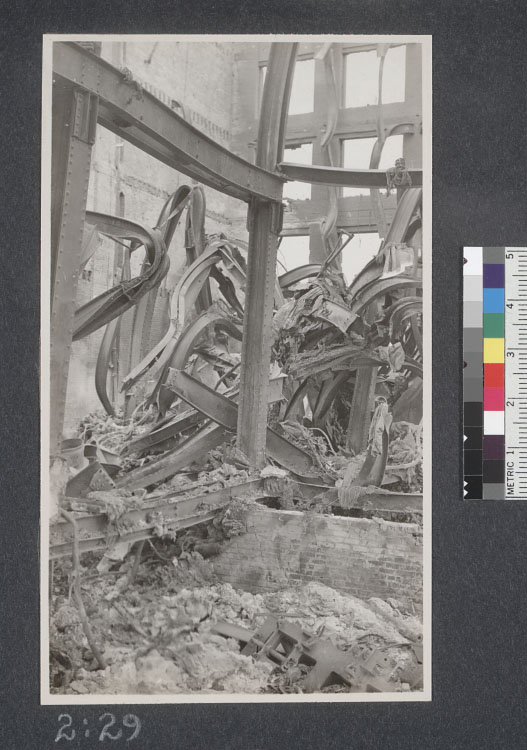
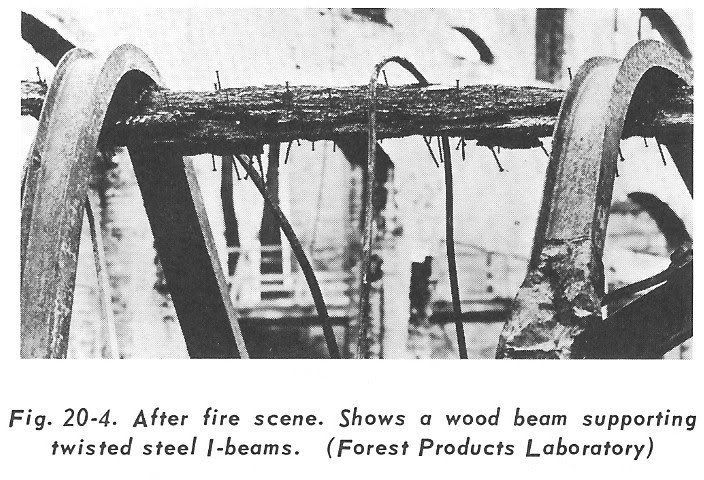
The steel collapsed, the concrete held up the building. You claim steel doesnt collapse in fire, you are talking total nonsense. I also showed you another picture, of what happens to steel in fire, was thermite used there too you believe?

hb6x0nb64h-FID3.jpg


woodbeambentsteel-full.jpg
 
Last edited:
Miragememories said:
My statements were directed to people in the world that understand that when an object is not moving, it has no velocity or acceleration.

Ok, when you throw the ball up in the air at every instant it feels the attraction of gravity wanting to pull it back down. The attraction is expressed as the force F=GmM/r^2, where G is a constant, m is the mass of the ball, M is the mass of the earth, and r is the distance center-to-center from earth to ball. Inserting the approximate values for earth's mass and radius, and the constant, GM/r^2 ~ 32.2 ft/s^2 = g, or 9.81 m/s^2 = g in metric. While the ball is in motion, neglecting air resistance, this is the only force acting on it.

Newton's second law tells us that the sum of the forces acting on the object is equal to the mass of the object times its acceleration, F = ma. So on the left we have only the force F=mg described in the paragraph above. On the right we have ma. That gives us:

mg = ma

Now clearly this is true at all times during the flight of the ball, since the gravitational force is always acting. Even when the ball comes to a stop at the top. If the acceleration were somehow zero (a=0) at the top, we would have mg = 0. There would suddenly be no gravitational attraction acting on the ball. No net forces at all. This presents a problem, because Newton's first law tells us that if there are no net forces acting on the object that it continues its motion at constant velocity or remains at rest. Since the ball is "at rest" at the top of its flight, it would thus remain so. If it is not your personal experience that objects remain hanging in the air once you have thrown them up, then you must accept that the sum of the forces is not zero, and thus ma must have some value, as we have shown that a must be equal to g.

 
Last edited:
If an object with zero velocity must also always have zero acceleration, how in the world can anything with zero velocity be moved?

ETA: It would pretty awesome to throw a ball into the air and have it "stick" at the point it reaches zero velocity.
 
Last edited:
Originally Posted by Miragememories

For example, need I drag out the news story where the fire chiefs are all claiming they had no expectation that the Towers were going to collapse?

=noahfence
yes

Please do. I'm also curious as to why you think their expectations would not be different from before WTC2 collapsed and after it collapsed. Mine certainly changed.:confused:

Clock's ticking.

*It was you that suggested you drag 'em out.
 
Here's a graph of the height, velocity and acceleration of a ball thrown with an initial velocity of 10m/s vertically upwards. Air resistance is neglected.

[qimg]http://www.internationalskeptics.com/forums/imagehosting/thum_147644ebc0a7d6dc81.jpg[/qimg]

The green line is the acceleration, which is constant at 9.81ms-2 vertically downwards (represented as negative on this graph). The red line is the velocity, which passes through zero at about 1.02 seconds. The blue line is the height, which reaches a maximum at the same instant. At this instant, the ball has zero velocity, but acceleration of 9.81ms-2.

Dave

Ok, I get it, Thanks.
 

Back
Top Bottom