Correa Neto
Philosopher

- Joined
- Aug 4, 2003
- Messages
- 8,548
I can has "cynic technocrat scientific skeptic" as title?


I've just finished reading through the last few pages that had been posted yesterday while I was out. I have to say I'm still perplexed about this null hypothesis issue. How can it still be so difficult to comprehend, even after all the exhaustive explanations we've given?
Please allow me the courtesy of taking one more whack at explaining it. OK?
The concept of a null hypothesis is not complicated, but it requires a grasp of the concept of falsification. Falsification means the disproving or nullification of an idea or concept. It is a very important concept to science.
First of all, the main points:
- A null hypothesis is not a normal kind of hypothesis. That is, it is not created with the intent of proving it, nor is it assumed to be a proven fact.
- The null hypothesis is basically the default assumption that the researcher's hypothesis is not true.
- It is merely assumed as a default position (due to lack of evidence), until such evidence is confirmed to falsify (disprove) it.
- The researcher does not have to believe the null hypothesis is true; in fact the entire point of the research is to falsify it.
- The null hypothesis is to be stated in the simplest and broadest possible terms, in order to make it easy to falsify in an unambiguous way.
- The only reason it is there is to eliminate confirmation bias from the research.
- The null hypothesis is applicable to any field of research that studies the objective, material Universe.
Note that at no point is the null hypothesis intended or assumed to be proven, it is merely assumed true on the basis that no evidence exists to refute it. Critical thinking posits that without evidence, a claim is not to be assumed true. Of course that does not mean it is assumed to be false either, but there is simply no good reason to believe it.
Here's a hypothetical example:
Let's assume for the purpose of this example that an ornithologist has received unconfirmed reports that white crows have been sighted in his local area. He personally has never seen an albino crow, but he suspects that such a thing might exist, so he decides to investigate the matter.
So the hypothesis he seeks to prove in his research is:
"Some crows are white."
Now the prevailing science dictates that all crows have black feathers. In the absence of evidence, there's simply no basis to assume otherwise, right?
Of course it would be wrong for him to just assume the white crows exist on hearsay without any material evidence, so he must posit a "null" hypothesis as a baseline goal for himself to falsify.
The null hypothesis essentially negates his own hypothesis. It states:
"All crows are black."
The null hypothesis is unproven. In fact, it's unprovable (there's no possible way for the ornithologist to have examined every single crow in the world).
But the null hypothesis is not an argument from ignorance, either. The null hypothesis is not a claim per se, and therefore does not need to be proven; it exists only for the purpose of being falsified, to prove a point. The researcher doesn't even believe it to be true (he's trying to prove it wrong, remember). But he must assume it's true, because the burden of proof is on him as the claimant to prove evidence to the contrary. To prove his hypothesis, he must falsify the null hypothesis.
This process may seem backward and counter-intuitive, but it is a very important step to ensure the researcher's own bias does not influence the outcome of the research. The researcher might feel 100% certain that his hypothesis is correct, but he must nevertheless assume it is wrong (for the purpose of research) until he can produce evidence to support it. If he cannot produce evidence, then he must concede that his hypothesis has not been proven and is probably wrong.
For the ornithologist to falsify the null hypothesis, all he has to do is capture a single white crow. Just one, and the null hypothesis will be falsified. He could then perform DNA testing on the animal to determine its origin, and publish his results in an ornithological journal. With every independent DNA test that confirms his findings, his hypothesis becomes stronger until the whole world must accept the fact that white crows exist in the world. This is how science is done, and now human knowledge is advanced.
See how that works? Do you have any questions?

Pythonic,
Actually your assumption is just parroting a bunch of cynics, technocrats and scientific skeptics, but in reality it is not always true. For example the video evidence out there is obviously filled with hoaxes, but you would still consider a You Tube video better than a report from an Air Force pilot?
Or let's take the UFO out of equation altogether. Stand outside looking up a the dark sky some night. With good eyes you can observe satellites passing over. When you see one try to take a picture of it with your cell phone. Then ask yourself if you believe your cell phone picture or your own eyes.
Human perception is much better than the cynics and skeptics give it credit for. It is based on well known scientific principles with known tolerances. That is why optometrists can measure eyesight and if necessary create perfect lenses for glasses. There are many instances when eyewitness tesimony may be better than material evidence.
Not only that, material evidence can also lead to false conclusions. A strand of hair at a crime scene doesn't prove the person it came from committted the crime. If that person was on the other side of the planet and seen by numerous independent witnesses, that person will not be convicted on mere trace evidence ... physical or not.
Be careful about using absolutes like "worst" or "always" when you are making statements, otherwise you'll run into trouble. Think for yourself.

Human perception is much better than the cynics and skeptics give it credit for. It is based on well known scientific principles with known tolerances. That is why optometrists can measure eyesight and if necessary create perfect lenses for glasses. There are many instances when eyewitness tesimony may be better than material evidence.
Human perception is much better than the cynics and skeptics give it credit for. It is based on well known scientific principles with known tolerances. That is why optometrists can measure eyesight and if necessary create perfect lenses for glasses.
There are many instances when eyewitness tesimony may be better than material evidence. Not only that, material evidence can also lead to false conclusions. A strand of hair at a crime scene doesn't prove the person it came from committted the crime. If that person was on the other side of the planet and seen by numerous independent witnesses, that person will not be convicted on mere trace evidence ... physical or not.
Be careful about using absolutes like "worst" or "always" when you are making statements, otherwise you'll run into trouble. Think for yourself.
There is nothing anyone can say to make what I experienced not have happened or convince me that what I saw wasn't some kind of alien craft, so your consensus on that point isn't relevant to me.

How about the picture taken with a real camera with actual depth of field?Or let's take the UFO out of equation altogether. Stand outside looking up a the dark sky some night. With good eyes you can observe satellites passing over. When you see one try to take a picture of it with your cell phone. Then ask yourself if you believe your cell phone picture or your own eyes.
Wait, you're serious?! LOL! Obviously you have no experience in the real world with eyewitness "identification."Human perception is much better than the cynics and skeptics give it credit for. It is based on well known scientific principles with known tolerances... There are many instances when eyewitness tesimony may be better than material evidence.
That's the worst attempt ever at painting anecdotal evidence as more conclusive than material evidence. Your example has zero to do with the validity of the evidence and everything to do with the in/accuracy of the person making conclusions based on the evidence.Not only that, material evidence can also lead to false conclusions. A strand of hair at a crime scene doesn't prove the person it came from committted the crime. If that person was on the other side of the planet and seen by numerous independent witnesses, that person will not be convicted on mere trace evidence ... physical or not.
I think you need to go back to the drawing board and work up some better arguments.Be careful about using absolutes like "worst" or "always" when you are making statements, otherwise you'll run into trouble. Think for yourself.
Of course this begs the question, what makes you any different than the guy who stands in front of the Court House all day, yelling about the CIA stealing his thoughts? Both of you have absolute faith in something that everyone else sees as crazy.There is nothing anyone can say to make what I experienced not have happened or convince me that what I saw wasn't some kind of alien craft, so your consensus on that point isn't relevant to me.

Not only that, material evidence can also lead to false conclusions. A strand of hair at a crime scene doesn't prove the person it came from committted the crime. If that person was on the other side of the planet and seen by numerous independent witnesses, that person will not be convicted on mere trace evidence ... physical or not.
Be careful about using absolutes like "worst" or "always" when you are making statements, otherwise you'll run into trouble. Think for yourself.

Material (physical) evidence can lead to false conclusions, yes. Just ask Amanda Knox....Not only that, material evidence can also lead to false conclusions. A strand of hair at a crime scene doesn't prove the person it came from committted the crime. If that person was on the other side of the planet and seen by numerous independent witnesses, that person will not be convicted on mere trace evidence ... physical or not.

Pythonic,
Actually your assumption is just parroting a bunch of cynics, technocrats and scientific skeptics, but in reality it is not always true. For example the video evidence out there is obviously filled with hoaxes, but you would still consider a You Tube video better than a report from an Air Force pilot?
Or let's take the UFO out of equation altogether. Stand outside looking up a the dark sky some night. With good eyes you can observe satellites passing over. When you see one try to take a picture of it with your cell phone. Then ask yourself if you believe your cell phone picture or your own eyes.
Human perception is much better than the cynics and skeptics give it credit for. It is based on well known scientific principles with known tolerances. That is why optometrists can measure eyesight and if necessary create perfect lenses for glasses. There are many instances when eyewitness tesimony may be better than material evidence.
Not only that, material evidence can also lead to false conclusions. A strand of hair at a crime scene doesn't prove the person it came from committted the crime. If that person was on the other side of the planet and seen by numerous independent witnesses, that person will not be convicted on mere trace evidence ... physical or not.
Be careful about using absolutes like "worst" or "always" when you are making statements, otherwise you'll run into trouble. Think for yourself.


Pythonic,
Actually your assumption is just parroting a bunch of cynics, technocrats and scientific skeptics, but in reality it is not always true.
For example the video evidence out there is obviously filled with hoaxes, but you would still consider a You Tube video better than a report from an Air Force pilot?
Or let's take the UFO out of equation altogether.
Stand outside looking up a the dark sky some night. With good eyes you can observe satellites passing over. When you see one try to take a picture of it with your cell phone. Then ask yourself if you believe your cell phone picture or your own eyes.
Human perception is much better than the cynics and skeptics give it credit for.
It is based on well known scientific principles with known tolerances. That is why optometrists can measure eyesight and if necessary create perfect lenses for glasses.
There are many instances when eyewitness tesimony may be better than material evidence.
Not only that, material evidence can also lead to false conclusions. A strand of hair at a crime scene doesn't prove the person it came from committted the crime. If that person was on the other side of the planet and seen by numerous independent witnesses, that person will not be convicted on mere
trace evidence ... physical or not.
Be careful about using absolutes like "worst" or "always" when you are making statements, otherwise you'll run into trouble. Think for yourself.
Fixed.Q. I wanna take pictures of night lights-type UFOs which I believe are alien craft. How can I do that?
A.Get a decent camera, a tripod (Martian tripods will make all this thread kinda pointless) and a shutter release cable. Go outside at night at the nearest UFO hotspot, set up camera, tripod and cable. Adjust camera to a high ISO setting, focus to infinite and exposure to "B". Look for an UFO. Here it comes. Point camera, press shutter, release it after some seconds. There you go- you've just acquired a register of the UFO's path. To get used to the method, you can train taking pictures of airplanes at night.
Get baked, throw on some Zeppelin, start talking "deep thoughts" with your fellow partygoers, point out window and go "dude, an alien ship totally just flew down the mountain over there." Then produce inaccurate drawing years later when you tell the story.
Pythonic,
Stuff


Or let's take the UFO out of equation altogether. Stand outside looking up a the dark sky some night. With good eyes you can observe satellites passing over. When you see one try to take a picture of it with your cell phone. Then ask yourself if you believe your cell phone picture or your own eyes.
Human perception is much better than the cynics and skeptics give it credit for. It is based on well known scientific principles with known tolerances. That is why optometrists can measure eyesight and if necessary create perfect lenses for glasses. There are many instances when eyewitness tesimony may be better than material evidence.
scientific skeptics
When you see one try to take a picture of it with your cell phone. Then ask yourself if you believe your cell phone picture or your own eyes.
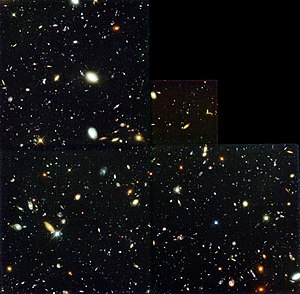
I'll do you one better:
Image from Wikimedia.
Wow, that's a really good picture! I'm totally going to go and get myself one of those Hubble phones.


