Nick Squires has written a new piece for the
Telegraph including five reasons why Knox is guilty. It illustrates nicely just how weak the prosecution case actually is, as does his second part where he highlights reasons why Amanda is innocent.
FIVE REASONS KNOX IS GUILTY
1) The confession.
Knox confessed that she was in the house on the night of the murder and that she heard Miss Kercher scream, identifying a Congolese bar owner, Patrick Lumumba, as the assailant. She told the court during the trial that the confession was made under duress but then repeated the entire account in a five page memorandum the next morning.
Here they are, the two
statements and the
note. Here's the 'entire account' she supposedly 'repeated:'
Amanda's Note said:
However, it was under this pressure and after many hours of confusion that my mind came up with these answers. In my mind I saw Patrik in flashes of blurred images. I saw him near the basketball court. I saw him at my front door. I saw myself cowering in the kitchen with my hands over my ears because in my head I could hear Meredith screaming. But I've said this many times so as to make myself clear: these things seem unreal to me, like a dream, and I am unsure if they are real things that happened or are just dreams my head has made to try to answer the questions in my head and the questions I am being asked.
Reading the rest of it, and knowing the context, it's pretty clear what probably occurred. They told her they had 'hard evidence' of her at the scene, that Raffaele had 'dropped' her alibi, and they kept threatening and lying to, and shouting at her until in the middle of the night she succumbed to their suggestion she must have been there, and these images she summoned at their request must be true, or at least
possible. Note
she didn't run out to arrest Patrick, it's clear by this note and the statements themselves she's unsure of all this, and they kept him in jail anyway for two weeks even after receiving this note which includes the following qualifiers regarding those statements and her state of mind, outside the one highlighted above:
"But the truth is, I am unsure about the truth..."
"...I want to make very clear that these events seem more unreal to me that what I said before, that I stayed at Raffaele's house. "
"I'm very confused at this time. My head is full of contrasting ideas..."
"...the way the truth feels in my mind, there is no way for me to have known because I don't remember FOR SURE if I was at my house that night."
"...I don't feel I can be used as condemning testimone [sic] in this instance."
2) The false accusation.
The prosecution said the fact that Knox falsely accused Lumumba of being the killer was a sign of her own guilt and an attempt to throw them off her trail. He was arrested in a dawn raid by armed police and spent two weeks in jail. It was only by chance that a Swiss businessman read about the case and came forward to say he had been talking to Lumumba in his bar on the night of the murder — offering him a rock-solid alibi. Lumumba says Knox nearly ruined his life and is suing her for defamation.
Here's the most interesting thing about using this 'accusation' as a sign of guilt, how did it, or was it supposed to, benefit Amanda? 'Throwing' them off the trail by putting yourself in a cell? They used this 'confession' as a justification to arrest Amanda, notably because it suggested she'd been lying to them all week and had been at the cottage the night of the murder. Doncha suppose if she was guilty, and this manipulative mastermind that could force cops to go out and arrest someone on a vague or confused remembrance, she might have been able to think up a lie that that didn't put her in a cage herself?
Ask yourself 'who
wanted Patrick in jail?' Who was it that actually went and arrested him on scant evidence and wouldn't let him free despite his day-long protestations of innocence being interrogated and who even went out and found a 'witness' to his bar being closed that day? The police in Perugia did that, Amamda wrote them a note saying she was unsure and that she couldn't be used as 'testimone' and celebrated in her diary when he was released. So, where does the actual
evidence come from that Amanda wanted ILE to arrest Patrick? How does the inference that she's 'throwing them off her trail' develop? Why would she pick someone she would know probably would have a personal or electronic alibi, having just communicated with him when he was in a public place directly before the murder, someone she
knew hadn't been in the cottage, and that cops could never find evidence of?
It's easy to explain by the cops putting too much pressure on Amanda to get a reason to arrest Patrick, it's difficult to imagine why a guilty Amanda would do something as bizarre as just accuse him out of the blue when there were other more likely people she could have blamed, or just insisted on a lawyer. Amanda trying to 'throw people off her trail' by blaming Patrick then not bothering to make it either descriptive or definite--
just doesn't make any sense if you stop to think about it. Cops getting frisky in their haste to make an arrest
does, and there's evidence that occurred as it
actually happened.
3) The alibi.
Sollecito could not back up Knox’s alibi on the night of the murder.
She claimed she spent the evening with him, smoking marijuana, watching the French film Amelie and making love. But Sollecito told police he could not remember if Knox was with him that evening or not.
Even assuming his memory was hazy because of the drugs, it seemed odd that a young man who had just embarked on a new relationship could not recall whether he had spent the night with his girlfriend or not.
Not exactly, Raffaele went in there stoned and 'changed' his story to basically what happened the night before, he and Amanda split up at the square, she went to
lLe Chic and he got a message from his Dad late, and Amanda came home late. That got him arrested, his shoes seized, charged with murder and locked in a bathroom for two days without a lawyer to 'think about it.' Before Matteini he withdrew that account and could only allow that he couldn't be
sure that Amanda had been with him every instant of the night and might have popped out at some time. Which if you think about it, more or less goes for anyone about anything at anytime. Since the last time he'd gone telling the police something definite had gotten him into this mess, perhaps he was simply allowing for his memory to have been incorrect, as it had been recently proven so at the time.
Since then he decided through 'reconstructing' that she was there the whole night, but as the last he spoke on it was before Matteini on November 8th, 2007, some on the internet have claimed unless he takes the stand he's not 'confirming' Amanda's alibi. That's just weird, his lawyers in court every day pressing his claim of being with Amanda that night, yet some people pretend because he never took the stand like Amanda that somehow he's not giving her an alibi.
It's one of those silly 'internet lawyer' things.
4) Computer and telephone records.
Sollecito claimed he used his computer to download and watch cartoons and Amelie. But computer experts told the court that there was no activity on his laptop between 9.10pm on Nov 1, and 5.32am the next morning — the time frame in which the murder took place.
Knox and Sollecito turned off their mobile phones on the night of the murder, from around 8.40pm, and turned them back on at around 6am, inviting further suspicion.
The computer data was destroyed in police hands, thus trying to use that
against Raffaele and Amanda is the height of hilarity. Police reconstructing data also missed a later opening of the Naruto file at 9:26, and further reconstruction by the defense has led to recovery of the screensaver and keyboard light data indicating a human presence all night on the computer. One cannot bring up the destruction of the data as a positive point without considering the lost data that was restored.
Amanda Knox turned off her phone the night of the murder, shortly after she replied to Patrick's text, to both save the battery and so Patrick couldn't call back and change his mind or he or anyone else interrupt their plans. I've never seen anything that would indicate Raffaele's phone was turned off, or turned back on, merely that he didn't receive a call. It also makes one wonder
just why one person admitting to turning off their phone would be cause for police to claim both were turned off and that was 'evidence' of their involvement in a murder. If they were bright enough to realize their movements might be tracked by their phones, why not keep them at home turned on suggesting they were at home the whole time?
5) The staged break-in.
A bedroom belonging to one of Miss Kercher’s Italian flatmates was ransacked on the night of the murder, with a window smashed with a rock. But police said the break-in was staged - broken glass from the window was found on top of clothes scattered on the floor, suggesting the window was broken after the contents of the room were messed up. Prosecutors accused Knox and her boyfriend of staging the break-in to make the killing look like a burglary that had turned into rape and murder.
If Raffaele and Amanda are involved in the murder, then that would suggest that the break-in would have to have been staged or it strains credulity to think that they planned a sex-game murder which just
happened to correspond with the night a burglar broke in. Thus the police were 'cognitively motivated' to find reasons for the break-in being staged if they planned on charging Raffaele and Amanda, thus they attempted to come up with 'inconsistencies' that suggest 'staging' which amount to pure silliness in the light of a
burglar having been arrested who left his DNA and Meredith's blood all over her room and the cottage with shoeprints.
So it's either the choice of a burglar having done a real burglary, or
The incredible coincidence that the person that Raffaele and Amanda had barely met but decided to hook up with for a spot of rape-n-murder just so happened to be a burglar who'd been caught a few times recently, and that they would emulate his trick of breaking into the second story, and that they wouldn't just leave the door open (like it was anyway) and would actually 'stage' the break-in not employing a method so simple and foolproof it can't be detected as 'staged:' just break into the place!
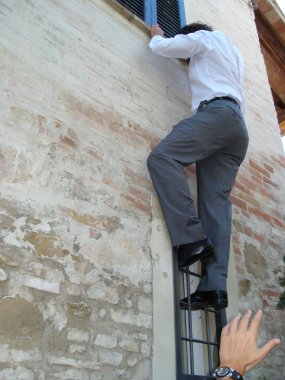
Then you find out that their primary 'proofs' of this are specious contentions like the only way for glass to have gotten on top of clothes are if the clothes were tossed around first and the window broken afterward--except they didn't even bother to photograph this precious 'proof!' They make absurd claims like an athletic young man couldn't climb into this window:
For Amanda and Raffaele to be guilty the break-in has to be staged, which explains it's prominence in the lexicon of guilt, however there's no way to
prove that, and is on the face of it a rather a curious idea in the context of a
burglar having been arrested and convicted already for the rape and murder of Meredith Kercher. The whole case is kinda like that...