No, I said you folks IGNORE them and the implications of the material in them.
To quote Tim's claim:
Mozina has never once, in all these years, even tried to present anything one might call a "scientific" argument.
When I hear statements like that, it's hard to believe that he actually heard, listened to, or seriously considered anything I've presented.
I have to concur with Tim. I've seen you put forward scattered bits of data, but nothing like a coherent theory. Peratt et al may have a coherent story, but you haven't been willing to dive into the details, partly because we keep getting sidetracked on much simpler concepts like optical depth.
"Addressed" how exactly? Yes, you folks made a few comments about them, but then you go right back to ignoring the implications in the papers none the less. You folks squeal like a stuck pig for maths, and then you promptly ignore them.
That's not my take at all. When we've shown you math, you've typically fallen back on the "I know what I see" argument.
I show you mathematical explanations of how plasma pinches produce gamma rays like we observe in flare events, and somehow I've still presented "no scientific argument" anyway. What a load of BS!
Discussed later in this post.
I don't and I don't. He did however address each issue he presented quite methodically and he explained where Cowlings made his error.
He paraphrased 2 of Cowlings' concerns. We have not actually seen Cowling's concerns. And, in any event, I consider this paper to be yet another red herring.
Did you find some specific fault with his rebuttal that you'd like to comment on?
Yes and no. The paper addressed 2 concerns: Cowlings' use of Lenz's law and the required thinness of the accelerating layer.
I don't grok Lenz's law well enough to follow either the argument or the rebuttal, and I doubt that you followed it, either. In any event, whether or not Dungey properly used Lenz's law does not have much bearing ES's accuracy.
For the thinness of the accelerating layer, Dungey's argument boiled down to the lack of observational data to confirm or deny his prediction.
So I don't see anything in the paper that provides significant support or refutation of ES.
If you think that the paper provides substantial support for ES, then tell us how rather than simply posting a link to it and then complaining that we're handwaving.
Meanwhile, are you going to address the conclusion from another of your cites?
http://adsabs.harvard.edu/abs/2007ApJ...670..841S:
We explored the implications of the measured currents for Joule heating of the corona . . . Use of the Spitzer resistivity leads to a value for the volumetric heating rate approximately 6 orders of magnitude less than the value indicated by observations.
Anyway,
Yes. That's why I provided papers that demonstrate all the things that electrical discharges can do, and how they apply to solar flares. Discharges are capable of ionizing iron to very high energy states, and do so in the lab. Yep, we see that happen in solar flare events. Discharges produce radio waves. Yep, we see that too. Discharges produce neutron capture signatures. We see that too. Discharges can heat plasmas to millions of degrees and sustain them at those temperatures virtually indefinitely. Discharges produce x-rays. Guess what flares do? Discharges produce radio waves in the lab, and guess what flares do? Discharges produce gamma rays here on Earth, and I've provided you with the maths to explain how pinches create such photons.
See, this is why we get frustrated, because we've been over this several times. All of those things are results of very hot plasma. Electrical discharges are one way of making things very hot (and often the most convenient way to do it in a lab), but there are many ways of making very hot plasma, so nothing on that list favors discharge over, say, magnetic reconnection, fusion, matter-antimatter reactions, or gravitational collapse.
For that matter, nobody is denying that there are some substantial currents flowing around the sun. We just don't give them the primacy that you do.
Discharges in fact occur naturally around EVERY body in the solar system with an atmosphere and a magnetic field and the sun has the biggest atmosphere and magnetic field in the system.
They're observed only in non-conductive atmosphere. We don't observe them in, say, Earth's oceans. If you're going to seriously argue that the conductivity of an atmosphere isn't relevant to lightning, then .. . that would be bizarre. And if you agree that the conductivity
is relevant, then the fact that we observe lighting in non-conductive atmospheres simply isn't relevant.
Compare and contrast that with your pathetic little weakling of a theory called "magnetic reconnection".
I'll leave that to the others because I lack the math & physics background. However, but I have to agree with Tim & tus that you also seem to lack math & physics background to actually discuss magnetic reconnection.
I think the problem here is that you folks feel that if you handwave a little bit at every paper I have presented, you can then somehow completely discard and ignore it too.
First, some of the others really have tried to engage you in discussions of the technical aspects of Alfven, Peratt, and Carlqvist, but you typically accuse them of denial, repeat already-debunked claims, and post pictures that, frankly, we don't consider relevant.
Second, let's take a particular little bit of one of your papers. In this case, it's a bit of the summary of
http://esoads.eso.org/abs/1991SoPh..132..307F
"... both quasi-static and wave-related macroscopic electric fields might be expected in the solar atmosphere at intensity levels comparable to or well above the senstitivity limits presently achieved. ... Nevertheless, a firm detection of solar macroscopic electric fields has yet to be achieved."
Do you feel that you've addressed that issue with anything better than handwaving and denial?
If not, isn't it a bit disingenous to then claim that the rest of us have provided nothing but handwaving and denial?



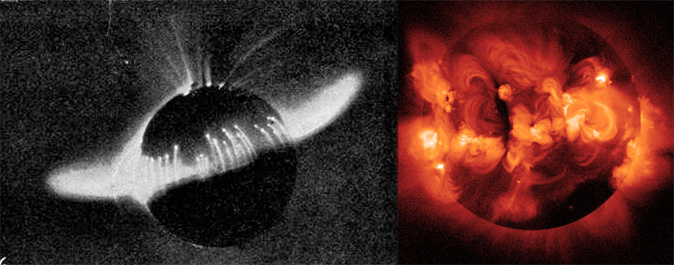


 That was really cool!
