• Quick note - the problem with Youtube videos not embedding on the forum appears to have been fixed, thanks to ZiprHead. If you do still see problems let me know.

Origin of the paint that was found as red-gray chips - any ideas?

Fair enough. BTW, I don't understand a lot of it, but excellent work to all of the experts here.

 
Something like a skin you might say. Is the grey layer of consistent thickness over all the chips that you know of ?

According to Harrit, no. In the Section about the DSC experiments of his Bentham article, he writes:

Proceeding from the smallest to largest peaks, the yields are estimated to be approximately 1.5, 3, 6 and 7.5 kJ/g respectively. Variations in peak height as well as yield estimates are not surprising, since the mass used to determine the scale of the signal, shown in the DSC traces, included the mass of the gray layer. The gray layer was found to consist mostly of iron oxide so that it probably does not contribute to the exotherm, and yet this layer varies greatly in mass from chip to chip.

Source: The Open Chemical Physics Journal, 2009, 2, p. 19

It seems that this group has no clue about the exact constitution of the examined chips.
 
Last edited:
According to Harrit, no. In the Section about the DSC experiments of his Bentham article, he writes:


Source: The Open Chemical Physics Journal, 2009, 2, p. 19

It seems that this group has no clue about the exact constitution of the examined chips.

Thanks. Jones remarked that the grey layer is tough and seemed to stress that point. Would iron oxide be tough and grey ?
--------------------------------------------------------------------------
In the Section about the DSC experiments of his Bentham article, he [Harrit] writes:

Proceeding from the smallest to largest peaks, the yields are estimated to be approximately 1.5, 3, 6 and 7.5 kJ/g respectively. Variations in peak height as well as yield estimates are not surprising, since the mass used to determine the scale of the signal, shown in the DSC traces, included the mass of the gray layer. The gray layer was found to consist mostly of iron oxide so that it probably does not contribute to the exotherm, and yet this layer varies greatly in mass from chip to chip.

Source: The Open Chemical Physics Journal, 2009, 2, p. 19
 
Last edited:
This is all that I could find in the paper about the grey layer. Just as an aide memoire

Thicknesses vary from roughly 10 to 100 microns for each layer (red and gray).
..
..confirms the higher average atomic number of the gray layer.

..The red material also shows specks and other heterogeneities,
in marked contrast to the smooth gray layer.
..
the adhering gray layer

..ndicate that the gray layers are consistently characterized
by high iron and oxygen content including a smaller amount
of carbon.

(After soaking in MEK)..The red layer of the chip was found, by visual inspection, to have swelled out from the gray layer by a factor of roughly 5 times its original thickness.

The gray layer was found to consist mostly of iron oxide so that it probably does not contribute to the exotherm, and yet this layer varies greatly in mass from chip to chip.

..a gray layer in which mainly iron and oxygen are found.

..The fact that most of the chips have a distinctive gray layer suggests that the unreacted material was in close contact with something else, either its target, a container, or an adhesive.

In addition, the gray-layer material demands further study. What is its purpose? Sometimes the gray material appears in multiple layers, as seen in Fig. (32).

..Fig. (31). Photomicrograph of a red/gray chip found in sample 3, showing multiple layers and an unusual light-gray layer between the red layers.

The red-mesoporous material is on the left in this view,with the touching dark-gray layer next and a lighter-gray material on the right as seen in a photograph of the same chip (right hand image in Fig. (32)). The gray layer in contactwith the red layer has the XEDS spectrum shown in Fig. (33) in which iron is not seen, while the outer gray material had an XEDS spectrum just like those displayed in Fig. (6).
Thus, the middle-layer gray material contains carbon and oxygen and presumably also contains hydrogen, too light to be seen using this method. Since the gray inner layer appears between two other layers, it may be a type of adhesive, binding a red porous thermitic material to another, iron-rich material. One might speculate that the red thermitic material has been attached to rusty iron by an adhesive. The cooling effect of the iron in such close proximity, acting as a heat sink, might quench the reaction and explain the fact that unreacted red thermitic material, always found by us in thin layers, remains in the dust. These hypotheses invite further experiments

http://www.benthamscience.com/open/tocpj/articles/V002/7TOCPJ.pdf
.
 
Last edited:
Thanks. Jones remarked that the grey layer is tough and seemed to stress that point. Would iron oxide be tough and grey ?

Of course it would. It has to be ground or sanded off of steel after it is forged into shape. This is an oxide that forms on the outside of steel subjected to heat in the manufacturing and shaping process. Go down to your local hardware store and look at the various sorts of bar stock available. All of the weldable steel has a similar greyish luster about it.
 
I remember Jones saying that the grey material was very tough. He seemed to stress that point but said no more about it. And I seem to remember somebody (maybe Jones at another point) speculating that the grey material might have been part of some kind of casing.
I then replied to this with:

The word "tough" has a very specific meaning in materials science.When you look at the SEM photos of the gray layer it can't be "tough". Infact it's obvious it's a brittle material, the fractures ans the fracture surface indicate that - the exact opposite of toughness. Again it shows that Jones doesn't know what he's talking about.
You Bill have now asked this:

Thanks. Jones remarked that the grey layer is tough and seemed to stress that point. Would iron oxide be tough and grey ?
This is why you fail Bill. You are profoundly incapable of learning. You refuse to acknowledge posts and answers directed to you and you ignore everything else that doesn't suit your fantasy and delusion, and then you just repeat what Jones has wrongly said.

Iron oxide is a brittle, ceramic-type, material that fractures very easily on impact, therefore by definition it is not tough. Both forms Fe2O3 and Fe3O4 are brittle. You can easily check this. The fracture surface observed in the gray layer is a brittle one, it's characterised by flat smooth surfaces, sharp edges, a glassy look to the surface clearly showing cleavage planes. Now if you want to argue against this then please do so. I could do with a laugh.

Infact that's another criticism of the Harrit et al paper - failure to describe the fracture surface as part of the materials characterisation exercise.

Is iron oxide a gray colour? If you had looked at the photos and EDX spectra in the paper you would know this. Do you realise that the "gray" layer is simply a term in the paper used to distinguish the two different layers in the SEM photos? You didn't read the paper did you? If you knew about SEM you'd also realise that you can't get a colour picture from the scan. So to distinguish the layers they are labelled. We are simply following the convention in the paper so we all know what we are referring to. If you want to know the colour of the "gray" layer look at Fig 2.

Now, if you don't believe that this layer is an predominantly an iron oxide then please explain in detail why. I'd love to see you try bearing in mind Fig 6. lol.

Jones does not know the meaning of the word tough in metallurgical terms. Nor do you, even though I've explained it to you. I've even shown you why the gray layer cannot be tough - infact it's obvious, but you are oblivious.

You parrot Jones because you have no idea what you are talking about. Here's proof of that:

Something like a skin you might say. Is the grey layer of consistent thickness over all the chips that you know of ?
:sdl: A skin eh? And?. Is it the skin on a rice pudding? What is this skin you speak of? Why is there no detail in your answers? You then ask another question. Why are you asking these questions when a) you won't accept the answer and b) you don't understand the answer?

I'll spell it out for you.

The red layer is paint. The gray layer is iron oxide (most likely from steel, possibly MIO) Simples see? Oh, nope you don't. Nevermind eh Bill.

Instead of asking silly questions why don't you read the paper
The chips are typically small but readily discernible by eye due to
their distinctive color. They are of variable size with major
dimensions of roughly 0.2 to 3 mm. Thicknesses vary from
roughly 10 to 100 microns for each layer (red and gray).

You didn't read the paper did you Bill?

Why not do some measurements of your own? It's easy to do with a ruler and your computer screen using the scale kindly provided in each photo. Ooops, I forgot, you're a truther and such a simple exercise is not possible.

And that's the difference; us "debunkers" are actually looking at things critically, doing some analysis and detective work and trying to explain things, truthers just parrot nonsense.

You can't refute a single technical post in this thread or contribute to it so why are you posting in it? Got any ideas where this paint is from Bill?
 
I now see he's managed to type the word gray into acrobe readers search box. Congratulations!
 
I now see he's managed to type the word gray into acrobe readers search box. Congratulations!

'Tough' in technical terms means more or less what 'tough'means in general usage. Jones said that the grey layer is 'tough'. He also said in the paper that it was composed of iron oxide,oxygen and a liitle carbon. Could that mixture be considered 'tough' in technical terms ?
 
'Tough' in technical terms means more or less what 'tough'means in general usage. Jones said that the grey layer is 'tough'.
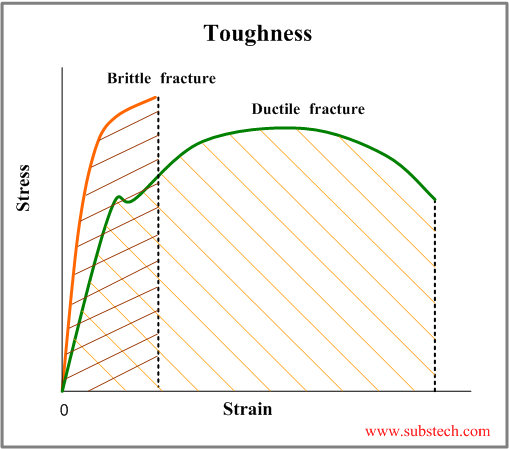
No it doesn't!

Toughness, in materials science and metallurgy, is the resistance to fracture of a material when stressed. It is defined as the amount of energy per volume that a material can absorb before rupturing.

Toughness can be found by taking the area (i.e., by taking the integral) underneath the stress-strain curve.

fetch.php


detail.php


Right lets see if you can answer this question. Look at this photo.

picture.php


Now using an arrow mark on the gray layer where you think plastic deformation has occured and say exactly why - what features of the fracture surface indicate plastic deformation? There must be plastic significant deformation for the material to be considered tough.

He also said in the paper that it was composed of iron oxide,oxygen and a liitle carbon. Could that mixture be considered 'tough' in technical terms ?
No. See above.

Now if you won't take my word for it then I suggest you take a degree in Materials Science so you can come to the same conclusion. There isn't a materials engineer on the planet that will say that material is tough. You have been on this site for 2 1/2 years - why have you not used that time to get a degree in a relevant subject to help you understand?
 
It fractures rather like the dark coating on weldable steel stock. That argues for its being formed in the forging process. I have not seen the underside, but the edges do suggest that they are rather rought, suggesting that they were chipped loose from the steel on which they formed. The grey substance is NOT a thermite component.
 
I'm enjoying the technical discussions of the chip composition. Thanks guys.

Generally I avoid reading BS's posts, but I heartily agree with your conclusions about him/her/it.

cheers

AE
 
Before I go to our polymer library to find something about DSC and TGA (thermogravimetric) measurements of oxidative degradation of epoxy resins at high temperatures...

Gray layer: It is written in the Laclede paint section in NCSTAR1-6b that the paint had to be applied by "the electrophoresces or similar process" (generally, some kind of paint "electrocoating" was applied).

I have just read an entry "Electrophoretic deposition" in Wiki. Basically, the steel is somehow cleaned/de-greased during the pretreatment, frequently with the formation of some very thin protective phosphate coating (can the phosphorus be detected by XEDS, since it has such a low atomic number (15)? Anyway, this operation is not mentioned in the specification so it was perhaps omitted in this case, e.g. because the steel floor elements used in the interiors of WTC did not require such a good corrrosion protection as (for instance) in the case of car steel elements.

After the pretreatment/cleaning, the steel is immersed into the bath containing a water emulsion/dispersion (colloidal form) of the paint. The painted steel serves as a one electrode here and there are counter electrodes immersed in the bath as well. An electrical field is applied (direct voltage ca 25 to 400 V). Colloid paint particles bearing positive or negative electrical charge migrate to the corresponding electrodes and form an uniform film there. This film is then rinsed in some additional cleaning baths, dried and cured/crosslinked by heat in some oven.

More specifically, an epoxide paint (like Laclede primer under discussion) forms colloid particles, consisting mostly of pigment and adducts of epoxide oligomers with amine hardener. Such an hardener is basic (positively charged) so the colloid particles migrate to the cathode (painted steel) in this case.

My question to Sunstealer or other expert on metallurgy (or paint expert): can a comparatively high voltage applied during electrophoresis change the composition of the upper layer of the painted steel? (I mean could it somehow contribute to the composition/structure of the so-called gray layers in the chips?)

Paint aging: I have mentioned that I would not expect any substantial additional shrinkage (negative change of thickness) of the epoxide paint even during 30 years. But this is just my guess. Tomorrow, I will ask my colleague who had been working for some big Czech paint company for many years...
 
Last edited:
No it doesn't!

Toughness, in materials science and metallurgy, is the resistance to fracture of a material when stressed. It is defined as the amount of energy per volume that a material can absorb before rupturing.

Toughness can be found by taking the area (i.e., by taking the integral) underneath the stress-strain curve.

[qimg]http://www.substech.com/dokuwiki/lib/exe/fetch.php?cache=cache&w=509&h=449&media=toughness.png[/qimg]

[qimg]http://www.substech.com/dokuwiki/lib/exe/detail.php?id=fracture_toughness&cache=cache&media=toughness.png[/qimg]

Right lets see if you can answer this question. Look at this photo.

[qimg]http://www.internationalskeptics.com/forums/picture.php?albumid=181&pictureid=872[/qimg]

Now using an arrow mark on the gray layer where you think plastic deformation has occured and say exactly why - what features of the fracture surface indicate plastic deformation? There must be plastic significant deformation for the material to be considered tough.

No. See above.

Now if you won't take my word for it then I suggest you take a degree in Materials Science so you can come to the same conclusion. There isn't a materials engineer on the planet that will say that material is tough. You have been on this site for 2 1/2 years - why have you not used that time to get a degree in a relevant subject to help you understand?

Where on the attached chart do you think the grey material would fit ? From 0.001 to 100 ?
http://www-materials.eng.cam.ac.uk/mpsite/interactive_charts/strength-toughness/IEChart.html
 
What was the reason again that Jones, Harrit, etc never got their samples sent to an independent lab?

Someone....truther...debunker...doesn't matter needs to press this issue with Jones....

Surely we can come up with a neutral lab to test the dust samples....I'm sure it can't be that expensive to get some XRD tests done on the samples along with various other tests....

At least then we can have some independent confirmation/verification of what this dust actually contains..
 
Ivan, thanks for the interesting details on electrophoretic deposition!

...
I have just read an entry "Electrophoretic deposition" in Wiki. Basically, the steel is somehow cleaned/de-greased during the pretreatment, frequently with the formation of some very thin protective phosphate coating (can the phosphorus be detected by XEDS, since it has such a low atomic number (15)?)
Surely.
Phosphorus is next to Al (13), Si (14) and S (16) in atomic number, which are all clearly detectable by XEDS. It has the following edge energies:
K-alpha: 2.015 keV
K-beta: 2.136keV
K: 2.149
Fig. 6 of Harrit e.al. shows no discernable peaks above noise around 2.1keV.

...
My question to Sunstealer or other expert on metallurgy (or paint expert): can a comparatively high voltage applied during electrophoresis change the composition of the upper layer of the painted steel? (I mean could it somehow contribute to the composition/structure of the so-called gray layers in the chips?)
You should specifically ask if the process would oxidize a surface layer of the steel.

Paint aging: I have mentioned that I would not expect any substantial additional shrinkage (negative change of thickness) of the epoxide paint even during 30 years. But this is just my guess. Tomorrow, I will ask my colleague who had been working for some big Czech paint company for many years...
Thanks! If your colleague could provide a citation, that would be great, so we don't have to rely on hearsay!
 
What was the reason again that Jones, Harrit, etc never got their samples sent to an independent lab?

Someone....truther...debunker...doesn't matter needs to press this issue with Jones....

Surely we can come up with a neutral lab to test the dust samples....I'm sure it can't be that expensive to get some XRD tests done on the samples along with various other tests....

At least then we can have some independent confirmation/verification of what this dust actually contains..

Actually, we already know fairly well.
Analysis of the organic matrix is missing, and of course more work on the gray layer. Some better XEDS data, especially beyond 10keV, and with better resolution, would be helpful, but what we have is 90% of what we need.
Of course, XRD would show clearly and beyond any residual doubt that we are correct about hematite and kaolinite, but we are already sufficiently certain about that: The relative amounts of Si and Al are too good a fit for Al2Si2O5(OH)4, and the platelike crystal structure look so very much like kaolinite, that there really is no doubt here. We can also be very sure that there is no Si and Al in the mix outside of kaolinite, so there is no free (elemental) Al in these chips at all. We know that aluminiumsilicate, of which kaolinite is one form, are part of many paints, including one particular primer used on a great deal of WTC steel - it all falls into place.
 
Oh, One excercise we could still do: Estimate total painted surface of core columns (definitely Tnemec), perimeter columns (probably Tnemec), and floor elements (LaClede). I have a hunch that there was much more LaClede primer in the towers than Tnemec.


Another thing we should do is to ignore Bill Smith, unless he provides constructive critique and helpfull hints, rather than displaying his ignorance and trollishness.
 

Back
Top Bottom