Are credit cards private currency.

Edited by kmortis: 
Removed presonal comments


If your using something that is not cash to pay for something then you are using an alternate currency.!

At least I know to use only one form of punctuation to end my sentences.

Oh, and I don't have any credit cards. Cash only, me.

I are smart now?
 
Last edited by a moderator:
To the OP:

Short answer; no.

Long answer; nope.

Crazy answer; Ron Paul's ideas on the permanence of gold and it's inherent centrality to the future of American economics are well founded and rational.
 
If your using something that is not cash to pay for something then you are using an alternate currency.!

I don't really know how to make it any simpler so you can understand it. A credit card is a loan of dollars. Same as a mortgage, same as student loans, same as car loans...

Are you calling loans alternate currency?
 
Just out of interest, if one wanted to use, say, a bit of plastic and some electronics to make a transaction, but didn't want to create a brand new currency, what would that look like?
 
I heard that the government is going to issue Ameros instead of dollars. I heard that the North American Union is going to be announced in 13 weeks and that they have already started building the Mexico-Canadian highway that will seal the deal. The lady at Menard's told me that they have already begun pricing some items in Ameros instead of U.S. dollars. Wake up sheeple!!!!!
Not to go too far off-topic, but where I work my agency head just recently asked me to find out what I could about the Kansas City Smartport. Little did I know that Googling what seemed to be a rather innocuous and, to many people I 'm sure, dull topic as a transportation hub would lead to CT websites about a NAFTA Super-highway and Ameros. That was the first I'd heard of either of these, and now you mention it. Where did that all come from?
 
Time for a real quick lesson on the nature of money.

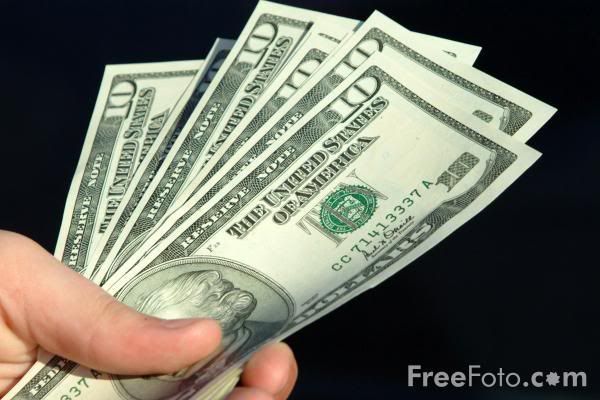
04_28_50---US-Dollar-Bills_web.jpg


Do you see any money in this image? No. You are looking at paper, or cash. Money is an abstract concept. This image depicts one of the forms used to represent it - paper bills. Money is also represented in other ways. If you've ever made a deposit to a modern bank, then your money has taken the form of a hard drive state.

Listen to this to learn more.
 
Well the government could issue electronic currency without the 7% markup. Instead its privatized. I suppose the dollars backing your loan come from the Fed. I don't suppose those dollars are actually there though. I mean there's nothing wrong with a private currency. This system seems kind of draining to the economy however.
 
What 7% markup? Are you talking about interest? You want interest to disappear?

It's really hard to carry on a conversation with somebody who just makes things up out of thin air. Banks and credit cards are not issuing money. They are loaning it to you, this is an important distinction.
 
Last edited:
What 7% markup? Are you talking about interest? You want interest to disappear?

It's really hard to carry on a conversation with somebody who just makes things up out of thin air. Banks and credit cards are not issuing money. They are loaning it to you, this is an important distinction.

5% to merchants at least isn't it. I am not sure what the exact amount is. All I know is that cash does not carry this fee.
 
5% to merchants at least isn't it. I am not sure what the exact amount is. All I know is that cash does not carry this fee.

It is more like 1-2%. And so what? Debit/credit cards are way more convenient to both merchants and customers than cash. You think banks would process all these billions of transactions for free?
 
Well the government could issue electronic currency without the 7% markup. Instead its privatized. I suppose the dollars backing your loan come from the Fed. I don't suppose those dollars are actually there though. I mean there's nothing wrong with a private currency. This system seems kind of draining to the economy however.

If I make a bank transfer from my dollar account to your dollar account have I or the bank created a new private electronic currency?
 
5% to merchants at least isn't it. I am not sure what the exact amount is. All I know is that cash does not carry this fee.

I'm going to start a collection agency. You give me a list of folks that haven't paid you. As a convenience for you not tracking them down, I'll pay you that amount (in US dollars) minus 15%. Then I'll go and collect money from them and I get to keep the entire amount I get.

I hope I'm not going to be shut down for creating a new currency. Except for the order of operations (which party gets paid first), this seems identical to how credit cards work.
 
If I make a bank transfer from my dollar account to your dollar account have I or the bank created a new private electronic currency?

We can be even more liberal with it, to highlight how absurd it really is.

One day, I took my girlfriend to Starbucks and I paid. "I'll pay you back later," she says. The next day we go again, and this time, she pays. Did we create a new private verbal currency?
 
It is more like 1-2%. And so what? Debit/credit cards are way more convenient to both merchants and customers than cash. You think banks would process all these billions of transactions for free?

Wow, maybe they are doing it for free. I never thought of that.

Nope I guess they are making money on this.

looking at fees

1st tier-might be 2% or less
2nd tier-2.5%
3rd tier-significantly higher

other fees to merchants

Authorization fee
statement fee
monthly minimum fee
batch fee
annual fee
early termination fee
chargeback fee

All I know is that merchants often give a 5% bonus for cash so likely the amount they pay for processing your credit card is 5%. Also many scores will not process a credit payment under 5.00 so the amount charged must be a flat rate plus a percentage. All of this falls under massive drain to the economy which is what the banking system is all about.
 
All of this falls under massive drain to the economy which is what the banking system is all about.

And that means credit cards constitute a private currency... how?

Oh, that's right: it doesn't.
 
All of this falls under massive drain to the economy which is what the banking system is all about.
I think you're confusing "massive drain to the economy" with "providing a service that people want at the price they're willing to pay"...in US dollars.
 
Where is this?

I've seen gas stations which do this (not the chain stations, but independent operators). And before switching insurance, my dentist used to give a discount for cash too, but I think it was less than 5%.

But of course, none of that has anything to do with MNBrant's original claim.
 
This made me think about visa, mastercard, etc. Apparently they are issuing electronic currency not backed by anything.
Credit card is a constantly fluctuating small loan, and bank stability laws apply to the loangiver.

The value of the loan does not fluctuate (like the value of an independent currency might), it is measured in a fixed currency.

What the government would be worried about would be widespread use of a private currency, whose value would not be under control of the government. All selfish inner circle interests aside, it is not a good idea for a government to take the risk that unknown and uncontrollable agents control the value and inflation of the currency in the pockets of people. Governments do their best to harness inflation, faceless uncontrollable agents might not.
 

Back
Top Bottom