• Quick note - the problem with Youtube videos not embedding on the forum appears to have been fixed, thanks to ZiprHead. If you do still see problems let me know.

Merged Is ufology a pseudoscience?

Well done on the presentation of the video debunking. That is exactly what ufology needs to help show that we can't believe everything that is claimed on a video clip. Very useful.

Nevertheless, with respect to the specific question at hand, there is no claim in the video that "ufology is a science" or that he is doing science. Sending the video to "experts" isn't the same as sending them to "scientists" and the text at the beginning poses the question "Is it proof?" which is different than calling it proof. Lastly, the word ufology isn't even used. He's just a reporter who is billed as a "paranormal personality" and makes no claim to doing science. He is simply making a statement based on his personal opinions and showing us a video. So what? I've never even heard of the guy before.

By contrast neither USI nor MUFON define ufology as a science. Between the two of our groups you have by far the largest portion of UFO buffs and ufologists represented. Ufology is a field of study not a science, but it can and does use the findings of science in its exploration of the topic. That in no way makes ufology pseudoscience.

To close this post, I will acknowledge that your concerns regarding the improper application of critical thinking with respect to the data are perfectly valid ... there is genuine ufology ( which is what I do and advocate ). Then there is ( for the lack of a better term ) "woofology". I won't deny that anymore than there are "quack" doctors. Please just don't paint us all with the same brush. Help us to build bridges between the skeptics and genuine ufologists and educate people about the differences. That is what the JREF is about and I'm all for it.

j.r.

I think this is an example of pseudoscience. What do you think?
 
Dishonesty noted. That would be the No True Scotsman fallacy: An intentional logical fallacy, an ad hoc attempt to retain an unreasoned assertion.


"No True Scotsman fallacy" you say ... very interesting. No true skeptic wouldn't doubt its validity. So in my example I compared ufologists vs woofologists to doctors vs quacks. So let's plug in the doctors and the quacks to the NTS fallacy ( as outlined in the Wikipedia article )

Imagine Ronald McDonald ( a doctor ), sitting down with his Glasgow Morning Herald and seeing an article Titled "Brighton M.D. Accused of Quackery". Ronald is shocked and declares that "No Doctor would do such a thing." ( this is the "universal claim" he himself made ).

The next day he sits down to read his Glasgow Morning Herald again and this time finds an article about a Surgeon whose brutal actions make the Brighton M.D. seem almost gentlemanly. This fact shows that Hamish was wrong in his universal claim regarding doctors, but is he going to admit this? Not likely. This time he says, "No true Doctor would do such a thing."

All the NTS fallacy proves is that Ronald McDonald didn't want to admit that doctors are quacks, so he finds a way to separate the doctors from the quacks and sidestep the fallacy of his original claim ... So what? There are doctors and quacks and there are ufologists and woofologists. The most important part is that I didn't make any "universal claim" that there weren't. So the NTS fallacy simply doesn't apply here.

j.r.
 
Last edited:
You've missed a lot of the points I've made, including the rationale regarding my Google search example.


You established this how, exactly? By counting posts?

Where have I seen that before?


It is the skeptics who claim that ufologists are calling themselves scientists. Where is the evidence?


The evidence is in the ufologists' hijacking of the ology suffix for their hobby in attempt to garner for it an air of scientific legitimacy to which it is not entitled.

Try doing the same with some other silly beliefs and see how it sounds.

Ghostology? Vampirology?


<snip further attempt to justify argumentum ad googlum>

However if there are all these ufologists claiming ufology is a science and it's a debated topic, then we should expect to find more evidence of ufologists calling ufology science ... we don't.

j.r.


Yeah we do. You've already been given links to the work of our very own resident flyingsaucerologist ufologist. No googling required.
 
"No True Scotsman fallacy" you say ... very interesting. No true skeptic wouldn't doubt its validity. So in my example I compared ufologists vs woofologists to doctors vs quacks. So let's plug in the doctors and the quacks to the NTS fallacy ( as outlined in the Wikipedia article )

Imagine Ronald McDonald ( a doctor ), sitting down with his Glasgow Morning Herald and seeing an article Titled "Brighton M.D. Accused of Quackery". Ronald is shocked and declares that "No Doctor would do such a thing." ( this is the "universal claim" he himself made ).

The next day he sits down to read his Glasgow Morning Herald again and this time finds an article about a Surgeon whose brutal actions make the Brighton M.D. seem almost gentlemanly. This fact shows that Hamish was wrong in his universal claim regarding doctors, but is he going to admit this? Not likely. This time he says, "No true Doctor would do such a thing."

All the NTS fallacy proves is that Ronald McDonald didn't want to admit that doctors are quacks, so he finds a way to separate the doctors from the quacks and sidestep the fallacy of his original claim ... So what? There are doctors and quacks and there are ufologists and woofologists. The most important part is that I didn't make any "universal claim" that there weren't. So the NTS fallacy simply doesn't apply here.


Your extreme misunderstanding of the No True Scotsman fallacy and your dishonest attempt to redefine it by use of nonsensical comparisons is noted.

As is your continued ignorance of this issue, which speaks, by the way, directly to the topic of this thread and to your continued inference that skeptics should somehow change their approach in order to help you overcome your failure...

So should skeptics and scientists lower their standards to accept anecdotes, lies, arguments from incredulity, arguments from ignorance, and other unsupported assertions and logical fallacies? What do you propose skeptics should do to bring "ufology" up out of the realms of religion or pseudoscience and give it some sense of legitimacy? And why do you continue to blame skeptics for your failure rather than analyze where the weaknesses are in the "ufologist's" approach and remedy those for yourselves?
 
Last edited:
I think this is an example of pseudoscience. What do you think?


I've reviewed quite a few of Rramjets posts and haven't found anything to pick on him about. The links to the stuies are no longer valid, so I can't comment on the specifics. Here is something I would be tempted to class as pseudoscience if I were predisposed to slapping labels on entire groups:

Homeopathy: http://www.homeopathicdirectory.com/

Code of Ethics ... theory and practice, and supporting other homeopaths in that goal. Promote the art and science of homeopathy through appropriate research. If conducting homeopathic research, give substances used in provings.

Above we have the claim being made that homeopathy is a science. Now we can ask the question, "But does it have supporting evidence and plausibility that can be reliably tested, and does it have scientific status?" Let's look at what Wikipedia says:

"Depending on the dilution, homeopathic remedies may not contain any pharmacologically active molecules, and for such remedies to have pharmacological effect would violate fundamental principles of science. Modern homeopaths have proposed that water has a memory that allows homeopathic preparations to work without any of the original substance; however, there are no verified observations nor scientifically plausible physical mechanisms for such a phenomenon. The lack of convincing scientific evidence to support homeopathy's efficacy and its use of remedies lacking active ingredients have caused homeopathy to be described as pseudoscience and quackery."

If we are to accept that there is any valid use for the word "pseudoscience", homeopathy would seem to be a good example.

j.r.

http://www.youtube.com/watch?v=HMGIbOGu8q0
 
Last edited:
Nevertheless, with respect to the specific question at hand, there is no claim in the video that "ufology is a science" or that he is doing science. Sending the video to "experts" isn't the same as sending them to "scientists" and the text at the beginning poses the question "Is it proof?" which is different than calling it proof. Lastly, the word ufology isn't even used. He's just a reporter who is billed as a "paranormal personality" and makes no claim to doing science. He is simply making a statement based on his personal opinions and showing us a video. So what? I've never even heard of the guy before.
Again in your attempt to hand wave away the pseudo-science tag, you are ignoring the fact that no one has to specifically claim it's science for it to be labeled pseudo-science, the implication is within the video that it has been examined and analysed by 'experts' and a conclusion reached... this alone implies the scientific method.

I'm surprised you have never heard of Cohen, he is responsible for promoting nearly as many hoaxes as Jamie Maussan (don't tell me, you've never hear of him either).

By contrast neither USI nor MUFON define ufology as a science. Between the two of our groups you have by far the largest portion of UFO buffs and ufologists represented.
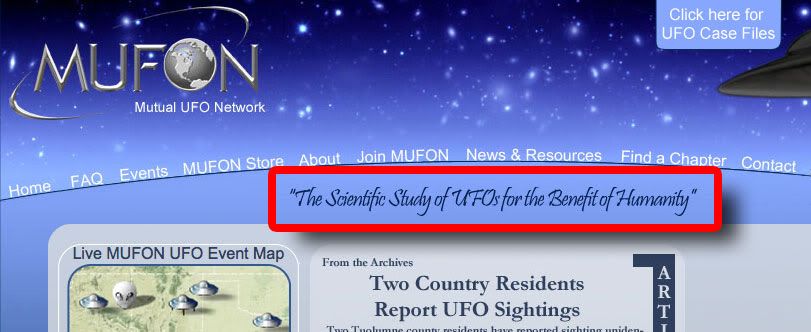
You mean this same MUFON who's tag line i've highlighted with a red keyline...

MUFON.jpg


Get yourself to hospital and get that bullet wound in your foot sorted. :)

Ufology is a field of study not a science, but it can and does use the findings of science in its exploration of the topic. That in no way makes ufology pseudoscience.
That depends entirely how it's scientific findings are applied to it's conclusions.
I've had all this over a decade ago with people researching crop circles calling themselves cereologists in an attempt to legitimise their pseudo-scientific practices in order to claim that aliens made crop circles.
Of course there have been real scientists involved and some of the science has been done kind of properly, but then the results have been misapplied, misrepresented and misinterpreted in order to cling to the cereologists PoV.

To close this post, I will acknowledge that your concerns regarding the improper application of critical thinking with respect to the data are perfectly valid ... there is genuine ufology ( which is what I do and advocate ).
In this respect, I consider myself to be a UFOlogist, though I know from experience that UFOlogists would describe me as a debunker (usually using the term as if it's a bad thing when in fact it's not derogatory at all).
 
Your extreme misunderstanding of the No True Scotsman fallacy and your dishonest attempt to redefine it by use of nonsensical comparisons is noted.


GeeMack ... I just noticed you are pretty good at taking notes, and your style is really quite ... something ... have you considered applying for the job of Court Reporter on the Raj Rajaratnam trial. If not, do your country a favor and get in there ... ya ... Thanks GeeMack ...

j.r.
 
You mean this same MUFON who's tag line i've highlighted with a red keyline...

MUFON.jpg


Get yourself to hospital and get that bullet wound in your foot sorted.:)the term as if it's a bad thing when in fact it's not derogatory at all).

ooooh ... slammed ... Good one! ( Count on MUFON to make things harder than they need to be ).

As damaging as the MUFON motto looks, it does no more than advocate the scientific study of UFOs. Anybody can do that, so could I. In fact I do. But nowhere does it say ufology is a science unto itself. And if you look at the FAQ section where it says: What is ufology? I don't think you'll find that it calls ufology a science there either ... at least I don't think so, now I'm beginning to doubt myself ... that last one was right up front ... and I handed it right to you! wham ... lol.

j.r.
 
Non-scientific ( in the strictest sense ) pursuits can be taken seriously. Philosophy for example. There is also a whole spectrum of sciences that calls itself science that doesn't completely fit with the strictest definitions involving empirical evidence ( for example radio astrononomy ), for which "direct observation" isn't really possible.


This is wrong. Radio astronomy is the science of astronomy.

The fact that they use special equipment to make their observations along a different wavelength of the electromagnetic spectrum in no way diminishes the validity of their science.

Even with regular optical astronomy we are dealing with remote data, in some cases what is being observed doesn't even actually exist anymore ( the distance/light travel time issue ). Geologists do the same thing with seismographs. We don't get to "directly observe" the Earth's core or atomic nuclei. We merely extrapolate their existence.


Over the millennia, we resourceful humans have developed countless sophisticated tools and techniques to extend our powers of perception, measurement, and manipulation of the world around us. The fact that we use tools in no way diminishes our ability to conduct scientific study.

That "direct observation" argument is so weird, I can't even imagine where in the world you ever came up with that idea. If that were the case, modern physics, chemistry, biology, medicine, astronomy, oceanography, and a huge number of other sciences would be rendered invalid because they use instrumentation to make observations.

I think you really need to learn the definition and practice of science, before you can even begin to determine what constitutes a pseudoscience.


Then we could say that although ufology itself isn't a "science", it offers genuine scientific data.


This is totally confused.

If you're using the trappings of science (such as collecting data, performing analyses, forming conclusions, etc.) but you don't follow proper scientific procedures (like observing strict standards for evidence and hypotheses, vetting your findings through a critical peer review process, verifying results by replicating experiments, etc.) then you're engaging in pseudoscience, regardless what specific claims your organization may make or not make about its work.

If you're publishing information and making authoritative claims based on the study of real world evidence, and you fail to use proper scientific procedures, then what you're doing is pseudoscience. It's as simple as that.


In the mean time I think that critical thinking adds just as much credibility as science.


So you admit that this is all about applying a veneer of credibility to your admittedly unscientific methods of research?

Engaging in that kind of deception is not only pseudo-scientific, it's also highly dishonest.


The bottom line is that we make a genuine honest effort not to decieve ourselves or others.


Good intentions do not ward off bad practices, and bad practices yield deceptive results. If you're really as honest as you're letting on, you need to learn the proper way to do research and conduct your business accordingly. Otherwise, it would be quite dishonest to stick the words "critical thinking" into your mission statement without the slightest understanding of what it entails.


For example a large portion of ufology is the history of ufology, which includes the contactee and abduction phenomena plus a whole array of social, political, arts and entertainment related topics. These things are what add the ice-cream topping to ufology, they make it fun. From the Far Side and Futurama to X-Files and the MIB, ufology has at it's core a genuine mystery, but if we were to discard the rest, I think we'd be losing something valuable from a humanities perspective.


I'm also a big fan of all those same comics, movies and TV shows, but remember that forgoing scientific procedure and critical analysis in favor of appealing to pop culture is going to throw up a bunch of big red flags that you're engaged in pseudoscience.

 
Last edited:
Edited by LashL: 
Edited. Do not make sockpuppet allegations in-thread. Doing so is considered a breach of Rule 12.
 
Last edited by a moderator:
Concerning unidentified objects
(...)
Is ufology a pseudo-science?
Ufology is a perfectly justified science, when it is an effort to identify flying objects which have been observed by someone somewhere, but not publicly identified by anyone in the society.

The most active ufologists must be military radar centers, which try to identify everything what flies in domestic or foreign airspace. And astronomers, who try to identify everything what moves, hmm "flies", in the distant outer space.

A less scientific combination is the amateur layman who observes a flying object somewhere, and starts wildly guessing what it might be, without having the (often secret) information possessed by the military radar centers, or the space observation information possessed by astronomers.
 
The most active ufologists must be military radar centers, which try to identify everything what flies in domestic or foreign airspace. And astronomers, who try to identify everything what moves, hmm "flies", in the distant outer space.


Aren't those people more commonly known as "air traffic controllers" and "military radar operators"?

A less scientific combination is the amateur layman who observes a flying object somewhere, and starts wildly guessing what it might be, without having the (often secret) information possessed by the military radar centers, or the space observation information possessed by astronomers.


I'd call that person a "layman who's curious about something he saw in the sky."

I'm pretty sure most people would agree that a "ufologist" is somebody who makes a career (whether amateur or professional) out of promoting UFO stories and postulating theories about their origin and characteristics.

The fact that these theories are generally not based on material evidence, they're unfalsifiable and therefore unscientific, and that's what makes ufology a pseudoscience.
 
Non-scientific ( in the strictest sense ) pursuits can be taken seriously. Philosophy for example. There is also a whole spectrum of sciences that calls itself science that doesn't completely fit with the strictest definitions involving empirical evidence ( for example radio astrononomy ), for which "direct observation" isn't really possible. Even with regular optical astronomy we are dealing with remote data, in some cases what is being observed doesn't even actually exist anymore ( the distance/light travel time issue ). Geologists do the same thing with seismographs. We don't get to "directly observe" the Earth's core or atomic nuclei. We merely extrapolate their existence.

On the question of, "should scientific principles not be applied?" I would say that the more we can apply scientific principles the better off we are, but if we are going to do that, it should be done by real scientists who know how to do it properly. Then we could say that although ufology itself isn't a "science", it offers genuine scientific data. In the mean time I think that critical thinking adds just as much credibility as science. Remember science also has it's credibility issues. The bottom line is that we make a genuine honest effort not to decieve ourselves or others.

Lastly, the reason ufology isn't well suited to be a science in and of itself is that it isn't limited to the contexts required by rigorous scientific testing. For example a large portion of ufology is the history of ufology, which includes the contactee and abduction phenomena plus a whole array of social, political, arts and entertainment related topics. These things are what add the ice-cream topping to ufology, they make it fun. From the Far Side and Futurama to X-Files and the MIB, ufology has at it's core a genuine mystery, but if we were to discard the rest, I think we'd be losing something valuable from a humanities perspective.

j.r.

How did you determine that?
 
I've reviewed quite a few of Rramjets posts and haven't found anything to pick on him about. The links to the stuies are no longer valid, so I can't comment on the specifics. Here is something I would be tempted to class as pseudoscience if I were predisposed to slapping labels on entire groups:

Homeopathy: http://www.homeopathicdirectory.com/

Code of Ethics ... theory and practice, and supporting other homeopaths in that goal. Promote the art and science of homeopathy through appropriate research. If conducting homeopathic research, give substances used in provings.

Above we have the claim being made that homeopathy is a science. Now we can ask the question, "But does it have supporting evidence and plausibility that can be reliably tested, and does it have scientific status?" Let's look at what Wikipedia says:

"Depending on the dilution, homeopathic remedies may not contain any pharmacologically active molecules, and for such remedies to have pharmacological effect would violate fundamental principles of science. Modern homeopaths have proposed that water has a memory that allows homeopathic preparations to work without any of the original substance; however, there are no verified observations nor scientifically plausible physical mechanisms for such a phenomenon. The lack of convincing scientific evidence to support homeopathy's efficacy and its use of remedies lacking active ingredients have caused homeopathy to be described as pseudoscience and quackery."

If we are to accept that there is any valid use for the word "pseudoscience", homeopathy would seem to be a good example.

j.r.

http://www.youtube.com/watch?v=HMGIbOGu8q0

Looks like a dodge to me.

Homeopathy isn't the topic here.
 
The "ology" in ufology just means "the study of". It is true that there are definitions of "ologies" that define anything with an "ology" to be associated with the sciences. But I think that such definitions are too broad. It can be better understood as a combining form used in the names of sciences or bodies of knowledge, e.g. theology ( as in the Wikipedia article).

Note: This is probably the best point I have seen yet that ufology assumes itself to be science, and I'm not even personally comfortable with the naming, but I didn't pick the name either. I traced it back to the Oxford Dictionary ( which BTW also doesn't call it a science ).

j.r.


You don't have to answer this question, of course, but why then did you choose your screenname to be ufology if you're uncomfortable with the term?
 
This is wrong. Radio astronomy is the science of astronomy.

The fact that they use special equipment to make their observations along a different wavelength of the electromagnetic spectrum in no way diminishes the validity of their science.


Over the millennia, we resourceful humans have developed countless sophisticated tools and techniques to extend our powers of perception, measurement, and manipulation of the world around us. The fact that we use tools in no way diminishes our ability to conduct scientific study.

That "direct observation" argument is so weird, I can't even imagine where in the world you ever came up with that idea. If that were the case, modern physics, chemistry, biology, medicine, astronomy, oceanography, and a huge number of other sciences would be rendered invalid because they use instrumentation to make observations.

I think you really need to learn the definition and practice of science, before you can even begin to determine what constitutes a pseudoscience.


This is totally confused.

If you're using the trappings of science (such as collecting data, performing analyses, forming conclusions, etc.) but you don't follow proper scientific procedures (like observing strict standards for evidence and hypotheses, vetting your findings through a critical peer review process, verifying results by replicating experiments, etc.) then you're engaging in pseudoscience, regardless what specific claims your organization may make or not make about its work.

If you're publishing information and making authoritative claims based on the study of real world evidence, and you fail to use proper scientific procedures, then what you're doing is pseudoscience. It's as simple as that.


So you admit that this is all about applying a veneer of credibility to your admittedly unscientific methods of research?

Engaging in that kind of deception is not only pseudo-scientific, it's also highly dishonest.


Good intentions do not ward off bad practices, and bad practices yield deceptive results. If you're really as honest as you're letting on, you need to learn the proper way to do research and conduct your business accordingly. Otherwise, it would be quite dishonest to stick the words "critical thinking" into your mission statement without the slightest understanding of what it entails.


I'm also a big fan of all those same comics, movies and TV shows, but remember that forgoing scientific procedure and critical analysis in favor of appealing to pop culture is going to throw up a bunch of big red flags that you're engaged in pseudoscience.

It sounds a lot like the creationists "were you there" argument against evolution.
 
You don't have to answer this question, of course, but why then did you choose your screenname to be ufology if you're uncomfortable with the term?

Ditto. I mentioned that above. Why not, "UFOphile" or "UFOphilia". I often refer to myself as a Sinophile to indicate my interest and fondness for many things about China. I'd never refer to my pastime as Sinology, though. That has a whole different connotation, one that I think the Ufologists like.
 
You don't have to answer this question, of course, but why then did you choose your screenname to be ufology if you're uncomfortable with the term?


It's become an established word in use for half a century now. So as much as I'm not really comfortable with the way it came into use and evolved, it's the best we have, it isn't practical to change it, and there is a future to improve upon.

j.r.

PS: It was also available and fit the bill.
 
It's become an established word in use for half a century now. So as much as I'm not really comfortable with the way it came into use and evolved, it's the best we have, it isn't practical to change it, and there is a future to improve upon.

j.r.

PS: It was also available and fit the bill.


Okay, thanks! :)
 

Back
Top Bottom