
• Quick note - the problem with Youtube videos not embedding on the forum appears to have been fixed, thanks to ZiprHead. If you do still see problems let me know.

Merged Discussion of femr's video data analysis

You don't honestly expect me to answer your questions, when your two choices when posed questions yourself is to either ignore them, or belittle the person answering them, do you?

But what the heck. I'll be the bigger man:

1) Who knows. Maybe because they observed inward bowing?
2) As I've made clear, I'm no engineer - but wiki defines it (yea, yea) several different ways.
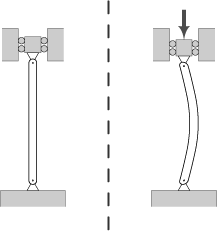
Buckled_column.png


That is buckling.
Edited by Tricky: 
Oversized image replaced with link.


A demonstration model illustrating the different "Euler" buckling modes. The model shows how the boundary conditions affect the critical load of a slender column. Notice that each of the columns are identical, apart from the boundary conditions.

I'm sure I'll be lambasted for using that as a source, but if you can find a better, more layperson oriented site I'll be happy to go there. And NO - you and MT are not that source. You dance around and go out of your way to try to confuse a layperson like me, and quite frankly it doesn't work, to the point of it being funny.

Bowing vs. Buckling:
I've spent a good deal of time trying to find a site that'll make some distinction. I can't find one. From what I know about "bowing" - it looks like, well, a bow. Which is precisely what the buckling examples above show. So yes, they can be the same thing as far as I know.

Not sure why they make a distinction, you'll have to take that up with them. I do know that in other aspects of just about everything you'll find multiple ways of saying the same thing. Welcome to the English language. Why this can't be one of those instances is beyond me.
 
Last edited by a moderator:
I have zero engineering experience beyond my ability to spell the word, and I can see that both the walls and columns buckled as plain as day.
See here.

Question you could ask yourself are...

Why does NIST use the phrase inward bowing ?

Where does bowing turn into buckling ?

Same thing ? Then why make the distinction ?
Inward bowing is a particular form of buckling. Hence inward bowing didn't "turn into" buckling; it was buckling from the instant it began.

And so, for several pages now, femr2 has been attempting to criticize NIST for choosing words with more specificity and precision than femr2 has been able to comprehend or to appreciate.

femr2's incomprehension has been evident since page 47 of this thread:
As an example of the previous paragraph... You have not offered any alternative explanation of motion, other than a notion regarding "amplification" of smaller-magnitude movements by an unspecified mechanism. Nor have you provided error analysis by which to assess the statistical likelihood that the data in these traces indicates any actual motion at all. So I have concluded that column buckling is the best available explanation, pending a better one.

...snip...

Answering these call-out posts of yours is wasting my time. Do you have any new points or any conclusions to discuss?

This discussion is exhibiting a rapid decay of coherence. I suggest you make an effort to regroup upon some sort of point.
450 posts later, we're still waiting for femr2 to formulate some sort of point.
 
Inward bowing is a particular form of buckling. Hence inward bowing didn't "turn into" buckling; it was buckling from the instant it began.
So why did NIST change terms from inward bowing to buckling inward ?

Where do you think their cross-over point was ?

Seems to me it was at the point that the bolts failed, and each pair of columns sprang-back.

They even go so far as to say...
With continuously increased bowing, the entire width of the east wall buckled inward.

Bowed inward, then buckled inward. Hmm. Wonder what they mean by buckling there...

Would you have a problem with bowed/buckled inward, then column splices failed and columns sprung back from inward bowing ? ;)

And so, for several pages now, femr2 has been attempting to criticize NIST for choosing words with more specificity and precision than femr2 has been able to comprehend or to appreciate.
ROFL. Nope. Trying to ensure that everyone is clear on the initiation behaviour, namely separation of upper and lower WTC2 east face along the staggered line highlighted many-many times.

You okay with that behaviour ?

(Which reminds me, must sort out that summary for you ;) )
 
Last edited:
Bowing is a form of bucking that, among other characteristics, lacks fracture of the displaced members. Once fracture began, the buckling was no longer bowing, but it continued to be buckling.

Respectfully,
Myriad
 
Bowing is a form of bucking that, among other characteristics, lacks fracture of the displaced members. Once fracture began, the buckling was no longer bowing, but it continued to be buckling.

Respectfully,
Myriad
The bolts fractured. The individual panel columns sprang back. What was buckling ?

NIST have the buckling continnuing long after the bolts fracture and tilt is well under way.


I'm aware that this to-and-fro is still bouncing around, but...


The context of NISTs summaries and texts really does suggest inward bowing -> fracture -> inward buckling...with the assumption that the panels (both top and bottom) folded inwards akin to the 3-point buckle diagrams kicking around.

One contributer to the report clearly recognised some of the actual behaviour by stating ...
Column splices failed at every third panel and columns sprung back from inward bowing
...but in my opinion (everyone else at) NIST missed the spring-back behaviour.

They may not have thought it important, who knows. Such things are not my concern. You have to look at specific pieces of video footage in zoomed detail to actually see the full behaviour, and cross-reference it with other pieces of footage to know that the staggered pattern emerges intact from the dust. NIST are not required to know about this behaviour.

I have repeatedly restated that...as long as everyone is fully aware...etc...yet folk keep coming back to defending what NIST said.

NIST say lots of things, and some of it contradicts what they say somewhere else, and some of it is phrased badly, and some of it is inaccurate.

After fracture of the bolts (and so at the beginning of spring-back), what was buckling ? (And in what direction ?)

I'd suggest primarily in-plane...
120520176.png
 
Last edited:
But what the heck. I'll be the bigger man:

1) Who knows. Maybe because they observed inward bowing?
2) As I've made clear, I'm no engineer - but wiki defines it (yea, yea) several different ways.

[qimg]http://upload.wikimedia.org/wikipedia/commons/5/54/Buckled_column.png[/qimg]

That is buckling.
That is, indeed, one particular form of buckling.

I'M the layperson.
Don't sell yourself short. As you have demonstrated by your posts in these last several pages, your technical sophistication exceeds femr2's.

Bowing and Buckling are the same thing.
No, they aren't. Bowing is a particular form of buckling. Almost all bowing is buckling, but not all buckling is bowing. It must be said, however, that your belief that bowing and buckling are the same thing is more correct than femr2's belief that they are entirely separate things.

Here is a technically correct statement of their relationship:
Bowing is a form of bucking that, among other characteristics, lacks fracture of the displaced members. Once fracture began, the buckling was no longer bowing, but it continued to be buckling.
 
So why did NIST change terms from inward bowing to buckling inward ?

Where do you think their cross-over point was ?

Seems to me it was at the point that the bolts failed, and each pair of columns sprang-back.

They even go so far as to say...
With continuously increased bowing, the entire width of the east wall buckled inward.

Bowed inward, then buckled inward. Hmm. Wonder what they mean by buckling there...

Would you have a problem with bowed/buckled inward, then column splices failed and columns sprung back from inward bowing ? ;)


ROFL. Nope. Trying to ensure that everyone is clear on the initiation behaviour, namely separation of upper and lower WTC2 east face along the staggered line highlighted many-many times.

You okay with that behaviour ?

(Which reminds me, must sort out that summary for you ;) )

And how does any of this move away from debate about the finer points of engineering terminology and into 9/11 CT?

Does the precise nature of the inward bowing/buckling (and where one might become the other) have any bearing on - say - whether WTC2 was subjected to stresses that went beyond the natural consequences of aircraft impact and the fires that ensued?

femr2 - I no longer have any idea why you're posting in this sub-forum, unless it's to prove that you're more rigorous in your analysis than NIST. That would not be an unworthy objective, but has no place in a CT discussion per se.

It's a very long time since you mentioned any 9/11 CT stuff. I'll echo what almost everybody else has said - poop or get off the pot. What the hell is your point ??
 
Last edited:
Does the precise nature of the inward bowing/buckling (and where one might become the other) have any bearing on - say - whether WTC2 was subjected to stresses that went beyond the natural consequences of aircraft impact and the fires that ensued?
Precision is important, of course.

Do you agree that NIST suggest a sequence comprising inward bowing -> buckling ?

If so, and the latter buckling occurs after fracture of the bolts, what is buckling ?
 
So why then is their exclusion of this "observable" or that "observable" so damn important to you?
Their exclusion isn't that important (though of course core-led versus perimeter-led is a different story), but accuracy and understanding of the actual behaviour is.
 
Last edited:
Precision is important, of course.

Do you agree that NIST suggest a sequence comprising inward bowing -> buckling ?

If so, and the latter buckling occurs after fracture of the bolts, what is buckling ?

http://www.nist.gov/public_affairs/contact.cfm


Literally ALL of your answers to why NIST said this or did that are available right there. You'll let us know the results of your queries?
 
Their exclusion isn't that important (though of course core-led versus perimeter-led is a different story), but accuracy and understanding of the actual behaviour is.

As has been stated numerous times, their accuracy and understanding of the behavior is not up to YOUR standards. This is only because you feel the need to whine about something, and the Kennedy assassination was already taken.

Their findings however, are more than adequate for 99.99 percent of the world's population that finds themselves caring about such things. People such as actual architects, actual engineers, and actual designers. Their findings were ALREADY used in part to design and build steel framed structures that DID NOT collapse due to fire.

Let me say that again.

Engineers and designers who were tasked to build (specifically) the Mandarin Oriental hotel used information gleaned from the NIST REPORT. Not from "[Merged] Discussion of femr's video data analysis".

I'm sorry it burns you so much. I suggest a less stressful hobby. Gardening for instance. Origami.

Perhaps you could build a scale model of the trade center using leggos.

OR

Maybe you can start another discussion about the collapse of the Pentagon.
 
So why did NIST change terms from inward bowing to buckling inward ?

Where do you think their cross-over point was ?

Seems to me it was at the point that the bolts failed, and each pair of columns sprang-back.
They even go so far as to say...
With continuously increased bowing, the entire width of the east wall buckled inward.

Bowed inward, then buckled inward. Hmm. Wonder what they mean by buckling there...

Seems to me that the bolded section is where you're getting confused. You've arbitrarily decided that the fracture of the bolts is where the NIST decided to change their wording from bowing to buckling. I would suggest they were still talking about the walls and columns before they broke up.

With continuously increased bowing, the entire width of the east wall buckled inward.

My interpretation of this is that as the columns bowed the small section of bowed columns in the wall produced the effect of a local buckle in the wall (i.e you can regard the entire building as a column with a small buckled section in it, as illustrated in post 7333358).
 
Seems to me that the bolded section is where you're getting confused.
What NIST is trying to say is far from clear, sure.

There shouldn't really be any lack of clarity for the NIST proposed initiating process, should there.

If there's detail that should be clear, the trigger event which they suggest initiates collapse should be clearly stated

You've arbitrarily decided that the fracture of the bolts is where the NIST decided to change their wording from bowing to buckling. I would suggest they were still talking about the walls and columns before they broke up.
And both interpretations could be wrong. Consider...
With continuously increased bowing, the entire width of the east wall buckled inward. The section of the building above the impact zone tilted to the east and south as instability progressed horizontally to the adjacent north and south walls.

Bowing increases -> East wall buckles inward -> tilt increase AS inward buckling progresses.

Another interpretation ?

you can regard the entire building as a column
No thanks. That would be silly.

As I've said, as long as everyone is fully aware that the columns making up each perimeter panel of WTC2 East face were separated by failure of the bolts holding upper and lower panels together, resulting in a staggered break-line across the width of the building, and the panel columns themselves sprang back from a state of bowing to their original straight form once the bolts had failed...it's all good.
 
Last edited:
What NIST is trying to say is far from clear, sure.

Then why was this report, so rife with error, used by actual engineers and designers to build a structure that survived a massive fire?

If it was that bad, surely these engineers who are at least in your ballpark as far as engineering prowess is concerned, would have just ignored NISTs findings, no?

Why did those people go with the NIST report, and not [Merged] FEMRs Useless Gif and JPEG party discussion thread at JREF?
 
There shouldn't really be any lack of clarity for the NIST proposed initiating process, should there.
It's interesting that you think so.

Why shouldn't that be, in your opinion?
 
Last edited:
And both interpretations could be wrong. Consider...

With continuously increased bowing, the entire width of the east wall buckled inward. The section of the building above the impact zone tilted to the east and south as instability progressed horizontally to the adjacent north and south walls.

Bowing increases -> East wall buckles inward -> tilt increase AS inward buckling progresses.

Another interpretation ?

It might be easier to understand if you don't substitute words as you read it, it seems fairly clear as originally written.
 
It might be easier to understand if you don't substitute words as you read it, it seems fairly clear as originally written.
You can have the slightly longer version if y'like...

Buckling of East Wall and Collapse Initiation. With continuously increased bowing and axial loads, the entire width of the east wall buckled inward (Fig. E–13). The instability started at the center of the wall and rapidly progressed horizontally toward the sides. As a result of the buckling of the east wall, the east wall significantly unloaded, redistributing its load to the softened core through the hat truss and to the east side of the south and north walls through the spandrels (see Fig. E–14). The section of tower above the buckled wall suddenly moved downward, and the building tilted toward the east (see Fig. E–15).

No mention of the staggered break line, nor spring-back.

Separation of bowing and buckling.

No mention of the fact that tilt began before *instability* and caused the late rapid increase in IB.

etc.

Or how about...

When the east wall reached instability and buckled, the northwest corner of the exterior wall lifted up about 2.0 in., which indicated that the tower was tilting toward the southeast around an axis passing through the southwest and the northeast corners (Fig. 4–87).

Instability followed by buckling. At what point do bolts fracture and panel columns spring back ? ;)

I have the same videos NIST did, yet I can highlight behavious NIST didn't see/didn't bother to look at/chose not to detail/...

(Anyone noticed the cut-and-paste nature of texts between WTC1 and WTC2 ? Even though there is no footage of the South side of WTC1 initiation. Quite an assumption that it would be exactly the same as WTC2 :eye-poppi)

By the way, why is this spring-back behaviour important ?

It provides a mechanism by which the upper perimeter (and so eastern upper block) can pass inside the lower eastern block rapidly, to instigate ROOSD and subsequent perimeter peeling.
 
Last edited:
A number of posts moved to AAH for bickering. Some may have contained relevant material, but I'm not going to bother editing them. If you have points to make, then do so without sniping, off-topic posts and personal attacks.
Replying to this modbox in thread will be off topic  Posted By: Tricky
 

Back
Top Bottom