• Quick note - the problem with Youtube videos not embedding on the forum appears to have been fixed, thanks to ZiprHead. If you do still see problems let me know.

Merged Discussion of femr's video data analysis

All observables for WTC2 indicate tha the east side of the core dropped out of the building and that there wasn't long truss sagging pulling in the east perimeter to the point of failure as the NIST claimed.

Wow! More new information! Having no memory retention capacity makes everything seem new... Was the topic of one of the threads that were removed.
 
FOCUS ON COLLAPSE INITIATION


No kidding. Remind me why this is in a conspiracy subforum again?

All of your graphs and technobabble hasn't swayed anybody from what they thought before the first tower even hit the ground.


Quote:
It was an elastic bend to the point of breaking along a specific set of bolt seams.

Is this elastic bend possible via aircraft impacts and fire, or just by explosives? How does an elastic bend happen?
 
Failure at the splices is self-evident as the splices could not develop the full capacity of the member. I recall saying such in my many head-beat-on-wall-discussions with Heiwa and Tony Szamboti that this would occur.

The picture is from BZ and it is a limiting case scenario where the connections are infinitely strong. Bazant acknowledges it as such:
I think he is trying to convince us that when a column fails at a notch (weak point, to non-technical types) due to axial loading, it's not really buckling in the theoretical sense. All the deformation will be in and about the notch. So what?
No engineer I know of will disagree that the notch is the most likely point of failure, nor that the notch actually contributes to the asymmetrical loading of the section which results in the failure.
It is STILL a buckling failure.
 
Yeah, apparently it's only buckling if a plastically bent obviously U-shaped or S-shaped piece of metal is generated. And as long as a member looks pretty much straight on video, it is free from plastic deformation. And if the connections did fail during purely elastic buckling it wouldn't count as buckling. And such non-buckling with an absence of obvious U-shaped or S-shaped plastic bends points to a cause of failure other than overloading and applied eccentric forces.

Normally it doesn't take so many wrong premises just to reach one wrong conclusion.

Respectfully,
Myriad
 
As long as everyone is fully aware of the fact that the break along the East face of WTC2 occurred along the bolt seams, resulting in the break following the pattern highlighted in purple...
WTC2_IZ_model2.jpg

...it's all good.

Anyone who has read recent posts (or the MT threads removed from this sub-forum) and didn't know that, now does ;)
 
All of this information is new. All basically ignored.

Someone who constantly and purposefully ignores simple questions has no right to piss and moan about being ignored himself.
=======================


I FOCUS ON COLLAPSE INITIATION


No kidding. Remind me why this is in a conspiracy subforum again?
All of your graphs and technobabble hasn't swayed anybody from what they thought before the first tower even hit the ground.


Quote:
Quote:
It was an elastic bend to the point of breaking along a specific set of bolt seams.


Is this elastic bend possible via aircraft impacts and fire, or just by explosives? How does an elastic bend happen?
 
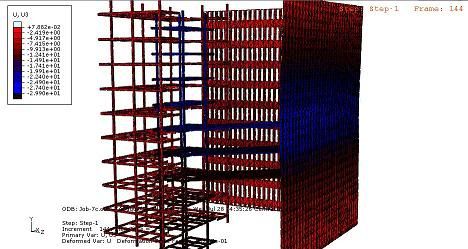
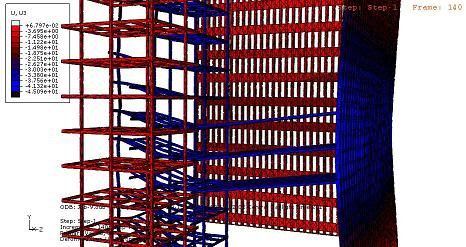
This is an example of core failure mechanism that pulls in the perimeter wall similar to what femr has shown.

tower_002a.jpg


tower_004a.jpg


It shows that in general there are ways to create IB by partial core failure rather than with long truss sagging as the NIST claims.

There are a number of observable features that are consistent with a core-led initiation mechanism for WTC1 and 2. I had shown them in the threads that were removed.
All observables for WTC2 indicate tha the east side of the core dropped out of the building and that there wasn't long truss sagging pulling in the east perimeter to the point of failure as the NIST claimed.

Wow! More new information! Having no memory retention capacity makes everything seem new... Was the topic of one of the threads that were removed.

So the core columns pulled in the perimeter columns.
For WTC1
a2 +b2 =c2Solving for a (vertical drop of core columns) where b (horizontal distance from core to bowed perimeter = 55.4 feet for 55" IIRC inward bowing over 20 or so minutes ) and where c (hypotenuse, the length of the trusses = 60 feet) , a then (the core columns drop ) = 23 feet.

The core columns, at the south side of WTC1 had to drop 23 feet in order to cause a gradual 55" inward bow of the perimeter columns.
Where's the "observable" of THAT.
 
Last edited:
So the core columns pulled in the perimeter columns.
For WTC1
a2 +b2 =c2Solving for a (vertical drop of core columns) where b (horizontal distance from core to bowed perimeter = 55.4 feet for 55" IIRC inward bowing over 20 or so minutes ) and where c (hypotenuse, the length of the trusses = 60 feet) , a then (the core columns drop ) = 23 feet.

The core columns, at the south side of WTC1 had to drop 23 feet in order to cause a gradual 55" inward bow of the perimeter columns.
Where's the "observable" of THAT.

Your math is correct, however there's a somewhat more complicated explanation that doesn't require a 23 foot drop. There were shorter span beams between the core columns. These beams can rotate and go into tension to hold up the severed core column. This tension then goes to the diaphragm and then to the outer walls.
 
Your math is correct, however there's a somewhat more complicated explanation that doesn't require a 23 foot drop. There were shorter span beams between the core columns. These beams can rotate and go into tension to hold up the severed core column. This tension then goes to the diaphragm and then to the outer walls.

I understand that members in compression can be supported by tension forces but how does this change the 23' drop.

ETA: True, the shorter beams could rotate in an arc, adding to the horizontal displacement, but at a very small angle and small vertical drop these connections would shear and the columns would collapse, unsupported.
We're talking here about something that didn't happen.
In16695.jpg
 
Last edited:
If you include a stationary pivot the IB geometry is calculated differently.

180678443.gif


south_wall_pul_lin.gif


DIfferent variations of pivots can lead to an IB of about 4 ft with only about 8 ft sagging of the 100 row columns. That would be the maximum IB seen on WTC1. WTC2 had much less IB until the initiation sequence.
 
Last edited:
If you include a stationary pivot the IB geometry is calculated differently.

180678443.gif


south_wall_pul_lin.gif


DIfferent variations of pivots can lead to an IB of about 4 ft with only about 8 ft sagging of the 100 row columns. That would be the maximum IB seen on WTC1. WTC2 had much less IB until the initiation sequence.

So you propose the vertical displacement of 8 feet for a column row, all the way to the hat truss without the same drop of the antenna and without shearing the adjacent support beams, and this seems reasonable to you, but not the sagging of the trusses.

Also I don't understand your math.
 
Last edited:
So you propose the vertical displacement of 8 feet for a column row, all the way to the hat truss without the same drop of the antenna and without shearing the adjacent support beams, and this seems reasonable to you, but not the sagging of the trusses.

Also I don't understand your math.

THese graphics show that there are at least 2 general ways to view inward bowing:

1) As a pulling in from sagging long span trusses (NIST)
2) As a downward displacement of the 1000 row core columns or others.

In the case of WTC2 we can see a part of the perimeter across from the 1000 row core columns on the north face pulling inward along with the IB during the earliest moments of the visible collapse initiation sequence:

cazz47pull.gif


It would seem pretty absurd to suggest that the famous sagging of long span trusses moved to the north face across the short truss span at that moment.

A dropping of the 1000 row columns would cause pulling in on both faces as witnessed.


Furthermore, even the NIST noticed the crimping of the roofline during the tilting and fall shown here

kinkoutrigger.gif


kink02b.jpg


Before the knee-jerk denial and insults please note that Uncle NIST saw the kinking also so this is a "peer reviewed" feature.

Dropped east side core matches all observables much better than sagging long span trusses like the NIST claims.

All included in the OP of the thread that was removed. Did anyone really read the contents???

 
Last edited:
Did anyone really read the contents???

Yes, and if requested to, we STILL CAN.

But..but..but...how's that possible if it were removed?


Is this elastic bend possible via aircraft impacts and fire, or just by explosives? How does an elastic bend happen?

Say it with me, Major_Tom:

I don't know.

Don't worry, you can still be smart and not have an answer for something. For instance, if I went to Harvard and approached the Dean, asking her if she knew how to get by Portal 2, level 12 - chances are she won't.

But she's still smart.
 
Why bother having a discussion if all you're doing is being 1 sided?

I've searched through the first 15 pages and have yet to see anything resembling a conspiracy, or been pointed in the direction of a conclusion (Fire or not)

I suspect when I go thru the rest of the thread, that will not change.
 
THese graphics show that there are at least 2 general ways to view inward bowing:

1) As a pulling in from sagging long span trusses (NIST)
2) As a downward displacement of the 1000 row core columns or others.

In the case of WTC2 we can see a part of the perimeter across from the 1000 row core columns on the north face pulling inward along with the IB during the earliest moments of the visible collapse initiation sequence:

[qimg]http://img850.imageshack.us/img850/9506/cazz47pull.gif[/qimg]


It would seem pretty absurd to suggest that the famous sagging of long span trusses moved to the north face across the short truss span at that moment.

A dropping of the 1000 row columns would cause pulling in on both faces as witnessed.


Furthermore, even the NIST noticed the crimping of the roofline during the tilting and fall shown here

[qimg]http://img690.imageshack.us/img690/2047/kinkoutrigger.gif[/qimg]

[qimg]http://img218.imageshack.us/img218/8224/kink02b.jpg[/qimg]

Before the knee-jerk denial and insults please note that Uncle NIST saw the kinking also so this is a "peer reviewed" feature.

Dropped east side core matches all observables much better than sagging long span trusses like the NIST claims.

All included in the OP of the thread that was removed. Did anyone really read the contents???
This does not address the question that was asked.


So you propose the vertical displacement of 8 feet for a column row, all the way to the hat truss without the same drop of the antenna and without shearing the adjacent support beams, and this seems reasonable to you, but not the sagging of the trusses.

Also I don't understand your math.

Is this why you don't want to discuss your work in "science and math"?
 
So the core columns pulled in the perimeter columns.
For WTC1
a2 +b2 =c2Solving for a (vertical drop of core columns) where b (horizontal distance from core to bowed perimeter = 55.4 feet for 55" IIRC inward bowing over 20 or so minutes ) and where c (hypotenuse, the length of the trusses = 60 feet) , a then (the core columns drop ) = 23 feet.

The core columns, at the south side of WTC1 had to drop 23 feet in order to cause a gradual 55" inward bow of the perimeter columns.
Where's the "observable" of THAT.
Why do all parties - truther or debunker - discuss perimeter column "pull-in" as if it resulted from a single cause?

We see it in these recent posts doing the geometry for core collapse. Same thing for the alternate and NIST preferred view of floor joist sagging.

In either case those pushing that explanation consider only the single factor. Why the simplistic approach?

The perimeter bits which bow inwards are columns intended to be axially loaded AND carrying quite large loads.

If an axially loaded column is pulled out of line its load carrying capacity is drastically reduced.

So why not recognise two factors - floor sag OR core movement which causes the initial bend of the column THEN axial overload takes over and causes that inwards bend to continue to the full (whatever) 55"?

...so add "(non)axial force overload" into the considerations and I will leave the "core led" v"floor catenary sag led" sides of the discussion to decide which was the initiating factor.
 

Back
Top Bottom