• Quick note - the problem with Youtube videos not embedding on the forum appears to have been fixed, thanks to ZiprHead. If you do still see problems let me know.

Merged Discussion of femr's video data analysis

The most difficult barrier to communication on this subject is that so many regular posters are defending the NIST mechanisms while being ignorant of them.

If you took the time to learn what you are defending and comparing the NIST claims with observables, you would probably find why we have been telling you for a long time.

Ignorance of the theory you defend is the only thing keeping this balloon afloat.

Most people don't have to read thousands of pages in technical reports to understand that fire is a very destructive force. Even to steel.
 
Said with such sure conviction...yet simply parroted from the NIST report.

Easy to do when I have the corroboration of dozens of the world’s top structural engineers and exhaustive analysis vs. the incompetent opinion of a graphic artist.
Chafes don't it.

femr2
You have clearly not understood the geometry of the alternate IB mechanism suggested. Nor the geometry of the NIST proposed mechanism.
ROFL. Ironic. What a moon-bat crazy nut-job y'are ;)
femr2
Have you ever actually bothered to check how much the floor assembly would have to sag to cause the associated IB ? Clearly not. A few feet ? No. Over 8 feet. Behaviour all at the mercy of a few bolted and welded connections...
You can believe whatever you please.
 
Last edited:
Given that you lack the qualifications to make such statement, as I do, let me contend that point.
LOL. You can believe whatever you please. You lack the information to make such a statement.

Buckling is...
I'm aware of what buckling is, thanks :rolleyes:

The perimeter columns in the WTC 1 and 2 were highly non-uniform: they were made of assemblies bolted together.
LOL. So you are treating multiple separate columns bolted together as a single column ? Oh dear. A rather flimsy way to try and make a (non)point, don't you think ?

Regardless of whether the assemblies buckled or not, that doesn't mean the columns didn't buckle.
Dear me. The assemblies did not buckle. Instead the connection between one assembly and the one above broke along the bolted connections across the width of the building. The columns which make up each of those assemblies did not buckle.

They buckled, and developed at least three hinge points.
Show me. (aka prove it)

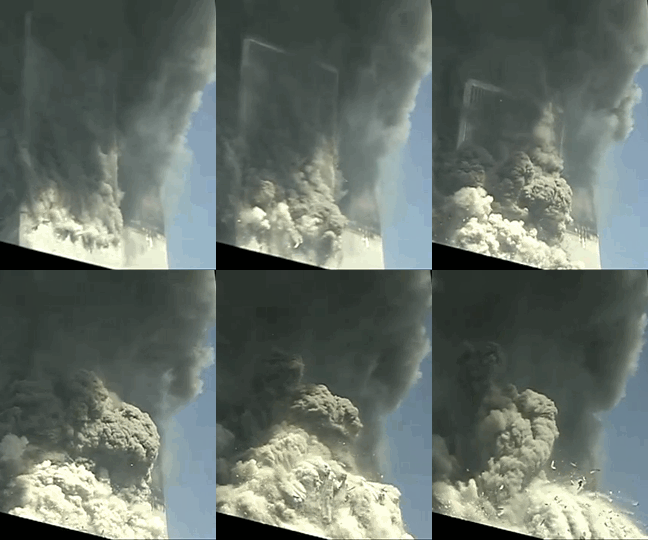
The visual evidence does not agree with you...
69989840.gif

lateperimeterpeel.gif


(I'll dig out some other views for you ;) )

Here's that upper edge shape (yes, I know it's on a South Face base image)...
bolt_line.jpg


There's a photo kicking around of the upper edge of that section (in two halves iirc) sticking out of the ground, showing no buckling, but instead a remarkably clean break along the bolt seams as indicated above.

You are probably already familiar with this graphic:

[qimg]http://www.formauri.es/personal/pgimeno/xfiles/cache/Bazant-Fig2.png[/qimg]
I am indeed.

Therefore, you have shown no contradiction in the NIST assertion that the perimeter columns buckled, even if the bolts snapped.

See above.
 
Last edited:
Show me. (aka prove it)

The visual evidence does not agree with you...
You proved it yourself:

786877858.gif


The whole point of disagreement is in whether the columns buckled even if the assemblies didn't. It's not flimsy, it's the whole point over whether NIST got it right or not. If you define "column" in a way different to that used by NIST, then you are cheating.

What part of the conclusions stated in chapters 8 and 9 of NIST's NCSTAR 1 would be affected if they referred to the assemblies and these assemblies actually didn't buckle?

Here is a map. Care to mark the X?

ncstar-1-chapters-8-9-collage.jpg
 
Last edited:
Here we go again
Cool Graphics.

I'm 100% convinced that fire took down the towers. I knew that before I even heard of NIST.

Having said that, what is it I should be looking for in those diagrams (or any of them you two have posted) that would change my mind? What is it about them that shows explosive controlled demolition?

Can femr or mt puhleeeze answer that so we can move on?
 
The whole point of disagreement is in whether the columns buckled even if the assemblies didn't.
The columns didn't buckle due to pull-in from the floor assemblies, instead the joint between separate perimeter assemblies broke along the bolt seams, leaving the columns unbuckled.

How much simpler can I make this for you ?

It's not flimsy, it's the whole point over whether NIST got it right or not. If you define "column" in a way different to that used by NIST, then you are cheating.
I define a column as a column. Two columns bolted together does not result in one column. It results in two columns bolted together.

If either of those columns which are bolted together buckle, then the appropriate column will have ...buckled...

If the bolted connection between those two separate columns breaks, then neither of those two columns has buckled. Similarly, if you undid the bolts with a wrench, you wouldn't be buckling the column now, would you.

Please stop this keep-the-faith NISTian-supporter nonsense.
 
Here we go again
Quote:
Cool Graphics.

I'm 100% convinced that fire took down the towers. I knew that before I even heard of NIST.

Having said that, what is it I should be looking for in those diagrams (or any of them you two have posted) that would change my mind? What is it about them that shows explosive controlled demolition?
Can femr or mt puhleeeze answer that so we can move on?
 
The columns didn't buckle due to pull-in from the floor assemblies, instead the joint between separate perimeter assemblies broke along the bolt seams, leaving the columns unbuckled.

How much simpler can I make this for you ?

You are 100 percent correct.

Does this prove collapse initiation by fire or explosives?
 
Here's that upper edge shape (yes, I know it's on a South Face base image)...
bolt_line.jpg


There's a photo kicking around of the upper edge of that section (in two halves iirc) sticking out of the ground, showing no buckling, but instead a remarkably clean break along the bolt seams as indicated above....
A statement for femr2 and a question - probably for Major_Tom.
I accept that femr2's scope for this discussion does not extend to the "big picture" question of whether there was MIHOP/CD assistance to impact and fire damage to ensure collapse.

Within that bigger picture this discussion is about the subset of events commonly termed "collapse initiation". And within "collapse initiation" the recent discussions have been about the phenomenon of "buckling".

Given that as my view of the context I note the diagram showing the failure line.

I am aware of Major_Tom's extensive forensic research in identifying where many of the panels of outer perimeter columns separated. That is commendable detailed research whether or not folks agree on its relevance or significance.

BUT - correct me if I am wrong - does this one diagram shows that the south face failed in the impact and fire zone and did so without column buckling?

If so that is a significant factor for my interpretation and understanding of the "initial collapse" and the transition to ROOSD.

Can you give me links to the supporting evidence at least to the evidence showing no buckling of those columns at that level in the tower?

Thanks.
 
What part of the conclusions stated in chapters 8 and 9 of NIST's NCSTAR 1 would be affected if they referred to the assemblies and these assemblies actually didn't buckle?

Here is a map. Care to mark the X?

[qimg]http://www.formauri.es/personal/pgimeno/xfiles/11-s/ncstar-1-chapters-8-9-collage.jpg[/qimg]
Bump. This was the cream of my message, actually, the one you ignored. Care to address it?

Or would it be too obvious that you're counting how many angels can dance on the head of a pin if you do?
 
BUT - correct me if I am wrong - does this one diagram shows that the south face failed in the impact and fire zone and did so without column buckling?

If so that is a significant factor for my interpretation and understanding of the "initial collapse" and the transition to ROOSD.

Thanks.

Could you elaborate on this before his reply? I'm not sure this design could buckle before connection failure.
 
correct me if I am wrong - does this one diagram shows that the south face failed in the impact and fire zone and did so without column buckling?
No, it's a depiction of the failure line on the East face of WTC2. The base image is of the South face, as I don't think MT had access to an unadorned facade diagram at the time the failure line outline was added.

Can you give me links to the supporting evidence at least to the evidence showing no buckling of those columns at that level in the tower?
The small GIF animations show it, but it's a little difficult to see I suppose. I'll dig out others, though you may want to read...
http://www.sharpprintinginc.com/911/index.php?module=pagemaster&PAGE_user_op=view_page&PAGE_id=121&MMN_position=282:282
 
Pgimeno, if you actually read the information in the introduction of each of those reports, it clearly states that the primary goal of the report is to describe the "how and why" of each of the collapses.
Bump for you, MT:

I have in past contended your and femr2's assertion that NIST's conclusions would change significantly if they got the initiation mechanisms wrong. NIST's conclusions are stated in chapter 8 (Principal Findings) and chapter 9 (Recommendations) of NCSTAR 1.
The relative importance you are assigning to the details of the collapse initiation sequence is your own. The part of their principal findings affected by your assessment, regardless of whether it's true or not, is this:

ncstar-1-chapters-8-9-collage-highlighted.jpg


Or maybe you want to dispute that map? Or where NIST's conclusions are written?

Even assuming you were right, it does not affect the immense majority of their conclusions. You are largely exaggerating the consequences of a possible mistake.


I am sure you will cling to your beliefs as you are still convinced the Bazant papers BV, BL and BLGB contain no major flaws.
None you have identified, certainly. You keep believing they are talking about the actual collapses and not an idealized mathematical model of them, which impedes you to notice the big mistake in your interpretation of the words in the papers.
 
Last edited:
No, it's a depiction of the failure line on the East face of WTC2. The base image is of the South face, as I don't think MT had access to an unadorned facade diagram at the time the failure line outline was added...
Thanks for the correction - I probably misread the earlier post. I do not retain a mental picture of the orientations of the towers and am not familiar with the New York layout - so I have to check against a map if ever I need it.

...The small GIF animations show it, but it's a little difficult to see I suppose. I'll dig out others, though you may want to read...
http://www.sharpprintinginc.com/911/index.php?module=pagemaster&PAGE_user_op=view_page&PAGE_id=121&MMN_position=282:282
Thanks. This is probably the first bit of detail I have seen for some time that has struck me as relevant to and affecting my own understanding of the events. Intriguing for understanding of initiation>>progression.
 
Last edited:
This is the map I prefer - I used it often on another forum.
upover4.jpg

...another version located where the US folk lived ..

...however it referred to them using Cockney rhyming slang that matches the word "Yanks" and could offend some who do not share the same sense of take the mickey humour.

I was born in Yorkshire - lived there till age 11 - the "phonetic spelling" for those who (wrongly) pronounce the English 'shire' names as if they rhyme with "tyre/tire".

PS for those who don't appreciate the "sanguine"* reference to our New Zealand brothers that "B" word is known as the "Great Australian Adjective". It is claimed with some validity that an Aussie cannot complete a sentence without using it. It is even authorised by some classic poetry. http://www.abc.net.au/overnights/stories/s1307296.htm

* It is an archaic usage of the word. )
 
Last edited:
What part of the conclusions stated in chapters 8 and 9 of NIST's NCSTAR 1 would be affected if they referred to the assemblies and these assemblies actually didn't buckle?

Here is a map. Care to mark the X?

Here's one...

[qimg]http://femr2.ucoz.com/_ph/9/423901023.png[/qimg]

:)

The X in that map points to a page about recommendations on improved active fire protection and improved building evacuation. Fail. Try again. Unless you are suggesting that these recommendations would be affected if the assemblies did not buckle.
 
Last edited:

Back
Top Bottom