Conservatives, under what conditions would you allow universal coverage?

Did you read my post 215? All your options above are comparing universal care versus not universal care. That isn't the part I care about. I am in favor of universal care. Somebody a ways back in this thread said something along the lines "The US could cover everyone and even save money doing it". I didn't question the "cover everyone" part, I questioned the "save money" part.

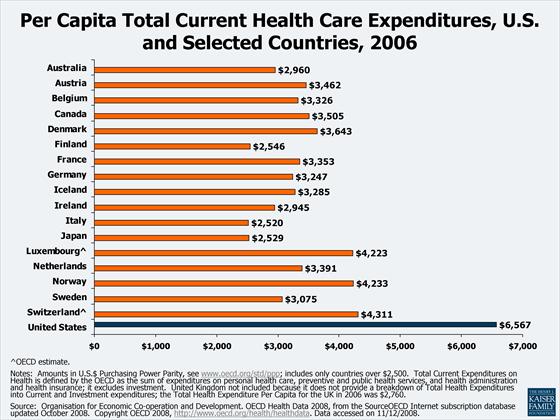
That follows necessarily from this:

health-care-per-capita-total-current-health-care-expenditures-us-and-selected-countries-2006.jpg


We pay more and don't cover everyone.

Some of the possible savings suggested are in the neighborhood of a trillion dollars a year. Claims that that can all be achieved by elimating waste need to be substantiated. That much money leaving a segment of the economy raises serious queston about whether quality or progress might sacrificed.

This would be a stronger argument if there weren't 20 different models for running a health care system that covers everyone and is cheaper than what we provide.

Hell, Medicare is cost-efficient compared to our private insurers and Medicare handles the highest risk patients in the country:

i1.jpg


As I believe I said in this thread last night, I am in favor of UHC and I'm willing to pay more taxes for it. I am not the least bit dubious about UHC, I'm dubious of UHC that will save money. And as I also said just a few posts back, I'd be dubious of private insurers coming up with a plan to eliminate a trillion dollars somehow.

I want UHC. I want everyone covered. I think the richest country on the planet should do it. We should do it even if it costs us more. If we can do it and save money that would be better but only if we do it without sacrificing quality and progress.

Again, there's absolutely no evidence to suggest any of this would happen. The examples you've brought up are funded independently of health coverage, and all available evidence suggests we pay too much in the US and achieve worse care.
 
We pay more and don't cover everyone.

That's correct. And we should cover everyone.

This would be a stronger argument if there weren't 20 different models for running a health care system that covers everyone and is cheaper than what we provide.

Why do you think that? In the first place, I already agreed a long time ago that there are cheaper models. Since they do actually exist there is no denying they exist. And we could adopt one of them.

But how does the fact that those models are in place somewhere translate to "removing a trillion dollars from the industry won't have any impact on quality or progress"? That just doesn't automatically follow.

The examples you've brought up are funded independently of health coverage, and all available evidence suggests we pay too much in the US and achieve worse care.

What examples are independent of health care coverage? What are you thinking? They can't possibly be independent. Do you mean they are not direct? Direct doesn't matter. Do you mean they aren't fully dependent (IOW they have other sources of income). That doesn't matter either.

Insurance companies pay hospitals, clinics, and doctors. They in turn purchase from medical providers (GE for MRI machines for example). Companies, such as GE, have research departments they fund out of their income. That's a dependency.
 
But how does the fact that those models are in place somewhere translate to "removing a trillion dollars from the industry won't have any impact on quality or progress"? That just doesn't automatically follow.

It doesn't follow from logic, but it does from practical experience. Stem cell research, for example, is exploding in countries that aren't our own. Germany has a universal model and manages to do a great deal of innovation and research.

Additionally, if you look at the source for costs differences between private insurance providers and single-payer systems, like Medicare, the gap is largely made up of adminstrative fees. That difference has nothing to do with research or quality, it simply has to do with delivering the services. If profit is considered on top of that, a huge chunk of that cost differential is completely unrelated to anything substantive, and that's before dealing with the specifics of the claim.


What examples are independent of health care coverage? What are you thinking? They can't possibly be independent. Do you mean they are not direct? Direct doesn't matter. Do you mean they aren't fully dependent (IOW they have other sources of income). That doesn't matter either.

Yes. Take pharmaceutical research. The majority of new drugs begin with NIH grants. The NIH decides where to allocate funds and they have absolutely nothing to do with health insurance. We could go to Medicare for all tomorrow or never and the NIH's grant giving responsibilities would be completely unaffected.

Insurance companies pay hospitals, clinics, and doctors. They in turn purchase from medical providers (GE for MRI machines for example). Companies, such as GE, have research departments they fund out of their income. That's a dependency.

Sure, but that's just how it works now. Medicare pays hospitals, clinics and doctors. We could increase or lower that amount or we could circumvent the system entirely and directly fund companies developing new equipment.

The point is that these types of decisions can be made independently of moving to UHC. If you concern is that a UHC model will overlook the way medical tech companies turn a profit and an unintended consequence will be a drop in innovation (which is a perfectly valid concern), then any potential bill will have to be written with that in mind.

Certainly if a system undergoes a dramatic change and little thought is paid to details, there will be a problem, but there's no reason UHC will lead to more or less research and tech investment. The question can be dealt with separately.
 
It does not rightfully belong to you until you have paid your utility bills. How many times need I remind you of that?


“Reminding”*me an infinite number of times will not endow this tired lie with even the faintest vestige of truth.

We are not talking about anything that any rational person would characterize as a “utility bill”.

And yes, the money that you earn belongs to you. All of it. Every last cent. That you may then have obligations that you subsequently must pay out of that money does not change this fact.

The companies that provide me with actual utilities do not get to get their hands in my paycheck before I receive it. Neither does the store that sells me my food and groceries, nor the gas station where I refuel my car. It's MY money until I spend it. Not yours. Not the grocery store's, not the gas station's, not the electric or gas or phone companies', nor the government's.
 
Yes. Are universities and private businesses no longer dependent on money?

Not sure why you think that link addresses my question. It takes me to an article about a study on wait times.

It links to an article on a study on wait times that looked at 22 million hospital visits in a country with UHC. The centralised system allowed them to pool all the data relatively easily because they didn't need to take data from different corporations scattered across the country with different demographics and specialities etc, they could just look at everything. Healthcare companies do not co-operate in the same way for the benefits of medical research because they have no financial incentive to do so.
 
And yes, the money that you earn belongs to you. All of it. Every last cent. That you may then have obligations that you subsequently must pay out of that money does not change this fact.

You're only able to earn that amount of money because the tax-funded government has provided a stable environment free of warfare, with free fire services and infrastructure, free policing etc etc. If someone builds me a workshop full of machinery and I go in and use their environment to earn myself money, is all of that money mine, or do I owe something to them?
 
But how does the fact that those models are in place somewhere translate to "removing a trillion dollars from the industry won't have any impact on quality or progress"? That just doesn't automatically follow.

When I take my kid to the doctor I talk to four people: the intake person, the nurse, the doctor, and the checkout person. Of the time I spend with these people less than 50% of it is with the doctor and nurse. In other words, 50% of my medical transaction is with people trying to figure out who is going to pay my bill and how much of it they should be collecting now to make sure they aren't stiffed. Invariably, they get it wrong and have to send me a bill anyway. Then I call their billing service, which is totally separate from the office, to pay the bill over the phone.

And this is where there is no dispute. A simple office visit to deal with simple illness.

A single payer system would reduce the billing overhead significantly.
 
The companies that provide me with actual utilities do not get to get their hands in my paycheck before I receive it. Neither does the store that sells me my food and groceries, nor the gas station where I refuel my car. It's MY money until I spend it. Not yours. Not the grocery store's, not the gas station's, not the electric or gas or phone companies', nor the government's.

You still owe it to the utility companies whose services you use. Stop quiblling. Until you subtract the utility bills, you cannot state that what you have is actual profit.
 
You mean he would have been "permitted" to get in one of many lines for "service"?

:rolleyes:
The only question under UHC would be "Is Travis a resident of the US?". If the answer is "yes", then he gets treated.

What his job is, his income, any pre-conditions in his medical history, all completely irrelevant.
 
Last edited:
Where you're getting confused is assuming that the savings would come from reduced spending on healthcare. That's not the proposal in UHC. The reduced spending would come mainly from no spending on advertising, no means testing, and no insurance company middle-men (ETA: and ofc. no administrative costs from billing people and chasing them up).
With the US population at 308 million and the per capita cost difference between Canada and the US being 3,062 dollars that works out to 945 billion dollars coming from somewhere. Can you give me some reason to believe that the areas you've identified are in that ballpark?
Actual spending on R&D under UHC will be determined by what the government wants to spend on R&D. If this is less than before, then your issue is with the government choice of low spending on R&D, not with the UHC system, and you should vote in a new government that spends more on it.
Are you talking about a specific country or proposal? Giving the government full control over funding medical research isn't a necessary part of UHC. And I don't think any country has actually done that.
 
It doesn't follow from logic, but it does from practical experience. Stem cell research, for example, is exploding in countries that aren't our own. Germany has a universal model and manages to do a great deal of innovation and research.
Well, I think there is probably another reason for stem cell research going on elsewhere.
Additionally, if you look at the source for costs differences between private insurance providers and single-payer systems, like Medicare, the gap is largely made up of adminstrative fees.

Can you provide some reason to believe that there is about a trillion dollars of adminstrative costs available to be recovered?

Yes. Take pharmaceutical research. The majority of new drugs begin with NIH grants. The NIH decides where to allocate funds and they have absolutely nothing to do with health insurance.
The Wikipedia article on NIH sas that they account for 28% of biotech research money in the US with the rest coming from private industry.

The point is that these types of decisions can be made independently of moving to UHC.
Exactly. I came in to conversation specifically because people were insisting our UHC would come with the same cost savings.

And I think it could, possibly necessarily would, be a very bad idea to believe we can or should implement similar cost savings. No country that has implemented healt care cost saving compares to the US doing it.

For one thing, most countries are smaller. The cost savings that Canada achieved were somewhere in the neighborhood of 70 billion dollars. The US dropping down to Canada's current per capita takes a trillion dollars out of the picture. That's almost Canada's entire GDP.

And it makes a big difference that for most practical purposes we're the last to do it. When other countries implemented their cost savings there is no guarantee that the money really left the industry. Some, maybe most, of it just got shifted to other countries. If we do it, there's no place left to go, the money will really be out of the industry.
 
It links to an article on a study on wait times that looked at 22 million hospital visits in a country with UHC. The centralised system allowed them to pool all the data relatively easily because they didn't need to take data from different corporations scattered across the country with different demographics and specialities etc, they could just look at everything. Healthcare companies do not co-operate in the same way for the benefits of medical research because they have no financial incentive to do so.

Yes, but there's a couple problems with this.

In the first place, I'm not arguing against universal health care. I'm arguing against the people who insist the US can or should achieve the same cost reductions that some other countries have. This study achieves it's goal due to universalization not due to cost savings. If we nationalized our health care system without tampering too much with the actual quantity of money being spent, we'd get this "benefit" (see below for why I use scare quotes here).

In the second place, this study is studying how wait times lower the quality of medical care. It's a study about how the cost savings have caused an impact on health care quality. Wait times in Canada are worse than here in the US and this study is about that. It's also answering a recent UK cost saving initiative to remove wait time caps.

In the third place, this study was cited as a compelling example of how UHC could improve health care research. It's not all that compelling. Yes, it's useful that they have a larger data set to study but that's not relevant to all or even most areas of research. And BTW here in the US the size of our country means that some of our private insurers already have access to more of such data than the entire country of Canada. It's not clear we need bigger "data sets" here and a lot of people would see the collection of that data as intrusive.
 
Well, I think there is probably another reason for stem cell research going on elsewhere.

The point is that crucial research is going on in countries with universal health care.

Can you provide some reason to believe that there is about a trillion dollars of adminstrative costs available to be recovered?

You're fixated on the trillion number, I'm not how that was arrived at, but there is a staggering amount of money being burned away in administrative costs in this country:

In 1999, health administration costs totaled at least $294.3 billion in the United States, or $1,059 per capita, as compared with $307 per capita in Canada. After exclusions, administration accounted for 31.0 percent of health care expenditures in the United States and 16.7 percent of health care expenditures in Canada.
http://www.nejm.org/doi/full/10.1056/NEJMsa022033

People are welcome to find more recent numbers. That was a good, clear expression.

Here's a comparison between private insurance and Medicare:

The Federal government usually reports its Medicare administrative costs at about 2% of total payments under the program while private costs vary dramatically from market to market, but frequently are cited to be in the 15-20% range on average.
http://www.cahi.org/cahi_contents/resources/pdf/CAHIMedicareTechnicalPaper.pdf

If we just use those Canadian numbers from 1999 (the gap has grown tremendously since then), and do some quick calculations, $1000 per capita means 1000 X 300,000,000 or $300 billion dollars spent on administrative costs. Given the disparity between Medicare and private insurers, going to Medicare only could easily save $100 to $150 billion annually in administrative costs alone.

This is before dealing with profit and the cost-effectiveness of having a large risk pool.

The Wikipedia article on NIH sas that they account for 28% of biotech research money in the US with the rest coming from private industry.

I was going off old numbers. In the 90's, 55% of the best selling drugs on the market began with NIH grants. 28% is pretty huge, though.

Looking at the raw percentages, however, is misleading. Private groups tend to invest in less experimental drugs, preferring to release something very similar to an existing treatment and sell through advertising. The last decade has seen a depressing slowing of new drugs and treatments reaching the market. Removing some of the profit motive from that industry is likely to result in more daring research and development.

Finally, private companies are allowed to purchase drugs from universities that made discoveries from NIH grants. I would be curious to see a breakdown of what % of private R&D goes to clinical trials and other processes after the patent has been purchased.

For one thing, most countries are smaller. The cost savings that Canada achieved were somewhere in the neighborhood of 70 billion dollars. The US dropping down to Canada's current per capita takes a trillion dollars out of the picture. That's almost Canada's entire GDP.

If you total the populations and economies of the European nations that have universal coverage, my guess is that you'd be close to an entity the size of the US both in terms of people and size of economy. If Germany-France-England-Switzerland-Scandinavia can do universal health care, I'm not seeing any reason that we can't.

And once again, there are 50 million people (1/6th of the country) on Medicare right now. They are also the most expensive, riskiest population possible, the elderly. If we can provide a single payer system to the riskiest population, which also happens to be a massive group of people, I don't really understand why that can't just be expanded.

And it makes a big difference that for most practical purposes we're the last to do it. When other countries implemented their cost savings there is no guarantee that the money really left the industry. Some, maybe most, of it just got shifted to other countries. If we do it, there's no place left to go, the money will really be out of the industry.

I would like to see you provide some evidence of this international cost shifting.

 
You're fixated on the trillion number, I'm not how that was arrived at, but there is a staggering amount of money being burned away in administrative costs in this country:
I think it was you that posted the per capita numbers I used to derive that. They showed a difference between US and Canadian per capita expenditures of 3,000 per capita. Multiplying that number times our population of 308 million gives 945 billion dollars. Using the unweighted average from your table lead to exactly a trillion dollars.
Given the disparity between Medicare and private insurers, going to Medicare only could easily save $100 to $150 billion annually in administrative costs alone.
These numbers seem defensible but these kind of cuts won't put us anywhere near Canada's per capita. We'll still be at the top of the chart on a per capita basis (not that I think that's a bad thing).
This is before dealing with profit and the cost-effectiveness of having a large risk pool.
It's also before factoring in that we want to extend coverage to tens of millions of people who aren't currently covered.
If you total the populations and economies of the European nations that have universal coverage, my guess is that you'd be close to an entity the size of the US both in terms of people and size of economy. If Germany-France-England-Switzerland-Scandinavia can do universal health care, I'm not seeing any reason that we can't.
Yes, I agree, but once again I need to point out I'm not arguing against universal health care. We can and should do UHC. But I think it's somewhere between unrealistic to disastorous to think we can get our per capita expenditures down to Canadian levels (or most of the other countries on that chart).
I would like to see you provide some evidence of this international cost shifting.
It was you who told me that we spend more and get less. Your numbers put the amount "more" at 3,000 per capita. And in the post I'm replying to you only identified about 600 per capita in systemic waste. That 2000+ discrepancy is at least a little evidence. My first post in the thread also linked to several sources of evidence of this (plus some opinion pieces I didn't agree with). Let's say I'm wrong about that though, does it change the claim that if the US removes a trillion from the industry that there aren't many countries or entities that can fill that gap?
 
How do you know all those administrators aren't doing medical research in their spare time?
The possibility exists.

The possibility that I am banging a woman who looks like Halle Berry's better-looking sister also exists.
 
Are you talking about a specific country or proposal? Giving the government full control over funding medical research isn't a necessary part of UHC. And I don't think any country has actually done that.

In the UK, the government (through NICE) decides what drugs are going to be cost effective for the NHS, and buys the ones it think will give the population the best benefit using the budget it has. Drug companies fund drug research themselves and try to sell them to the NHS. If the government wants to increase drug research funding, it can give the NHS a bigger budget to spend on drugs, encouraging the drug research companies to compete for a larger bid by increasing their own expenditure. The same would apply to the US, the effect probably being a good deal greater.
 
In the UK, the government (through NICE) decides what drugs are going to be cost effective for the NHS, and buys the ones it think will give the population the best benefit using the budget it has. Drug companies fund drug research themselves and try to sell them to the NHS. If the government wants to increase drug research funding, it can give the NHS a bigger budget to spend on drugs, encouraging the drug research companies to compete for a larger bid by increasing their own expenditure. The same would apply to the US, the effect probably being a good deal greater.

While correct, the way you've written this leaves the door open for kooks like mhaze and beerina to go spouting off at the mouth about death panels or some such nonsense.

It would probably be better to point out that NICE is independent from the government, and that it is made up solely of trained doctors who assess clinical trials and give the nod based on what is the most effective drug. Drugs only get refused if the benefit is minimal or would not help the majority of people with whatever it is designed to treat. Occasionally they get it wrong and as always happens, it goes to court and the drug/treatment is either rejected by the courts (and still available for private purchase) or immediately allowed on the NHS.
 

Back
Top Bottom