
I was wondering when you'd resort to the old "Go find it yourself" tactic.ROFL. Go find out. Much more informative that way.

You are using an out of date browser. It may not display this or other websites correctly.
You should upgrade or use an alternative browser.
You should upgrade or use an alternative browser.
Moderated WTC 1 features list, initiation model / WTC 2 features list, collapse model
tsig
a carbon based life-form

- Joined
- Nov 25, 2005
- Messages
- 39,049
Those who wish to learn about the mechanics of WTC1 and 2 initiation can do so elsewhere.
I have been posting threads for a few years now in various forums. I post mainly within threads I have created.
Like R Mackey or RIchard Gage, you make the mess and expect others to clean it up, or you just leave the mess until it starts to stink.
I started these threads and you destroyed them. They are your mess now. They are a monument to how serious you are in your historic review of the events of 9-11-01.
We all know that WTC1 and 2 collapse initiations are the events to study the closest.
You had only two threads in your forum which deal with the issues in detail.
You have destroyed both of them. You do not really want your beliefs tested for accuracy.
Go back to your cocoon, I don't care.
Anyone who wishes to give the attention to the WTC1 and 2 collapse initiation processes that sincere historic review merits, they know where to look.
Who is "you"?
Oystein
Penultimate Amazing

- Joined
- Dec 9, 2009
- Messages
- 18,903
...
The following post shows what the feature list for WTC1 looked like before having many of the items removed a week or 2 ago:
http://www.internationalskeptics.com/forums/showpost.php?p=7175497&postcount=1042
This is what it looks like now after the hacking and editing:
----------BEFORE COLLAPSE-----------
Damage to Basement and Lobby
Fire, Smoke Ejections as WTC2 is Struck
Strong Fire Ejections As WTC2 Collapses
Ejections Witnessed at 10:18
.
--------COLLAPSE INITIATION MODEL---------
...
Before the hack, you had 6 pre-collapse features, now you have 4.
Was the list of 6 exhaustive, and is the list of 4 not?
If 6 wasn't exhaustive, why did you pick those 6 instead of any other?

It has been days. Found the reference in NIST for all your numbers? NIST says the aircraft impacted with ~10,000 gallons of jet fuel. Where did you get your numbers, and how did you calculate them?...
... Really deep observations of pre-initiation, initiation and post-initiation behaviour these...engineer/aircraft accident investigator/pilot/test pilot (all for over 30 years each). Impressive. 120 years old by now ?
- 7415 US gallons according to NIST
- 1483 US gallons of which burned outside the tower immediately after impact
- 5932 US gallons remaining inside the tower
- 2966 US gallons within impact zone
The building withstood the impact fine.
...
120 years old? I am not a test pilot.
Fine, show me the buildings. If you think the collapse was not a gravity collapse due to impact and fires, then I understand why you say fine, you believe it was an inside job, a Fictional Official Theory.
Crikey, not even capable of searching for jet fuel distribution in a PDF document you've apparently read. Awesome.So u made up your numbers out of thin air?
ROFL. Tactic ? Others' laziness is not my problem.000063 said:I was wondering when you'd resort to the old "Go find it yourself" tactic.
ROFL. You not managed to even read the document index yet ? Funny stuff.beachnut said:It has been days.
Of course.Found the reference in NIST for all your numbers?
NIST contradict themselves regularly, stating different values in different places, for different purposes.NIST says the aircraft impacted with ~10,000 gallons of jet fuel.
Told you already. And bear in mind we're talking about ~2500 US Gallons difference. Guess you don't like that NIST repeatedly state...the simulations were insensitive to both the amount and distribution of the jet fuel. Sensitivity studies showed that the amount of fuel spilled in the simulation only influenced the results of the first few minutes; the long-term behavior of the simulated fires was unaffected. Guess you don't like being informed (after 10 years) the the jet fuel burned off rather rapidly.Where did you get your numbers, and how did you calculate them?
They say 10,000. They also say 9,120. They also provide per-floor totals (which if you add them up...
 ). They also...
...
They say 10,000. They also say 9,120. They also provide per-floor totals (which if you add them up...
I was right, it was 10,000 gallons (~). The weight and balance of aircraft is filed with the FAA at takeoff. You messed and picked the wrong numbers. You could say you messed up, but then you have the opinion of a Fictional Official Theory which you will quibble and claims their is no Official Theory, which is what you say when you say it is Fictional. The 911 truth quickstep quibble.
At least I got you to read NIST again, so you could agree with my numbers; took you long enough. You read NIST, but you did not read all of NIST, or what? How did you mess up your numbers? Do you need more help?
Why did Major Tom leave out aircraft impacts in his feature list? Is he a no-plane believer?
Are you going to keep your wrong numbers? Need help with them?
Don't quote-mine NIST, you will be wrong again. Please try to present the big picture, instead of trying to down play the heat energy and the role jet fuel played destroying the WTC. Your failed inside job theory is approaching 10 years of failure, when will you be able to explain why you think 911 was an inside job?
How long did it take to burn all the jet fuel? Tell us how long and how many joules the jet fuel added to the heat. Was the fire not hot? Not enough air? The WTC towers collapsed due to impacts and fires, and those features were left out of the comprehensive Major Tom inside job feature list. Initiation model? This is what 911 truth uses as science?
Quote mine NIST, make it look like little fires. Good luck. You better read NIST again, you missed the big picture.
You take numbers you want, and failed to find the real numbers and failed. Now you act as if you knew all the time. How is 7 coming along?
Do you want me to explain how you messed up and came up with the wrong numbers, or do you want to explain?
...
- 7415 US gallons according to NIST
- 1483 US gallons of which burned outside the tower immediately after impact
- 5932 US gallons remaining inside the tower
- 2966 US gallons within impact zone ...
Not exactly. He survived the shotgun blast, but died of blood loss. No impacts, no collapse (like math).... The building withstood the impact fine. ...
Last edited:
ROFL. You just don't listen do you ? Not managed to read NCSTAR 1-5F yet ? Not managed to search for the per-floor fuel distribution values ? Not managed to make a point ? What is your point ? How many questions do you feel compelled to ask ? Why are you asking questions ? Do you like JAQing ? Beachnut a closet JAQer, funny stuff.I was right, it was 10,000 gallons.
NIST have wrong numbers in their report ? Surely not. 10,000, 9,120, 7415 all for the same aircraft. Stunning work. You choose the varying global estimate rather than the more specific per floor values provided for each impact separately ? You like big numbers huh ? Ususally means you are trying to compensate for something.You messed and picked the wrong numbers.
I don't agree with your numbers. I agree that NIST have stated varying values, and could show you where they do so, but I'll let you have a moment of discovery and learn how to use the search function.At least I got you to read NIST again, so you could agree with my numbers; took you long enough.
Yeah, I've read *NIST*. Still can't find the per floor fuel distribution data even though I've told you what document it is in ? Why can't you learn to use PDF search functions ?You read NIST, but you did not read all of NIST, or what?
Mess up ? They are the numbers in the NIST report. Are you saying NIST messed up ? Where are there any other per floor fuel distribution values ?How did you mess up your numbers?
LMAO. From you ? No.Do you need more help?
Ask him.Why did Major Tom leave out aircraft impacts in his feature list?
No.Is he a no-plane believer?
Until NIST change their document, sure. No other per floor fuel distribution numbers available.Are you going to keepyour wrong<the NIST> numbers?
No.Need help with them?
Wrong about what ?Don't quote-mine NIST, you will be wrong again.
About 10/15 minutes. Not long.How long did it take to burn all the jet fuel?
Not down-playing anything. Both NIST and FEMA state that the jet fuel burned off after a few minutes. Are you disgreeing with both NIST and FEMA simply because you do not like me repeating their conclusions ? You don't like me repeating their fuel distribution estimates ? You want to lie and extend the period of time that jet fuel influenced the fires ? You want to distort the truth ? CorPlease try to present the big picture, instead of trying to down play the heat energy and the role jet fuel played destroying the WTC.
 Sterling work beachnut.
Are you going to look for the numbers you keep saying are wrong. Hint: NCSTAR 1-5F. Fuel Distribution. Off you go. Chop, chop. Aaaand...when you're done, you'll also eventually get to the point where you accept that the jet fuel burned off after a few minutes. Call it a million galons if you like. Still served only to start some other class-a fires, burned off rapidly. Got a point beachnut ?
Another reminder...
NIST said:The jet fuel consumption estimate put forth by the FEMA team was used in the model because (1) no evidence or analysis emerged that significantly altered the FEMA estimate, and (2) the simulations were insensitive to both the amount and the distribution of the jet fuel. Sensitivity studies showed that the amount of fuel spilled in the simulation only influenced the results of the first few minutes; the long-term behavior of the simulated fires was unaffected.
Last edited:
Page number, source, etc.... About 10/15 minutes. Not long.
...
Another reminder...
Major Tom is pure inside job 911 truth.
I assume your Fictional Official Theory stand/opinion has you in 911 truth too.I cannot see how Osama could have dropped WTC1 and WTC7 by collective core failure. I also cannot see how he got the WTC2 NW and SW quarters of the 75-77 west MER panels to be ejected from the building with flooring still attached.
How could Osama have compelled the NIST to fabricate a collapse initiation scenario for WTC1 and WTC7 that flatly contradicts observables?
http://the911forum.freeforums.org/obama-reports-bin-laden-dead-t545.html
Your numbers are still wrong, and you can't figure it out. Why do you fail to fix your numbers? That was big post. Was it all a smoke screen?
Point is your numbers are wrong, and you quibble by posting a giant smoke screen. No big deal, I see the same pattern in your video acceleration thread. Smoke screen as you try to back in CD, to match your Fictional Official Theory claims. Do you share Major Tom's claims of an inside job?
Why did Major Tom leave out impacts 7 to 11 times greater than design, and the jet fuel setting fires on multiple floors?
Post the source for all the jet fuel burning off in 10 to 15 minutes.
"Aircraft combustibles: The mass was 12,100 kg (25,800 lb)
for WTC 1, 12,500 kg (27,600 lb) for WTC 2 (Tale 3-7)."
Where did you get your numbers from? Bet you took 40 percent of your 7415 for the combustible, which was wrong. Like your acceleration stuff, just off. Your numbers were made up by you, and you cherry picked NIST as needed. No big deal, it is what 911 truth does, be proud you are a member in good standing; be all you can be. Can you explain the rest of your errors, or you want me to, in kind?
I already know about jet fuel and NIST, and why you failed to have the correct numbers. I looked this up many years ago. You cherry picked the numbers you wanted, and I find it ironic you bash NIST, and then used cherry picked and numbers you made up erroneously to support your posts to me. The 90 year old super pilot. Wait, I went to aircraft accident investigation school April 27, 1990 graduate, USC, 1974 engineer, 1973 pilot, private, 1976 USAF pilot, 1982 masters engineering. Is the 120 years your best math? I was looking for where you got your numbers, only one of them is from NIST, but that is not what they used for much, they explain this in the text, and much more than you cherry pick and quote out of context to support your inside job stand.
Last edited:
They are NIST numbers beachnutYour numbers are still wrong, and you can't figure it out.
Nope, it was tongue-in-cheek at your expense. Why do you fail to notice ? Why do you delude yourself into believeing I have posted *wrong* numbers when you have simply failed to find them in the report ? Why do you choose to use the largest value of the several in the report, then fail to accound for the fuel consumed in the fireball ? Why do you fail to account for the fuel which flowed away from the impact zone ? Why do you fail so often ?That was big post. Was it all a smoke screen?
FEMA and NIST.Post the source for all the jet fuel burning off in 10 to 15 minutes.
ROFL. Is it so hard to find ? Try Tables 5-3 and 5-4Where did you get your numbers from?
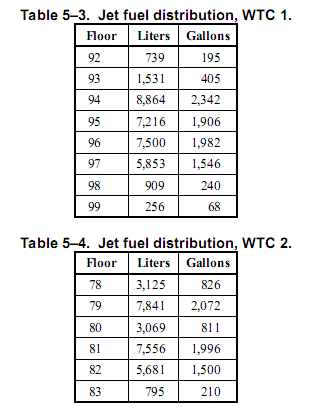
Nope. Found the right section of the report now then ?Bet you ook 40 percent of your 7415 for the combustible, which was wrong.
Nah. Point and laugh.stand by for edit....
Last edited:
They are NIST numbers beachnut
Nope, it was tongue-in-cheek at your expense. Why do you fail to notice ? Why do you delude yourself into believeing I have posted *wrong* numbers when you have simply failed to find them in the report ? Why do you choose to use the largest value of the several in the report, then fail to accound for the fuel consumed in the fireball ? Why do you fail to account for the fuel which flowed away from the impact zone ? Why do you fail so often ?
FEMA and NIST.
ROFL. Is it so hard to find ? Try Tables 5-3 and 5-4
http://femr2.ucoz.com/_ph/2/2/324922461.png
Nope. Found the right section of the report now then ?
Nah. Point and laugh.
Source your numbers, I already know your 7415 is from NIST. The rest of your numbers are made up.
You are posting stuff I already have for almost 5 years....
- 7415 US gallons according to NIST
- 1483 US gallons of which burned outside the tower immediately after impact
- 5932 US gallons remaining inside the tower
- 2966 US gallons within impact zone ...
Source your 2966, 1483, 5932. The 7415 is a fraction of the Jet Fuel on board the flight, did you figure that out yet?
You made up the 1483 by taking 20 percent of your 7415 value by mistake.
You made up the 2966 by taking 40 percent of your 7415 value by mistake.
2966 should be 3909, at least.
1483 is really over 1800, or more, and that is if you are using NIST, and not doing your own research.
You used cherry picked NIST values, and made up your nonsense based on nothing. You could fix this by admitting your errors, or attack the poor pilot who had everything.
I am here to help you and Major Tom escape from 911 truth, into reality. Need some more help?
Do I need to point out some more stuff?
Why did Major Tom miss so many features?
Really ? Where is that figure ?Source your numbers, I already know your 7415 is from NIST.
Nope...The rest of your numbers are made up.
My bold. The data in tables 5-3 and 5-4 are the total fuel distribution values.NIST said:Of the total amount of fuel distributed to each floor, only 40 percent was used in the simulations. The reasoning behind this estimate followed that of the Federal Emergency Management Agency (FEMA) study (McAllister 2002). It has been estimated by various forms of analysis (Zalosh 1995; Baum and Rehm 2002) that roughly 20 percent of the jet fuel was consumed in the fireballs that were observed outside of the buildings within seconds of impact. The authors of the FEMA report suggested that half of the fuel not consumed in the fireballs could have flowed away, presumably down the elevator shafts and stairwells based on eyewitness accounts.
20% fireball, 50% flowed away.
Combined you end up with the 40% used in the simulations. See how that confirms the calcs ?
Yet you are asking me repeatedly where the numbers come from. Feeling pretty silly now are you ?beachnut said:You are posting stuff I already have for almost 5 years.
1483 is the 20% consumed in the fireball.Source your 2966, 1483, 5932.
5932 is the remainder in the building.
2966 is 50% of that, remaining in the impact zone.
Your actual made up numbers are really funny though. Talk about a rapid change of direction beachnut. Gone from complaining that the numbers don't exist to quibbling about how you think they were calculated in 5 seconds flat. Funny, funny man. If you want to have an argument with NIST, be my guest
Be careful though, you wouldn't want to say anything silly, would you ?By all means beachnut. I do enjoy a good giggle you know.Do I need to point out some more stuff?
Last edited:
Nope...
My bold. The data in tables 5-3 and 5-4 are the total fuel distribution values.
Yet you are asking me repeatedly where the numbers come from. Feeling pretty silly now are you ?
1483 is the 20% consumed in the fireball.
5932 is the remainder in the building.
2966 is 50% of that, remaining in the impact zone.
There's the possibility that NIST pre-removed the fireball 20%, but it doesn't seem so (see NIST quote above). You can assume they did if you like. It doesn't change much. Your actual made up numbers are really funny though. Talk about a rapid change of direction beachnut. Gone from complaining that the numbers don't exist to quibbling about how you think they were calculated in 5 seconds flat. Funny, funny man.
By all means beachnut. I do enjoy a good giggle you know.
Fuel used for fire simulation was...
"Aircraft combustibles: The mass was 12,100 kg (25,800 lb)
for WTC 1, 12,500 kg (27,600 lb) for WTC 2."
These are 40 percent of the about 10,000 gallons, and 7415 is not close.
Giggle as much as you want, but you made up your numbers from a cherry picked number, ironically from NIST, the guys you bash.
Do you need me to do the math again. Why does 911 truth have problems reading and with math?
50 percent of 10,000 gallons after 20 percent is gone is 4,000 gallons not your 2966. Or of 9,000 after 20 percent is gone is 3600 not your 2966.
20 percent of 10,000 gallons is 2,000, not 1483.
You need to read NIST again. But better yet, review your numbers...
You must start with nearly 10,000 gallons, if you like take it down to 9300, but 7415 is not close to 10,000 gallons, and it was close to 10,000 gallons.
You are saying NIST has 20 percent consumed in the fireball, which leaves 8,000 gallons, or the 7415 they list remaining in the floors, and then they say they used 3909, or 3707, not your 2966.
You use NIST numbers and then fail to understand what NIST said, and make up fake numbers based on what you think NIST said; a lot of using NIST; like your acceleration stuff, and your Fictional Official Theory claim.
You could do a FOIA, and get the exact fuel at take off and use a pilot to figure out the fuel used. What will you cherry pick next?
Last edited:
Fuel used for fire simulation was...
NIST said:Of the total amount of fuel distributed to each floor, only 40 percent was used in the simulations. The reasoning behind this estimate followed that of the Federal Emergency Management Agency (FEMA) study (McAllister 2002). It has been estimated by various forms of analysis (Zalosh 1995; Baum and Rehm 2002) that roughly 20 percent of the jet fuel was consumed in the fireballs that were observed outside of the buildings within seconds of impact. The authors of the FEMA report suggested that half of the fuel not consumed in the fireballs could have flowed away, presumably down the elevator shafts and stairwells based on eyewitness accounts.
If you want to argue with NIST about their numbers, be my guest.
You can quibble NISTs numbers if you like, sure.Do you need me to do the math again.
No need. Have stated exacly how they are derived.But better yet, review your numbers...
You need to direct your argument towards NIST. They supplied the fuel distribution values.You must start with nearly 10,000 gallons, if you like take it down to 9300, but 7415 is not close to 10,000 gallons, and it was close to 10,000 gallons.
No, NIST are saying that.You are saying NIST has 20 percent consumed in the fireball
You are missing a rather useful cross-check...which leaves 8,000 gallons, or the 7415 they list remaining in the floors
Of the total amount of fuel distributed to each floor, only 40 percent was used in the simulations.
...and...
20 percent of the jet fuel was consumed in the fireballs
...and...
half of the fuel not consumed in the fireballs could have flowed away
Tell me, what fraction of the total amount of fuel distributed to each floor do you end up with if you combine a 20% reduction with a 50% reduction ? What does that suggest ? Does it tell you how they go from the total amount of fuel distributed to each floor to the final 40 % ? Does it tell you that the total amount of fuel distributed to each floor had both 20% and then 50% reduction ?
No they don't.and then they say they used 3909
Nor that.or 3707
They don't state that value either. I have shown you how it is derived.not your 2966.
By all means keep trying to find a way to increase the published NIST values. Bear in mind that you MUST end up with the number 7415 at some point, or your *math* is *wrong*
http://femr2.ucoz.com/_ph/2/2/324922461.png
If you want to argue with NIST about their numbers, be my guest.
You can quibble NISTs numbers if you like, sure.
No need. Have stated exacly how they are derived.
You need to direct your argument towards NIST. They supplied the fuel distribution values.
No, NIST are saying that.
You are missing a rather useful cross-check...
Of the total amount of fuel distributed to each floor, only 40 percent was used in the simulations.
...and...
20 percent of the jet fuel was consumed in the fireballs
...and...
half of the fuel not consumed in the fireballs could have flowed away
Tell me, what fraction of the total amount of fuel distributed to each floor do you end up with if you combine a 20% reduction with a 50% reduction ? What does that suggest ? Does it tell you how they go from the total amount of fuel distributed to each floor to the final 40 % ? Does it tell you that the total amount of fuel distributed to each floor had both 20% and then 50% reduction ?
No they don't.
Nor that.
They don't state that value either. I have shown you how it is derived.
By all means keep trying to find a way to increase the published NIST values. Bear in mind that you MUST end up with the number 7415 at some point, or your *math* is *wrong*
You made up the following numbers based on a cherry picked value from NIST.
NIST say about 10,000 gallons....
- 7415 US gallons according to NIST
- 1483 US gallons of which burned outside the tower immediately after impact
- 5932 US gallons remaining inside the tower
- 2966 US gallons within impact zone ...
Your numbers make no sense.
NIST used these numbers, you failed to read the right stuff, and you messed up your math.
10,000 gallons, 20 percent is 2,000 gallons, not your 1483.
10,000 gallons, 40 percent remaining on the floor to burn is 4,000 gallons, not 2966.
This is math, not make up your own numbers based on the wrong number you cherry pick from NIST.
I know the real value of fuel is 10,000 gallons, which is more than 9,000 gallons, not 7415, which may be from a 9268.75 gallon estimate, of total fuel, where you messed up in the first place.
You know why a 767 needs more fuel than a 757 on 911? Got any pilot stuff in there?
NIST used the following fuel (like the 40 percent stuff).
"Aircraft combustibles: The mass was 12,100 kg (25,800 lb)
for WTC 1, 12,500 kg (27,600 lb) for WTC 2 (Tale 3-7)."
Want to know how many gallons that is? Good luck, but you were being schooled in math in your video thread, you need to brush up on this stuff.
Do the math based on 10,000 gallons, not 7415. Try doing a FOIA for the fuel on board for takeoff. Do you want to buy that info? After they way you treat NIST it is funny you use NIST as your source blindly without reading all of NIST and without checking with an expert on fuel. But have at it, be true to 911 truth, and the Fictional Official Theory Claim.
Last edited:
Grizzly Bear
このマスクに&#
- Joined
- May 30, 2008
- Messages
- 7,963
Major Tom has been doing one thing; He's stating that the tilts are faked or exaggerated when they're not. What he's done is conflated it. It's not that the "tilts" were "faked," he thinks the <insert maximal value here> is reported as being immediately upon the moment the building began to fail rather than a maximal value attained during the descent.If you continnually suggest a mode of destruction which does not fit observables, yet in the same breath call for MT to explain *what it all means !!1!1*, when there are threads which go into significant detail about the mechanisms being proposed, ROOSD for instance, then can you blame him for pointing you* at your own flawed stance ?
I think this is rather stupid quibble especially when one considers he's chasing something that in reality has nothing to do with the moment of collapse he keeps talking about... Any time it gets pointed out, he goes back to bashing the NIST and Bazant without even acknowledging that he's chasing a tangent and that his argument "might" be just fine without referring to those values at all.
As far as I'm concerned it doesn't matter how screwed he thinks the NIST worded the whole thing; when he's not communicating the point well himself... then it's not helping, and it definitely does him no service on a venue that is generally unfriendly with any kind of "demolition" argument, or whatever he's getting at with the ROOSD argument. It's not just the "tilt" topic either... I think most people already get the point that he's saying the NIST and Bazant "got the observables wrong"... which has been about 90% of what I keep reading... he's also over estimating the scope of some of that work as well... no offense man... :\
Last edited:
ROFL. 7415 is the simple sum of the per-floor fuel distribution values. NISTs fuel distribution values.You made up the following numbers based on a cherry picked value from NIST.
They also say 9120 gallons. They also provide per-floor fuel distribution data totalling 7415 gallons.NIST say about 10,000 gallons.
Don't shoot the messenger beachnut. They are values derived directly from the report.Your numbers make no sense.
It soesn't matter how many times you say it beachnut, the tales 5-3 and 5-4 state the specific per-floor fuel distribution values. NIST state how they then reduced those values to 40% of such.NIST used these numbers, you failed to read the right stuff, and you messed up your math.
ROFL. Who is making up numbers beachnut ? 9268.75 gallon estimate eh ? Talk about scrambling around trying to dig yourself out the hole. Priceless. Again, you MUST end up with 7415 at some point, mustn't youI know the real value of fuel is 10,000 gallons, which is more than 9,000 gallons, not 7415, which may be from a 9268.75 gallon estimate, of total fuel, where you messed up in the first place.
ROFL. You are getting more delusional by the day. It's quite disturbing you know. I think you actually believe what you just wrote. No mention of *math* on my video thread for quite a while beachnut. You alright mate ?Good luck, but you were being schooled in math in your video thread, you need to brush up on this stuff.
Grizzly Bear
このマスクに&#
- Joined
- May 30, 2008
- Messages
- 7,963
Femr2 (or anyone that gets to it first)... do you mind if I ask you about which section the fuel values are listed under? Do you remember off-hand? I'll look into having a full read of that section.
Last edited:
No. Are you suggesting that the maximum angle of *the upper block* was 8 degrees ? It was far higher.<insert maximal value here> is reported as being immediately upon the moment the building began to fail rather than a maximal value attained during the descent.
ROOSD involves no demolition at all. It is gravity driven. It is a refined pancake.any kind of "demolition" argument, or whatever he's getting at with the ROOSD argument
Femr2... do you mind if I ask you about which section the fuel values are listed under? Do you remember off-hand? I'll look into having a full read of that section.
NCSTAR 1-5F Ch5. Tables 5–3 and 5–4 present the predicted fuel distributions from the impact analysis.
Last edited:
Grizzly Bear
このマスクに&#
- Joined
- May 30, 2008
- Messages
- 7,963
NCSTAR 1-5F Ch5.
Thank you kindly... I will have a look...
8 degrees was the north tower, south tower was 28 degrees... at least those are the maximal figures I've seen as described before the dust obscured the upper sections.No. Are you suggesting that the maximum angle of *the upper block* was 8 degrees ? It was far higher.
Thanks again for clarifying what it was about.ROOSD involves no demolition at all. It is gravity driven. It is a refined pancake.
Last edited: