triforcharity
Banned

- Joined
- Jun 23, 2009
- Messages
- 13,961
Freddy .... I AM A TRUTHER YOU!
Yeah, but you're not one of those dumb*** truthers. You get a pass.

Freddy .... I AM A TRUTHER YOU
Who said they "pretended" not to? Maybe they just went and, y'know, learned?As I said earlier–the credibility of you people who pretended not to understand the question is shot.
Whee! Arbitrary claims based on ad hominems and avoiding the issue in question! Having fun?Oystein made the mistake of trying to obfuscate something that was too clear to be obfuscated. The credibility of anyone who doesn't simply come out and say he was wrong is shot.
They way you people are tap dancing around to avoid doing this looks pretty pathetic.


BCR, assuming you haven't lost the will to live already; my rough... actually very rough extrapolations from GE show:
* The flight-path (BD in the above image we've been working from) as approximately 53 or 233 degrees from North.
* The line-of-sight (AD in the above image) from the camera to the plane's centre as approximately 21 or 201 degrees from North.
I accept the plane may have been oriented 62 degrees from North, but I still can't reconcile the 2% difference you talked about (although this may well be me being t'ick).
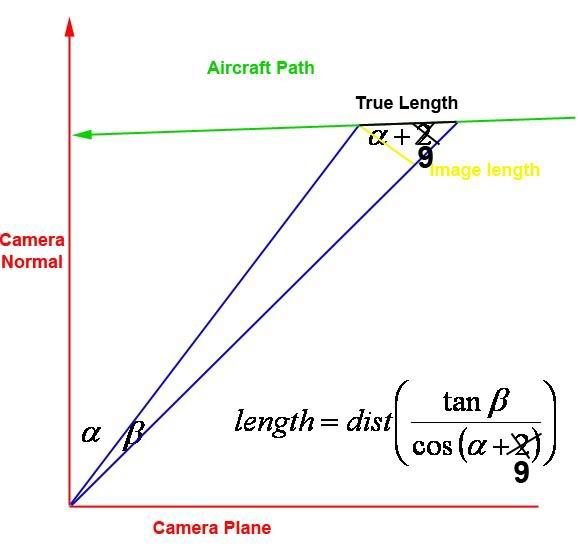
 (wonders why the corrected image is not showing up)
As I said earlier–the credibility of you people who pretended not to understand the question is shot.


It's pretty clear that you pro-official version posters don't even believe your own arguments. All of you know as well as the truthers that 9/11 was an inside job. I don't think many viewers and lurkers need to have what's happening here explained to them.
http://www.opposingdigits.com/forums/viewtopic.php?t=1222
I'm not particularly interested in your math, or anyone else's, at this time. We have a solid model that illustrates that the aircraft in the picture is the correct size to be a 757, much more accurately than the simplified mathematical approximations used in this thread can.


So that we are on the same page, I added my reference points to your image.
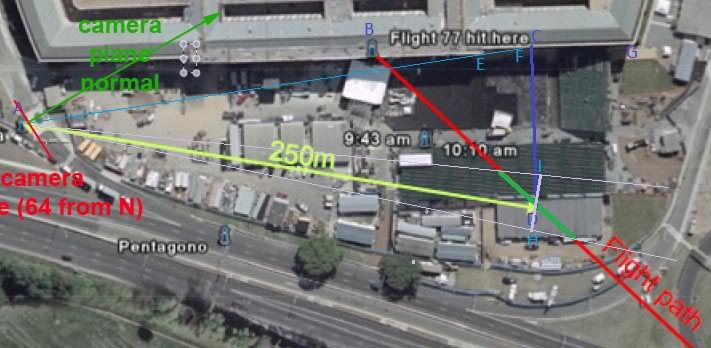
I think you can see how they correspond a little better. The 2 degrees I was talking about is the difference between the camera plane and the aircraft's path.
Stop trying to obfuscate the issue. According to your measurements the difference was 24%. According to my measurements the difference was 27%.
http://www.internationalskeptics.com/forums/showpost.php?p=7203863&postcount=228
FatFreddy88 said:Oystein maintains that the length of the craft must be increased by 32% to get the real length of the craft
...
Do you agree with Oystein when he says the 32% figure is the correct figure to use to increase the size of the craft behind the picture to get its length?
That's a pretty pathetic attempt at damage-control. Here are your posts.
(from post #233)
(from post #246)
(from post #259)
Your attempts to obfuscate mathmatics are ludicrous. Mathmatics can't be obfuscated. This is what I said in post #243.
...
...I had several people question me on what I was talking about in regards to the 2 degree difference. Did I question their credibility? No, I simply worked with them to find a better method of explaining what I was talking about in a more clear and concise manner. It is incumbent upon me to express my ideas coherently and has nothing to do with their 'credibility'.
Of course, we do speak the common language of mathematics which does make life a little easier
Oystein is not wrong (since he/she never claimed that 32% should be used), but neither percentage has anything to do with determing the "correct" length of the plane.
Gah, this whole exercise reminds me of the time a CTist tried to multiply a speed by a length to come up with a distance (or something similar).
I don't fully get why the image plane is important here.
The lens will distort in ways we can't know exactly without going to extreme depths. The nose of the plane is closer to the camera than the tail, and it is oriented at an angle of roughly 40° to the line of sight, which is the reason why it appears shorter in the photo. This wouldn't change substantially if you panned the camera, except for the lens distortion, which we can't compute.
Or can we?
math·e·mat·ics
[math-uh-mat-iks] Show IPA
–noun
1.
( used with a singular verb ) the systematic treatment of magnitude, relationships between figures and forms, and relations between quantities expressed symbolically.
a·rith·me·tic
[n. uh-rith-muh-tik; adj. ar-ith-met-ik] Show IPA
–noun
1.
the method or process of computation with figures: the most elementary branch of mathematics.

Do you think Oystein was right, or wrong?

Do you think Oystein was right, or wrong?
The lens will distort in ways we can't know exactly without going to extreme depths.
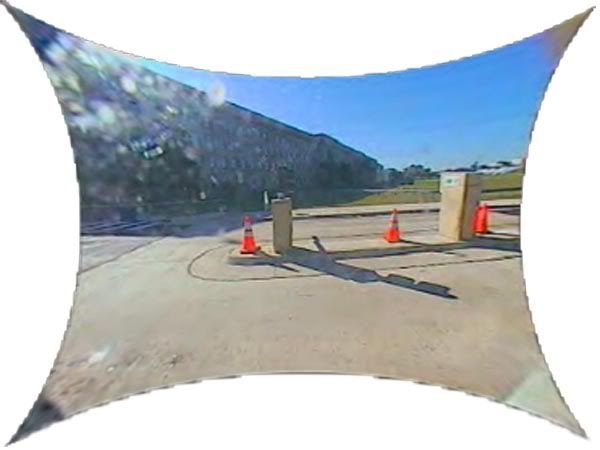
I don't fully get why the image plane is important here. The lens will distort in ways we can't know exactly without going to extreme depths. The nose of the plane is closer to the camera than the tail, and it is oriented at an angle of roughly 40° to the line of sight, which is the reason why it appears shorter in the photo. This wouldn't change substantially if you panned the camera, except for the lens distortion, which we can't compute. Or can we?

Just to illustrate your point (and mine) which makes this all an exercise in futility, I used the lens distortion filter in Photoshop to attempt to correct some of it. Even on the second cycle, I was unable to remove it all, but it will give folks an idea of just how much angular distortion there is and why Freddy's methodology is flawed from the get-go.
[qimg]http://i1138.photobucket.com/albums/n525/John_Farmer/distortion.jpg[/qimg]
Yeah. I use packages that have models for correcting lens distortion. Even on fairly sane focal lengths you can get a surprising amount of distortion, especially towards the edges, which you don't tend to notice until you have to deal with it for a specific reason.
