• Quick note - the problem with Youtube videos not embedding on the forum appears to have been fixed, thanks to ZiprHead. If you do still see problems let me know.

2011 Arctic Sea Ice Thread

I recall a 2014 in the science press a couple years back.

Gore: Polar ice cap may disappear by summer 2014 -

14 Dec 2009 ... New computer modeling suggests the Arctic Ocean may be nearly ice-free in summer as early as 2014, Al Gore said today at the U.N. climate .


Arctic summers ice-free 'by 2013'


By Jonathan Amos
Science reporter, BBC News, San Francisco
999999.gif


o.gif


Scientists in the US have presented one of the most dramatic forecasts yet for the disappearance of Arctic sea ice.

Anyone keeping up on the pace of Arctic summer sea ice melting, take note: Mongabay is reporting on new research presented by the National Space Institute at Technical University of Denmark (and others) which says that if current melting trends continue, the Arctic Ocean will be ice-free in the summer by 2015:

http://www.treehugger.com/files/2009/09/arctic-ocean-ice-free-summer-by-2015.php

- more than I thought.
 
Last edited:
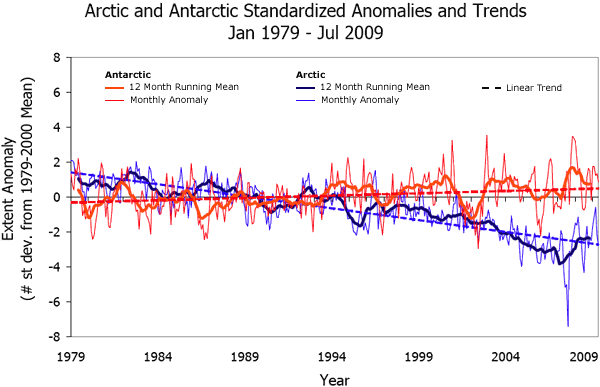
The Arctic summer sea ice extent has dropped by an average of about 11% per decade since we started satellite monitoring of it in 1979. I understand that the fall is not linear and that a sudden state change is possible, but surely the loss of the other 55% within the next five years is one of the more unlikely scenarios?

When I first started reading about AGW a decade or so ago the most likely date being talked about for an Arctic ice free in summer was around 2080 so the fact that most models and estimates now put it around 40 years earlier is a dramatic reduction, but touting an unlikely date like 2015 is only giving ammunition to the deniers when it doesn't happen.
 
I suggested by 2015 for an ice-free summer Arctic, but my record on sea-ice prediction is not stellar :o.

I see it as very muh like ice break-up on a pond or stream. The ice seems unchanging for a while, then the melt starts to come through from below and after that things happen very quickly. We're in that final stage now, I think.

Any sign of a Round-the-World yacht-race the short way yet? That can't be far off.

This is pretty much what the models have shown, years of rapid loss followed by longer periods of slower loss. Most were showing a mostly ice free arctic sometime around 2040-2060 but were consistently underestimating the speed of ice decline. My guess for a mostly ice free arctic is 2030-2040.

IIRC there was one run of one model that showed it ice free by 2015, but even the other runs of the same model were out around 2040. With the wording the statement is still accurate, the artci could be ice free that soon, but the chances are low.
 
I suggested by 2015 for an ice-free summer Arctic, but my record on sea-ice prediction is not stellar :o.

I see it as very muh like ice break-up on a pond or stream. The ice seems unchanging for a while, then the melt starts to come through from below and after that things happen very quickly. We're in that final stage now, I think.

Any sign of a Round-the-World yacht-race the short way yet? That can't be far off.

I hope Santa has the floatation barges in place under the workshop, stables and Wee-Worker Inn!
 
The Arctic summer sea ice extent has dropped by an average of about 11% per decade since we started satellite monitoring of it in 1979. I understand that the fall is not linear and that a sudden state change is possible, but surely the loss of the other 55% within the next five years is one of the more unlikely scenarios?

When I first started reading about AGW a decade or so ago the most likely date being talked about for an Arctic ice free in summer was around 2080 so the fact that most models and estimates now put it around 40 years earlier is a dramatic reduction, but touting an unlikely date like 2015 is only giving ammunition to the deniers when it doesn't happen.

Actually, at the time of making my personal projection, the professional judgement was just in the process of being lowered to around 2050, and I believe most recent (last couple of years) projections are in the 2025-35 range. Most current projections are edging towards the lower end of that range. It would not hurt my feelings to be off by 10-15 years, particularly since when I first made that projection the conservative estimates were 6 decades or so later than mine. Additionally, I never claimed that such were based upon solid science with well supported evidences and calculated factors, but rather were more an educated guess, and it was stated as such, a personal and private guestimation. If wrong it reflects upon the methodology and assumptions upon which it was based, which is why professional science tends to be so conservative in its projections and statements of findings. As individuals, however, even scientists and researchers are permitted, and often prone to, considerations and speculations that are less couched in rigorous support and calculated estimation. The only people likely to seriously misunderstand and or misattribute the consequences of errors in such casual considerations, are those who are unlikely to be strongly influenced or persuaded by such considerations if they proofed out 100% prescient.
 
Last edited:
You state "three measures" and then you define four terms, how can we trust a thread that begins with such deceptive and misleading practices!?!?

:)

Seriously, should be an interesting summer. I believe my original prediction from several years back was for 2015 as the first ice-free period, I'll have to dig back to confirm, but it looks like the arctic is on-track, or perhaps even a bit ahead of track for that prediction. Given that when I made it, it was about 20 years ahead of most official predictions, it'll be interesting to see how far off I, and the larger professional community were off,...back then.

Nobody expects the Spanish Inquisition!
 
When I first started reading about AGW a decade or so ago the most likely date being talked about for an Arctic ice free in summer was around 2080 so the fact that most models and estimates now put it around 40 years earlier is a dramatic reduction, but touting an unlikely date like 2015 is only giving ammunition to the deniers when it doesn't happen.

On the other hand it puts their accusations of alarmism in stark focus if it does happen. And it might well do. There are reasons why the rate of reduction in sea-ice extent might accelerate at the end.

As the Arctic basin becomes more open the sea-ice which does exist can be moved around more easily by currents and winds, taking it from the Pole to warmer latitudes or even out of the Arctic basin altogether. At the same time it allows the existing sea-ice to spread, which flatters the extent measure (15% ice cover) until it starts to dilute below that 15%. (The latter is an artificial effect, of course, but real where the numbers are concerned.)

2015 isn't that far away, so we'll see soon enough :). In the meantime, every Arctic summer is interesting these days. It's been that way since 2005.
 
Chart just released;

Volume is the heart of the matter, of course, and the rate of loss depends on the ratio of surface-area to volume. When the loss of volume is mostly in one direction (as in the Arctic, where the melt is mostly from the bottom) that ratio increases quite rapidly.
 
Back on topic; I have been monitoring the PIOMAS chart postings for this year, but they are well behind their "every two weeks" schedule at present.

Last month it was the 19th before they posted the April numbers, so I expect that we will have it in a few days.

I have also been monitoring the North Pole Web Cam ( http://www.arctic.noaa.gov/gallery_np.html )

Look at the ice motion we can see in these animations;

http://www.arctic.noaa.gov/np2011/2011-cam1web.mov
http://www.arctic.noaa.gov/np2011/2011-cam2web.mov

Note that you can see instruments and ice buoys sliding right and left with respect to the camera POV and other object in the foreground, and the sudden appearance of leads and rifts and ridges. I do not recall dynamics like this so early in prior years.
 
Note that you can see instruments and ice buoys sliding right and left with respect to the camera POV and other object in the foreground, and the sudden appearance of leads and rifts and ridges. I do not recall dynamics like this so early in prior years.


http://arctic.atmos.uiuc.edu/cryosphere/NEWIMAGES/arctic.seaice.color.000.png

There has been a substantial area of partial ice coverage near the North Pole for at least 3 weeks. I think it’s very rare to see so much rotten ice so far north this early but it will likely close up as the season progresses.
 
http://arctic.atmos.uiuc.edu/cryosphere/NEWIMAGES/arctic.seaice.color.000.png

There has been a substantial area of partial ice coverage near the North Pole for at least 3 weeks. I think it’s very rare to see so much rotten ice so far north this early but it will likely close up as the season progresses.

Wind tends to close up leads so far into the pack, that's true. But it doesn't say anything good about the mass of ice that exists. I expect to see PIOMAS (an anomaly measure, remember) tick downward again.
 
OK, May PIOMAS is out, and the downward anomaly trend continues. This is starting to resemble last year's excursion, and points to a very low ice volume at the height of the melt.

NOTE: This is a new PIOMAS model version, and it has for the first time Error Bars!
 

Attachments

  • BPIOMASIceVolumeAnomalyCurrentV2.jpg
    BPIOMASIceVolumeAnomalyCurrentV2.jpg
    33.8 KB · Views: 8

Back
Top Bottom