Moderated Global Warming Discussion

Status
Not open for further replies.
AGW Skeptics Changing Their Minds?

http://www.slate.com/id/2293607/pagenum/all/#p2

So, this is an interesting bit of trivia of which I'm sure we're all aware from personal experience. Tucker changes his position and goes the other way, so he's still an extremist but others just want an apology for how they were treated (sniff, sniff, cry me a river; you want an apology for being called out as a liar and scientific illiterate?). What's always interesting are the comments where, just like here, pithy one-liners are supposed to substitute for real debate. Anyhow, any of you guys had an experience where you've witnessed a conversion? How about the other way where someone who accepted the data is now a denier?
 
One could accept the data and still realize it's being used as a rhetorical tool to gain control of business. Both sides could be right.


The one thing that both sides miss is that massive government intervention would be worse than the disease. There's this presumption that the correct course of action is to simply put the slammer down on industrial advancement.


You're trying to slow down a process that, well, look at where we were technologically 50 years ago, or 100, vs. today. I don't care what the holy hell we do to the environment, making us lag 10 or 20 years behind where we are now would kill more people, or just make lives worse off, then we are today.


It's the exact same argument I make about socialized medicine, or generally business-unfriendly environments of Europe -- you slow down advancement, you kill people. And a lot more than you save, even assuming every last bloviated miraculous plan of governments comes to pass, which as we all know is, trivially, laughable.


At the end of the day, someone who says we must slow down industrial advancement because in 50 or 100 years seas will rise 30 or 100 feet, "and that's a problem" clearly has no concept of what's going on w.r.t. the bigger picture of humanity.
 
Last edited:
This part was telling:

I asked Anthony Watts, the meteorologist who runs what may be the most popular climate-skeptic blog, Watts Up With That, what could lead him to accept climate science. A "starting point for the process," he said, wouldn't begin with more facts but instead with a public apology from the high profile scientists who have labeled him and his colleagues "deniers."

So basically he’s saying he could never acknowledge his position was wrong as long as people don’t apologize for saying he’s wrong. W... T... F...
 
I don't doubt it's not a problem for you. Most alarmists don't care about the ends the only want to preach about the means.
You assume too much - I am not an "alarmist", I am a realist.

If you want to be literal then it's actually only part of the problem.
[/quote[]
Then it is part of the problem. So what?

That's part of the solution as it's rather simplistic. We also need to change the way we live.
That is why I said a solution, not the solution.

Rubbish. We need to know what our money is doing to reduce CO2. Nuclear power plants don't but themselves :D
Rubbish - we know that spending money to reduce CO2 will reduce CO2! That is the purpose of spending the money.
Spending money to replace fossil fuel power plants with less CO2 emitting sources like nuclear power plants (and solar plants, wind farms, tidal plants) will reduce the amount of CO2 emitted.
 
lol, you may want to get out some graph paper for this one. (1,1) (2,1) (3,1) (4,1) (5,1)

Straight line?

(1,1%) (2,1%) (3,1%) (4,1%) (5,1%)

Straight line? I hope so.

Now let me explain the numbers. 1 means the first year, 2 means the second and so on. The 1% is the increase in CO2 from the last year. Each year there is a linear increase of 1%.

Basic stuff really.
You are being rather imprecise, that's why you are being picked up for it. You are arguing for a 1% of the original value for your increase, but phrasing it that it seems that you are looking at a compounded 1% increase which is definitely not linear!
 
One could accept the data and still realize it's being used as a rhetorical tool to gain control of business. Both sides could be right.


The one thing that both sides miss is that massive government intervention would be worse than the disease. There's this presumption that the correct course of action is to simply put the slammer down on industrial advancement.


You're trying to slow down a process that, well, look at where we were technologically 50 years ago, or 100, vs. today. I don't care what the holy hell we do to the environment, making us lag 10 or 20 years behind where we are now would kill more people, or just make lives worse off, then we are today.


It's the exact same argument I make about socialized medicine, or generally business-unfriendly environments of Europe -- you slow down advancement, you kill people. And a lot more than you save, even assuming every last bloviated miraculous plan of governments comes to pass, which as we all know is, trivially, laughable.


At the end of the day, someone who says we must slow down industrial advancement because in 50 or 100 years seas will rise 30 or 100 feet, "and that's a problem" clearly has no concept of what's going on w.r.t. the bigger picture of humanity.

Well, the central question really is if the costs of doing something are less than the costs of doing something. It's a fair question, of course, but you are making some pretty big assumptions about the advancement of technology. At some point, we will stop advancing at such a rapid pace. Some people claim we already have gotten at all the low-hanging fruit already and that all future advancements will be few and far between. Thinking that some big technological discovery will come along and mitigate any negatives is really just ignoring the problem, no?
 
lol, you may want to get out some graph paper for this one. (1,1) (2,1) (3,1) (4,1) (5,1)

Straight line?

(1,1%) (2,1%) (3,1%) (4,1%) (5,1%)

Straight line? I hope so.

Now let me explain the numbers. 1 means the first year, 2 means the second and so on. The 1% is the increase in CO2 from the last year. Each year there is a linear increase of 1%.

Basic stuff really.

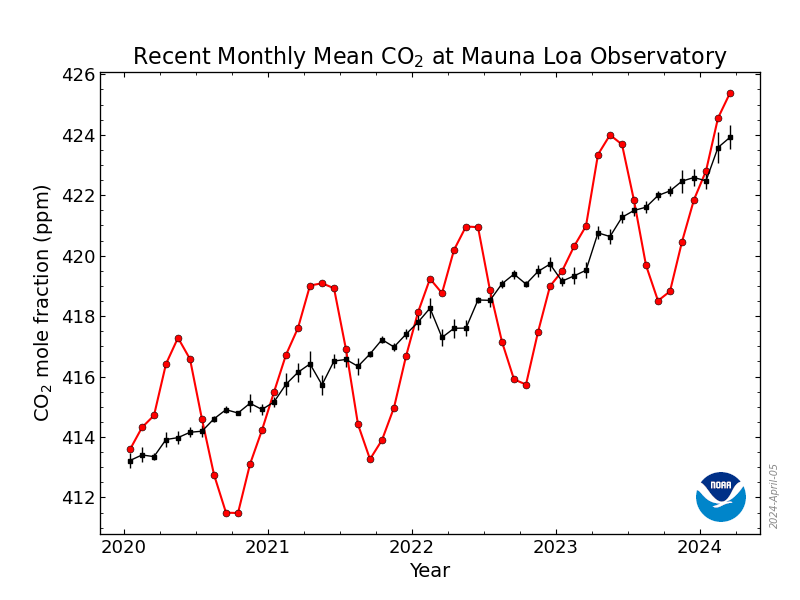
(1, 0.95)
(2, 0.53)
(3, 0.95)
(4, 0.65)
(5, 0.71)
(6, 0.28)
(7, 1.02)
(8, 1.23)
(9, 0.74)

http://www.esrl.noaa.gov/gmd/ccgg/trends/

agreed, elementary even
so why do you continue to misrepresent the issue?
 
How about the other way where someone who accepted the data is now a denier?

Yah, while I was in University I was a raving loon about AGW. At least I thought I was until I met activists and that's when I backed off a bit and took a long look at the issue.
During that decade things changed but the alarmists reached a fevered pitch. As a reformed alarmist I feel the need to try and settle people, let them know that things aren't progressing along the "worst case scenario" and it isn't business as usual. I've seen a lot of changes in that time and while I realize we can always do more there are those in the world that simply can't worry about CO2 while they are fighting for their immediate survival.
Yes, it's an issue and it's going to take a combined world wide effort, but there are more pressing issues to deal with. Alarmists are escapists and until we solve this current generations problems we can't take a serious look at future ones.
In a perfect world this wouldn't be the case, but this world is far from perfect. While the scientists figure out exactly what we can expect based on what we do, we need to focus on present day issues and quite fantasizing about the future.
 
I don't care what the holy hell we do to the environment, making us lag 10 or 20 years behind where we are now would kill more people, or just make lives worse off, then we are today.
Praising rapid technological growth while at the same time claiming not to care about the environment is a bit like praising the construction of a tall skyscraper and claiming the ground on which it is built doesn't matter... The environment is not some nebulous concept, it is our direct environment. The environment that up to now has allowed us such rapid growth, but which may not keep up supporting it indefinitely.

It's the exact same argument I make about socialized medicine
Yes, I have noticed that it is the same argument; the one that is wrong in every conceivable way.
 
http://www.esrl.noaa.gov/gmd/ccgg/trends/

agreed, elementary even
so why do you continue to misrepresent the issue?

co2_trend_mlo.png


The "line of best fit" through the above graph represents an approximate increase of 1% per year.

382+(1%)=385.82 (2008)
385.82+(1%)=389.67 (2009)
389.67+(1%)=393.57 (2010)
393.57+(1%)=397.51

That's an approximate increase of 1% per year. The actual numbers are approximately (385) (386) (388) (391). A little less than 1% per year.

So if I've misrepresented anything it's that the increase is a little less than 1% per year.

You're not really making your case here (I'm assuming given your proclivity for overestimating things of this nature pointing out it "isn't as bad as I said it was" wasn't your intent)
 
Then it is part of the problem. So what?

So what? Forgive me for pointing this out, but I find this is quite typical of the alarmist mindset. There's such a panic about the problem they don't stop to think about "what".
What did the $13 Billion spent on carbon trading do for the problem last year? What effect did all of the wind turbines erected, and the billions spent, do last year, that's "what".
People like the make the analogy that this is a car heading for a brick wall. Now we're pumping the brakes and nothing is happening but the guy in the back seat keeps screaming "pump harder!". Without a working speedometer it's impossible to tell if if it's working or if we're just exercising our legs.

Rubbish - we know that spending money to reduce CO2 will reduce CO2! That is the purpose of spending the money.

And yet here we are arguing about how the CO2 increase is accelerating, not slowing down. Maybe we're not hitting the brake we're hitting the gas. A speedometer would be nice.

Spending money to replace fossil fuel power plants with less CO2 emitting sources like nuclear power plants (and solar plants, wind farms, tidal plants) will reduce the amount of CO2 emitted.

You're going on faith because you'll notice the good folks at Mauna Loa say otherwise. :D
I'm not saying these don't reduce CO2, it's obvious they do, what I'm saying is you're going on faith that this is an effective way of dealing with the problem. If these measures don't have any effect on the problem then the immediacy of them being implemented isn't as great. If that's the case then it stands to reason alarmism is hurting our effort not helping it. That's something to consider.
 
You are being rather imprecise, that's why you are being picked up for it. You are arguing for a 1% of the original value for your increase, but phrasing it that it seems that you are looking at a compounded 1% increase which is definitely not linear!

Yes, I said that was my fault because I was mixing up the ppm increase and the percentage increase.
 
So basically he’s saying he could never acknowledge his position was wrong as long as people don’t apologize for saying he’s wrong. W... T... F...

Imagine a person taking exception to being publicly labeled a slanderous term designed to invoke disdain because of the obvious correlation to Nazi apologists :rolleyes:

The key here being "publicly". It's one thing to call someone a "denier" or an
"alarmist" within a closed group that understand the context. It's another to do so publicly. Many people don't know what "denier" means as it applies to discussion on AGW and instead only know it as it applies to the Holocaust. Because of that it's very misleading and highly offensive especially among the Jewish community.

That's compounded by the obvious fact that most people being labeled "deniers" don't deny global warming or climate change. It's misleading in the way that most pejorative terms are.
 
Well, the central question really is if the costs of doing something are less than the costs of doing something. It's a fair question, of course, but you are making some pretty big assumptions about the advancement of technology. At some point, we will stop advancing at such a rapid pace. Some people claim we already have gotten at all the low-hanging fruit already and that all future advancements will be few and far between. Thinking that some big technological discovery will come along and mitigate any negatives is really just ignoring the problem, no?

To me it looks like we made most of the big breakthroughs about a hundred years ago, and the progress of the last twenty or thirty could be summed up as 'make faster computers, build them into everything, and make cell phones smaller'. I'd talk to a command line on a terminal and carry my phone in a briefcase if it meant that my grandchildren and great to the x'th grandchildren would live in a world a lot like this one, have the same opportunities to prosper as I had, etc. (I spent an awfully long time carrying around a phone that pretty much filled a briefcase and weighed as much as your average unabridged dictionary, and typing my commands at the prompt. It wasn't a hardship. At the time it felt shiny and new. Early adopter shiny, even. It'd be a good trade)
 
One could accept the data and still realize it's being used as a rhetorical tool to gain control of business. Both sides could be right.


The one thing that both sides miss is that massive government intervention would be worse than the disease. There's this presumption that the correct course of action is to simply put the slammer down on industrial advancement.


You're trying to slow down a process that, well, look at where we were technologically 50 years ago, or 100, vs. today. I don't care what the holy hell we do to the environment, making us lag 10 or 20 years behind where we are now would kill more people, or just make lives worse off, then we are today.


It's the exact same argument I make about socialized medicine, or generally business-unfriendly environments of Europe -- you slow down advancement, you kill people. And a lot more than you save, even assuming every last bloviated miraculous plan of governments comes to pass, which as we all know is, trivially, laughable.


At the end of the day, someone who says we must slow down industrial advancement because in 50 or 100 years seas will rise 30 or 100 feet, "and that's a problem" clearly has no concept of what's going on w.r.t. the bigger picture of humanity.


Do you mean that the best course of action would be to continue as we are, not change anything at all and then just deal with the consequenses as they arise, hoping that, by then, we'll have sufficient technology to deal with it. Kind of like jumping into the river and hoping you'll learn to swim before you drown?

I'm not sure that's a good plan for taking care of anything, let alone for thaknig care of that which keeps us alive and without which we can't live.
 
Last edited:
3body trying to defend the indefensible.
This is representative of the problem plaguing the discussion.
Not it's not - the problem is scientific illiteracy which you exhibit ad nauseum in a science forum......this one..
Some get their "wires crossed" even on the basics ....oh yeah - that was you.....

••••
Beerina
At the end of the day, someone who says we must slow down industrial advancement because in 50 or 100 years seas will rise 30 or 100 feet, "and that's a problem" clearly has no concept of what's going on w.r.t. the bigger picture of humanity.
Moving to a carbon neutral economy in no way slows, rather it enhances an industrial society and according to people like John Doerr who bets billions on such advancements, will bring about the biggest boom in the history of humanity.

Of course like buggy whip manufactures and gas station pump attendants there will be some flotsam left to wither.

I'm sure the fossil fuel fossils applaud your concern. :garfield:

By the time sea level becomes an issue there will and are far more pressing concerns hydrology and climate band shifts. Comprehending that would require reading the science on the subject rather than republican pundits and denier blogs.

as for your tech solution Beerina

Report: Direct removal of carbon dioxide from air likely not viable


Posted May 9, 2011; 12:40 p.m.

by Steven Schultz

Technologies for removing carbon dioxide from the atmosphere are unlikely to offer an economically feasible way to slow human-driven climate change for several decades, according to a report issued by the American Physical Society and led by Princeton engineer Robert Socolow.
"We humans should not kid ourselves that we can pour all the carbon dioxide we wish into the atmosphere right now and pull it out later at little cost," said Socolow, a professor of mechanical and aerospace engineering.
The report "Direct Air Capture of CO2 with Chemicals," was issued by a committee of 13 experts co-chaired by Socolow and Michael Desmond, a chemist at BP. The group looked at technologies known as "Direct Air Capture," or DAC, which would involve using chemicals to absorb carbon dioxide from the open air, concentrating the carbon dioxide, and then storing it safely underground.
more
http://www.princeton.edu/main/news/archive/S30/49/58I08/index.xml?section=students

You really gonna bet your only planet's biome on a mystery cure..?
 
Last edited:
Do you mean that the best course of action would be to continue as we are, not change anything at all and then just deal with the consequenses as they arise, hoping that, by then, we'll have sufficient technology to deal with it.

I have to ask what you mean by that? I'm seeing this in other threads under the banner "business as usual". I don't know what that is exactly. Do you mean go back to incandescent lights and single pane windows driving 440 V8 Cuda's? Or do you mean scheduling the shutdown of coal plants and building nuclear reactors like we're doing where I live?
With the natural variability in climate 1 or 2 years isn't enough to determine a pattern so the commonly accepted time frame is 30 years. So when I think of "continuing as we are" I think of what we've done over the last 30 years.
There's been considerable change in that time and I'm not saying it's enough, but it's change none the less. When people say "don't change anything at all" like you've done above I find it a bit of a nonsequitur. I mean there has been change.
 
I have to ask what you mean by that? I'm seeing this in other threads under the banner "business as usual". I don't know what that is exactly. Do you mean go back to incandescent lights and single pane windows driving 440 V8 Cuda's? Or do you mean scheduling the shutdown of coal plants and building nuclear reactors like we're doing where I live?
With the natural variability in climate 1 or 2 years isn't enough to determine a pattern so the commonly accepted time frame is 30 years. So when I think of "continuing as we are" I think of what we've done over the last 30 years.
There's been considerable change in that time and I'm not saying it's enough, but it's change none the less. When people say "don't change anything at all" like you've done above I find it a bit of a nonsequitur. I mean there has been change.


A good point.

The tone I got from Beerina's post was that it was pointless to do anything as you can't slow the pace of progress and that it is foolish to do so.

As you say, things are obviously changing - I would say not quickly enough, but that's as an aside - and will continue to change, the question is if the rate of change is fast enough. Beerina seems to think (I think) that the changes are too fast and that we should just tech our way out of any problems we create. I don't think this is a good idea.
 
3body trying to defend the indefensible.
Not it's not - the problem is scientific illiteracy which you exhibit ad nauseum in a science forum......this one..
Some get their "wires crossed" even on the basics ....oh yeah - that was you.....

lol, yes I said 1% increase in ppm when I meant to say 1% increase in rate.

I'm obviously scientifically illiterate.:rolleyes:

Again this is just representative of how the discussion always proceeds. If you don't agree with them well then "You just don't understand" or are incapable of understanding. It's just another reason to move from the edges and more towards the middle and take a skeptical approach. There's no reason for someone without a University degree such as myself to feel like they can't understand climate change. Sure some of the math and physics can be complex and well beyond your understanding, but most of it isn't.

And really for the most part it isn't about the science. At least the debate isn't about the science. The real debate is about whether or not what is happening is manageable, and what we need to do in order to manage it.
 
As you say, things are obviously changing - I would say not quickly enough, but that's as an aside - and will continue to change, the question is if the rate of change is fast enough. Beerina seems to think (I think) that the changes are too fast and that we should just tech our way out of any problems we create. I don't think this is a good idea.

OK, not quickly enough I get.

If I've read Beerina's post right he's talking not so much about teching it, but allowing the market to guide us as opposed to forcing it. By forcing it I mean diverting funds or subsidizing green measures.

I don't know where I stand on this. Some of the really big projects have to come by way of government involvement. Obviously here in Canada, but also in the US. I think there are effective ways of providing stimulus, but the government seems to get wrong more often than get it right. I think it has to do with urgency resulting in short sightedness. It seems like if the government doesn't do a 5 year multimillion dollar study they're bound to get it wrong.

At the same time I think the last time the government undertook projects like this they did fairly well. I'm not that well versed in US history but what I've seen of the projects they did during the depression most worked out well and dug the country out of a hole like they are currently in. Then again I've heard the opposite.
 
Status
Not open for further replies.

Back
Top Bottom