• Quick note - the problem with Youtube videos not embedding on the forum appears to have been fixed, thanks to ZiprHead. If you do still see problems let me know.

Merged Discussion of femr's video data analysis

A different point only identified as 'near the center'. 'B' is 'near the center', it would be logical that they used a point directly above it.
Not only logical, but absolutely required to be above region B.

However, Femr2 claims, strangely, that this is not possible.
Nonsense. You seem to have awful trouble reading you know.

What I've said, repeatedly, is that a trace above region B cannot be performed from T0, as the rooftop buildings are in the way. A trace above region B has to be started at a latter point in time.

That's where his argument fails, IMO. He doesn't know where it was, and he hasn't contacted NIST to find out, so he seems to be in limbo. (hard to disprove something if you don't know what it is)
ROFL.

It's above region B.
It's NOT pixel column 304 :)
 
Once again to be very clear: WD Clinger is asserting that the NIST camera 3 data is good during the early motion....

Don't you get it? Femr doesn't use camera 3 data, the NIST does and WD Clinger thinks it is a good measurement....

The horizontal motion is your problem, not femr's. It is your problem and the problem of the NIST and WD Clinger....
Once again, to be very clear: Major_Tom is neither authorized nor qualified to speak for me.

I do not recall making the statement he alleges, and I am absolutely certain that Major_Tom doesn't know what I think. There are three possible explanations for what Major_Tom has said above and below:
  1. I have made the statement he alleges but have forgotten all about it, which seems unlikely.
  2. Major_Tom just made it up.
  3. Major_Tom is just confused.
Since Major_Tom can't seem to come up with a direct quote, everyone should assume some combination of explanations 2 and 3.

It is the NIST that ignores it in their camera 3 measurements, the ones that WD Clinger believe are good. How many posts will you need to grasp what is going on?
Everyone should assume some combination of explanations 2 and 3.
 
Not only logical, but absolutely required to be above region B.


Nonsense. You seem to have awful trouble reading you know.

What I've said, repeatedly, is that a trace above region B cannot be performed from T0, as the rooftop buildings are in the way. A trace above region B has to be started at a latter point in time.


ROFL.

It's above region B.
It's NOT pixel column 304 :)
One more time before I go to work and operate heavy equipment all night.

What would be wrong with using a horizontal line of pixels starting at "A" and ending at "B"?

Be gentle.

;)
 
Last edited:
Nonsense. You seem to have awful trouble reading you know.

What I've said, repeatedly, is that a trace above region B cannot be performed from T0,

Hmmm, which I summarized correctly as 'Femr2 claims, strangely, that this is not possible.'

So you again confirm what I've written, while trying to deny it. Cognitive dissonance?

Similarly, there was vertical motion, and horizontal motion. You agree, but then strangely deny that the vertical motion is valid. Hmmm.

I see a pattern emerging.:D
 
Once again, to be very clear: Major_Tom is neither authorized nor qualified to speak for me.

I do not recall making the statement he alleges, and I am absolutely certain that Major_Tom doesn't know what I think. There are three possible explanations for what Major_Tom has said above and below:
  1. I have made the statement he alleges but have forgotten all about it, which seems unlikely.
  2. Major_Tom just made it up.
  3. Major_Tom is just confused.
Since Major_Tom can't seem to come up with a direct quote, everyone should assume some combination of explanations 2 and 3.


Everyone should assume some combination of explanations 2 and 3.

And what do you make of the arguments of Femr2 and MT regarding the angle of the CBS footage?
 
What would be wrong with a horizontal line of pixels starting at "A" and ending at "B"?

I'm not clear what you mean.

Do you mean:

a) Tracing along a diagonal line from A to B, shifting the horizontal trace location wrt time.

or

b) Tracing a wide section of the roofline.

?

If (a)..very silly.

(b) would have issues but in principle would be a wide region trace. Too wide in my opinion, but hey.

However, NIST clearly state that they selected a position, and their method clearly relates to a horizontal pixel column within the image frame.
 
Last edited:
Hmmm, which I summarized correctly as 'Femr2 claims, strangely, that this is not possible.'
Ye gads man. Again, the trace location MUST be above region B, but must ALSO be started quite a while after T0, as the roofline structures are still in place until later on*

* You can't see the roofline while the structures are in place. You could guess where it is, but the accuracy would be incredibly poor. Automated tracing would be impossible until the rooftop structures have dropped. If NIST DID trace above region B from T0 then...

a) They traced manually by hand.

b) The early trace dta would be even lower quality than the data later on.

c) They *forgot* to record that data in the displacement graph.

:rolleyes:

You can see some of the effect of such in the displacement sample frequency (though they still have it too early to be valid data above region B).

You are repeatedly being shown to be incorrect, and are repeatedly descending into ridiculous posturing to feign some form of victory. Doesn't work. Stop making silly mistakes.
 
Last edited:
I'm not clear what you mean.

Do you mean:

a) Tracing along a diagonal line from A to B, shifting the horizontal trace location wrt time.

or

b) Tracing a wide section of the roofline.

?

If (a)..very silly.

(b) would have issues but in principle would be a wide region trace. Too wide in my opinion, but hey.

However, NIST clearly state that they selected a position, and their method clearly relates to a horizontal pixel column within the image frame.
Why would (a) be very silly? Would it effect their (over all) conclusions? Seems it would be sufficient for their model.
 
Why would (a) be very silly? Would it effect their (over all) conclusions? Seems it would be sufficient for their model.
Because the trace would not be from A position on the roofline, but, as the building descends, a position on the roofline gradually moving Westward (plus the wandering effect from the building moving East)

Regardless, that's not what NIST did. They traced the roofline position on a pixel column *near the center of the roofline*.
 
Because the trace would not be from A position on the roofline, but, as the building descends, a position on the roofline gradually moving Westward (plus the wandering effect from the building moving East)

Regardless, that's not what NIST did. They traced the roofline position on a pixel column *near the center of the roofline*.
So it's sort of a literal interpretation. Maybe like your work (to you) they thought their methods were good for the purpose.


;)
 
So it's sort of a literal interpretation.
No, and I forgot to highlight that, as the perspective in the Cam#3 footage has the roofline at a significant angle from horizontal, changing the horizontal position over time would drastically affect the vertical data extracted.

they thought their methods were good for the purpose
Probably, yeah. I have issues with their methods, as you are aware.
 
Last edited:
You can see some of the effect of such in the displacement sample frequency (though they still have it too early to be valid data above region B).

You are repeatedly being shown to be incorrect, and are repeatedly descending into ridiculous posturing to feign some form of victory. Doesn't work. Stop making silly mistakes.

I correctly summarized your position. I understand your position. For some reason you don't like the idea that your position can be summarized as 'this is not possible' even though you go to great lengths to explain why it 'is not possible'. :)

You rely on a ton of assumptions, none of which you've confirmed by anything but more assumptions. Problem is, I have no confidence that all your assumptions are correct.

IMO you are feigning certitude when it isn't there.

Carry on....
 
Besides, the summary provided by NIST directly contradicts what FEmr2 is suggesting.

'To obtain a better understanding of the vertical motion of the building in the first several seconds of descent, the motion of the north face was studied in more detail by tracking the vertical position of a point near the center of the roofline using the same video.'

Note they don't say mention 'points', as in, two different positions spliced together. And the point they chose was selected to better study the vertical motion, once T=0 had been established.
 
Also I can't find any mention that they tracked the point as a 'vertical column', where does that term come from?
 
Note they don't say mention 'points', as in, two different positions spliced together. And the point they chose was selected to better study the vertical motion, once T=0 had been established.
As I've said many times (28/04)...
Their GRAPH starts at T0 (their defined very earliest moment of motion).

The roofline structures above (B) are STILL THERE at T0.

THEREFORE for their graph to begin at T0 (at best) they spliced together the pixel brightness data from region (A) with data starting at a latter point in time vertically above region (B).

It had to be a latter point in time, because otherwise the roofline structures would still be there.

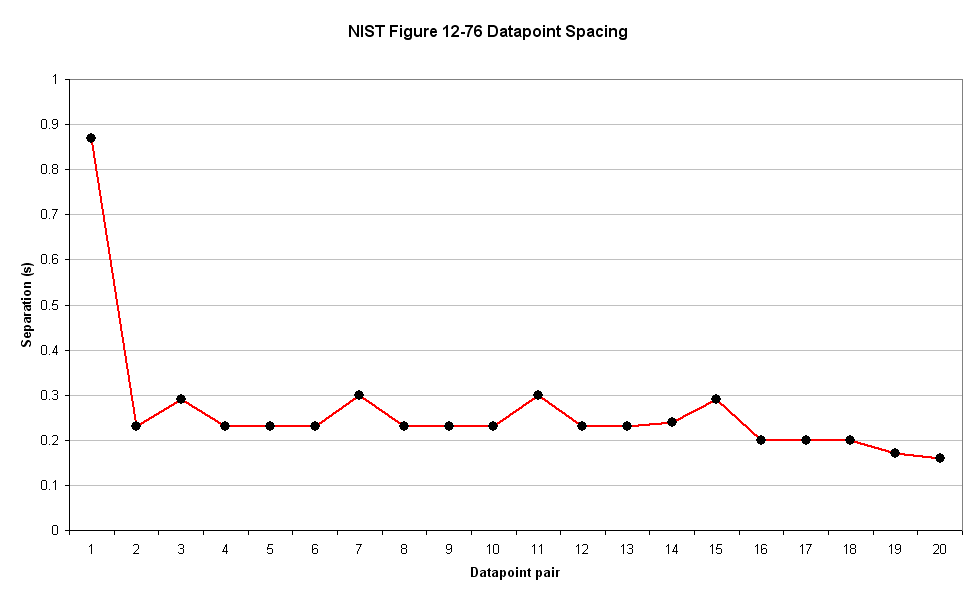
On their displacement data, there is a datapoint at T0, and the next one is nearly a second later...


They waited a bit (though not long enough) before extracting data for the trace above region B.

Sloppy. (And indication they may have manually traced. Yuk.)
 
Last edited:
Also I can't find any mention that they tracked the point as a 'vertical [pixel] column', where does that term come from?
It comes from choosing a horizontal position on the frame and the roofline moving downwards while you look at it's vertical position at that horizontal position on the frame. Elementary my dear Watson. For example, if they had traced using the point they defined their dodgy T0 from, they'd be tracing pixel column 304. The column of pixels 304 pixels from the left of the frame.

(My pixel location is zero indexed btw)
 
Once again, to be very clear: Major_Tom is neither authorized nor qualified to speak for me.

I do not recall making the statement he alleges, and I am absolutely certain that Major_Tom doesn't know what I think. There are three possible explanations for what Major_Tom has said above and below:
  1. I have made the statement he alleges but have forgotten all about it, which seems unlikely.
  2. Major_Tom just made it up.
  3. Major_Tom is just confused.
Since Major_Tom can't seem to come up with a direct quote, everyone should assume some combination of explanations 2 and 3.


Everyone should assume some combination of explanations 2 and 3.


Your earlier comments comparing the results of the NIST with the results of femr seem pretty meaningless unless you ignore the problems outlined in the last 2 pages.


Any time you want to update your comments by considering these other problems, please do.

We have kind of moved along so any time you wish to update your opinion of the accuracy of the NIST data, please jump in.


Do you have anything else to add to your previous opinion of the accuracy of the NIST data or do your previous posts still stand??


???


(Think kink! Think kink!) My point is that you seem to be a little behind with your latest praise of the NIST data. You do not remember evaluating the quality of the NIST data? Don't you think you missed a few things?
 
Last edited:
[/URL]

They waited a bit (though not long enough) before extracting data for the trace above region B.

Sloppy. (And indication they may have manually traced. Yuk.)

Figure 12-76 in NCSTAR 1-9 doesn't look like the graph in your post! Not in my version anyway.
 
Figure 12-76 in NCSTAR 1-9 doesn't look like the graph in your post! Not in my version anyway.
ROFL. Read the graph title for pity's sake...

"NIST Figure 12-76 Datapoint Spacing"

Axes: Separation (s)/ Datapoint Pair

I would certainly hope "Figure 12-76 in NCSTAR 1-9 doesn't look like the graph in [my] post" :D
 
ROFL. Read the graph title for pity's sake...

"NIST Figure 12-76 Datapoint Spacing"

Axes: Separation (s)/ Datapoint Pair

I would certainly hope "Figure 12-76 in NCSTAR 1-9 doesn't look like the graph in [my] post" :D

So where is it from then? You haven't given a reference.
ETA, nevermind, why bother asking you for proper documentation? The graph doesn't provide any insight re: your earlier points anyway. It doesn't make any difference.
 
Last edited:

Back
Top Bottom