• Quick note - the problem with Youtube videos not embedding on the forum appears to have been fixed, thanks to ZiprHead. If you do still see problems let me know.

Merged Discussion of femr's video data analysis

the part that shows the acceleration graph...
...which NIST didn't do.

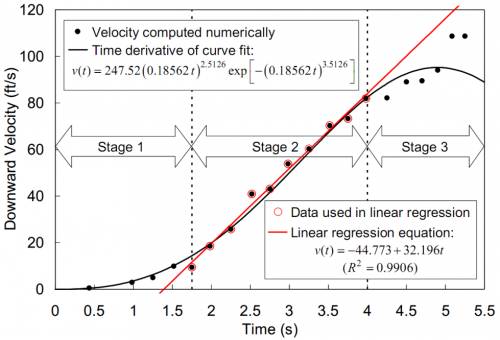
Instead, they used the datapoints circled in red...
659040095.jpg

...(which were themselves determined by central difference approximation from the underlying displacement data) to calculate their stated linear regression (the red line)...

v(t) = -44.773 + 32.196t
 
By gosh, you're right -- the building hardly moved vertically at all while that kink appeared!

On the other hand, those other two nearby buildings both jumped up about forty feet! I guess they were startled by all the horizontal-only movement (and were built on giant springs).

:boggled:

Seriously -- did you really think that animation would fool anyone into thinking you were showing "mostly horizontal motion"?

Respectfully,
Myriad

You just confessed you do not understand the basic argument behind "phase 1 " acceleration. The gif is not proof. Femr has demonstrated far superior methods for that. So has Achimspok a few months ago.

It was just to remind you why you cannot ignore the horizontal component of motion, and if you were actually paying attention you would have already known that.

Horizontal is a very real component of motion. It is surreal I need to explain this to you at this point.


Coming to JREF is like entering a different world of very moody people. Myriad, more focus and less personal attacks please.

Maybe this can help you see something for the first time since 2001:


bowingnorthface2.gif


Perimeter has early horizontal component to motion. If you ignore this and measure upward like the NIST, you screw up the early acceleration.


How? You smooth it out without realizing it.

Are you following?
 
Last edited:
You just confessed you do not understand the basic argument behind "phase 1 " acceleration. The gif is not proof. Femr has demonstrated far superior methods for that. So has Achimspok a few months ago.

It was just to remind you why you cannot ignore the horizontal component of motion, and if you were actually paying attention you would have already known that.

Horizontal is a very real component of motion. It is surreal I need to explain this to you at this point.


Yeah, I'm sure it's somehow my fault that you chose to illustrate your claim of "mostly horizontal motion" with an image showing mostly vertical motion, but presented in a way that disguised said vertical motion. :rolleyes:

You obviously succeeded in deceiving DGM with it. Was that your goal? Congratulations, if so. (Though, if you ask me, I think he's still skeptical of your overall claims, despite this proof of your ability to make confusing arguments.)

Of course, there actually was some horizontal motion. The building was collapsing, after all. What can you tell me about that horizontal motion? Have you done the three dimensional geometry on multiple viewpoints needed to even determine which direction the horizontal motion is in (toward the camera, or toward the left, or somewhere in between)? I asked about such analysis months ago, and you didn't seem interested, so I figured you'd concluded the horizontal motion was not important. Now you're saying it is? Does that mean you'll be doing that geometry soon?

Respectfully,
Myriad
 
To summarise...

IF NIST had derived for acceleration (rather than calculate a linear regression from velocity data determined by central difference), it would look like this when compared to three of my acceleration profile graphs...
513801604.png


I have set T0 for the NIST equation as I think it should be given the Savitzky-Golan profile.


I do not agree that *the NIST model(s)* provide greater accuracy...

NIST's models are considerably more accurate than femr's near the beginning of the collapse (from 11 to 13 seconds on femr2's time scale), but are considerably less accurate near the end of femr2's data (at 17.2 seconds on femr2's time scale).
Do you want to hold to this er assessment ?
 
Last edited:
What can you tell me about that horizontal motion?
Within this context, the important point is that it is not vertical motion.

NIST set T0 based of pixel brightness data change which was actually caused by the non-vertical motion highlighted, rather than actual vertical motion, which skewed their data.
 
Wait..........No smilies?

:boxedin:


I use too few. And the irony is, I have have boxes full of them cluttering up my desk. Staples doesn't sell them in less than 10-gross quantities. :o

Respectfully,
Myriad
 
Yeah, I'm sure it's somehow my fault that you chose to illustrate your claim of "mostly horizontal motion" with an image showing mostly vertical motion, but presented in a way that disguised said vertical motion. :rolleyes:

You obviously succeeded in deceiving DGM with it. Was that your goal? Congratulations, if so. (Though, if you ask me, I think he's still skeptical of your overall claims, despite this proof of your ability to make confusing arguments.)

Of course, there actually was some horizontal motion. The building was collapsing, after all. What can you tell me about that horizontal motion? Have you done the three dimensional geometry on multiple viewpoints needed to even determine which direction the horizontal motion is in (toward the camera, or toward the left, or somewhere in between)? I asked about such analysis months ago, and you didn't seem interested, so I figured you'd concluded the horizontal motion was not important. Now you're saying it is? Does that mean you'll be doing that geometry soon?

Respectfully,
Myriad

You must have the wrong "you". I think you missed the whole point about why the Dan Rather viewpoint is important.

( Um........ Has to do with the viewing angle.)

I am convinced that as people catch up to speed, they will see why the femr early acceleration is much better than the NIST measurements.

Myriad is making it painfully obvious where the part of the confusion lies.

The whole secret of early acceleration and the "greater than g" spring action is in the early flexure.

If you do not identify the early horizontal component and the subsequent spring flexure action, you know nothing about the acceleration profile
 
Last edited:
Within this context, the important point is that it is not vertical motion.


What can I say, when you're right you're right!

Cats said:
You've seen us both at work and games
And learnt about our proper names
Our habits and habitat
But how would you ad-dress a cat
So first, your memory I'll jog
And say: A cat is not a dog


NIST set T0 based of pixel brightness data change which was actually caused by the non-vertical motion highlighted, rather than actual vertical motion, which skewed their data.


By how much?

And the method you used to prevent your own data from being skewed for the same reason is...?

Respectfully,
Myriad
 
By how much?
Why have you not read this thread before asking such questions ?

I suggest (and have done so many times) that the NIST T0 is about a second early.

And the method you used to prevent your own data from being skewed for the same reason is...?
Primarily choosing a video which is not affected by North-South movement, in other words the Dan Rather viewpoint.

There has been lots of discussion within this thread on the point. May I suggest you delve in.
 
No, you unfortunately missed the point...
I was referring to pointing out the side effects that are shown (mostly from the GIF makers trying to make a point) in the GIFs. Unless you are claiming the buildings in the foreground jumped up and WTC7 expanded sideways (dramatically) as the penthouse sank into the building. Dangerously close to propaganda. don't you think?

:rolleyes:
 
Primarily choosing a video which is not affected by North-South movement, in other words the Dan Rather viewpoint.


That would do it -- if the lens were perspective-free (or at an infinite distance).

One could also choose a reference point that, being near the center of the "kink," shows little or no left-right movement from any viewpoint and therefore could not have moved a great deal north-south.

Sorry, details whose relevance has not been established are difficult to remember after months. I have read the thread but in the absence of a coherent thesis it's difficult (and entirely unnecessary) to keep it all straight.

Respectfully,
Myriad
 
TOne could also choose a reference point that, being near the center of the "kink," shows little or no left-right movement from any viewpoint and therefore could not have moved a great deal north-south.
Here's a view from the Dan Rather viewpoint after the formation of *the kink* and when the building is well on its way down...
321729423.png


Tell me, where is the kink ?

What can you infer from your answer ?
 
Here's a view from the Dan Rather viewpoint after the formation of *the kink* and when the building is well on its way down...
[qimg]http://femr2.ucoz.com/_ph/7/321729423.png[/qimg]

Tell me, where is the kink ?


It's at the same place it is in the other images and videos. They're all of the same event, right?

What can you infer from your answer ?


From looking at all the viewpoints, it appears most likely that the kink was caused by differential amounts of north-south movement or lean, with the most occurring at the left side of the building, tapering off to none at the vertex of the kink just left of the east-west center of the building. On the right half of the building we see little or no horizontal movement from any viewpoint, so there is no reason to expect tracked y movement on those parts of the building from any viewpoint (when suitably corrected for perspective) to represent anything other than vertical collapse.

This cannot be proven, though, without real 3-D analysis. Various combinations of differential vertical movement and differential horizontal movements could result in the same visual effects, though that does seem less likely.

Respectfully,
Myriad
 
Last edited:
This will be my last response to femr2 before I restore his contributions to their rightful place in my reading list.

As I explained in my most recent post, NIST section 12.5.3 uses a nonlinear model with 3 parameters to describe the downward displacement of the north wall
Indeed, but a linear regression for acceleration.
This may come as quite a shock to you, but NIST's report was written for people who understand calculus. They will recognize what is implied by the formulas even if you don't.

I think the reason they didn't derive again is clear once you superimpose the resultant NIST acceleration curve atop one of mine. The inference of what you are saying is that the NIST acceleration curve is more accurate. As you can imagine, I don't agree.
You are drawing an incorrect inference. My calculations provide an objective measure of how well the modelled displacements matched your measurements. They provide only an indirect measure of the accuracy for acceleration, which (in this case) can only be inferred from the measured displacements.

It is an objective fact that during the first moments of WTC 7's collapse (between 11 and 13 seconds on your time scale), according to your own displacement data, using the standard sum of squares criterion, NIST's model is more accurate than your Poly(10) model.

Keeping those numbers to yourself is okay so long as your only purpose is to discuss vague trends, but you should not make any claims concerning the accuracy of your models without stating or publishing the numbers necessary to evaluate your claims properly.
I'm not *keeping those numbers to myself*. As I said, the tools I use will only output coefficients up to degree 16.
Yet you have kept the Poly(10) numbers to yourself, and they're for degree 10. At this point, you've spent more time defending your decision to keep those numbers to yourself than it would have taken to tell us what they are.

That was just yesterday. You were telling us that your polynomials must be better than NIST's approximations because (you thought) NIST's approximations were linear.
Which I hold to.
Of course you do.

Near the beginning of the collapse, where the "early gradient" makes a difference, your Poly(50) model would have performed even worse than your Poly(10) model because its slope is steeper and it intersects the zero-acceleration line at a later time than your Poly(10) model.
Which would have required you to reevaluate your personal choice of T0.
That's nonsense. I have not made any "personal choice of T0". The data are yours, the Poly(10) and Poly(50) models are yours, and NIST's model is theirs. The only parameters for which I have had any choice are
  1. the parameters I had to reverse-engineer because you wouldn't reveal them
  2. the choice of 10.9 seconds as a reasonable offset between your time axis and NIST's
If you're unhappy with my reverse-engineered parameters, then the fault is yours for not revealing your numbers. You can repair that problem by revealing your numbers or by performing your own calculation. You have done neither.

My choice of 10.9 seconds cannot affect the computed accuracy of your model. A better choice for that offset can only improve the computed accuracy of NIST's model. Hence you cannot complain about that choice.

I find it eyebrow raising that you suggest the curve resulting from deriving the NIST velocity equation is a closer fit to ACTUAL motion.
Yet it is an objective fact that the model in NCSTAR 1-9 section 12.5.3 fits your own measurements of the NW corner's motion better than your own Poly(10) model during the interval between 11 and 13 seconds (your scale), when the collapse was beginning.

I invented one of the (less important) numerical algorithms your software is using.
Interesting. Which one ? What software do you mean ?
Any software that converts decimal scientific notation to binary floating point according to the standards set forth in IEEE 754-2008, XML Schema (W3C), the Java Language Specification, ...

It is entirely reasonable for you to assume that I understand the consequences of increasing a fitting polynomial's degree.
Good. Then I suggest the Poly(50) curve would have been the better choice for your analysis.
Yet you cannot support your suggestion with actual numbers, because your Excel plug-in won't tell you what the relevant numbers are.

I have already explained why your Poly(50) model would have even more error near the beginning of the collapse than your Poly(10) model
Again, rather, you would have to rethink your T0.
You are talking nonsense. Calculating the residual sum of squares for your models does not involve any notion of a T0. If you understood that calculation, you would not be saying such silly things.

Run the numbers and find out, or tell me its numeric parameters and I'll find out for you. I've already told you what I think is likely to happen, but I could be wrong.
Am limited to output data at degree 16 with current software :mad:
:cool:

I do not agree that *the NIST model(s)* provide greater accuracy.
Yet it is an objective fact that, during the interval from 11 to 13 seconds on your time scale, using your own measurements of the NW corner, using the objective criterion of least squares, NIST's model as described in section 12.5.3 is more accurate than your Poly(10) model.

 
That would do it -- if the lens were perspective-free (or at an infinite distance).

One could also choose a reference point that, being near the center of the "kink," shows little or no left-right movement from any viewpoint and therefore could not have moved a great deal north-south.

Sorry, details whose relevance has not been established are difficult to remember after months. I have read the thread but in the absence of a coherent thesis it's difficult (and entirely unnecessary) to keep it all straight.

Respectfully,
Myriad

Early WTC7 motion is a "detail whose relevence cannot be established"?

When you "study", what exactly is it that you do?

Almost 10 years. This is WTC7. Early motion kind of important, remember?


Surreal. How can you pretend to have knowledge over how natural these buildings collapsed with so little understanding or interest in real motion?
 
Last edited:
They will recognize what is implied by the formulas even if you don't.
Here is the acceleration profile implied by their formulas...
http://femr2.ucoz.com/_ph/7/513801604.png


You really should note the close correlation between the two poly-based and one Savitzky-Sobel smoothed profiles in contrast to the implied NIST curve.

Perhaps you'd also like to compare to tfk's acceleration profile derived from my data...
51514794.png

(Note his personally chosen T0)

My calculations provide an objective measure of how well the modelled displacements matched your measurements. They provide only an indirect measure of the accuracy for acceleration, which (in this case) can only be inferred from the measured displacements.
Yet as you can see from the graph above, the implied NIST acceleration profile is drastically different.

T0 cannot be ignored.

NIST's model is more accurate than your Poly(10) model.
T0 cannot be ignored.


That's nonsense. I have not made any "personal choice of T0". The data are yours, the Poly(10) and Poly(50) models are yours, and NIST's model is theirs. The only parameters for which I have had any choice are
  1. the parameters I had to reverse-engineer because you wouldn't reveal them
  2. the choice of 10.9 seconds as a reasonable offset between your time axis and NIST's
You chose T0.
I have not refused to reveal parameters.

My choice of 10.9 seconds cannot affect the computed accuracy of your model. A better choice for that offset can only improve the computed accuracy of NIST's model. Hence you cannot complain about that choice.
There seems to be a drastic misunderstanding going on here.

If you align the start of the NIST model data at 10.9s, you are setting T0 to 10.9s.

In the graph above, I have set the start of the NIST implied model data to ~11.75s, and you can see the result.

Remember that the Sovitzky-Sobel smoothed curve is simply smoothed data with derivation by simple symmetric differencing. It will reflect the true profile.

Yet it is an objective fact that the model in NCSTAR 1-9 section 12.5.3 fits your own measurements of the NW corner's motion better than your own Poly(10) model during the interval between 11 and 13 seconds (your scale), when the collapse was beginning.
See above.

Yet you cannot support your suggestion with actual numbers, because your Excel plug-in won't tell you what the relevant numbers are.
Correct, though the close correlation with the Poly(10) curve and the Savitzky-Sobel smoothed profile allows me the privelage of making the suggestion with confidence.

You are talking nonsense. Calculating the residual sum of squares for your models does not involve any notion of a T0. If you understood that calculation, you would not be saying such silly things.
Perhaps you'd like to explain then, and also explain why setting the relative start point of the NIST formulas about an hour previously would have zero effect upon how closely it matches the underlying displacement data (as you say T0 doesn't matter)...
 
Last edited by a moderator:

Back
Top Bottom