• Security incident: ISF was recently accessed by intruders. Please change your password, and change it anywhere else you used it. Read more

Merged DDWFTTW in a “Real” Wind

Status
Not open for further replies.
We can use Newton's impact theorem. Not accurate, but good enough.

<long but sadly irrelevant analysis snipped>

[qimg]http://www.internationalskeptics.com/forums/attachment.php?attachmentid=22002&stc=1&d=1304094331[/qimg]

The headwind slows the cart. If you think that rotation helps because the blade can move the the other way, then you are forgetting that the whole blade move forwards too. When at constant speed, the translation of the surface in the direction of the cart is constant, and independent of the angular velocity of the rotor.

You mean we can misapply Newton's impact theorem.

Your analysis makes the basic error of failing to account for the fact that the blade is a) turning and b) pitched. You have wrongly imagined that you can model the surface of the blade as a flat plate advancing into a headwind. Basic geometry should tell you that this is wrong because the angle of incidence of the air and blade are not as you imagine.

Consider in your diagram the small area A moving forward by distance X. Due to the rotation of the blade, A also rotates on the hub, say by by distance Y. The portion of the blade which is now at the same angle to the hub as A was, let's call it A', is actually further back on the blade due to the blade's pitch. Let's call that distance X'. If the speed and pitch of the prop make X' greater than X (which in the case of the BB they necessarily do) then the blade does not impact the air molecules which were immediately in front of A.

If only you could imagine yourself in the position of one of those air molecules immediately in front the surface of the blade it would be much clearer. the whole blade is moving forwards toward you but it's rapidly turning and the point on the steeply pitched blade perpendicular to you is constanly shifting to a part which is further away. This retreating surface actually makes space which allows you and your 500ms-1 buddies to spread out a bit. A drift will be created which makes you all tend to follow the retreating blade backwards.

This unfortunately makes irrelevant your long description of what happens when the front face of the blade impacts the molecules, since it doesn't. Don't worry that the work was wasted though, because the air has to impact the moving blade somewhere. It rather depends on how steep the angle of attack is, but fundamentally it's on the other side of the blade.
 
Give Humber two identical airfoil sections, each travelling downwind at 40 degrees off the downwind direction.
The first one is on a land yacht; Humber accepts that this sail airfoil provides thrust from the apparent wind it experiences, and that the yacht can travel at around 5 times the wind speed.
The second is a point on a propellor blade: this, according to Humber, just cannot work. The hub is going directly downwind and meeting a headwind, therefore any point on the propellor must be too!
Humber just can't grasp that the point on the prop blade is, like the land yacht's sail, continually moving 40 degrees off the downwind direction, as he can't grasp the concept of helical motion through the air.
Or if he can, he has been waffling to the contrary for so long that he just can't admit it!
 
Last edited:
The speed of the molecules is simply a fact. The wind speed is a drift in that random motion, .......

Your belief seems to be that wind is simply a directional tendency of Brownian motion? Please clarify.
 
The speed of the molecules is simply a fact. The wind speed is a drift in that random motion, ...<snip>

Oh, and there was me thinking that wind was caused by weather, you know, the sun heating the Earth differently in different places and causing pressure differences. You live and learn (well, some of us learn)

I'm sorry but I just cannot take you seriously, and I regret responding to your nonsense.

To the sensible posters, thanks for your contributions. I may not understand some of the finer points of this discussion, but it has been and continues to be of interest.

Dave

ETA I will be away with erratic internet access until Monday week, so will probably not be able to respond to any responses.
 
Last edited:
This unfortunately makes irrelevant your long description of what happens when the front face of the blade impacts the molecules, since it doesn't. Don't worry that the work was wasted though, because the air has to impact the moving blade somewhere. It rather depends on how steep the angle of attack is, but fundamentally it's on the other side of the blade.

No, you are out of luck. It demonstrates that you have all been fooled.

The plate is in motion with still air. It is driven or towed to 10m/s, and then released. The molecular motion of 500m/s, is a frame of reference, and the plate's motion is relative to that. The calculation shows that the plate will lose KE very quickly and slow.

3) This means in the ground frame, the kinetic energy of the molecules being reflected from the front has increased from m/2*u² to m/2*(u+2v)² =m/2*u² +2*m*u*v + 2*m*v², i.e. an increase of +2*m*u*v + 2*m*v².

4) Molecules reflected from the back side, have changed their energy from m/2*u² to m/2*(-u+2v)² = m/2*u² -2*m*u*v + 2*m*v²
i.e. a change of -2*m*u*v + 2*m*v².

5) Adding and averaging (3) and (4) gives the average increase of the kinetic energy of the molecules with mass m hitting the plate with velocity v as
ΔK = 2*m*v².

The last is the equation for the transfer of the plate's KE to the air. Note from (3) and (4) that u, the molecular velocity, drops out to leave only the plate speed v ;the speed of the plate relative to the air.

If u includes a wind, which is a drift speed added to the molecular speed, it will still drop out, leaving the v, speed relative to the air.

The KE loss is proportional to the square of the difference of wind and plate, and so (Vw-Vplate)^2 as normally expected, and free of the speed relative to the ground; only the relative speed of wind and plate are significant.

That is in accordance with Rayleigh and Galileo: a plate moving 5m/s faster than the wind, will lose KE at the same rate as a plate moving at 5m/s in still air, and independently of the speed relative to the ground. Tell me my calculation is wrong, with that support...

That is a direct consequence of the same transform that allows you to say that at WS, there is no relative motion of plate and air, other than the molecular motion of the air, so like the still air of a room.

The calculation says the entire cart, prop included, will lose KE independently of its speed relative to the ground. Angular motion of the prop, is an instantaneous addition to u at the front of the blade, and a subtraction at the rear -u, and that drops out as before.

To overcome that, power must be applied to the prop, so adding acceleration to u. That is why planes have engines.

The cart has no engine. The claim is PM, and that proves it.

The TM is an Atwood's balance and the trials a farce and the theory is bunk.

As to the excuses that will follow...suck it up. The cart has been shot down by its own Galilean claim. Carteers can wait to see how well Spork and JB defend their claim against a direct theoretical challenge.
 
Last edited:
Your analysis makes the basic error of failing to account for the fact that the blade is a) turning and b) pitched. You have wrongly imagined that you can model the surface of the blade as a flat plate advancing into a headwind. Basic geometry should tell you that this is wrong because the angle of incidence of the air and blade are not as you imagine.

You certainly would think so wouldn't you?

There is no reason anyone should do something because I suggest it, but I think we need to do what spork has done long ago and stop responding to Humber. There is a difference between playing blind man's bluff and stealing a blind man's cane and putting him on a merry-go-round.

As you can see from Humber's response to your post he is not just ignorant, he is not even a normal troll. He really isn't ok folks.

It proves beyond a doubt that the cart is a phony. Big cog diz moment for The Carteerian alliance. The rate of loss may be approximate, but it will be there no matter what. And the bet over the TM has been called, and your bluff exposed...though by all means, take it up again.
 
Last edited:
rotating props generate thrust!

No, you are out of luck. It demonstrates that you have all been fooled.

"Irrelevant discourse":)

To overcome that, power must be applied to the prop, so adding acceleration to u. That is why planes have engines.

The cart has no engine. The claim is PM, and that proves it.

. [/U]

Humber, this is such silly nonsense.

The purpose of an airplane engine is to provide torque to the prop shaft so the prop can produce thrust. We have all agreed that the prop is receiving torque in its prop shaft from the drivetrain and not driving the wheels. (exactly like an engine!) The prop on the BB has the equivalent of an "engine".

However, let me be clear that the cart, as a whole, only has the Wind as an "engine" very similar to a sailboat. There is no PM nor COE violation since this energy comes from "outside the system (the cart)". (Also to reduce trivial feedback, Wind is defined as "movement of the airmass over the ground")

Your argument is just absurd at this point. You need some new material. You are now being irrelevant repetitiously.

Regards,

WindGrins:)
 
Last edited:
The rate of loss may be approximate, but it will be there no matter what.

Once again you have failed to grasp the relative motion of the "plate" (i.e propeller blade) and the air. Your model of a propeller blade is a flat plate advancing face-on into still air. That is utterly wrong and patently idiotic.

You seem to have no idea that what you claim means that propellers cannot work ever. You have declared that no matter how fast you turn a propeller, when it advances through a medium it only produces drag identical to that which it would produce if it were not turning.

If you disagree (as I'm sure you will) perhaps you can reconsider your calculations to see what difference it makes to your result if the prop is static, freewheeling or powered. Answer: none. In the humberverse a propeller plane with a 1000hp engine has no more chance of taking off under its own power than has a glider with a pair of criss-crossed planks nailed on the front.

I am coming round to jduffy77's point of view: Humber does not need help to understand simple mechanics. He needs some different kind of help.
 
Humber, this is such silly nonsense.

The purpose of an airplane engine is to provide torque to the prop shaft so the prop can produce thrust. We have all agreed that the prop is receiving torque in its prop shaft from the drivetrain and not driving the wheels. (exactly like an engine!) The prop on the BB has the equivalent of an "engine".

However, let me be clear that the cart, as a whole, only has the Wind as an "engine" very similar to a sailboat. There is no PM nor COE violation since this energy comes from "outside the system (the cart)". (Also to reduce trivial feedback, Wind is defined as "movement of the airmass over the ground")

Your argument is just absurd at this point. You need some new material. You are now being irrelevant repetitiously.

Regards,

WindGrins:)


More nonsense.
The engine furnishes angular power to the shaft, so providing a means of accelerating the air,.
Thrust = л/4•D^2•[v+∆v/2] • ρ, where ∆v/2 is the velocity component provided by the engine.

At one stage, the ground was said to power the cart, but of course that put the cart well and truly in the crank and PM class, so a new lode of BS was mined.
 
Humber's retort

I am coming round to jduffy77's point of view: Humber does not need help to understand simple mechanics. He needs some different kind of help.

JBTH,

I think you are right. It's not even fun punching holes in his statements anymore because they are now so trivially wrong! I think this guy does need help but not the kind we are able to provide.

I'm confident he will have the final word in this because everyone else will have reached the point where it is not worth bothering to respond. See immediate message above as a case in point.

Regards,

WindGrins:)
 
Angular motion of the prop, is an instantaneous addition to u at the front of the blade, and a subtraction at the rear -u, and that drops out as before.

To overcome that, power must be applied to the prop, so adding acceleration to u. That is why planes have engines.
Humber, you may know how to quote an equation but you have no idea beyond word-matching which equations may be relevant to a system. You also clearly have absolutely no grasp of the mechanism by which a propeller operates.

If you think otherwise, please explain to us in as much detail as you feel able what you think you meant by the highlighted part.
 
Once again you have failed to grasp the relative motion of the "plate" (i.e propeller blade) and the air. Your model of a propeller blade is a flat plate advancing face-on into still air. That is utterly wrong and patently idiotic.

You seem to have no idea that what you claim means that propellers cannot work ever. You have declared that no matter how fast you turn a propeller, when it advances through a medium it only produces drag identical to that which it would produce if it were not turning.

If you disagree (as I'm sure you will) perhaps you can reconsider your calculations to see what difference it makes to your result if the prop is static, freewheeling or powered. Answer: none. In the humberverse a propeller plane with a 1000hp engine has no more chance of taking off under its own power than has a glider with a pair of criss-crossed planks nailed on the front.

I am coming round to jduffy77's point of view: Humber does not need help to understand simple mechanics. He needs some different kind of help.


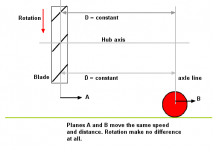
More text-book free fantasy from Spork. No tacking props, nor blades that move slower or faster than the wind. All planes of rotation move at the speed of the cart, and a simple case of translation. Added BS for those who like to think they have "insight" and sell it.

attachment.php
 

Attachments

  • constant_distance.png
    constant_distance.png
    7.8 KB · Views: 56
Last edited:
Sad Facts

More nonsense.
The engine furnishes angular power to the shaft, so providing a means of accelerating the air,.
Thrust = л/4•D^2•[v+∆v/2] • ρ, where ∆v/2 is the velocity component provided by the engine.

At one stage, the ground was said to power the cart, but of course that put the cart well and truly in the crank and PM class, so a new lode of BS was mined.

Humber,

The sad fact is I actually understand the equations you keep trotting out and how they never apply to anything you state.

No matter how you spin it (no pun intended) the props of all the big and little carts in all the videos that go DW properly all have their props being turned by torque on their propshafts. Rotating propellers produce thrust.

Your credibility is severely diminished even further when you prove that "propellers only produce drag."

How is this going to help you with any argument?


Regards,

WindGrins
 
Humber, you may know how to quote an equation but you have no idea beyond word-matching which equations may be relevant to a system. You also clearly have absolutely no grasp of the mechanism by which a propeller operates.

If you think otherwise, please explain to us in as much detail as you feel able what you think you meant by the highlighted part.

Try again. Duffy has already shown his mettle, and what a Carteer's opinion is worth.
You have all been HAD by an unqualified crank.
 
Last edited:
Picture is wrong.

More text-book free fantasy from Spork. No tacking props, nor blades that move slower or faster than the wind. All planes of rotation move at the speed of the cart, and a simple case of translation. Added BS for those who like to think they have "insight" and sell it.

[qimg]http://www.internationalskeptics.com/forums/attachment.php?attachmentid=22011&stc=1&d=1304170351[/qimg]

Humber,

PS, You have your blades backwards (rotate the blades 90 degrees CCW around their center to fix or reverse your rotation arrow to pointing up) in your irrelevant diagram.

It pains me to have to help you (not make) your point!

Windgrins
 
Last edited:
Humber,

The sad fact is I actually understand the equations you keep trotting out and how they never apply to anything you state.

No matter how you spin it (no pun intended) the props of all the big and little carts in all the videos that go DW properly all have their props being turned by torque on their propshafts. Rotating propellers produce thrust.

Your credibility is severely diminished even further when you prove that "propellers only produce drag."

How is this going to help you with any argument?


Regards,

WindGrins

No you don't. A buzz word jockey, for whom a little knowledge is a dangerous thing. Balloons with out PE...closing speed that falls to zero...
etc etc
Planes have engines because engineers design them for that task, using the tool of mathematics and structural engineering.

Simply being able to drive a plane, does not make a pilot a physicist - though many seem to think that spending the money for a ubiquitous but over-priced license does - anymore than it makes a motorist an automotive engineer. Most do not know of aeronautics, but pilots know enough to get it wrong.

Your credibility is severely diminished even further when you prove that "propellers only produce drag."
We can add that to your " actual understanding" of the equations.
Go ahead, point to the errors....
 
Last edited:
Status
Not open for further replies.

ISF - Join now!

Every member here is approved by hand. No bots, no spam, just people who care about evidence and honest debate.

Membership is free!

Create your free account

Back
Top Bottom
