Merged Molten metal observations

If molten aluminum cannot be "incadescent" at the temps of an office fire how do you explain the fact that the flames of the fires themselves do give off visible light in not only this fire but in all fires?

So you're saying aluminium can't become incandescent in office fires? So you're claiming that what we see in the video isn't aluminium? Seems like you just switched sides to the truther movement.
 
Well I'm trying to prove that it couldn't be aluminium because it couldn't have that shape. On the other hand steel having a much higher melting point could be incandescent in a vertical position as parts of it are melted away by thermite.

For example in this picture http://www.loupiote.com/photos/26781935.shtml You clearly see how it is necessary to have a view from above to see the molten metal in the crucible.

In this picture http://www.loupiote.com/photos/26781866.shtml the molten material is hardly visible as our view approaches the level of the molten metal. It is clear to see how hard it would be to see said molten material pool from the street. Notice also how the bottom of the crucible is no longer as hot as the pouring material. Something we don't see in the video. The wall has the same brightness and color as the falling material.

So you're saying aluminium can't become incandescent in office fires? So you're claiming that what we see in the video isn't aluminium? Seems like you just switched sides to the truther movement.

Are you really that dense?

No, you are saying that aluminum cannot be incadescent at office fire temps and I am asking why it cannot be given that all offices fires produce visible light even from burning office furnishings.

My post, this time with the entire implied reference included.
Originally Posted by jaydeehess
If molten aluminum cannot be "incadescent"(apparently according to you) at the temps of an office fire how do you explain the fact that the flames of the fires themselves do give off visible light in not only this fire but in all fires?
 
Last edited:
Furthermore would you have a picture of molten steel being poured in direct sunlight?

Yes I do:

metald.png


LOL, just kidding

http://www.flickr.com/photos/23930432@N06/2537759352/

http://www.flickr.com/photos/23930432@N06/2536941243/
 
Are you really that dense?

No, you are saying that aluminum cannot be incadescent at office fire temps and I am asking why it cannot be given that all offices fires produce visible light even from burning office furnishings.

My post, this time with the entire implied reference included.

I believe it is you being dense. I'm not claiming that aluminium can not be incandescent at office fire temps. I'm claiming that it would have melted a long time before reaching incandescence and thus would have pooled and not stayed in a vertical position like steel would given its higher melting point.
 
I'm trying to find the sources, but I did see a video that said it was aluminum. More specifically, debris from the aircraft that impacted the tower.

If you think about it, it makes perfect sense. The aircraft came in at an angle, unlike the head-on collision of the other tower. This is why the debris is in the NE corner of the south tower, (the dripping melted material) while in the north tower, we don't see this happening. The aircraft stopped in the Northeast corner of the South Tower, right where the metal is seen exiting the building.

When the 80th floor started sagging, it took this melted debris and pooled it to the point where it started flowing out of the building. As for the debris that is somehow immune to gravity - I would suggest that part is still inside the building, not outside which would account for it sitting there prior to it flowing out.

There are several oxygen containers inside the aircraft, too - all wrapped in aluminum. Obviously those would be extremely flammable - and hot enough to melt aluminum.

Since all other possibilities have been ruled out, this is the only theory which holds water. I have yet to see any other theory which makes more sense.
 
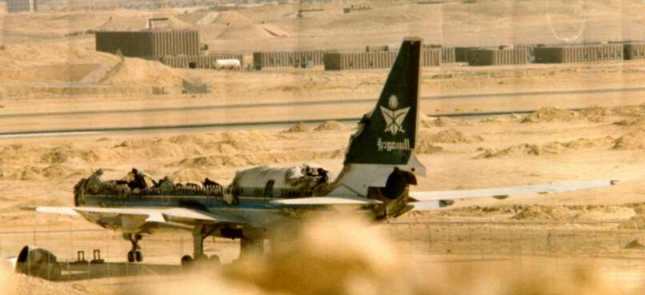
Before you pull a checkmate move you should consider that the aluminium you claim melts actually burns as seen in these photos:

http://msnbcmedia3.msn.com/j/MSNBC/Components/Photo/_new/090323-japan-crash-hmed-1125p.grid-6x2.jpg

http://www.thenational.ae/deployedfiles//Assets/Richmedia/Image/AD200910712179918AR.jpg

http://farm2.static.flickr.com/1028/1302615941_54293b6954.jpg

So no, the aluminium you claim melts actually burns in an airplane fire.

I'll assume that you mean that the fires didn't burn hot enough to melt the aluminum? Since I already shown that a) the fires were 800-1000 degrees celcius and b) the aluminium in that plane would melt at approx 550 degrees, you need to disprove a) or b. Showing me a pictures of planes burning on their own, where temperatures wouldn't be that hot for long, makes no sense.
 
Last edited:
I'm trying to find the sources, but I did see a video that said it was aluminum. More specifically, debris from the aircraft that impacted the tower.

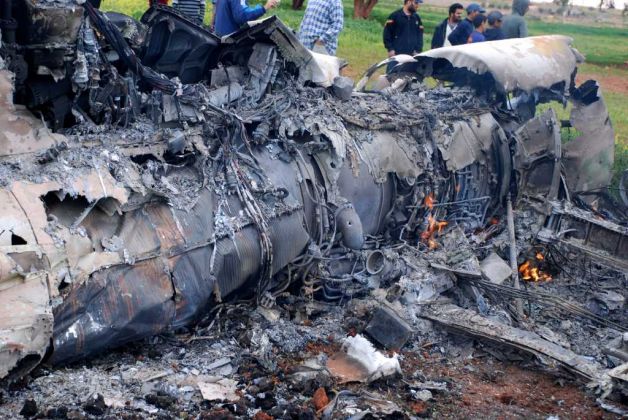
You're just pulling at straws here in a desperate attempt to make your point. I've said this before in this thread. Airplane fuselages burn in fires they don't melt.

http://www.dailymail.co.uk/news/art...S-pilots-F-15E-plane-crash-near-Benghazi.html

http://i.telegraph.co.uk/multimedia/archive/01210/denver-plane-crash_1210284c.jpg
 
I'll assume that you mean that the fires didn't burn hot enough to melt the aluminum? Since I already shown that a) the fires were 800-1000 degrees celcius and b) the aluminium in that plane would melt at approx 550 degrees, you need to disprove a) or b), showing me a picture of planes burning on their own, where temperatures wouldn't be that hot for long, makes no sense.

Please show me the molten aluminum under the wreckage? There is none, it goes up in smoke. So no aluminum pooling for the photo.
 
Please show me the molten aluminum under the wreckage? There is none, it goes up in smoke. So no aluminum pooling for the photo.

You have misunderstood me.

Where is your evidence that those plane fires reached 800-1000 degrees celsius for a sustained period of time? You have none, I know. It's a different kind of fire.
 
Airplane fuselages burn in fires they don't melt.

I don't know if I should comment on that or ignore it. Are you suggesting that metal doesn't melt? I dunno man....that might be stundie material.

Metal melts. You may have said it already, but that doesn't make it so.

ANYWAY

9-11_thermite2.jpg


The aircraft that struck the tower came to rest where the aluminum material in question exits the building. Where the blue arrow points to is proof of that
- the perimeter columns are bowing outwards, as if they've been pushed from the inside.

Now - forgive me, but you'll have to use your imagination for this part.

The yellow arrow denotes what happened, according to NIST, MIT and FEMA. The floor sagged, causing the aluminum from the aircraft to flow downwards, and outside the building. You asked, you got an answer.

Just because it's apparently not good enough for you, doesn't make it any less TRUE. Accept it and move on.
 
You have misunderstood me.

Where is your evidence that those plane fires reached 800-1000 degrees celsius for a sustained period of time? You have none, I know. It's a different kind of fire.

So I guess airport runways are full of office material? And coincidently so are all the airplane crash sites in the world! Or how else do airplanes burn as they do without the help of office furniture?

May I nominate you for a stundie? It's pretty clear that if an airplane burns on a runway it very well burns up inside a WTC tower. Even if the tower were stripped naked of any flammable material.
 
Guys,

Aluminium Melting Point: 660.37 °C or 933.52 K or 1220.666 °F
If a fire reaches 1,220*F, then the aluminum is going to melt. Since the insides of the Towers reached 1,800*F, then that suggest that the planes skin melted due to the extreme heat.

Saying that the aluminum doesn't melt in extreme fires is just rediculas. I can see a low burning fire under 1,220*F burning aluminum.
 
[qimg]https://lh5.googleusercontent.com/-d6Ta55mTC4w/TYOdVliLykI/AAAAAAAAIL4/rOutRI1ynXw/s1600/zzplanezz.jpg[/qimg]

Another photo of melted metal on an aircraft accident.

All we see there is ash. There's no melted aluminum puddles. Your fuselage aluminium theory is looking harder to believe with every picture YOU post.
 
Guys,

Aluminium Melting Point: 660.37 °C or 933.52 K or 1220.666 °F
If a fire reaches 1,220*F, then the aluminum is going to melt. Since the insides of the Towers reached 1,800*F, then that suggest that the planes skin melted due to the extreme heat.

Saying that the aluminum doesn't melt in extreme fires is just rediculas. I can see a low burning fire under 1,220*F burning aluminum.

http://education.jlab.org/itselemental/ele006.html

Carbon Melting Point: 3823 K (3550°C or 6422°F)

So Chewy, according to you if I heat carbon in my kitchen to 4000º K it should melt over my stove. Oh but wait I guess it would just burn away way sooner than that given the oxygen in the atmosphere around it.
 
[qimg]http://www.paulhackett.ca/wp-content/uploads/2007/08/chinaairlines.jpg[/qimg]

China airlines crash.

Melted fuselage.

WOW yea look at all that dripping aluminium, not. LOL give me a break. You're doing yourself more harm than good by posting pictures of accidents that lack a single pool of molten aluminum.
 

Back
Top Bottom