• Security incident: ISF was recently accessed by intruders. Please change your password, and change it anywhere else you used it. Read more

Merged DDWFTTW in a “Real” Wind

Status
Not open for further replies.
.
As mentioned a few thousand pages back, the big turboprop airplanes -must- have a device that will de-couple a propellor which has failed into low pitch in the air, from the rest of the gearbox and the motor.
The windmilling drag is so high if the low pitched prop is connected and driving the motor thru the gearbox, the flight control system is incapable of handling the asymmetric drag.
The runs I made yesterday with the tacking prop were more successful when I switched to a lower pitched prop from the first runs, as it has more windmilling drag for the available winds at the time, than the higher pitched prop and could move the cart sooner and further once it got going.
The usual fix for a motor failure on a full-scale is to increase the pitch of the prop, so the incoming airstream can't rotate it. Failing into low pitch is seriously bad.
Reading about a guy flying his Cub, he routinely turns the motor off in flight.
The Cub has a fixed pitch prop, and will windmill until he slows the plane down to where the incoming wind due to airspeed can't push the prop around against the compression of the motor.
He then thermal soars with the prop not moving.
To restart, he has to dive the plane to get the prop windmilling again, and then turns on the ignition, and the motor fires and powers the prop.
Someone noted that the airspeed he has to dive to get the prop going is beyond the Vne of the airplane!
But there's a margin of no windmilling airspeeds he can play with while gliding.
There has to be something like this involved here.
The sail force from behind pushes the cart until the windmilling force from the front balances it.

This guy is definitely a few steps behind Humber.
 
.
Yes, didn't, never, couldn't, wouldn't say it was.
But the freewheeling effect has to be considered.
The cart moves downwind with the prop fixed, no motion at all.
That's a sail.
Windmilling and -not- connected to the drive wheels, it's still a sail.
Freewheeling, it would rotate opposite the direction of rotation needed to move the wheels.
No. It's a turbine to the tailwind

attachment.php


.
For the props used, the normal right hand twist, and the wind impinging on the back of the prop, it rotates opposite the direction it would freewheel with the wind coming from the front.
Connecting to the drive wheels, it's the sail effect that starts the cart moving, and then the wheels begin add velocity, as the prop -can't- windmill.
"Something":) occurs when the downwind speed of the cart reaches and exceeds the wind speed, for the cart to continue in what becomes a headwind.
The "somehow" is that the cart's KE, replaces the engine, but acceleration is impossible, because losing KE causes the cart to slow. The system has an overall loss. Towed to >WS, it would slow to some speed <WS. About 50-60% at best.
 

Attachments

  • Ratant_1.png
    Ratant_1.png
    31.1 KB · Views: 54
Once more: the prop is never, ever windmilling.

You would be right, but there is said to be a ratchet that prevents the prop from driving the wheel. Should it turn faster than the shaft to the wheel, it would disengage and freewheel.
 
You would be right, but there is said to be a ratchet that prevents the prop from driving the wheel. Should it turn faster than the shaft to the wheel, it would disengage and freewheel.

As usual Humber argues against himself. In the same post.
 
.
As mentioned a few thousand pages back, the big turboprop airplanes -must- have a device that will de-couple a propellor which has failed into low pitch in the air, from the rest of the gearbox and the motor.
That is correct. There are large forces. That is why a prop that is just idling makes a better air brake than a free-wheeling prop.

.
The windmilling drag is so high if the low pitched prop is connected and driving the motor thru the gearbox, the flight control system is incapable of handling the asymmetric drag.
The runs I made yesterday with the tacking prop were more successful when I switched to a lower pitched prop from the first runs, as it has more windmilling drag for the available winds at the time, than the higher pitched prop and could move the cart sooner and further once it got going.
The usual fix for a motor failure on a full-scale is to increase the pitch of the prop, so the incoming airstream can't rotate it. Failing into low pitch is seriously bad.
But then there is a "headwind" the prop takes air in from the front. That is not the same as being driven by a tailwind. Above WS, then the rotor behaves as you have described, so brakes the cart.

.
Reading about a guy flying his Cub, he routinely turns the motor off in flight.
The Cub has a fixed pitch prop, and will windmill until he slows the plane down to where the incoming wind due to airspeed can't push the prop around against the compression of the motor.
The air comes in from the front. The prop accelerates it, so throwing it to the rear as thrust. When freewheeling it should continue to turn in the same direction as when powered. At slow airspeeds, there will not be enough power to turn the engine.

.
He then thermal soars with the prop not moving.
To restart, he has to dive the plane to get the prop windmilling again, and then turns on the ignition, and the motor fires and powers the prop.
Like the cart in some ways. The potential energy from being raised in the gravitational field accelerates the plane towards the ground, and so the incoming air, and that drives the rotor. But it produces drag, so the dive will be slower than if the prop were not there.

.
Someone noted that the airspeed he has to dive to get the prop going is beyond the Vne of the airplane!
Lucky? Design margin? Greenbird has the record at 128mph, but did achieve ~150mph, but Jenkins did not want to risks breaking the craft.

.
But there's a margin of no windmilling airspeeds he can play with while gliding.
There has to be something like this involved here.
The sail force from behind pushes the cart until the windmilling force from the front balances it.
Gravity, I think. Operates on the mass of the plane.
 
As usual Humber argues against himself. In the same post.

Is it there or not? A great deal of effort has gone into the ratchets to ensure the prop can't drive the wheels. Wind from the front, such as a gust, should drive it in the same CW prop mode, and free-wheel. As you know, it's the wheels that drive the prop, not the wind...
 
Is it there or not? A great deal of effort has gone into the ratchets to ensure the prop can't drive the wheels.

No, the ratchet is there to protect the drive train during braking. That it also prevents the prop from driving the wheels is a side effect.
 
Is it there or not? A great deal of effort has gone into the ratchets to ensure the prop can't drive the wheels. Wind from the front, such as a gust, should drive it in the same CW prop mode, and free-wheel. As you know, it's the wheels that drive the prop, not the wind...

More Humber nonsense. More lies/learning disability. As has been patiently explained to you the ratchet mechanism is to allow the prop to freewheel during braking.

ETA: oops sorry, beaten to the punch
 
I remember, and wonder why you returned as if a newbie.
The answer to your question is that the forth coming data from NALSA,
will show that the cart is a sail cart, once the deliberate data manipulation
is exposed. Then the supporting math will look silly.
You have no idea how much BETTER the cart looks with the un-averaged data. Though you should, the test period data alone looks better for the cart than the averaged data.


I don't expect to change your mind. NALSA will.

No, you will have to misrepresent the data even more egregiously than you have so far, and be taken seriously, for that to happen.
 
Nothing to do with force, but energy. There is no energy to be had from a headwind.

Then sailors have been wrong for all these millennia? They didn't do what it appears they did, and still do to this day, a million times daily all over the world?
 
Two graphs.
One------the freewheeling experience---
For the wind impinging on the rear of the prop, my props get to a higher rpm, Point A, than when the wind is coming from the front of the prop...Point B.
What this does to the vehicle...???
.
The other, the driven experience...
.
And, yes, the prop is never in the freewheeling mode.
But I want to see what is going for the whole thing.
YMMV.
 

Attachments

  • Performance-Airflow-Windmilling.jpg
    Performance-Airflow-Windmilling.jpg
    117.5 KB · Views: 0
  • Performance-Airflow-Driven.jpg
    Performance-Airflow-Driven.jpg
    110.1 KB · Views: 0
Okay, aside from all the lunacy, I've been trying to work out how this thing works.

I've been thinking of the prop as an aircraft prop, creating an area of low pressure in front of itself and dragging the cart along.

The prop's powered by the wheels of the cart, geared up.

The additional energy extracted by the fact that the props are cutting into moving air rather than still air provides enough excess energy for the prop to pull the cart along?

It makes My head hurt.


Or....

(and I find it really difficult to put this into words)

A static (relative to the cart), and very thin, cross section of the propeller at (say) top dead centre (looking down), would (thanks to the angle of the blade) show a moving cross section of the blade moving backwards at such a rate that it does not outrun the wind?

My head still hurts, I think I've explained that very badly. Twice.

You have the essentials right. At first glance, it looks a lot like a perpetual motion machine, and it would be a perpetual motion machine with no wind. However, because there air is moving relative to the ground it is possible to extract energy from it by this mechanism, even if the cart is moving above wind speed.

Humber's problem appears to be that he never got past that first impression, and now finds himself inventing increasingly bizarre wrongness to try to explain away experimental results that show he is wrong. Note that the treadmill tests were sufficient to prove the design was capable of ddwftw, though they couldn't really show how much faster than the wind was acheivable, because the cart would run off the treadmill once it went faster than the wind. Of course, a treadmill in a wind tunnel could overcome this difficulty, but thinking about that would probably make humber's head explode.

For me, it was the treadmill videos that helped me get it. The whole thing is much easier to understand (for me anyway) from that frame of reference. Of course, humber doesn't get the treadmill tests at all, so came up with his totally bizarre and impossible "stored angular momentum" hypothesis to explain it way. Of course, he fails to realize that propellers make really lousy flywheels, unless they're in a vacuum.

1st law of humberphysics. Anything humber doesn't understand is impossible or faked.
2nd law of humberphysics: There's a whole lot of stuff humber doesn't understand.
 
More Humber nonsense. More lies/learning disability. As has been patiently explained to you the ratchet mechanism is to allow the prop to freewheel during braking.

ETA: oops sorry, beaten to the punch

More of what,you say?

The spool was proposed to obviate accusations that the prop could return KE to the cart. It was pointed out to JB that when the cart braked or slowed, the thread would spill off the reel and tangle. The solution being a second ratchet.

It's a fossil from the days when the ground drove the wheels. The new broom of the "distance" argument meant that the ratchet was not a good idea, but was neglected. Neither Spork nor JB, have been willing to say if is operational or not.
But, your objection fails, because a braking cart will slow the drive shaft, and the momentum of the prop will see it spin on the ratchet. All cases where the prop spins faster than the shaft, will disengage the ratchet.
 
You have the essentials right. At first glance, it looks a lot like a perpetual motion machine, and it would be a perpetual motion machine with no wind. However, because there air is moving relative to the ground it is possible to extract energy from it by this mechanism, even if the cart is moving above wind speed.

Humber's problem appears to be that he never got past that first impression, and now finds himself inventing increasingly bizarre wrongness to try to explain away experimental results that show he is wrong. Note that the treadmill tests were sufficient to prove the design was capable of ddwftw, though they couldn't really show how much faster than the wind was acheivable, because the cart would run off the treadmill once it went faster than the wind. Of course, a treadmill in a wind tunnel could overcome this difficulty, but thinking about that would probably make humber's head explode.

For me, it was the treadmill videos that helped me get it. The whole thing is much easier to understand (for me anyway) from that frame of reference. Of course, humber doesn't get the treadmill tests at all, so came up with his totally bizarre and impossible "stored angular momentum" hypothesis to explain it way. Of course, he fails to realize that propellers make really lousy flywheels, unless they're in a vacuum.

1st law of humberphysics. Anything humber doesn't understand is impossible or faked.
2nd law of humberphysics: There's a whole lot of stuff humber doesn't understand.

Thanks for that.

What clinched it for me are any number of thought experiments that show it has to work. If a boat can tack across the wind and go downwind faster than the wind then, with the right engineering, a cart can replicate that effect in a straight line, even if you have to have a tacking sail going up and down on a long track. It's impressive engineering though. :)
 
It's a simple as that.

JB

History says that is an ad-hoc cover for the real reason, and will still free-wheel as I described. I wondered about that, because it never sees to do so, even if the cart is turned against the wind, and you have not to my knowledge shown it to be functioning. Have you the evidence that it does?
 
Then sailors have been wrong for all these millennia? They didn't do what it appears they did, and still do to this day, a million times daily all over the world?

They tack. Not ddw. Even more car engineers and advertising folk, put effort into reducing the drag of the headwind. Despite sailor talk of apparent wind, it is not that wind which drives the boat, but an effect of being driven, just like the car. Sailors use that apparent wind as a yard stick. It's easier to sense the wind on the face or on a tell tale, than it is to measure the lift force that drives the boat. There you go.
 
Thanks for that.

What clinched it for me are any number of thought experiments that show it has to work. If a boat can tack across the wind and go downwind faster than the wind then, with the right engineering, a cart can replicate that effect in a straight line, even if you have to have a tacking sail going up and down on a long track. It's impressive engineering though. :)

This scene has already been performed.
 
Last edited:
Two graphs.
One------the freewheeling experience---
For the wind impinging on the rear of the prop, my props get to a higher rpm, Point A, than when the wind is coming from the front of the prop...Point B.
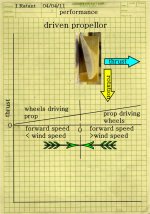
It's because they are designed to be driven. If you put the prop in front of a fan, it will windmill in the turbine mode, faster than if the air comes from the front. The aim is to avoid air being accelerated to the front of prop, so "biased" to the rear as useful thrust. Apologies for my drawing, the "thrust" arrow is the direction of the accelerated air. The force acts the other way, of course.

What this does to the vehicle...???
B is the case above WS, I think. There is no engine, so the wheels drive the prop. But, not faster. It is already being driven by the wheels, as dictated by the cart's speed. The cart can't increase its speed, unless it gains KE...but from where? Not possible. The prop will produce drag and slow the cart.

The other, the driven experience...
And, yes, the prop is never in the freewheeling mode.
But I want to see what is going for the whole thing.
YMMV.
No engine, I Ratant, so no thrust.
 
Status
Not open for further replies.

ISF - Join now!

Every member here is approved by hand. No bots, no spam, just people who care about evidence and honest debate.

Membership is free!

Create your free account

Back
Top Bottom