• Security incident: ISF was recently accessed by intruders. Please change your password, and change it anywhere else you used it. Read more

Merged DDWFTTW in a “Real” Wind

Status
Not open for further replies.
It was pushed to 11mph in a nominal 10mph wind.
And then continued to accelerate. That doesn't mean it wasn't pushed downwind, by the wind, faster than the wind.
And the formula stands.
Stands forlorn. You do appreciate, I hope, that the term "T" in each of your equations (1) and (2) is not the same value.
 
A performance graph.
At point A, the vehicle starts to move downwind faster than the wind.
At point B, the windmilling drag on the prop balances the driving force from the wheels, and velocity doesn't increase.
 

Attachments

  • Performance-2.jpg
    Performance-2.jpg
    128.1 KB · Views: 3
Okay, aside from all the lunacy, I've been trying to work out how this thing works.

I've been thinking of the prop as an aircraft prop, creating an area of low pressure in front of itself and dragging the cart along.

The prop's powered by the wheels of the cart, geared up.

The additional energy extracted by the fact that the props are cutting into moving air rather than still air provides enough excess energy for the prop to pull the cart along?

It makes My head hurt.


Or....

(and I find it really difficult to put this into words)

A static (relative to the cart), and very thin, cross section of the propeller at (say) top dead centre (looking down), would (thanks to the angle of the blade) show a moving cross section of the blade moving backwards at such a rate that it does not outrun the wind?

My head still hurts, I think I've explained that very badly. Twice.
 
A performance graph.
At point A, the vehicle starts to move downwind faster than the wind.
At point B, the windmilling drag on the prop balances the driving force from the wheels, and velocity doesn't increase.

Not above WS. The cart will need to add to its KE to accelerate, and that rises as V^2. Where does that energy come from, I Ratant?
 
Okay, aside from all the lunacy, I've been trying to work out how this thing works.

I've been thinking of the prop as an aircraft prop, creating an area of low pressure in front of itself and dragging the cart along.

The prop's powered by the wheels of the cart, geared up.

The additional energy extracted by the fact that the props are cutting into moving air rather than still air provides enough excess energy for the prop to pull the cart along?

It makes My head hurt.


Or....

(and I find it really difficult to put this into words)

A static (relative to the cart), and very thin, cross section of the propeller at (say) top dead centre (looking down), would (thanks to the angle of the blade) show a moving cross section of the blade moving backwards at such a rate that it does not outrun the wind?

My head still hurts, I think I've explained that very badly. Twice.

Not bad at all actually.
 
Okay, aside from all the lunacy, I've been trying to work out how this thing works.

I've been thinking of the prop as an aircraft prop, creating an area of low pressure in front of itself and dragging the cart along.

The prop's powered by the wheels of the cart, geared up.

The additional energy extracted by the fact that the props are cutting into moving air rather than still air provides enough excess energy for the prop to pull the cart along?

It makes My head hurt.


Or....

(and I find it really difficult to put this into words)

A static (relative to the cart), and very thin, cross section of the propeller at (say) top dead centre (looking down), would (thanks to the angle of the blade) show a moving cross section of the blade moving backwards at such a rate that it does not outrun the wind?

My head still hurts, I think I've explained that very badly. Twice.

Like a car on the road, the wind that you are talking about is a headwind.
It is there because the cart is moving faster than the wind. That can no more drive a car, than it can drive the cart.
Gearing to the wheels makes no difference, except to make things worse.
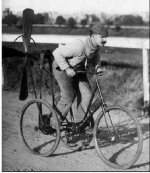
Prop bikes have been around for at least 100 years. Most, though not all, do not connect the wheels to the prop, but simply the pedals to the prop.
If the claim for the cart were correct, you could pedal a prop-bike downwind,
connect the prop to the wheels, and accelerate to 3WS.
A bike like this
attachment.php

or this one of about 20 others.
attachment.php


The cart is a sail cart, that is never ddw for any point of the trial. It is tall, and exploits wind gradients and gusts.
 

Attachments

  • propbike25.jpg
    propbike25.jpg
    35.9 KB · Views: 56
  • propbike27.jpg
    propbike27.jpg
    27.5 KB · Views: 55
Last edited:
Not above WS. The cart will need to add to its KE to accelerate, and that rises as V^2. Where does that energy come from, I Ratant?
.
The sail effect diminishes as the speed passes windspeed, until the prop drag is more than the forward speed of the cart can exceed.
.
Makes my head hurt too. :)
 
Like a car on the road, the wind that you are talking about is a headwind.
It is there because the cart is moving faster than the wind. That can no more drive a car, than it can drive the cart.
Gearing to the wheels makes no difference, except to make things worse.
Prop bikes have been around for at least 100 years. Most, though not all, do not connect the wheels to the prop, but simply the pedals to the prop.
If the claim for the cart were correct, you could pedal a prop-bike downwind,
connect the prop to the wheels, and accelerate to 3WS.
A bike like this
[qimg]http://www.internationalskeptics.com/forums/attachment.php?attachmentid=21676&stc=1&d=1301940426[/qimg]
or this one of about 20 others.
[qimg]http://www.internationalskeptics.com/forums/attachment.php?attachmentid=21677&stc=1&d=1301940496[/qimg]

The cart is a sail cart, that is never ddw for any point of the trial. It is tall, and exploits wind gradients and gusts.

This

...Tell me what would prove you wrong. I'm betting you won't. If you don't, I shan't respond again. Sorry.
 
.
The sail effect diminishes as the speed passes windspeed, until the prop drag is more than the forward speed of the cart can exceed.
.
Makes my head hurt too. :)

Nothing to do with force, but energy. There is no energy to be had from a headwind.
 
Okay, aside from all the lunacy, I've been trying to work out how this thing works.

I've been thinking of the prop as an aircraft prop, creating an area of low pressure in front of itself and dragging the cart along.

The prop's powered by the wheels of the cart, geared up.

The additional energy extracted by the fact that the props are cutting into moving air rather than still air provides enough excess energy for the prop to pull the cart along?

It makes My head hurt.


Or....

(and I find it really difficult to put this into words)

A static (relative to the cart), and very thin, cross section of the propeller at (say) top dead centre (looking down), would (thanks to the angle of the blade) show a moving cross section of the blade moving backwards at such a rate that it does not outrun the wind?

My head still hurts, I think I've explained that very badly. Twice.

I don't think it's bad at all. All the machines that move faster than the medium that is driving them have something in common: the part of the machine that is interacting with that medium is effectively moving slower than the body of the machine. I thing this must be the simplest such machine:

166124d9614330a322.png


It's a cotton reel propelled by a strip of stout paper. When we talk about the velocity of the cotton reel, we are in fact talking about the velocity of its centre of mass, indicated by the small cross. Other points on the wheel have other velocities: the point touching the ground has zero velocity, for instance, and the point diametrically opposite is moving twice as fast as the centre of mass. The point where the paper touches the reel is moving forwards slower than the centre of mass: if the velocity of the centre of mass is u, then the velocity of this point is (b-a)/b * u. By always pushing/pulling as a point that moves forwards slower than the centre of mass, we can make the centre of mass move forwards faster than the thing that's doing the pushing/pulling.
 

I remember, and wonder why you returned as if a newbie.
The answer to your question is that the forth coming data from NALSA,
will show that the cart is a sail cart, once the deliberate data manipulation
is exposed. Then the supporting math will look silly.

I don't expect to change your mind. NALSA will.
 
Last edited:
.
The sail effect diminishes as the speed passes windspeed, until the prop drag is more than the forward speed of the cart can exceed.
.
Makes my head hurt too. :)

In fact the sail effect diminishes right from the start, as soon as the vehicle starts moving forwards and the prop starts turning. Even at the slowest speed, the prop is thrusting against the air, working as a prop. It is never, ever freewheeling.
 
In fact the sail effect diminishes right from the start, as soon as the vehicle starts moving forwards and the prop starts turning. Even at the slowest speed, the prop is thrusting against the air, working as a prop. It is never, ever freewheeling.

If the prop is not connected to the wheel, it will stop at WS. The "no wind" condition can be seen in Jenkins' video as the anemometer almost stops turning at WS. There is no wind power at all, not even enough to turn the anemometer.

When connected to the wheel, that forces the prop to turn, and the cart loses KE to the air. It slows. I can only get to wind speed ddw, if towed.
It's a tacking sail cart. And the data will prove it.
 
Nothing to do with force, but energy. There is no energy to be had from a headwind.
.
As mentioned a few thousand pages back, the big turboprop airplanes -must- have a device that will de-couple a propellor which has failed into low pitch in the air, from the rest of the gearbox and the motor.
The windmilling drag is so high if the low pitched prop is connected and driving the motor thru the gearbox, the flight control system is incapable of handling the asymmetric drag.
The runs I made yesterday with the tacking prop were more successful when I switched to a lower pitched prop from the first runs, as it has more windmilling drag for the available winds at the time, than the higher pitched prop and could move the cart sooner and further once it got going.
The usual fix for a motor failure on a full-scale is to increase the pitch of the prop, so the incoming airstream can't rotate it. Failing into low pitch is seriously bad.
Reading about a guy flying his Cub, he routinely turns the motor off in flight.
The Cub has a fixed pitch prop, and will windmill until he slows the plane down to where the incoming wind due to airspeed can't push the prop around against the compression of the motor.
He then thermal soars with the prop not moving.
To restart, he has to dive the plane to get the prop windmilling again, and then turns on the ignition, and the motor fires and powers the prop.
Someone noted that the airspeed he has to dive to get the prop going is beyond the Vne of the airplane!
But there's a margin of no windmilling airspeeds he can play with while gliding.
There has to be something like this involved here.
The sail force from behind pushes the cart until the windmilling force from the front balances it.
 
In fact the sail effect diminishes right from the start, as soon as the vehicle starts moving forwards and the prop starts turning. Even at the slowest speed, the prop is thrusting against the air, working as a prop. It is never, ever freewheeling.
.
Yes, didn't, never, couldn't, wouldn't say it was.
But the freewheeling effect has to be considered.
The cart moves downwind with the prop fixed, no motion at all.
That's a sail.
Windmilling and -not- connected to the drive wheels, it's still a sail.
Freewheeling, it would rotate opposite the direction of rotation needed to move the wheels. For the props used, the normal right hand twist, and the wind impinging on the back of the prop, it rotates opposite the direction it would freewheel with the wind coming from the front.
Connecting to the drive wheels, it's the sail effect that starts the cart moving, and then the wheels begin add velocity, as the prop -can't- windmill.
"Something":) occurs when the downwind speed of the cart reaches and exceeds the wind speed, for the cart to continue in what becomes a headwind.

 
.
As mentioned a few thousand pages back, the big turboprop airplanes -must- have a device that will de-couple a propellor which has failed into low pitch in the air, from the rest of the gearbox and the motor.
The windmilling drag is so high if the low pitched prop is connected and driving the motor thru the gearbox, the flight control system is incapable of handling the asymmetric drag.
The runs I made yesterday with the tacking prop were more successful when I switched to a lower pitched prop from the first runs, as it has more windmilling drag for the available winds at the time, than the higher pitched prop and could move the cart sooner and further once it got going.
The usual fix for a motor failure on a full-scale is to increase the pitch of the prop, so the incoming airstream can't rotate it. Failing into low pitch is seriously bad.
Reading about a guy flying his Cub, he routinely turns the motor off in flight.
The Cub has a fixed pitch prop, and will windmill until he slows the plane down to where the incoming wind due to airspeed can't push the prop around against the compression of the motor.
He then thermal soars with the prop not moving.
To restart, he has to dive the plane to get the prop windmilling again, and then turns on the ignition, and the motor fires and powers the prop.
Someone noted that the airspeed he has to dive to get the prop going is beyond the Vne of the airplane!
But there's a margin of no windmilling airspeeds he can play with while gliding.
There has to be something like this involved here.
The sail force from behind pushes the cart until the windmilling force from the front balances it.

Once more: the prop is never, ever windmilling.
 
If the prop is not connected to the wheel, it will stop at WS. The "no wind" condition can be seen in Jenkins' video as the anemometer almost stops turning at WS. There is no wind power at all, not even enough to turn the anemometer.

When connected to the wheel, that forces the prop to turn, and the cart loses KE to the air. It slows. I can only get to wind speed ddw, if towed.
It's a tacking sail cart. And the data will prove it.

Ha ha,

How little you know. The data backs up the fact that the more crosswind it goes, the worse it works. It founders at angles where a normal sail cart really moves.
 
.
Yes, didn't, never, couldn't, wouldn't say it was.
But the freewheeling effect has to be considered.
The cart moves downwind with the prop fixed, no motion at all.
That's a sail.
Windmilling and -not- connected to the drive wheels, it's still a sail.
Freewheeling, it would rotate opposite the direction of rotation needed to move the wheels. For the props used, the normal right hand twist, and the wind impinging on the back of the prop, it rotates opposite the direction it would freewheel with the wind coming from the front.
Connecting to the drive wheels, it's the sail effect that starts the cart moving, and then the wheels begin add velocity, as the prop -can't- windmill.
"Something":) occurs when the downwind speed of the cart reaches and exceeds the wind speed, for the cart to continue in what becomes a headwind.

In fact nothing special "occurs" at the moment where the cart reaches the speed of the wind. At this point the prop is developing considerable thrust. It was already developing thrust before this point and it keeps on developing thrust after this point. The cart goes from under wind speed to over wind speed without any change in mode.
 
I remember, and wonder why you returned as if a newbie.
The answer to your question is that the forth coming data from NALSA,
will show that the cart is a sail cart, once the deliberate data manipulation
is exposed. Then the supporting math will look silly.

I don't expect to change your mind. NALSA will.

Humber, could you elaborate on this a little? Are you predicting that NALSA will rescind the record sometime soon?
 
Status
Not open for further replies.

ISF - Join now!

Every member here is approved by hand. No bots, no spam, just people who care about evidence and honest debate.

Membership is free!

Create your free account

Back
Top Bottom