• Security incident: ISF was recently accessed by intruders. Please change your password, and change it anywhere else you used it. Read more

Merged DDWFTTW in a “Real” Wind

Status
Not open for further replies.
I am pre-empting your excuses, and giving you warning that you may have to support your chart in the light of NALSA's data.

I will analyze that data.
If it is inscrutable, and you are unwilling to assist, then NALSA will have to do that for you.

Now this is the kind of delusion you have to witness for yourself. I don't think anyone would believe this if I simply told them.
 
Now this is the kind of delusion you have to witness for yourself. I don't think anyone would believe this if I simply told them.

The largest file for the GPS will not exceed 18K. How many runs 20? 50?
How about 100? 1.18MB

How that got to be 60MB is a mystery, and you should not have access to the data under any circumstances. Rules of science and even sport, Spork.
 
I love this -- The Humberverse "rules of science" dictate that we can't even have a copy of the data that NALSA gave us.

JB

That's right. You were such good pals, that they gave you their data.
That is a breach of any formal contest or trial. The published chart shows that the wind direction data was massaged to remove all of the fast and large wind changes seen in the raw data. That is cheating.
 
.
Noted. :)
Those are just to show what is happening in the conditions, not the why.
As far as I'm concerned, this thing was discussed and settled in February of 2007 on some other site.. which I don't recall.
And explained.
But the animosity and rancor surfaced there also. From the same source attacking all and sundry who expressed interest/doubts about the thing as here.
The personal attacks really waste everyone's time, and demean any credence one might place on the science if that even gets mentioned.
I expect to get jumped for showing a propellor as a rotating wing. :)
.
I did spend some time yesterday jazzing up a couple photos of the freewheeling cart.
The driven cart has yet to move without assistance.
The Antelope Valley Wind Festival has taken a few days off. :(

Yes. This cart has been promoted by use of a sledge hammer.

You may be interested in some of the video of the small cart in the wind.
I have slowed it down from the original video. The rotor is seen to turn CW as expected, and then the other way. Finally it slides with both the wheels and rotor stalled.
That is the effect of the wind on the bluff body of the cart, opposed by the CCW turbine force of the rotor.

http://img130.imageshack.us/img130/9523/f4u.mp4
 
One, out of many, funny "points" is that humber thinks the data from the 3 GPS's that NALSA provided is "spork's" data, while the data from all the other instruments that spork and TAD provided is "NALSA's" data.
 
The cotton reel shows that acceleration may yield short term speed gains, but the average speed is that of the hand.

You are still completely missing the point of the cotton reel analogy.

The point was to demonstrate that the under-wrapped reel, pulled by the thread, travels faster than the thread.

That's all.

It's not about acceleration, it's not about stability and it's absolutely not about what might happen next when the reel catches up with your hand.

The reel does not show that "acceleration may yield short term speed gains". It shows that when the thread is pulled at a steady speed, the reel rolls the same way also at a steady speed which is a fixed multiple of the thread's speed. That's all.
 
...
You may be interested in some of the video of the small cart in the wind.
I have slowed it down from the original video. The rotor is seen to turn CW as expected, and then the other way. Finally it slides with both the wheels and rotor stalled.
That is the effect of the wind on the bluff body of the cart, opposed by the CCW turbine force of the rotor.

http://img130.imageshack.us/img130/9523/f4u.mp4
.
My driven cart with plastic drive wheels would slide rather than roll.
Changed to rubber for more gripping friction.
Adjusted the tension in the drive cord to the least amount commensurate with no slipping or tossing the cord. Too much tension adds breakout friction.
 

Attachments

  • jrFoamWindCartFriction-05.jpg
    jrFoamWindCartFriction-05.jpg
    141.4 KB · Views: 1
You are still completely missing the point of the cotton reel analogy.

The point was to demonstrate that the under-wrapped reel, pulled by the thread, travels faster than the thread.

That's all.

It's not about acceleration, it's not about stability and it's absolutely not about what might happen next when the reel catches up with your hand.

The reel does not show that "acceleration may yield short term speed gains". It shows that when the thread is pulled at a steady speed, the reel rolls the same way also at a steady speed which is a fixed multiple of the thread's speed. That's all.
When the conclusion is undesirable, crimson fish are always there to try to cover your tracks.
 
You are still completely missing the point of the cotton reel analogy.

The point was to demonstrate that the under-wrapped reel, pulled by the thread, travels faster than the thread.

That's all.

It's not about acceleration, it's not about stability and it's absolutely not about what might happen next when the reel catches up with your hand.

The reel does not show that "acceleration may yield short term speed gains". It shows that when the thread is pulled at a steady speed, the reel rolls the same way also at a steady speed which is a fixed multiple of the thread's speed. That's all.

It will not show a gain unless it is accelerating. Distance is not velocity.

You will not be able to tow it at twice the speed at constant speed. Hand operation of small reels over small distances will mislead. Try it with a constant force and not a hand.

It will only remain constant when 1:1, and that means a lot of friction. Sliding is the most likely outcome.
The acceleration is averaged to zero, when it overtakes the puller, and slows, until one again pulled. Of course, some mechanical device must be employed if the under reel is not to become and over reel as it passes by, and rolls over the thread.
 
.
My driven cart with plastic drive wheels would slide rather than roll.
Changed to rubber for more gripping friction.
Even small surface imperfections will cause a light cart to lose traction, just like Spork's does. The BB is too massive to slide, so creeps along until the wind changes and it can tack.
In front of a fan, a small cart can be made to go either way according to the size of the bluff area.

.
Adjusted the tension in the drive cord to the least amount commensurate with no slipping or tossing the cord. Too much tension adds breakout friction.
That's a problem I found too. I am limited in what is available. A toothed belt would have been better on my cart, rather than a pulley and narrow leather belt, which tends to bind a bit.

I have a comment about the propeller.

attachment.php


The prop will windmill in the >WS headwind, and turn CW. At all other times the air passes from the front to the rear, so that is expected. But no thrust will be generated without an engine, so the cart will not accelerate.

The only source of energy is the cart's KE. That may act for a short time as an "engine" but at the expense of a slowing cart.
Is that what you meant, rather than actually accelerating against the headwind?
 
Last edited:
You will not be able to tow it at twice the speed at constant speed. Hand operation of small reels over small distances will mislead. Try it with a constant force and not a hand.

Wrong. I towed my spool of fishing line sooo slowly, and at such a length of line (PowerPro braid, 50lbs, excellent stuff for heavy lure fishing as you can get your lure snagged on a log and pull the hook straight to retrieve your fancy expensive lure for just the cost of a new hook. Highly recommended. This spot available for *your* advert. Low cost. PM me.) that the period of acceleration was long gone. The spool still advanced faster than the pull for a good long time after max speed had been reached..

It's fair to say that I needed a long 'track' of 1"x1" battens to stop the damn spool skewing off sideways into MrsB's flower beds, and the kitten was pretty spooked, and our Labrador nearly ate the spool because, well, just because (he's a Labrador), but this is mere detail. Actually an excellent test would be to wind the spool of line in with a fishing reel. Easy to measure the rate of retrieve given that I keep my reels well-filled and the growing diameter can easily be discounted.

Who likes fishing? mmmmmmm fishing.
 
Last edited:
Wrong. I towed my spool of fishing line sooo slowly, and at such a length of line (PowerPro braid, 50lbs, excellent stuff for heavy lure fishing as you can get your lure snagged on a log and pull the hook straight to retrieve your fancy expensive lure for just the cost of a new hook. Highly recommended. This spot available for *your* advert. Low cost. PM me.) that the period of acceleration was long gone. The spool still advanced faster than the pull for a good long time after max speed had been reached..

It's fair to say that I needed a long 'track' of 1"x1" battens to stop the damn spool skewing off sideways into MrsB's flower beds, and the kitten was pretty spooked, and our Labrador nearly ate the spool because, well, just because (he's a Labrador), but this is mere detail. Actually an excellent test would be to wind the spool of line in with a fishing reel. Easy to measure the rate of retrieve given that I keep my reels well-filled and the growing diameter can easily be discounted.

Who likes fishing? mmmmmmm fishing.

There is no text book support for a spool going faster than the line pulling it, kittens being spooked by same, or labradors eating spools. Fishing line will not work as you describe, and it's impossible to pull a hook straight in a non-conservative gravitational field without making special provisions for time dilation using the Lorentz transforms. Furthermore, your spool was being powered by your hand - not the wind. It was tacking, and you fudged the data. I'm giving you fair warning that you will be called on to defend your claims, and you will not be able to do so - and that is that.

The above rant is my tribute to humber. It may save you a little time.
 
Wrong. I towed my spool of fishing line sooo slowly, and at such a length of line (PowerPro braid, 50lbs, excellent stuff for heavy lure fishing as you can get your lure snagged on a log and pull the hook straight to retrieve your fancy expensive lure for just the cost of a new hook. Highly recommended. This spot available for *your* advert. Low cost. PM me.) that the period of acceleration was long gone. The spool still advanced faster than the pull for a good long time after max speed had been reached..
My that is clever.

It's fair to say that I needed a long 'track' of 1"x1" battens to stop the damn spool skewing off sideways into MrsB's flower beds, and the kitten was pretty spooked, and our Labrador nearly ate the spool because, well, just because (he's a Labrador), but this is mere detail.
But you are quite certain the the batons won't be providing the necessary friction.

Actually an excellent test would be to wind the spool of line in with a fishing reel. Easy to measure the rate of retrieve given that I keep my reels well-filled and the growing diameter can easily be discounted.
Who likes fishing? mmmmmmm fishing.

And the "oh so slowly" is you changing the force so the average acceleration is controlled to see that you get what you want. Do it with your eyes shut.

When you get the 2:1 velocity ratio, the reel will overtake you. It's as simple as that. When that doesn't happen, ask yourself or the Labrador why that may be.
 
Last edited:
I try to channel humber but you just can't come up with this stuff. humb used to do a much better job.
 
I try to channel humber but you just can't come up with this stuff. humb used to do a much better job.

And you have the evidence that you did not rip off the latest idea from Smith?
That you did not modify the data to produce a real nice chart?
 
The relevance of the spool and thread to the general theme of the OP is ????
But anyway...
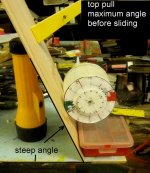
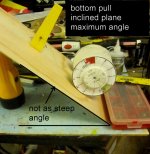
Rigorous test procedure to follow..
Propping the inclined plane.
Thread feed from the top of the spool. VIII-01
Thread feed from the bottom of the spool. VIII-02
The top feed spool will go to a much steeper angle before it begins to slide down the plane, than the bottom feed point.
At the slip/roll angles, the spool moves down, away from the tie point, different angles for the pulls, but the thread gets longer despite the direction the spool rotates.
 

Attachments

  • jrChainWheel-VIII-01.jpg
    jrChainWheel-VIII-01.jpg
    93 KB · Views: 0
  • jrChainWheel-VIII-02.jpg
    jrChainWheel-VIII-02.jpg
    99.6 KB · Views: 0

Here are the vectors at the propeller blade for a propeller cart going DDWFTTW :

propellervectors.png


Here for comparison the vectors for a sail craft on broad reach with downwind VMG > true wind :

downwindvectorsen3.png
 
Last edited:
Status
Not open for further replies.

ISF - Join now!

Every member here is approved by hand. No bots, no spam, just people who care about evidence and honest debate.

Membership is free!

Create your free account

Back
Top Bottom