• Quick note - the problem with Youtube videos not embedding on the forum appears to have been fixed, thanks to ZiprHead. If you do still see problems let me know.

Why are we so obsessed with our identity? Imprinting, Gods,& labels we give ourselves

Trent Wray

Unregistered
Joined
Jan 25, 2010
Messages
4,487
Why are we so obsessed with our identity? Imprinting, Gods,& labels we give ourselves

* I am not talking about Genomic imprinting, rather the psychological aspect of "imprinting"


So why are we (as human beings) seemingly so obsessed with our identity? "I'm a Conservative," or "I'm an implicit atheist," or "I'm gay," or "I'm an electrician," .... etc and so forth?

Is it mostly a status thing? Is it more culturally related? Or some other need to identify with "something"?

And when did this become a noticeable aspect to our society ... is it the result of analytical thinking, etc and so forth? Or is it the result of imaginative thinking? Or both?

Geese are a good example of the kind of imprinting I'm speaking of, which if I understand it correctly is filial imprinting. Between the first 13-16 hours after hatching, they will lock on and identify with a suitable moving stimulus, and for the rest of their life they will recognize that same stimulus and follow it. There is also apparently the imprinting that goes on with unborn humans in the womb and recognizing the voice of those around them, there is sexual imprinting, and the Westermarck effect (reverse sexual imprinting) ... for examples.

So is a person's need or desire to understand themselves, and identify themselves as "this or that", akin to us having a need to further imprint for some reason? If so .... is it because we "lack something"? There is something missing for us to imprint on and identify with suitably?

I'm not making a claim, but exploring questions and an idea: suppose human imprinting in this manner is partially responsible for authority recognition, mother/father recognition and emulation, sexual preferences and fetishism, etc and so forth. In these ways, we are not dissimilar perhaps from other creatures. So we, as humans, imprint on humans, and thus do not really need to look at the squirrel and call it "mama!", etc and so forth.

However intellectually speaking ... we do not have "equals". So, as our intellect and knowledge grows and changes, we still have this need to imprint on things. To identify with something else in order to continue to "progress". Some will look to animals .... and begin to identify with "totem spirits" and ideas like the Otherkin, actually thinking they are perhaps something other than a human being, etc and so forth (one of my favorite polls/threads). Others will look to other people, and try and forum groups classified by their intellect and reasoning capacity and ability. Still others will try and imprint with "something even greater" or unknown ... the idea of a god, or gods, or advanced extra-terrestrial beings, etc and so forth.

So perhaps the ideas behind us identifying with certain groups and ways of believing and thinking, has more to do with a need to imprint on something similar to us for recognition, guidance, etc and so forth .... but since our intellect and ability to reason seems to be advancing and changing alongside civilization, when we look to our parents or others around us, we don't always see something we can identify with, for whatever reason. So we have to look elsewhere ... and if we continue to not find something we can identify with and imprint on, then we have to "fill in the gaps" .... and thus fantastical thinking finds solutions for us, or galvanizing into groups (like, "I'm a die hard atheist, not a theist and this is important to me you understand the terminology"), or looking into ourselves and "self imprinting", or to a career or profession to identify ourselves with, or whatever.

I hope I've described this idea clearly enough.

Thoughts anyone?


One more thing: from what I understand as an obvious laymen, imprinting usually involves a "critical period". If there is any validity to this idea above, what would the critical period for a person be involving this identity/intellectual type of imprinting? And when would it ever end? Because people can go to their graves being "die hard republicans" and fighting the systems, etc and so forth ... with their own personal identities being perhaps the most important aspect of their day to day lives.
 
Last edited:
I've always thought that it was as much about who we don't identify with as who we do. It seems like basic selfishness to me. We can't expect others to respect our rights if we don't respect theirs. But, if we divide the world into "us" and "them", we don't have to respect "their" rights the way "ours" have to be respected.

For things like political affiliations, it's also a matter of simplifying things. If you're a member of one party you can safely support your party and oppose the other(s) without having to worry about familiarizing yourself with all (or even any) of the issues.
 
It's because we need to believe that we're not the sole holders of a belief or feeling, that others share them and agree with us.

If people knew what other people really believed, that no one holds the exact same belief, I think it'd be earthshattering for most.
 
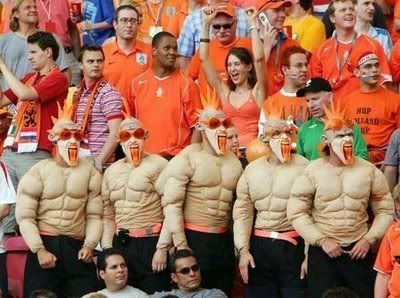
I think it's connected with tribalism. It seems to me we're made to see our family and friends with greater degrees of distance as humans, and everyone else is an "other". This is a subtle thought that spreads into many different aspects of our lives. As we've formed larger societies in the past ten to twenty thousand years, we've had to force the idea a bit. But we're always determining who is part of our group, and who is the other. There are many different shades of other, and it's interchangeable between who is part of the tribe and who isn't.

Humans like this so much we create imaginary tribes all the time and imaginary rivalries.

sports_fans_01.jpg


On a whole, in many ways we are all the same basic person, but the things that make us different are a lot more subtle than we'd sometimes like to think. We all tend to decide to take different choices here or there, but most of the drastic differences we like to imagine between things like good or evil, criminal or law abiding citizen, bully or victim etc, this is only a matter of some very basic differences in choice that end up being not so drastic until they add up. But really, any one of us could plausibly end up making a few decisions that really aren't that drastic that end up leading to what we see as drastic difference.
 
I'm far from an expert on this, but since you happened to ask me this particular week, my opinion is that it has to do with establishing a sense of self. During development from an infant stage, we begin to establish a sense of agency; this is born out of a period where we have a pre-verbal sense of omnipotence. Throughout normal development into adulthood, this sense of omnipotence is beaten into submission until it simply becomes a desire to control with the realization that we have limitations.

But as we develop further from this omnipotent stage, we start to recognize a separation between our selves and our caregivers. As we begin to realize our virtual lack of power, the sense of pre-verbal omnipotence we have transitions to our caregivers; at this point we are idealizing them. But we don't always get our wishes and needs fulfilled, because our caregivers aren't actually as powerful as we would like them to be. Once we start to realize this, we devalue the same caregivers (and during this stage we alternate between idealization and devaluation). From this idealization/devaluation stage evolves a sense of good and evil.

Eventually we grow into healthy adults, carrying a remnants of this idealization/devaluation process, out of which grows identifying ourselves as certain groups to develop a sense of community with people we like, and/or a sense of separation from people we dislike.
 
Only in as much as it has something to do with actual identity or tribalism, I would add. Sometimes a description is just a description, and a detail is given only because it -- or disclosing it -- is relevant to the topic at hand.

I mean, for example, it's not like I sign my correspondence with "Hans Mustermann, By the Grace of God an Atheist, Debunker Of Jesus, Flipper Of The Bird, Tripper Of Balls" ;) But sometimes it's just a statement of fact, i.e., basically acknowledging something I am. Just like mentioning that I've read War And Peace. Doesn't mean it's got some special meaning for my identity, nor that now I'm the grand shaman of that tribe.

I would imagine the same goes for most of those examples you mentioned. For example it's hard for me to imagine many people saying "I'm gay" as a way to gain some kind of status, especially in places where that's still actually got a stigma. It's just something they are.

But basically before turning it into a bigger rant, maybe it would be more useful to make sure we're on the same page. Do you have any examples of such things used as status or tribe membership or whatever? Then we can discuss exactly what's wrong with those particular uses.
 
Last edited:
Couldn't it essentially be as simple as: we focus on identity, because we are intellectually capable of having identity?

Certain other animals display identity traits. Wolves, for example, and other hierarchical species, have behavior sets according to their place within the pack that identify them to one another. These traits are somewhat rigid, but also somewhat fluid: we see other pack members move into the alpha position, or identity, from time to time, as when the original alpha dies, or is deposed. This suggests to me that identity may exist within the animal's consciousness, because he or she appears able to choose to act in ways that will change his or her identity within the pack, within the social structure.

Then again, we have ants and bees, which also have a social structure and hierarchy, but which is much more rigid and determined by sex or other genetic marker. A drone bee, for instance, is always male. He has no choice in his identity, and cannot change it, or his role within the hive. He can't depose the queen and take over the hive. Identity does not appear to exist within the bee's limited consciousness.

A richness of identity traits or markers appears to be a function of richer, more elaborate consciousness.

This works hand-in-hand with our constant social modeling of identities for our young. We start asking them what they "want to be" at a very early age, and we model various and often simultaneous identities for them from the start. This person, for example, is not just "Mommy." She's also any combination of wife, daughter, granddaughter, sister, aunt, cousin, friend, employee or employer...as well as tall or short, pretty or not, blonde or brunette or redhead, and so on.

I was able to watch this happening with my eldest granddaughter, at 4 years old, when my son explained that her Grandma was also his Mom. She had a hard time grasping that for a few moments; she shook her head, smiling as if she thought Daddy was teasing her, and said "nuh-uh," when he said, "This is my mommy." It took a bit more explaining, that everyone has a mommy and a daddy, and I was his mommy, while Grandpa T was his daddy. She then made the leap, "And Nana M and Papa L are Mommy's mom and dad?" Indeed so.

The next time I saw her, she came bounding up, gave me a hug, stepped back and said, "Hi, Grandma! You're my daddy's mommy!" Yeah, I grinned. :D

So, I don't think identity is necessarily an obsession with us. It's more a reflection of both our richer and more complicated consciousness, and our richer and more complicated social structure.
 
I'm far from an expert on this, but since you happened to ask me this particular week, my opinion is that it has to do with establishing a sense of self. During development from an infant stage, we begin to establish a sense of agency; this is born out of a period where we have a pre-verbal sense of omnipotence. Throughout normal development into adulthood, this sense of omnipotence is beaten into submission until it simply becomes a desire to control with the realization that we have limitations.

But as we develop further from this omnipotent stage, we start to recognize a separation between our selves and our caregivers. As we begin to realize our virtual lack of power, the sense of pre-verbal omnipotence we have transitions to our caregivers; at this point we are idealizing them. But we don't always get our wishes and needs fulfilled, because our caregivers aren't actually as powerful as we would like them to be. Once we start to realize this, we devalue the same caregivers (and during this stage we alternate between idealization and devaluation). From this idealization/devaluation stage evolves a sense of good and evil.

Eventually we grow into healthy adults, carrying a remnants of this idealization/devaluation process, out of which grows identifying ourselves as certain groups to develop a sense of community with people we like, and/or a sense of separation from people we dislike.
This is all very interestingly put .... and almost could make a case as to whether or not children have an innate "need for a god" in some form of fashion: an idealized, all powerful, omnipotent "Self or Other".

Only in as much as it has something to do with actual identity or tribalism, I would add. Sometimes a description is just a description, and a detail is given only because it -- or disclosing it -- is relevant to the topic at hand.

I mean, for example, it's not like I sign my correspondence with "Hans Mustermann, By the Grace of God an Atheist, Debunker Of Jesus, Flipper Of The Bird, Tripper Of Balls" ;) But sometimes it's just a statement of fact, i.e., basically acknowledging something I am. Just like mentioning that I've read War And Peace. Doesn't mean it's got some special meaning for my identity, nor that now I'm the grand shaman of that tribe.

I would imagine the same goes for most of those examples you mentioned. For example it's hard for me to imagine many people saying "I'm gay" as a way to gain some kind of status, especially in places where that's still actually got a stigma. It's just something they are.

But basically before turning it into a bigger rant, maybe it would be more useful to make sure we're on the same page. Do you have any examples of such things used as status or tribe membership or whatever? Then we can discuss exactly what's wrong with those particular uses.
I definitely think you are describing something that is a factor: the use of titles/labels/identification terms is more of a "relevant information" type of thing. But this is just one factor I think. It doesn't really speak to those who DO use their identity markers to find their sense of self, or to try and understand others through identity markers and labels, group affiliation, etc.

As far as saying anything is "wrong" with a particular usage, I wasn't really looking at anything in terms of right/wrong. But if you still want me to bring up more examples, I can think of some generic ones of the top of my head of what I'm describing:

"I'm not some wuss who drinks Natty Ice ... I drink Patron m***********r. If I ever see you drinking Natty Ice around me, I'll put a beat down on you ..."

"I'm a proud, life long member of the NRA ...."

"I am a child of God ... I am not like you people ...."

"I'm American by birth, Southern by the Grace of God .... "

"I'm a skeptic, and not one of those face-palm worthy woos .... "

"Does it look like I'm ashamed? I'm a male nurse, and proud of it ...."

And perhaps people like Ayn Rand, etc. These are just generic examples trying to show a spectrum of things people cling to in order to "identify themselves" .... and not just at the fundamentalist extremes.

I was more interested in the possible reasons behind the emergence of this trait, and comparing it to the mechanism of imprinting biologically. It's interesting to me to think about whether or not humans have this imprinting "need", for whatever reason, that perhaps never gets fully realized or met somehow (concerning those who seem to always be "looking for their place in the world" so to speak, or those who violently defend their identities) ... but since I'm not even a laymen in all honesty, I don't know how valid the comparison is or if they are even directly linked IRL.

If people knew what other people really believed, that no one holds the exact same belief, I think it'd be earthshattering for most.
Yes ... but WHY. Why do we need this validation or identity?

@ anyone: And if it can be linked to imprinting or something similar ... is their a "critical window" for a person where they are most easily influenced? Can a person be imprinted to believe in god, or no god, or democrat, or regime-worthy, or an emo or goth, etc and so forth? And once imprinted, can they ever change? And if they can change ... were they ever imprinted in the first place?

I've always thought that it was as much about who we don't identify with as who we do. It seems like basic selfishness to me. We can't expect others to respect our rights if we don't respect theirs. But, if we divide the world into "us" and "them", we don't have to respect "their" rights the way "ours" have to be respected.

For things like political affiliations, it's also a matter of simplifying things. If you're a member of one party you can safely support your party and oppose the other(s) without having to worry about familiarizing yourself with all (or even any) of the issues.
I wonder how many people "switch" parties, what the incidence of something like that is. And not just political parties, but religious camps, overall outlooks, etc. Those personal "paradigm shifting moments". Devoted, believing, theism/deism/godism to atheism perhaps would be an excellent example possibly. I wonder if, assuming there is something to the "imprinting idea" .... whether some individuals are more flexible and malleable throughout their lives, more able to "switch around camps" for some reason, whilst as perhaps others are not capable of it even biologically speaking.

I think it's connected with tribalism. It seems to me we're made to see our family and friends with greater degrees of distance as humans, and everyone else is an "other". This is a subtle thought that spreads into many different aspects of our lives. As we've formed larger societies in the past ten to twenty thousand years, we've had to force the idea a bit. But we're always determining who is part of our group, and who is the other. There are many different shades of other, and it's interchangeable between who is part of the tribe and who isn't.

Humans like this so much we create imaginary tribes all the time and imaginary rivalries.

[qimg]http://img.photobucket.com/albums/v84/evilknick/sports_fans_01.jpg[/qimg]

On a whole, in many ways we are all the same basic person, but the things that make us different are a lot more subtle than we'd sometimes like to think. We all tend to decide to take different choices here or there, but most of the drastic differences we like to imagine between things like good or evil, criminal or law abiding citizen, bully or victim etc, this is only a matter of some very basic differences in choice that end up being not so drastic until they add up. But really, any one of us could plausibly end up making a few decisions that really aren't that drastic that end up leading to what we see as drastic difference.
Hmm ..... good points I think.

But is it a need that, once a person identified ... cannot be reversed? Or again, is there a "window of opportunity?"

Perhaps a good example, would be someone who grows up in a close family unit. Us and Them mentality, but then a member falls in love with another person from a very contrasted type of family. They leave to go off and form a new, different unit together. And then a "new us/them" arises out of that unit.

In this example, there is a window of opportunity where new "imprinting" can occur.

Couldn't it essentially be as simple as: we focus on identity, because we are intellectually capable of having identity?

Certain other animals display identity traits. Wolves, for example, and other hierarchical species, have behavior sets according to their place within the pack that identify them to one another. These traits are somewhat rigid, but also somewhat fluid: we see other pack members move into the alpha position, or identity, from time to time, as when the original alpha dies, or is deposed. This suggests to me that identity may exist within the animal's consciousness, because he or she appears able to choose to act in ways that will change his or her identity within the pack, within the social structure.

Then again, we have ants and bees, which also have a social structure and hierarchy, but which is much more rigid and determined by sex or other genetic marker. A drone bee, for instance, is always male. He has no choice in his identity, and cannot change it, or his role within the hive. He can't depose the queen and take over the hive. Identity does not appear to exist within the bee's limited consciousness.

A richness of identity traits or markers appears to be a function of richer, more elaborate consciousness.

This works hand-in-hand with our constant social modeling of identities for our young. We start asking them what they "want to be" at a very early age, and we model various and often simultaneous identities for them from the start. This person, for example, is not just "Mommy." She's also any combination of wife, daughter, granddaughter, sister, aunt, cousin, friend, employee or employer...as well as tall or short, pretty or not, blonde or brunette or redhead, and so on.

I was able to watch this happening with my eldest granddaughter, at 4 years old, when my son explained that her Grandma was also his Mom. She had a hard time grasping that for a few moments; she shook her head, smiling as if she thought Daddy was teasing her, and said "nuh-uh," when he said, "This is my mommy." It took a bit more explaining, that everyone has a mommy and a daddy, and I was his mommy, while Grandpa T was his daddy. She then made the leap, "And Nana M and Papa L are Mommy's mom and dad?" Indeed so.

The next time I saw her, she came bounding up, gave me a hug, stepped back and said, "Hi, Grandma! You're my daddy's mommy!" Yeah, I grinned. :D

So, I don't think identity is necessarily an obsession with us. It's more a reflection of both our richer and more complicated consciousness, and our richer and more complicated social structure.
Also good points. We do it because we can. Kind of like entertainment. We focus on it, because we are capable of doing so. Not necessarily an "imprinting" mechanism involved per se ....
 
As far as saying anything is "wrong" with a particular usage, I wasn't really looking at anything in terms of right/wrong. But if you still want me to bring up more examples, I can think of some generic ones of the top of my head of what I'm describing:

Well, thank you for those either way. At least now we both have a shared understanding of what we're talking about, even without necessarily filing them under right or wrong.

That said, I do have to wonder how much of those are really about self-identity. I mean, for example equally a very human factor is trying to fit in a group or community -- a trait which until very recently was even necessary to survival -- and some people are just trying too hard to give the right image. E.g., someone who's trying too hard to fit on a Nintendo board, may sound like a bit more of a rabid Nintendo fanboy than really necessary for his identity, just to feel more like a really really devoted member of the group.

"I'm not some wuss who drinks Natty Ice ... I drink Patron m***********r. If I ever see you drinking Natty Ice around me, I'll put a beat down on you ..."

Anything this extreme, I would file actually under extreme insecurity. Anyone who not just is that vocal about his being a Real Man down to such details as what drinks are approved for Real Man use, but offers to back it with violence, has got to be a lot less sure about it than he sounds.

It's actually known to not just happen, but be taken to silly extremes occasionally. Certain cases of OCD actually end up horribly insecure that they're not really gay, for example. Oh, they know they're attracted to the opposite sex, but can they be sure that they're attracted enough to not be even a little gay? Go figure.

In other words, in that case I'd say it's not as much about the identity someone _has_ but the kind of identity they'd like to have or be mistaken for.

"I'm a proud, life long member of the NRA ...."

TBH, much as I like gun regulation, I have to have some sympathy for gun fans. Almost no other group short of the NAMBLA has to justify itself at every turn, and as soon as they even mention even knowing which end to hold.

What I'm getting at is that some such strong wordings may not be about identity or tribalism or anything, but just a preemptive "F### OFF! I don't want to have THAT discussion all over again, OK?"

Of course, it all depends on what context it's used in, and how.

"I am a child of God ... I am not like you people ...."

Could be an identity or tribalism issue too, but I think the most vocal along those lines are just trying to quell their own doubts about God.

"I'm American by birth, Southern by the Grace of God .... "

Chest thumping tribalism...

"I'm a skeptic, and not one of those face-palm worthy woos .... "

Again a case of it depending on how it's used. It sounds almost like something I could say in certain situations, but as just a way to convey a meaning. E.g., if someone insisted that I believe some woowoo just because they said so, I might actually tell them something along the lines of "Psst, I'm a skeptic, not one of your bible study group. I expect evidence." But really as a way of emphasizing the latter.

Of course, it's also not inconceivable that someone would make an identity issue out of it.

"Does it look like I'm ashamed? I'm a male nurse, and proud of it ...."

Again, see what I said about too proud gun owners. That sounds more like a preemptive "F OFF! I don't want to have THAT talk all over again." than necessarily someone's identity depending on being a male nurse. Especially in parts where the least sign of not being a Real Man is taken as possibly gay, and can get you anywhere between ostracized to killed, I would assume that someone could already get enough grief for picking a "woman job" as it is. Might not take very much snark on a board towards male nurses to get a response like that, even if the poster's identity doesn't have much to do with being a male nurse.

And perhaps people like Ayn Rand, etc. These are just generic examples trying to show a spectrum of things people cling to in order to "identify themselves" .... and not just at the fundamentalist extremes.

I was more interested in the possible reasons behind the emergence of this trait, and comparing it to the mechanism of imprinting biologically. It's interesting to me to think about whether or not humans have this imprinting "need", for whatever reason, that perhaps never gets fully realized or met somehow (concerning those who seem to always be "looking for their place in the world" so to speak, or those who violently defend their identities) ... but since I'm not even a laymen in all honesty, I don't know how valid the comparison is or if they are even directly linked IRL.

Dunno if imprinting is the most likely explanation. To be honest, I don't know if it's not it, either.

It seems to me like we already know from the conformism experiment that some people will try to fit in any group, no imprinting necessary. And that half an hour later they'll change their answer to fit yet another group of perfect strangers, if you ask them again.

Just as a quick reminder, the experiment was basically this. They had a chart with one bar and a group of three other bars, and you had to answer which of those three bars is the same length. Basically like this:

This bar:

[========] Is equal to which of these three:

[========] (A)
[====] (B)
[============] (C)

The trick was that, for all a test subject knew, they were in a very small group of such subjects and everyone answered in turn. What actually happened was that all but one in that group were actors. And the non-actor got to answer last. And the actors answered the same wrong answer. E.g., you could get two guys saying it's B, before you got your turn to answer.

IIRC about a third answered the same blatantly wrong stuff as the actors.

Not small differences in length, either, or anything. It was meant to be blatantly obvious which is right, and they actually tried increasing the difference, when they started getting funnier results then expected. It made no difference.

(Though funnily enough in a more recent re-enactment it turns out that when the test is actually difficult enough to have an excuse to answer "wrong", more people felt secure enough to contradict the group by answering right. Kind of paradoxical, because you'd think then they'd be more likely to cheat by taking the same answer several others did.)

But, at any rate, I fail to see how imprinting or identity would explain that. They hadn't been exposed to that group of strangers for more than a few minutes, nor to such tests, or anything, and they were already basically trying to fit in and not rock the boat.
 
Well, thank you for those either way. At least now we both have a shared understanding of what we're talking about, even without necessarily filing them under right or wrong.

That said, I do have to wonder how much of those are really about self-identity. I mean, for example equally a very human factor is trying to fit in a group or community -- a trait which until very recently was even necessary to survival -- and some people are just trying too hard to give the right image. E.g., someone who's trying too hard to fit on a Nintendo board, may sound like a bit more of a rabid Nintendo fanboy than really necessary for his identity, just to feel more like a really really devoted member of the group.


Anything this extreme, I would file actually under extreme insecurity. Anyone who not just is that vocal about his being a Real Man down to such details as what drinks are approved for Real Man use, but offers to back it with violence, has got to be a lot less sure about it than he sounds.

It's actually known to not just happen, but be taken to silly extremes occasionally. Certain cases of OCD actually end up horribly insecure that they're not really gay, for example. Oh, they know they're attracted to the opposite sex, but can they be sure that they're attracted enough to not be even a little gay? Go figure.

In other words, in that case I'd say it's not as much about the identity someone _has_ but the kind of identity they'd like to have or be mistaken for.


TBH, much as I like gun regulation, I have to have some sympathy for gun fans. Almost no other group short of the NAMBLA has to justify itself at every turn, and as soon as they even mention even knowing which end to hold.

What I'm getting at is that some such strong wordings may not be about identity or tribalism or anything, but just a preemptive "F### OFF! I don't want to have THAT discussion all over again, OK?"

Of course, it all depends on what context it's used in, and how.


Could be an identity or tribalism issue too, but I think the most vocal along those lines are just trying to quell their own doubts about God.


Chest thumping tribalism...


Again a case of it depending on how it's used. It sounds almost like something I could say in certain situations, but as just a way to convey a meaning. E.g., if someone insisted that I believe some woowoo just because they said so, I might actually tell them something along the lines of "Psst, I'm a skeptic, not one of your bible study group. I expect evidence." But really as a way of emphasizing the latter.

Of course, it's also not inconceivable that someone would make an identity issue out of it.


Again, see what I said about too proud gun owners. That sounds more like a preemptive "F OFF! I don't want to have THAT talk all over again." than necessarily someone's identity depending on being a male nurse. Especially in parts where the least sign of not being a Real Man is taken as possibly gay, and can get you anywhere between ostracized to killed, I would assume that someone could already get enough grief for picking a "woman job" as it is. Might not take very much snark on a board towards male nurses to get a response like that, even if the poster's identity doesn't have much to do with being a male nurse.
So, along these trains of thought .... basically it boils down to tribalism or insecurity (when it's not merely a functional reason to identify "what you are").

I wonder, also, if we are shifting away from tribalism, towards a more "Army of One" mentality. Esp. in the West. I wonder if this is somewhat confusing, even to ourselves, as we try and figure out how to "stand on our own" without the need for the close knit tribe. I wonder if this is some of the cause behind insecurities as well.

Dunno if imprinting is the most likely explanation. To be honest, I don't know if it's not it, either.
Yeah neither do I lol :). I was hoping there might have been some sort of concrete studies making these connections, but a quick google didn't bring anything up that stood out to me blatantly.

In regards to the insecurity reasoning ... it still makes me want to know "what causes the insecurity?" in the first place, and if it's possible to imprint someone, at a specific point in their life perhaps, so that they will be "secure" because they identify with a specific group or person successfully. Someone who is more prone to overcompensating all the time, for example, might have this imprinting type of issue. It might not be only due to environmental and social factors (i.e. wimp in school, or too short for the girls, or whatever).

It seems to me like we already know from the conformism experiment that some people will try to fit in any group, no imprinting necessary. And that half an hour later they'll change their answer to fit yet another group of perfect strangers, if you ask them again.

Just as a quick reminder, the experiment was basically this. They had a chart with one bar and a group of three other bars, and you had to answer which of those three bars is the same length. Basically like this:

This bar:

[========] Is equal to which of these three:

[========] (A)
[====] (B)
[============] (C)

The trick was that, for all a test subject knew, they were in a very small group of such subjects and everyone answered in turn. What actually happened was that all but one in that group were actors. And the non-actor got to answer last. And the actors answered the same wrong answer. E.g., you could get two guys saying it's B, before you got your turn to answer.

IIRC about a third answered the same blatantly wrong stuff as the actors.

Not small differences in length, either, or anything. It was meant to be blatantly obvious which is right, and they actually tried increasing the difference, when they started getting funnier results then expected. It made no difference.

(Though funnily enough in a more recent re-enactment it turns out that when the test is actually difficult enough to have an excuse to answer "wrong", more people felt secure enough to contradict the group by answering right. Kind of paradoxical, because you'd think then they'd be more likely to cheat by taking the same answer several others did.)

But, at any rate, I fail to see how imprinting or identity would explain that. They hadn't been exposed to that group of strangers for more than a few minutes, nor to such tests, or anything, and they were already basically trying to fit in and not rock the boat.
Thanx for mentioning this :). It shows some good points.

Although it makes me wonder if people who are more quick to emulate and be "sheeple" are still looking for something to imprint on? Although perhaps something like what you just pointed out shoots the imprinting idea all to hell :) lol

It reminds me of the Stanford Prison Experiment. Arguably, the reaction of the individuals in that experiment wasn't due to any imprinting idea .... it was more situational rather than dispositional. Which would further shoot down the imprinting idea ...
 
So, along these trains of thought .... basically it boils down to tribalism or insecurity (when it's not merely a functional reason to identify "what you are").

I wonder, also, if we are shifting away from tribalism, towards a more "Army of One" mentality. Esp. in the West. I wonder if this is somewhat confusing, even to ourselves, as we try and figure out how to "stand on our own" without the need for the close knit tribe. I wonder if this is some of the cause behind insecurities as well.

Well, at the very least what I'm trying to say is that there are many paths to the same end, and possibly enough of a difference in the exact causes. Someone just answering the 1000'th ridicule at his choice of job with basically an FU may not really have any need to identify himself as one of the tribe of male nurses or anything, but simply be sick and tired of hearing the same lame thing one more time.

In regards to the insecurity reasoning ... it still makes me want to know "what causes the insecurity?" in the first place, and if it's possible to imprint someone, at a specific point in their life perhaps, so that they will be "secure" because they identify with a specific group or person successfully. Someone who is more prone to overcompensating all the time, for example, might have this imprinting type of issue. It might not be only due to environmental and social factors (i.e. wimp in school, or too short for the girls, or whatever).

I'm not sure if everything has to be imprinting.

The case of people worrying if they're straight enough for example is filed under OCD, which is to say, it's a disorder, not a normal mechanism. It's conceivable that in a different environment they'd worry about some other possible shortcoming -- if nothing else, different people worry about different things as it is -- but I don't think it's clear that that imprinting causes OCD.
 
Last edited:
I think it has its roots in the evolutionary past. Humans are pack animals, not solitary animals, and idenifying with a group (and loyalty to that group) obviously had survival advantages on the savannah. Especially given that humans compared to other animals are weak and slow.

I've read that in many developed countries, many people no longer identify with their countries but instead identify with what they call "neotribes", or perhaps subcultures, and that this development is even further accelerated with the Internet. I would suspect Japan and South Korea are different, as these countries still retain very nationalistic cultures. Cosmopolitanism barely exists outside of Europe and North America.

Steven Novella wrote a bit on this.

File:WBA_The_Great_Escape.jpg


794px-Winter_2004_DreamHack_LAN_Party.jpg
 

Back
Top Bottom