• Security incident: ISF was recently accessed by intruders. Please change your password, and change it anywhere else you used it. Read more

Merged DDWFTTW in a “Real” Wind

Status
Not open for further replies.
I believe many analogies and thought experiments enrage Humber and Hprang not because they don't understand them; instead it is because they do.

Very true.

Harold went off on a rampage over Sporks example of two ice-boats with a telescoping rod between them.

His excuse why it did not show DDWFTTW was theoretically possible?

The engineering problems would be too great...
 
If there is energy gain then it is [perpetual motion]
But there is no energy gain; the energy comes from the wind moving over the ground and it is not a PM machine.

<words>
But, where is the evidence that a salesman-jock has any more knowledge than most, let alone the academics he maligns?
The evidence is a cart doing 2.8 x windspeed downwind. Don't like that evidence? Bring better-argued objections next time.

The cart is a bungled mechanical junk yard. Many build much bigger projects in a fraction of the time, and do better at it.
This kind of childish, mean-spirited bitterness just loses you any remaining sympathy. Seriously.
 
If there is energy gain then it is.
There is no energy gain asserted, claimed or otherwise implied with the cart. Except by you and Hyev.

A PM machine can be one that runs forever because there are no losses.
And the cart will only run with a wind to provide energy. Not to mention a long enough, flat enough, surface that happens to be in line with the wind's direction to take advantage of it.

One that claims to accelerate, is over-unity and PM.
Plenty of things accelerate without being over unity, this is just a ridiculous statement on its face.


The only one claiming any "magic" is the straw man that you have created.
 
That is perfectly possible (well, probably not for a prop and certainly not for this cart, but in general). It's possible for exactly the same reason DDWFTTW is - you can extract energy at any interface where there's a velocity difference between two masses, be it air and ground (the cart) or air and air (this thing you're proposing) or ground and ground (down ruler faster than the ruler) or table and finger, regardless of your speed.
The BB is something that one may find in a parody, and mechanically, perhaps from The Three Stooges.
Woop...Woop...Woop....Boing!

But if you agree to the possibility, have given no reason why "this cart" won't work. I say it will. It's easy to throw in words like "extract" , "interface", "frame". Math separates the wheat from the chaff. So, that is how the matter is resolved, no who can "see" more.

The chain or rail which drives the geared wheel will be inefficient. As I said, you can see why if you work out the forces that make is turn CW or CCW. It could roll the other way. It's friction and the moment of the reel, which determines that. Force it, and there will be losses. Other than that, more force is needed and the work will be the same. There are no free lunches. Big ideas using sticks and stones have all been long exhausted, and that goes for gears.

The wine glass? No. That's a turkey. The hand which drives the finger, moves further than the glass. The finger rolls over the glass stem.
If the outer circumference is 2pi and the inner 1pi, then one turn sees the glass move 2pi. The finger moves 1pi wrt the glass, so the total motion for the hand is 3pi.

attachment.php


You've just admitted that not only can one extract energy from such an interface, theoretically one can use it to go at any speed... including faster than either mass. You've just acknowledged that DDWFTTW is possible. Is the thread over now?

It's a joke. Don't you "get it". If "counter-intuitive" means that there is something that at first looks implausible but isn't, then what is something that at first looks plausible, but isn't?
A sophism

sophism
1.1 A specious but fallacious argument, either used deliberately in order to deceive or mislead, or employed as a means of displaying ingenuity in reasoning. .

And something that at first looks implausible, and is?
Guess what has generally been confused for the other?
 

Attachments

  • ruler4.png
    ruler4.png
    34.5 KB · Views: 70
Last edited:
Yeah, just as I said: Halfwits fail to see that PMMs are isolated feedback loops, while this one isn't.

BTW: Directly-upwind-carts are feedback loops too: The apparent headwind turns the turbine, which turns wheels, which drives the cart upwind, which increases the apparent headwind, which turns the turbine even faster... impossible in the humberverse!

No. Upwind, The relative velocity of the wind wrt the rotor always increases.
The wind powers the motor and that drives the cart forwards. The cart does not produce the wind. No matter how fast it goes, there is always a real wind.

Your proposal is positive regenerative feedback. Possible and common, but if accompanied by a power gain, is over-unity.
 
Harold went off on a rampage over Sporks example of two ice-boats with a telescoping rod between them.
Harold must really hate this one by now. On RatScep there were several DDWFTTW-skeptics. But as soon as they understood and accepted downwind VMG > windspeed, they immediately saw that a vehicle with moving parts can go DDWFTTW. They pointed out to Harold how inconsistent his position is, so he got angry and left.
 
Last edited:
Very true.

Harold went off on a rampage over Sporks example of two ice-boats with a telescoping rod between them.

His excuse why it did not show DDWFTTW was theoretically possible?

The engineering problems would be too great...

Are you an aerodynamicicist, Captain? Say, involved in the design of F1 cars?
You want me to provide proof that the cart can work as a sailcart, but who are you to judge the answer? I'm not an aerodynamicist, and neither of us could prove the case without the necessary data, which Spork will not provide.

I think that evens the score on that point, so leaving the trial to demonstrate it one way or the other. I say the trial shows the cart is doing nothing that a sail boat can't do.

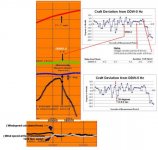
NALSA say that the average deviation is 10 degrees, I say it may be more, perhaps 30 or even 40. The raw data would allow that to be determined.

But, why do you object? If you say the cart works best ddw, why do you not say "well 20 degrees shows that it could do even better", rather than trying to wish it away? Meaning, you do see that the claim is dependent on it being ddw. If not, why is Spork so reluctant to show the data?

And steady state. Steve Smith has said he thinks that the cart could exploit the changing direction of the wind, rather than just the angle itself, or gradients. It's important to note changing. That is why simple static vectors will not give the correct answer. It is always changing, even if it remains within 10 degrees ( it doesn't but...)
If the claim had been "ddw changing wind, not steady-state" I would have said , why not? I proposed a cart that could do that. Goodman's is somewhat like that.

But, how honest is it to change the goal posts and claim victory?

What if I had a cart that could go >WS, but not when less that 9 degrees. I know that for a fact by testing it. I say to you that I have a ddw cart, and that is steady-state etc. You say "no way"
I arrange a trial, or agree to a trial, where the margin allowed is 10 degrees. I then claim ddw on that basis. That is underhanded to say the least. If I do that, make poor measurements, know the wind is gusty, filter the data, AND ensure the run is too short for steady state, then I am a whining pussy cheat.

 
Last edited:
No. As usual you are not paying attention. Read it again. I am comparing an aeroplane using reverse-pitch propellers for braking with a car using its engine for braking. Don't you ever tire of being so obviously, consistently wrong?

Ironically, I was only doing so to illustrate the irrelevance of your previous daft analogy.
Then don't make comparisons with vehicles which use combustion engines.
If an engine does not make a difference, then one is given pause to wonder why they are fitted.

I absolutely don't care what you think "the deal" was. I care that BB went directly downwind, faster than the wind, powered by the wind. I don't even care about your bleating that it wasn't directly enough downwind, because BB does not gain any advantage from it (and aside from some handwaving you have nothing to say it does).

See my reply to RossFW, but the chart says a lot.
As a simple peak speed under acceleration, the outcome is dependent on mass and pushing. Why not roll a dice?
attachment.php


But, the precise pattern of the wind over the short term can produce contradictory outcomes.
attachment.php


NASA claim that acceleration at the time of measurement when the cart is said to be close to ddw, "proves" is works best at ddw. Rubbish. Illogical.
According to the NALSA chart, the wind moves rapidly to the South, and is 25 degrees off at the end of the 10 second period, but the cart continues to accelerate. Surely it should slow quite rapidly. It always accelerates, and that is a general characteristic, so what is so special about is doing that when they want to measure the speed.
They don't even comment on the fact that it does just as well when the wind has changed. There is a strong relationship between a wind that changes direction, and acceleration. Steve Smith of NASA says he thinks that is a plausible mechanism, and the chart says that is what is happening.
 

Attachments

  • heth_3.jpg
    heth_3.jpg
    44 KB · Views: 68
  • steady_2.jpg
    steady_2.jpg
    28.5 KB · Views: 67
Last edited:
The chain or rail which drives the geared wheel will be inefficient. Can you explain why? As I said, you can see why if you work out the forces that make is turn CW or CCW. Nope, I guess you can't. It could roll the other way. No, it really couldn't. It's friction and the moment of the reel, which determines that. Force it, and there will be losses. Force it to do what, precisely? Other than that, more force is needed and the work will be the same. There are no free lunches. Nobody's proposing a free lunch. Big ideas using sticks and stones have all been long exhausted, and that goes for gears. Meaningless.

The wine glass? No. That's a turkey. The hand which drives the finger, moves further than the glass. The finger rolls over the glass stem. No. You fundamentally misunderstand. The finger rolls under the glass stem, and the finger and hand both move less far than the glass. If you cannot envisage it, try it.
If the outer circumference is 2pi and the inner 1pi, then one turn sees the glass move 2pi. The finger moves 1pi wrt the glass, so the total motion for the hand is 3pi.

[qimg]http://www.internationalskeptics.com/forums/attachment.php?attachmentid=21487&stc=1&d=1300807584[/qimg]
Your diagram is wrong. The finger goes under the glass stem, and gently moves it forwards. As it moves, the glass rolls along your finger until it rolls off the tip. If the glass radius is 2 and it's (rather chunky) stem has radius 1 then, as the glass rolls forward 2pi, the point of contact with your finger also moves forward 2pi, but the stem rolls forward 1pi along your finger so the finger itself only has to move forward 1pi. Total motion for your hand is 1pi.

It's a joke. Don't you "get it". If "counter-intuitive" means that there is something that at first looks implausible but isn't, then what is something that at first looks plausible, but isn't?
A sophism

sophism
1.1 A specious but fallacious argument, either used deliberately in order to deceive or mislead, or employed as a means of displaying ingenuity in reasoning. .

And something that at first looks implausible, and is?
Guess what has generally been confused for the other?

Hmm. Is it hubris?

My bits in red.
 
According to the NALSA chart, the wind moves rapidly to the South, and is 25 degrees off at the end of the 10 second period, but the cart continues to accelerate. Surely it should slow quite rapidly. It always accelerates, and that is a general characteristic, so what is so special about is doing that when they want to measure the speed.
They don't even comment on the fact that it does just as well when the wind has changed. There is a strong relationship between a wind that changes direction, and acceleration.

The cart performs best at 0 degrees off the wind, dead dw but no one has said it will not perform at all 4 degrees off the wind. Humber says it should slow "quite rapidly" as the cart gets further away from ddw. It does.

Humber either lies about the charts or is unable to understand the data. It does not matter how many times his errors are pointed out to him. I would encourage anyone who wishes to obtain the NALSA data and look at it for themselves.
 
Point out which statement is wrong.

You miss the beauty of humber... never talk about a statement when you can claim an entire concept, nay, an entire branch of 'simple' physics has been misunderstood...


Dave
 
I notice as I was replying he edited his post to include one of his most hilarious arguments ever. I hope everyone will get as many laughs out of it as I have.

Notice his charts with the white A B and C lines. He thinks it matters how the cart got up to wind speed. No one has ever been able to get him to say when the clock starts ticking on his average speed targets. No one knows if lunch breaks and flat tire changes should be included as well as pushing time.

I notice he also slipped in some more wrongness in the form of his misunderstanding of the meaning of steady state.
 
Last edited:
The chain or rail which drives the geared wheel will be inefficient. Can you explain why? As I said, you can see why if you work out the forces that make is turn CW or CCW. Nope, I guess you can't.
Have done. Posted 3 times. I will fish it out.


It could roll the other way. No, it really couldn't. It's friction and the moment of the reel, which determines that. Force it, and there will be losses. Force it to do what, precisely? Other than that, more force is needed and the work will be the same. There are no free lunches. Nobody's proposing a free lunch. Big ideas using sticks and stones have all been long exhausted, and that goes for gears. Meaningless.
Math says not.

The wine glass? No. That's a turkey. The hand which drives the finger, moves further than the glass. The finger rolls over the glass stem. No. You fundamentally misunderstand. The finger rolls under the glass stem, and the finger and hand both move less far than the glass. If you cannot envisage it, try it.
If the outer circumference is 2pi and the inner 1pi, then one turn sees the glass move 2pi. The finger moves 1pi wrt the glass, so the total motion for the hand is 3pi.
Nope. I have a video for that. I was going to post it today, but feedback from this forum says I should extend it a bit.

http://www.internationalskeptics.com/forums/attachment.p...1&d=1300807584
Your diagram is wrong. The finger goes under the glass stem, and gently moves it forwards. As it moves, the glass rolls along your finger until it rolls off the tip. If the glass radius is 2 and it's (rather chunky) stem has radius 1 then, as the glass rolls forward 2pi, the point of contact with your finger also moves forward 2pi, but the stem rolls forward 1pi along your finger so the finger itself only has to move forward 1pi. Total motion for your hand is 1pi.
That is a deliberate trick, or poor experimental control. video shows why.

It's a joke. Don't you "get it". If "counter-intuitive" means that there is something that at first looks implausible but isn't, then what is something that at first looks plausible, but isn't?
A sophism

sophism
1.1 A specious but fallacious argument, either used deliberately in order to deceive or mislead, or employed as a means of displaying ingenuity in reasoning. .

And something that at first looks implausible, and is?
Guess what has generally been confused for the other?

Hmm. Is it hubris?
Is it technical ignorance?
 
The cart performs best at 0 degrees off the wind, dead dw but no one has said it will not perform at all 4 degrees off the wind.
NALSA submission report. The Chief Expounds

Proof that the vehicle performs best Dead Downwind

As can readily be seen from the above analysis, the vehicle performance is
driven significantly by the prop efficiency. This of course is primarily a function of the Lift/Drag ratio of the propeller airfoil at its operating angle of attack. The propeller on the Blackbird is based on the NACA 6412 airfoil which has it’s maximum L/D at 4.0 degrees, and has a twist such that the airfoil at each spanwise station is presented at that angle of attack (AOA). When the relative flow is aligned with the propeller axis, that AOA can be maintained at all spanwise stations throughout the complete rotation. As the prop rotates counter-
clockwise when viewed from in front of the vehicle, any cross-wind component from the right will cause the AOA for the top blade to increase while the angle of attack of the bottom blade is decreased. A cross wind component from the left will have the same effect in the opposite direction. In both cases the AOA will depart from its optimum value to varying degrees over the full rotation of the prop in this case – reducing the propeller performance – and thus the overall performance of the cart. The cart employs no other aerodynamic surfaces that can take advantage of a cross-wind component.

Humber either lies about the charts or is unable to understand the data.
It does not matter how many times his errors are pointed out to him. I would encourage anyone who wishes to obtain the NALSA data and look at it for themselves. Humber says it should slow "quite rapidly" as the cart gets further away from ddw. It does.

Assume I am lying,. Show me where.
attachment.php
 

Attachments

  • jref_chart2.jpg
    jref_chart2.jpg
    34.9 KB · Views: 69
Last edited:
So we will see it "by Monday" then? :)

Worried? Do you think I dance to the beat of your drum, especially when you are being hammered?

ETA:
I am not all that interested in the wheel thing. Do you remember Mark CC's "A real Bozo Atones?"

He was right the first time, but capitulated in a grovelling way. That is to play into the hands of those who see science as the cult of personality. His retraction was wrong. There are comments on that. He then faced the problem of changing again. His promised follow-up never came, all because of "face".

The video will appear, but in the meantime, you can discuss the topic of the cart in the wind, and how the trial data supports that.
 
Last edited:
Math says not.
Really?

130124925c11c452d4.jpg


If the point of contact with the chain is A and the point of contact with the track is B, then when the chain is pulled to the right there is a torque applied to the gearwheel between points A and B trying to turn the wheel clockwise. (Why would it go anticlockwise?)

As the chain moves to the right, the cogwheel has to move right with it (inertia might tend it to rotate anticlockwise in place, but it can't rotate in place because it cannot slip against the rail. The lever AB compels it to turn clockwise).

Since the wheel must move to the right, it must also roll along the rail.

If the small gear has diameter X and the large wheel has diameter Y, then for each revolution of the wheel, the point of contact B moves Y Pi along the rail, and the point of contact A moves X Pi along the chain.

Since the points of contact remain perpendicular to each other at all times we can see that the displacement of B relative to the rail equals the displacement of A relative to the rail.

The displacement of A along the chain is X Pi and along the rail is Y Pi.
The difference between Y Pi and X Pi is the displacement of the chain.

For each rotation of the wheel, the chain moves (Y-X)Pi relative to the rail.
 
NALSA submission report. The Chief Expounds

Proof that the vehicle performs best Dead Downwind

As can readily be seen from the above analysis, the vehicle performance is
driven significantly by the prop efficiency. This of course is primarily a function of the Lift/Drag ratio of the propeller airfoil at its operating angle of attack. The propeller on the Blackbird is based on the NACA 6412 airfoil which has it’s maximum L/D at 4.0 degrees, and has a twist such that the airfoil at each spanwise station is presented at that angle of attack (AOA). When the relative flow is aligned with the propeller axis, that AOA can be maintained at all spanwise stations throughout the complete rotation. As the prop rotates counter-
clockwise when viewed from in front of the vehicle, any cross-wind component from the right will cause the AOA for the top blade to increase while the angle of attack of the bottom blade is decreased. A cross wind component from the left will have the same effect in the opposite direction. In both cases the AOA will depart from its optimum value to varying degrees over the full rotation of the prop in this case – reducing the propeller performance – and thus the overall performance of the cart. The cart employs no other aerodynamic surfaces that can take advantage of a cross-wind component.

Assume I am lying,. Show me where.

As far as everyone else is concerned thanks Humber, you have again done what you so often do. Introduced incontrovertible proof of your own wrongness as evidence in your defense.

I do not know if you are capable of being shown where you are lying/wrong but I do know for certain that you cannot accept being shown. I know this because you have been shown all your errors and misunderstandings regarding the chart more than a hundred times.

I also know that you will not, or are not capable of understanding, even the most basic concepts required; such as the difference between instantaneous and averaged data points.
 
Really?

[qimg]http://www.internationalskeptics.com/forums/imagehosting/130124925c11c452d4.jpg[/qimg]

If the point of contact with the chain is A and the point of contact with the track is B, then when the chain is pulled to the right there is a torque applied to the gearwheel between points A and B trying to turn the wheel clockwise. (Why would it go anticlockwise?)
When a wheel rolls, there is an opposing force of rolling resistance.
A tyre rolled down a ramp on to a level surface will eventually stop because of that (and drag with the air). That "roll down test" is used to test both car and bike tyres. Friction opposes the wheel, so is a force decelerating it - applied to turn the wheel the other way. Without it, the wheel will not roll, but slide. Friction may be a loss, but no wheel can roll without it.
Which way it turns depends of the direction of that frictional force.
I will find the calculation for that, when I find the post again. Nobody responded when I posted it - 3 times. Will you do that, this time?

As the chain moves to the right, the cogwheel has to move right with it (inertia might tend it to rotate anticlockwise in place, but it can't rotate in place because it cannot slip against the rail. The lever AB compels it to turn clockwise).
That will cost energy.

Since the wheel must move to the right, it must also roll along the rail.
If the small gear has diameter X and the large wheel has diameter Y, then for each revolution of the wheel, the point of contact B moves Y Pi along the rail, and the point of contact A moves X Pi along the chain.
Since the points of contact remain perpendicular to each other at all times we can see that the displacement of B relative to the rail equals the displacement of A relative to the rail.
Tried it have you? There's more to it than that. It is best via video.

The displacement of A along the chain is X Pi and along the rail is Y Pi.The difference between Y Pi and X Pi is the displacement of the chain.
For each rotation of the wheel, the chain moves (Y-X)Pi relative to the rail.
So you say. The driving thing is a rack, so its a rack and pinion. Instead of "imagining" that, make the rack a fixed length and push on the end. See how far that end moves.
 
Status
Not open for further replies.

ISF - Join now!

Every member here is approved by hand. No bots, no spam, just people who care about evidence and honest debate.

Membership is free!

Create your free account

Back
Top Bottom