• Quick note - the problem with Youtube videos not embedding on the forum appears to have been fixed, thanks to ZiprHead. If you do still see problems let me know.

Merged nuclear power safe?

I have to say that the last few pages have been a great laugh thanks to r-j. I did a search and discovered that while most of the obvious literature dates from the 60's, there have been studies over the past decade looking at Cs-137 and St-90 levels in milk.

Now I'm not going to say that there is no milk without both present, but the blind testing done across both North America and Europe show that both elements are still present in very trace amounts (about 0.05-0.30 becquerels) along with I-131 as well (similar extremely low levels.) This has been shown to be true for both domestic and wild milk.

I also know that they are present in extremely low levels in milk from NZ, mostly due to the French atmospheric and underground testing in the Pacific through to the 70's and 80's, and it doesn't seem to have harmed our dairy industry.

Thanks for the laughs r-j. Oh, and you might want to look up e-coli sometime too....
 
Last edited:
Correct. In fact, if you check this page from the United States' EPA, you'll see that the average person receives a radioactive dose of approximately 40 mrem/year simply from eating food & consuming water (no matter what the source).

Bottom line: if you want to ensure that you receive no radiation at all from food, stop eating.

And if you're a smoker, you've already gotten more radiation from your ciggies than you're ever likely to get from Fukushima. Smoking 1.5 packs a day gives you an extra radiation dose of up to 50 mSv/year. (That would be considered significant if you got it from working at a nuclear plant.)
 
Now I'm not going to say that there is no milk without both present, but the blind testing done across both North America and Europe show that both elements are still present in very trace amounts (about 0.05-0.30 becquerels) along with I-131 as well (similar extremely low levels.) This has been shown to be true for both domestic and wild milk.

Low indeed. A Bequerel is a single radioactive decay event in a second; a single beta or alpha emission per second. A Curie of radiation is 37 GBq. It's not a unit of concentration or density, so such a measurement leaves out the quantity of milk involved; it it is a liter or a micromL makes a lot of difference.

In 1961 the BMJ published a report citing a dosage of 130 micro-microcuries / per liter for a years duration or less as safe. That's 5 Bq / liter, lasting for a year. During their Windscale nuke disaster, they saw levels reaching 500 time that high. With a half-life of 8 days, that would have shrunk to the sustainable limit in 72 days. And it did.

http://www.ncbi.nlm.nih.gov/pmc/articles/PMC1970323/?page=1
 
I have to say that the last few pages have been a great laugh thanks to r-j. I did a search and discovered that while most of the obvious literature dates from the 60's, there have been studies over the past decade looking at Cs-137 and St-90 levels in milk.

Now I'm not going to say that there is no milk without both present, but the blind testing done across both North America and Europe show that both elements are still present in very trace amounts (about 0.05-0.30 becquerels) along with I-131 as well (similar extremely low levels.) This has been shown to be true for both domestic and wild milk.

I also know that they are present in extremely low levels in milk from NZ, mostly due to the French atmospheric and underground testing in the Pacific through to the 70's and 80's, and it doesn't seem to have harmed our dairy industry.

Thanks for the laughs r-j. Oh, and you might want to look up e-coli sometime too....

To be fair with r-j , the first time I read about that shortly after chernobyl, I had a 5 minutes meltdown like him, until I realized what (minutes) quantity are involved.
 
Last edited:
So there was a suitable emergency generator available. Did it have to take a week to get it there?

Apparently.
Unless the workers were spending most of the week goofing around, having tea breaks and reading the paper instead of working. :rolleyes:

(Drawing and connecting cables that size takes a while, these appears to be 6.6KV, they take longer to strip and connect than 440V ones.)

This tread is weird, I am becoming less hostile to nuclear power than I have been since kindergarten.:eek:
 
This tread is weird, I am becoming less hostile to nuclear power than I have been since kindergarten.:eek:

The shills are doing a good job.

I am more educated about the plants now, and am noticing the same effect - but then, I honestly cannot judge how big the various risks are.
 
Apparently.
Unless the workers were spending most of the week goofing around, having tea breaks and reading the paper instead of working. :rolleyes:

(Drawing and connecting cables that size takes a while, these appears to be 6.6KV, they take longer to strip and connect than 440V ones.)

This tread is weird, I am becoming less hostile to nuclear power than I have been since kindergarten.:eek:

Like I said before, all they had to do was ask for help. There are plenty of people out there willing to help prevent a level 6 emergency.
 
The shills are doing a good job.
Yes, I guess it is the "sounds like rational people" thing. :D

I am more educated about the plants now, and am noticing the same effect - but then, I honestly cannot judge how big the various risks are.
Same here.
I am still worried about the idea that you can engineer your way out of Enron or Soviet style plant management.
Also, the claim that the risk of radiation drop off non-linearly at low levels sounds a bit too convenient*. I can think of interest groups who would love to claim that passive smoking was actually good for you.;)

*Does the immune system really work like that?
ETA:
Like I said before, all they had to do was ask for help. There are plenty of people out there willing to help prevent a level 6 emergency.
It is possible the management screwed up, but there are also limits to how many people can work at a given task without stumbling on each other.
 
Last edited:
A worker at the plant has been blogging about her experience of the emergency.

http://www.straitstimes.com/BreakingNews/Asia/Story/STIStory_646210.html

Mitsuko’s blog was first posted on Tuesday on the Japanese social networking site Miki (it has since been taken down) then picked up and translated by Singapore’s Straits Times, which has published her harrowing account:
“In the midst of the tsunami alarm (last Friday) at 3am in the night when we couldn’t even see where we were going, we carried on working to restore the reactors from where we were, right by the sea, with the realisation that this could be certain death.
“The machine that cools the reactor is just by the ocean, and it was wrecked by the tsunami. Everyone worked desperately to try and restore it. Fighting fatigue and empty stomachs, we dragged ourselves back to work.
“If we could not recover the cooling system, the second plant would have exploded as the first one. But we, TEPCO (Tokyo Electric Power Co.) could manage to prevent it.
“All of us have been working hard without thinking of their own lives.”

So the first issue here is lack of outside support, and an apparent lack of awareness that there would have been outside help if it had been requested. I don't blame the workers at the site for not trying, and risking their lives, but you have to wonder about the management of TEPCO and it's insular and inward looking approach to resolving an emergency. The Government in general learned from the Kobe quake that is OK to bring in outside help, but this lesson learned does not appear to have sunk in at TEPCO.
 
Low indeed. A Bequerel is a single radioactive decay event in a second; a single beta or alpha emission per second. A Curie of radiation is 37 GBq. It's not a unit of concentration or density, so such a measurement leaves out the quantity of milk involved; it it is a liter or a micromL makes a lot of difference.

Sorry that was my fault, most of the results I found where Bq/L.
 
The Government in general learned from the Kobe quake that is OK to bring in outside help, but this lesson learned does not appear to have sunk in at TEPCO.

It may have been that no one could have gotten to the plants at the time this message got out....
:(
 
Like I said before, all they had to do was ask for help. There are plenty of people out there willing to help prevent a level 6 emergency.

Asking for help is great however it also helps if you know what you want people to do and that people are in the position to provide it. It also takes a while to mobilise the help.

The asking for and managing the help also takes up resources that might otherwise be employed tackling the problem.

Finally, there's always the question of whether the people you are asking for help are in a better position to do something than you are yourself.

It's not always just a simple question of calling for the cavalry when something goes wrong and as outsiders I don't think we are in the position to judge whether they have managed this well or not based on the info we have.
 
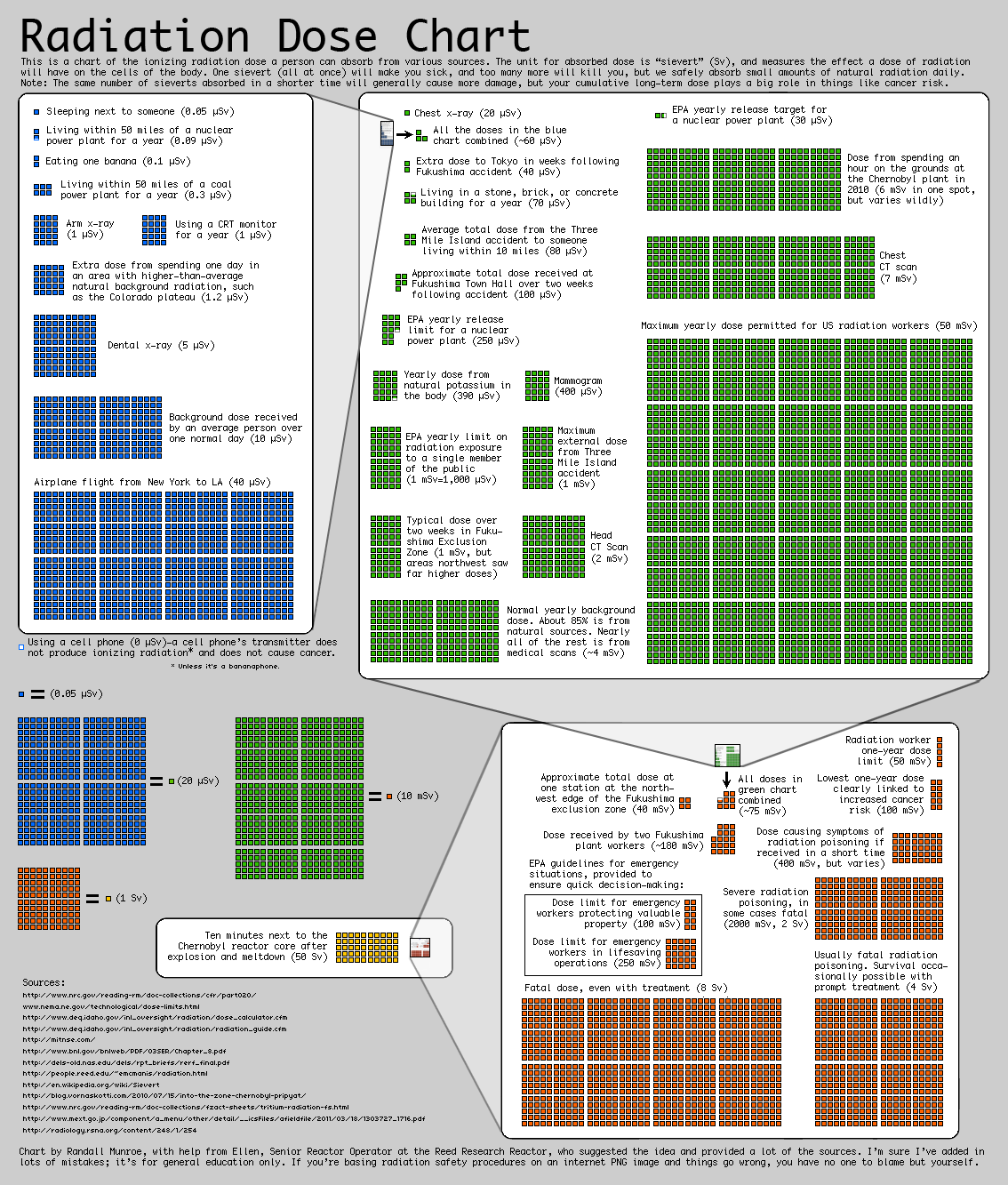
Radiation doses

radiation.png

http://xkcd.com/radiation/
 
Again, this is post hoc reasoning. Let’s let the event stand by itself. The safest place to be during this event was inside the nuclear plant. So far one person has died and not as a result of radiation. By what logic do you consider this unsafe? It is fair to compare nuclear with other sources of electricity. Coal, natural gas and oil have all caused many more deaths as has been pointed out and are far more polluting considering this event and others.

This is mediocrity at its best. Your main line or argument is comparing nuclear power with coal/oil/gas power. Which are basically three century old solutions from the beginning of the industrial age.

You will always excel if you compare yourself with the loser in the class. Rather than compare it archaic technologies, compare it with itself and see what could have been improved.


Based on your posts, you really don't understand what has been included in the design of these plants or how design is done in general. There is no "belief" in what could happen when designing a plant. All nuclear plants are designed assuming worst case scenarios which include missle protection, earthquake, flooding, hurricanes and tornadoes. You seem to assume that every possible natural disaster is predictable and there can't be an unseen event. Are you a lawyer?

glenn

There are plenty of recorded tsunamis of greater hight recorded in Japan's history prior to the building of the plan. Secondly they should have contemplated the scenario in which the wall is not enough. On the following lines
a) we have a wall to contain tsunamis and it will contain waves up to X height
b) what are our options if the wall is compromised or not high enough for the incoming wave?

Unfortunately b was not answered. While it is true that there could be many events and natural disasters, there is one important outcome to consider : vast quantities of water get in. You don't need to think of all the possible events, just one important outcome : water in the plant perimeter. Why not seal the generator in concrete buildings that don't allow water to get in? Why not put some generators up hill, far from the waterline?

Thinking all possible scenarios is not all that complex. For each backup system you have to think about a) being ok or b) failing. Since there was powerline, generator and battery as options you really don't have that many decision points. Now you may rant all you want about reasons for that to fail, a tree falling, an airplane crash, an earthquake, etc etc etc. But the bottom line is just this: what do we do when backup X fails?

Why not the option of having an external jack to plug a trailer loaded generator? Why not auxiliary water connections to put in an external cooling unit for the pools? Why no containment dome on the pools themselves!!??

The main concern right now is the fuel in the pools. Nobody cared to ask what if all three backups fail. It is pretty clear to anybody in the industry that those pools would dry up. Ironically the fuel from the shutdown reactor is one of the ones posing the greatest threat right now. And no one ever though of putting tubes to the outside of a the building to connect some water hydrants?

How expensive can it be to put an external connector to water sprinklers? How hard was it to think of a safer pool? Particularly when it is clear that power failure would lead to its overheating.

So to address your point about worse case scenarios. No they are not designed to consider worse case scenarios because clearly we are living through a worse case scenario that wasn't considered. Once again I don't believe "that every possible natural disaster is predictable and there can't be an unseen event." To do so is impossible, but it is possible to consider the failure of all the systems and all backup systems we implement. Because those are finite and set by us and thus predictable. And then ask us what do we do then.
 
"Alright, folks. We need to replace the power station. I'm sure no one will object to a 5% increase in income tax. Anyone ? Yes, mister Java Man has his arm raised..."

And now they're going to need to do it now anyway, and they have the lack of power from the shutdown reactors, and they're in the middle of a crisis, and bleeding money on other things, and on top of that they'll have the cleanup bill. Suddenly Java Man's 5% tax increase begins to sound like a drop in a bucket compared to all this.

Prevention is usually cheaper than correction. Ever heard of insurance policies? It's the stuff you pay with the intent on not using it.
 

Back
Top Bottom
