
How many times does it need to be repeated?
Once more. If you know.
Try 38%.
Is this some sort of tactic?
No. "Try 38%" might be.
Don't know, ain't science fun!
Numbers are dull for some, but science tries to deal in them. "Considerable" just can't match numbers (especially when they come with explicit uncertainties). Even "significant" has some meaning.
That's a nonsequitor. It's "suggested" because it isn't proven, needs more study etc.
If it was enormous it would have been noticed, not in some obscure paper on input entropy-flow from the Sun (the paper doesn't even address
output entropy-flow) but in reality.
That's not correct, entropy is a result of radiation interacting with the Earth. The intensity of incident radiation varies throughout the spectrum on a fairly regular basis.
That's the blackbody assumption, which the paper refutes. (Permission to treat the paper as a hostile witness, your honour?)
I am, of course, correct that entropy is carried from Sun to Earth by radiation. (Yes, there's some from solar flares and solar wind, but the day-in day-out transfer is by radiation.). It's also carried thusly to a satellite above the atmosphere, where the spectrum can be measured by, for instance, the SIM instrument on SORCE, which is what the discussion paper is based on.
Entropy is inversely related to wavelength. Ergo, if entropy varies signiicantly it shows up in the spectrum.
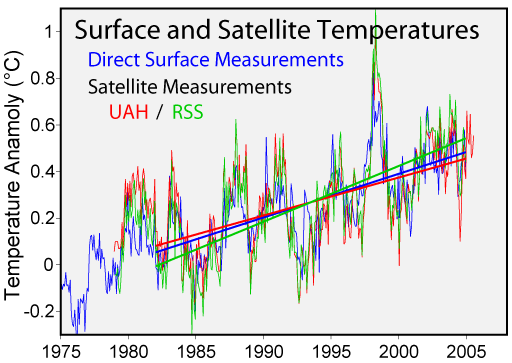
That's an assumption, it isn't proven however. If it were possible to accurately measure the change in entropy GW would be an open and shut case. Until then we have a rough estimate of the Sun's energy and some poorly placed thermometers.
Entropy and energy are not the same thing, and "poorly placed thermometers" is just sad. AGW is proven by the fact that it's happening, it requires no new laws of physics (on the contrary, it would requires new laws to explain why it
didn't happen, but it has, so there's no need), and is based on the
energy budget.
They have when it comes to how it affects the climate.
There's no
observable effect outside current understanding, which is why you're left to grasp at an obscure (and apparently hostile) discussion paper on how entropy ties into the important stuff.
There's no understanding to begin with.
There is. You could share in some of it if you wanted to.
Well that doesn't make any sense.
It makes sense to people observing you.
This tends to be the problem with alarmists ...
For the record, I'm not an alarmist. I'm loving this.
...they go "Oh no CO2, aaaaakckk! we're all going to die".
Also for the record, you are all going to die. I have other plans, and so far they're working out.
If global warming were as simple as measuring CO2 ppm climate science would be a rather simple affair. Instead we're employing super computers and some of the most brilliant minds on the planet to figure this thing out.
The computers aren't figuring things out, they're just running the numbers. And those brilliant minds have figured a great deal out. Many of them are alarmed (I blame it on caring, which I don't).
In the mean time taking a closer look at the sun is actually a very good idea.
There are solar scientists doing just that, and I follow their considerable progress with great interest. Sun-directed satellites (and computer models) have led to understanding of what was previously hidden.
If you bothered to try and read the paper cited you'd see the radius of the sun is a consideration in the calculation of TSI.
The paper doesn't say that.
I'm not sure how important it actually is, but that's not my job. I'm just here to point out how foolish it is to assume more than you really know and instead take a skeptical look at the issue.
I'm here to point out that how foolish it is to think that what
you don't know, nobody knows. That what you have no understanding of,
nobody has any understanding of. And that "poorly placed thermometers" are at the heart of things.



 .
.




 . In which case :
 !
!