Moderated WTC 1 features list, initiation model / WTC 2 features list, collapse model

I am making a collapse initiation model. I need accurate measurements.

Anyone making a collapse initiation model will need to know the tilt angles over which all core and perimeter columns originally failed.

If columns on one side of the building are buckling/failing and columns on the other side of the tower are bending but not buckling, the building is still in the process of tilting during the failure sequence.

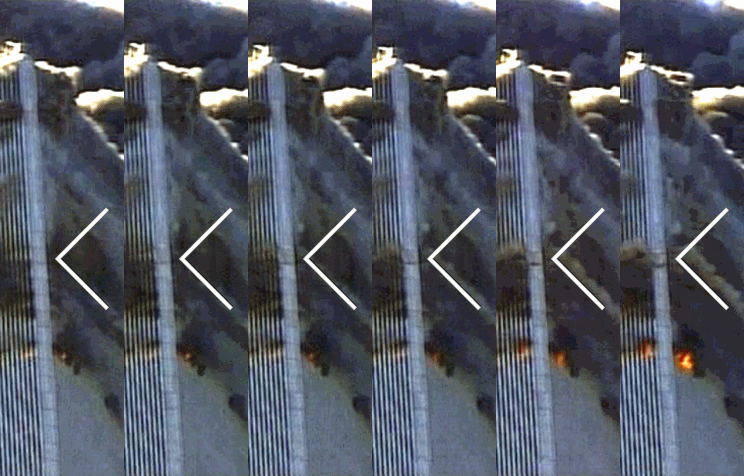
I want to know at what tilt angles the last columns failed. Using synchronized videos and the naked eye we can determine that the following two images represent the moment when the NW corner has clearly failed. It is a conservative estimate favoring more tilt, not less:


which represents 0:32 in the synchronized video:
http://www.youtube.com/user/femr2?&MMN_position=312:312#p/u/3/_lnHn9yN6Is


which represents 0:21 in the synchronized video:
http://www.youtube.com/user/femr2?&MMN_position=312:312#p/u/5/zaB7NJdtVic

These two images show the true state of tilt just after the moment that the last columns failed on the NW corner of the building. In the lower picture we can see that the NW corner has already failed at fl 98. You can already see the break on the corner so this image is a conservative estimate of true tilt. Precise measurements will actually yield less tilt than is shown in the images.

Can we all finally agree on this?

>>>>

Notice that the tilt angles shown above are very consistent with the claim that the true tilt of vertical features as all core and perimeter columns failed was within 1 degree.

Can we all agree that this is the most accurate guess available?

We all got together on this and the answer is no.
 
Guys, over what tilt angles did all columns in WTC1 fail?

It has nothing to do with your religious submission to the Word of NIST.

I'm looking for an actual number.

sauret_ballou.jpeg


About 1 degree seems pretty close, no?


At what tilt angle did the last groups of columns fail? What was the tilt of the antenna at that time? The north wall?

Is there anyone courageous enough to stray from the herd and simply admit that all columns failed with minimal tilt? About 1 degree?

>>>>>>>>>>>>>

While I wait for someone to show the smallest amount of backbone, the next question is...

After almost 10 years, does anyone have evidence that any official government report or academic paper on the WTC does not overestimate the true tilt of WTC1 over which all the columns originally failed?


The answers are obviously that the tilt angles were about 1 degree by visual inspection and less when subpixel measurements are used on the antenna and the north wall.

The answer to the second question is "no".


In a thread called "WTC1 feature list, initiation model", identification of the correct tilt angles over which all columns failed is not a "distraction".

The 20+ page distraction about measuring the correct angle is from yourselves, not me.

I had pretty correct answers in the OP. I am not in denial over the early motion. The delay is because not one person could manage to grow enough spine to admit that the true angle is minimal.

All core and perimeter columns failed within 1 degree of tilt of the antenna or the north face.
 
Last edited:
Just like with the progression model, I'll construct a WTC1 initiation model based on observables from the feature list.

I'd like to clarify a few basic points, written in the form of Q&A::


What is a collapse initiation model?

a) A description of the column failure sequence.

b) A description of a mechanism which led to column failure.

c) An identification of the causal mechanism of collapse.


What is collapse initiation?

Initiate means (Miriam-Webster definition): to cause or facilitate the beginning of : to set in motion.

So collapse initiation must mean the process that causes the collapse, or that which facilitates the beginning of collapse.

A collapse initiation model is a model of what set the collapse in motion.


This will be my working definition of the term.


The WTC towers were obviously held up by columns. The failure of a group of columns will not necessarily lead to total collapse, so a collapse initiation model must also show how the failure of a group of columns leads to "collapse" or global failure.

It is not enough for a collapse initiation model to show that a local group of columns failed, since local failure does not inevitably lead to collapse.


Would a collapse initiation model cover motion of the building after all the columns have failed?

From the definition of "initiate" I cannot understand why it would. Any type of collapse initiation is clearly over by that time. The period of initiation involves the first group of column failures and the spreading of column failures to global failure, or "collapse".


Over what tilt angles did the columns of WTC1 fail?

All columns had failed before the antenna or the north wall tilted 1 degree from plumb.


How is the failure of all core and perimeter columns over tilting of less than 1 degree explained in official govt reports and academic literature?

It is not explained at all. It is not even recognized to exist. There is no evidence in any govt report or academic paper on the subject that any author or research group was aware of such a small tilt angle.


Does anyone disagree with this basic outline? You'll need to provide some proof to the contrary if you disagree.

Basically, the heart of my model will be in recognizing the true tilt angles over which all columns fail and the measurable deformities of building features leading up to collapse.

The correct angle range is very important in determining whether the first group of columns to fail were on the south wall. If the angle is too small, the claim of south wall failure as the initiating event is not at all certain.
 
Last edited:
At some point in my old age, I hope that younger folks will point out to me that talking to myself is crazy.
 
...Does anyone disagree with this basic outline? You'll need to provide some proof to the contrary if you disagree....
WRONG again. How many times do you need to be told? YOU are making the claim. It is your onus to "prove" your claim not ours to disprove it. (And allowing all the disclaimers about using the word "prove" in a para-scientific context.)

...Basically, the heart of my model will be in recognizing the true tilt angles over which all columns fail and the measurable deformities of building features leading up to collapse....
Maybe I have missed it in all the noise on this "channel" but where is your proof that tilt is causally related to column failure???
...The correct angle range is very important in determining whether the first group of columns to fail were on the south wall. If the angle is too small, the claim of south wall failure as the initiating event is not at all certain.
I'm "...not at all certain..." that your claim is warranted - if you can sort the "double negative" construct. :rolleyes:
 
Ozeco, are you aware there are many pages in this thread in which the tilt arguments have been made?

Are you aware of the tilt arguments in the features list?

When your repeat:

"WRONG again. How many times do you need to be told? YOU are making the claim. It is your onus to "prove" your claim not ours to disprove it."

could you specify what you mean by the word "claim"?

You use the same comment in very different contexts. In the current context, it seems you don't realize that those specific "claims" are the result of many pages of discussion.
 
Just like with the progression model, I'll construct a WTC1 initiation model based on observables from the feature list.

I'd like to clarify a few basic points, written in the form of Q&A::


What is a collapse initiation model?

a) A description of the column failure sequence.

b) A description of a mechanism which led to column failure.

c) An identification of the causal mechanism of collapse.


What is collapse initiation?

Initiate means (Miriam-Webster definition): to cause or facilitate the beginning of : to set in motion.

So collapse initiation must mean the process that causes the collapse, or that which facilitates the beginning of collapse.

A collapse initiation model is a model of what set the collapse in motion.


This will be my working definition of the term.


The WTC towers were obviously held up by columns. The failure of a group of columns will not necessarily lead to total collapse, so a collapse initiation model must also show how the failure of a group of columns leads to "collapse" or global failure.

It is not enough for a collapse initiation model to show that a local group of columns failed, since local failure does not inevitably lead to collapse.


Would a collapse initiation model cover motion of the building after all the columns have failed?

From the definition of "initiate" I cannot understand why it would. Any type of collapse initiation is clearly over by that time. The period of initiation involves the first group of column failures and the spreading of column failures to global failure, or "collapse".


Over what tilt angles did the columns of WTC1 fail?

All columns had failed before the antenna or the north wall tilted 1 degree from plumb.


How is the failure of all core and perimeter columns over tilting of less than 1 degree explained in official govt reports and academic literature?

It is not explained at all. It is not even recognized to exist. There is no evidence in any govt report or academic paper on the subject that any author or research group was aware of such a small tilt angle.


Does anyone disagree with this basic outline? You'll need to provide some proof to the contrary if you disagree.

Basically, the heart of my model will be in recognizing the true tilt angles over which all columns fail and the measurable deformities of building features leading up to collapse.

The correct angle range is very important in determining whether the first group of columns to fail were on the south wall. If the angle is too small, the claim of south wall failure as the initiating event is not at all certain.

You mean the specific claims made in this quote? These statements are correct. Angle has bee discussed many times.

The statement about the official lack of recognition of the minimal tilt angle over which all columns failed is a fact.

You cannot produce proof otherwise because the statement is a fact. Nobody can. (Because such recognition doesn't exist).


There are no official statements or academic literature that recognizes that all columns failed within 1 degree of tilting of the antenna or north wall. There is no acknowledgement of how small the angle range actually was. This thread has many examples of people who over-estimate the tilt angle. The thread is an excellent example of how few people seem to realize just how small the tilt was as the last columns failed.

After so much BS, I really don't want to go over the angle measurements again just for you. Please read the thread. And as you read, please notice how nobody seems to recognize how small the angle range was while they provide useless, incorrect measurements of their own which exaggerate the tilt to absurd degrees.
 
Last edited:
You mean the specific claims made in this quote? These statements are correct. Angle has bee discussed many times.

The statement about the official recognition of the minimal tilt angle over which all columns failed is a fact.

You cannot produce proof otherwise because the statement is a fact. Nobody can. (Because such recognition doesn't exist)...
I am not questioning the content of official reports.

Putting my main question as simply as I can:
Are you claiming that "tilt" caused the column failure OR are you merely using the amount of tilt as a timing or sequence marker? (Or is there another alternative which I have missed?)

So this is an example of the terminology which I find to be ambiguous:
...There are no official statements or academic literature that recognizes that all columns failed within 1 degree of tilting of the antenna or north wall....
Are you saying that (a) failure of all columns had occurred by the time the antenna had tilted 1 degree but not caused by the tilt OR are you saying that (b) the tilting caused column failure??
There is no acknowledgement of how small the angle range actually was. This thread has many examples of people who over-estimate the tilt angle. The thread is an excellent example of how few people seem to realize just how small the tilt was as the last columns failed...
Why does it matter in your claim???

After so much BS, I really don't want to go over the angle measurements again just for you...
I didn't ask you to. I asked a simple question seeking clarification of what you are claiming.
Please read the thread. And as you read, please notice how nobody seems to recognize how small the angle range was while they provide useless, incorrect measurements of their own which exaggerate the tilt to absurd degrees.
I am well aware of people disputing your measurements. What I am asking is "Why does the angle matter?"
 
You don't seem aware of the NIST collapse initiation mechanism. I understad that defending it is not as important to you as it is to other posters, but if you do not know on what their mechanism is based, then it would be hard to understand my criticism of it.

If you understood the initiation mechanism, then you will understand why angle is important.

A few more Q&A that may help towards an understanding of the NIST mechanism...


Is there an official govt explanation for WTC1 collapse initiation?

Yes. A detailed outline of the model in NIST NCSTAR 1.6 Executive Summary

The short 44 page summary linked:
http://wtc.nist.gov/pubs/NCSTAR1-6ExecutiveSummary.pdf

The initiating mechanism is long truss floor sagging in the OOS south region, pulling in the south perimeter columns to the point of failure. The south perimeter fails first, and failure progresses to the east and west perimeter walls and the core.


How does south wall failure as the initiation mechanism account for all columns failing within 1 degree of antenna or north wall tilt?

No explanation is given. The small failure angle is never acknowledged to exist.


If there is a big freaking antenna at the top of the building and the last group of columns to fail in the NW corner is clearly visible, how did a failure of all core and perimeter columns at less than 1 degree go unnoticed for so many years?

I don't know.


Is there any consideration of the possibility of a collective core failure within the NIST examination of the cause of initiation?

No. The NIST explanation relies only on the mechanism of sagging long span trusses in the south OOS region which pull in the south perimeter to the point of failure. No suggestion is ever given by the NIST of the possibility of collective core failure. It is never considered as an option.


What is the stated purpose of the NIST reports?

Within the preface of each NIST report the following statement is repeated:

The specific objectives were:

1. Determine why and how WTC 1 and WTC 2 collapsed following the initial impacts of the
aircraft and why and how WTC 7 collapsed;

2. Determine why the injuries and fatalities were so high or low depending on location,
including all technical aspects of fire protection, occupant behavior, evacuation, and
emergency response;

3. Determine what procedures and practices were used in the design, construction, operation,
and maintenance of WTC 1, 2, and 7; and

4. Identify, as specifically as possible, areas in current building and fire codes, standards, and
practices that warrant revision.


Determining "why and how WTC 1 and WTC 2 collapsed" basically means finding an initiation mechanism for each building. The discovery of the actual initiation mechanism is the NIST's first and foremost stated objective.

If the NIST believes it has discovered the true initiation mechanism, it will naturally use this information towards objective #4, which is the recommendation of code changes to affect high-rise buildings throughout the US and the world.

If they fail to identify the correct failure mechanism and instead make recommendations based on a false model, then they have clearly failed in objectives #1 and #4.

The more convinced they are in a false initiation mechanism, the more dangerous and costly their recommendations can become.

Simply from an engineering point of view, it would be wise to double-check the NIST findings before building new structures and upgrading existing ones based on incorrect recommendations.

 
On the question of the NW corner, consider this simple model placed over the actual movement from the north:

tiltfallsmall.gif


Can you see how there is a slight east to west failure along the north face? The NW corner will be the last group of columns to fail in this sequence, no?

Well, the same thing happens along the west face, it fails very quickly south to north.

Obviously the NW corner is the last group of columns to fail.

Here is the NW corner:

700566080.gif


we can all see it fail. So when that goes, it means all core and perimeter columns have failed by that time.

At the moment of failure, the antenna and north wall tilt angles are within 1 degree of plumb. That is the reality, guys.
 
Last edited:
...If you understood the initiation mechanism, then you will understand why angle is important...

...
A few more Q&A that may help towards an understanding of the NIST mechanism...
Your patronising evasions do you no credit Major_Tom.
I have questioned your claim. Your claim does not depend on either the NIST explanation, my understanding of the NIST mechanism OR my comprehension of the initiation mechanism.

The questions I put to you are simple requests for clarification of your claim.

I note your refusal to answer those simple questions.


..
What is the stated purpose of the NIST reports?...
I am not interested in your misinterpretation of the NIST objectives. I have previously attempted without success to advise you of the structural error in your logic.

My interest is in your partially and confusingly stated claim. Hence the simple requests for clarification which you are not prepared to answer.
 
It is a direct quote from the the preface of each NIST report. Don't you realize that?


Please specify what you mean by "claim" whenever you use that word. I have no idea which "claim" you mean. I am showing you portions of the NIST reports and you don't seem to recognize them.


Please quote a "claim" to verify that I made it.

Ozeco, it seems from your posts that you do not understand the NIST initiation mechanism. If you do not know what it is, how can you offer comments on my criticism of it?

You also don't seem to understand that tilt angles of less than 1 degree cast serious doubt on whether the NIST correctly identified the "how and why" of WTC1 initiation.
 
Last edited:
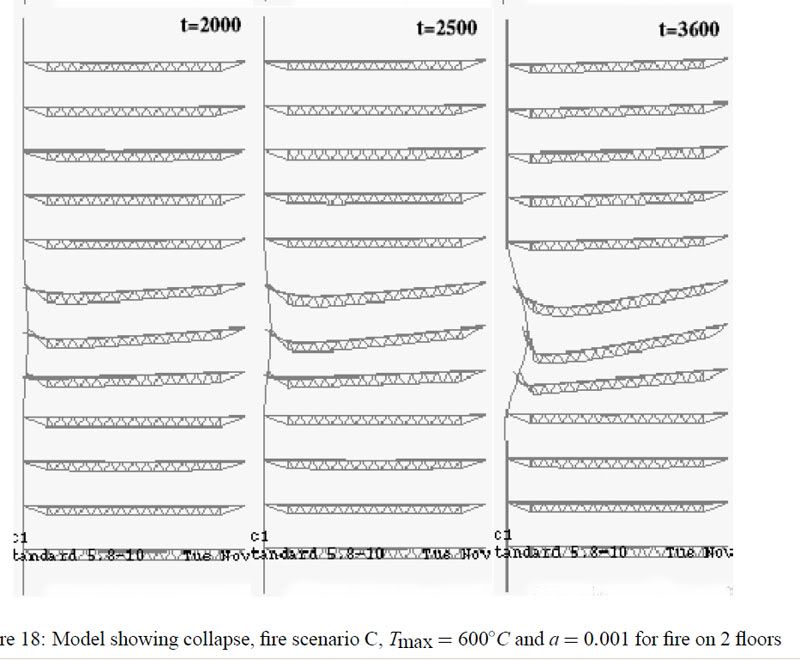
The NIST initiation scenario looks something like this:

usmanidiagram.jpg


(From Usmani, Chung, Torero)

Long truss sagging and perimeter pull in. That is it. There is no other explanation of the "how and why" of the WTC1 collapse offered by the NIST.

South wall failure is all you have left. That is the NIST explanation. Somehow, the south wall pulls all the other columns down with it within a 1 degree tilt of any vertical feature.

Somehow, the south perimeter causes all 60 columns in the west perimeter to fail within a 0.5 degree time interval.


How? Nobody knows.

Perhaps only the Good Lord knows how, but that is your 20+ million dollar theory.

(But it gets worse! That sagging supposedly happens over a 22 minute interval in an area half of which had no visible fire intil just a few minutes earlier. The fires on the east side of the south wall began just after 3 large fireballs shot out the side of the building, from the middle of the area which would bow inwards just a few minutes later.


But it gets even worse than that.....)
 
Last edited:
Last edited:
Guys, over what tilt angles did all columns in WTC1 fail?
It has nothing to do with your religious submission to the Word of NIST.
I'm looking for an actual number.
………
Is there anyone courageous enough to stray from the herd and simply admit that all columns failed with minimal tilt? About 1 degree?
>>>>>>>>>>>>>
While I wait for someone to show the smallest amount of backbone, the next question is...
……….

Bazant already calculated this angle. You just don’t know where it is.

……….
How is the failure of all core and perimeter columns over tilting of less than 1 degree explained in official govt reports and academic literature?
It is not explained at all. It is not even recognized to exist. There is no evidence in any govt report or academic paper on the subject that any author or research group was aware of such a small tilt angle.
……….
False. Bazant already calculated this angle. You just don’t know where it is.

……… The statement about the official lack of recognition of the minimal tilt angle over which all columns failed is a fact.
You cannot produce proof otherwise because the statement is a fact. Nobody can. (Because such recognition doesn't exist).

There are no official statements or academic literature that recognizes that all columns failed within 1 degree of tilting of the antenna or north wall. There is no acknowledgement of how small the angle range actually was. This thread has many examples of people who over-estimate the tilt angle. The thread is an excellent example of how few people seem to realize just how small the tilt was as the last columns failed.

False. Bazant already calculated this angle. You just don’t know where it is.

……….

Is there any consideration of the possibility of a collective core failure within the NIST examination of the cause of initiation?
No. The NIST explanation relies only on the mechanism of sagging long span trusses in the south OOS region which pull in the south perimeter to the point of failure. No suggestion is ever given by the NIST of the possibility of collective core failure. It is never considered as an option.


False. NIST considered the failure of the core before the perimeter walls but dismissed it. You just don’t know where this is.

What is the stated purpose of the NIST reports?

Within the preface of each NIST report the following statement is repeated:
Determining "why and how WTC 1 and WTC 2 collapsed" basically means finding an initiation mechanism for each building. The discovery of the actual initiation mechanism is the NIST's first and foremost stated objective.
If the NIST believes it has discovered the true initiation mechanism, it will naturally use this information towards objective #4, which is the recommendation of code changes to affect high-rise buildings throughout the US and the world.
If they fail to identify the correct failure mechanism and instead make recommendations based on a false model, then they have clearly failed in objectives #1 and #4.
The more convinced they are in a false initiation mechanism, the more dangerous and costly their recommendations can become.
Simply from an engineering point of view, it would be wise to double-check the NIST findings before building new structures and upgrading existing ones based on incorrect recommendations.
Def: Competent - having suitable or sufficient skill, knowledge, experience, etc., for some purpose; properly qualified.

False. The structural failures of WTC1,2 were the result of structural damage and fires. The structural failure of WTC7 was the result of fires.
Competent structural engineers understand and accept this conclusion.
Incompetent Conspiracists choose to believe in CD contrary to the evidence.
 
Last edited:
NIST NCSTAR 1.6 Executive Summary is an excellent condensed version of NISTian thought.

For our purposes, it serves as the perfect "CliffNotes" version of how the NIST attempted to show that impact damage and fires alone can explain the WTC1 collapse initiation.

This is the heart of what many posters here would call "proof" of how the impact and fires could reasonably result in the WTC 1 collapse.

The short summary linked again:
http://wtc.nist.gov/pubs/NCSTAR1-6ExecutiveSummary.pdf

..............

The title of this thread is "WTC1 feature list, initiation model". This executive summary acts as a good synopsis of a NIST version of a "WTC1 feature list" (or "list of observables") and the NIST initiation model.

It is fair to request that this is the minimum required reading to participate in this thread. There is no excuse for not knowing this material.
:id:

Bazant already calculated this angle. You just don’t know where it is.

False. Bazant already calculated this angle. You just don’t know where it is.

False. Bazant already calculated this angle. You just don’t know where it is.

False. NIST considered the failure of the core before the perimeter walls but dismissed it. You just don’t know where this is.

Def: Competent - having suitable or sufficient skill, knowledge, experience, etc., for some purpose; properly qualified.

False. The structural failures of WTC1,2 were the result of structural damage and fires. The structural failure of WTC7 was the result of fires.
Competent structural engineers understand and accept this conclusion.
Incompetent Conspiracists choose to believe in CD contrary to the evidence.
:id::id:

 
Last edited:
When any column fails, additional load is transferred to other columns. If the other columns are able to support that load a new equilibrium will be reached. If not, other columns will fail in turn.

Tilting is in no way necessary for that process to occur. It may well occur as a result of the process, but it is not a direct cause of anything. It happens because for some small span of time, some columns have failed and others have not. Those that fail later do so because of the transferred load, not because of the tilt.

In no case is it ever possible to rationally conclude that a given column could not have or should not have failed because the tilt was insufficient to cause a failure.

So, with that in mind, what significance is being claimed here regarding the amount of tilt over which all columns failed? What if anything is indicated if the angle is small, or large?

Respectfully,
Myriad
 

Back
Top Bottom