LightningTeg
Scholar

- Joined
- Jan 25, 2011
- Messages
- 101

… I've spent lots of time looking for evidence of creep, both in terms of it's previous *evidential form*...progressive tilt, and in terms of extremely fine displacement of building features over time.
Looking for per-element creep behaviour would be a little silly, so looking for the *effect* of *progressive creep* over *time* is the next best thing in terms of extracting data from the visual record.
Some of the data (especially the 9.5s motion data) has been available for looong time tom. Silly boy.

femr,
And you produce another complete derail from the thread topic. For no particular reason at all.
Reading your posts makes it obvious that you don't know what creep is.
As proof, I invite you to relate to us:
A) what value of creep you think that NIST was claiming in the South & east wall of the (undefined) figure you posted (fig 4-89, NCSTAR1-6D).
B) what value of creep NIST claims was in the same walls at the same time in Fig. 4-123 of the same document.
C) calculate the amount of creep that you say the building underwent during the last 9.5 seconds.
D) compare the A, B & C answers, and explain the differences in the values.
___
The "enormously increased rate of creep" that I was referring to in my post to P4T is simple & clear in the post. It was the greatly increased amount of creep that Bazant described that results from increased stress levels and modest temperature rises.
"… if, for instance, the column load is raised at temperature 250° C from 0.3Pt to 0.9Pt (where Pt = failure load = tangent modulus load), the critical time of creep buckling ... gets shortened from 2400 hours to 1 hour …"
Journal of Engineering Mechanics ASCE , Vol. 134 (2008)
What Did and Did not Cause Collapse of WTC Twin Towers in New York
Zdenek P. Bazant, Jia-Liang Le, Frank R. Greening and David B. Benson
The nice thing about materials is that the have no political agenda. They behave fairly consistently, from the test lab to the application. Therefore I believe Bazant's assessment will apply to all structural steel under those conditions, as it was generated by engineers who know what creep really is.
Plus I consider a creep rate that produces a buckling failure in 1 hour instead of 2400 to be "enormously increased".
That's just me...
In other words, you just confirmed everything I said from the beginning. You do not look at creep. You can't see creep. You can't measure creep.
You look for what you think is "the *effect* of *progressive creep* over *time*". Presumably displacement and tilt. But it would be asking WAY too much of you to state it clearly, of course.
Just out of curiosity, what features of how many columns did you look at in your analysis?
My best guess is "zero features of zero columns".
Never mind. It just perpetuates your derail.
___
Yet you chose to not produce your data, or provide a link to it. In spite of being invited to numerous times.
Typical.
You suggest (without saying, of course. God forbid you ever state anything clearly.) that the 9.5 seconds of building motion just before external collapse initiation is creep.
How amusing...
Stealth data, unlabeled charts, redefined "terms". Yeah, debating you is a real joy...
___
Thanks for proving, once again, that your primary debating tools are obfuscation, uniquely defined terms and games.
Write your paper. Publish your results.
Oh yeah. You're not going to publish anything. Which relegates all of your work to the class called "nonexistent".
Captain Irrelevant strikes again.
Silly boy.
Captain Irrelevant strikes again.
Ah, that explains why you guys don't want to publish your studies.Femr: "The history is indeed set in print, and in stone."
The written word is a wonderful thing. There is no need to rely on memory when we have it all recorded.
It's a good thing, too, because if we needed to rely on memory, we'd be destined to move in circles..

Just pointing out that 5 or 6 floors in wtc towers was OMG huge (even if ergo wishes it wasn't). And that I dont' think there is any valid comparsion between cctv tower in beijing (different construction, different design) and not allowing truthers to even try to bring in to any discussion of the fires at wtc1 and 2.
that is all.
From what I understood
Hot temperatures --> ... --> Columns sag --> ... --> Local stress exceeds local strength at exterior column/floor column connection/s --> ... --> The first floor collapses --> ...
Are you telling me this is wrong?
By the scenario that you've posted (just fires), the towers would, to a very high probability, both still be standing.
...
You've left out some fundamental things that would have completely changed the outcome.
loss of insulation
physical damage from plane impact
greatly increased stresses as a result of damage
the enormously increased rate of creep because of the high stress levels


… if we needed to rely on memory, we'd be destined to move in circles..


tfk said:Ever vigilant in his Giant Nit Hunt, femr proceeds to claim that the loss of insulation & physical damage are merely "speculative".
And why are they merely speculative?
Because he thinks that the plane hit at a slightly different angle than NIST calculated.
It doesn't get any more clueless than that.
Anyone who sees this:

or this:

… and concludes that physical damage to the building is "speculative" has got more than a few screws loose.
Or is perversely, purposefully argumentative.
Not the question asked, but to interpret...I consider a creep rate that produces a buckling failure in 1 hour instead of 2400 to be "enormously increased".

Utter crap tom. I've lost count of the number of times you have made the same stupid baseless assertion, and I have responded stating that I'm not saying there was no creep.femr asserts that, since he can not measure some parameter peripherally related to *non-creep creep*, then real creep did not happen.
No, he doesn't. He means that the NIST estimate is an estimate. Estimate being speculative. Accuracy of speculative estimate being increasingly poor due to inaccurate initial aircraft impact trajectory and orientation parameters...He does not mean that "the damage is speculative". He means: "NIST's assessment of the exact location of the damage is different than mine."
I have indeed, as well you know.You look for what you think is "the *effect* of *progressive creep* over *time*".
Presume ? I've told you repeatedly...tfk said:Presumably displacement and tilt.
femr2 said:Some of the data (especially the 9.5s motion data) has been available for looong time tom.
femr2 said:As you well know I've spent lots of time looking for evidence of creep, both in terms of it's previous *evidential form*...progressive tilt, and in terms of extremely fine displacement of building features over time.
...etc...femr2 said:That's right. Easily detectable motion of multiple WTC1 features beginning 9.5s in advance of release.
...and we have had much discussion on the topic of progressive tilt.It is proven in the slow, progressive tilt of the buildings
...
The temperature was hot enough to allow the steel to creep. That is unequivocal, from the video.
...
ANY AND ALL buildings that undergo continuous, progressive leaning WILL collapse. That is also unequivocal. The ONLY way in which a building does NOT collapse is to bring the progressive leaning to a halt.

Not the question asked,
As proof, I invite you to relate to us:
A) what value of creep you think that NIST was claiming in the South & east wall of the (undefined) figure you posted (fig 4-89, NCSTAR1-6D).
B) what value of creep NIST claims was in the same walls at the same time in Fig. 4-123 of the same document.
C) calculate the amount of creep that you say the building underwent during the last 9.5 seconds.
D) compare the A, B & C answers, and explain the differences in the values.
You think the period of enourmously increased creep applies to...the hour before release ?
If so, then I assume you also agree with the NIST estimated displacements, such as...
http://femr2.ucoz.com/_ph/9/495244215.png
Utter crap tom. I've lost count of the number of times you have made the same stupid baseless assertion, and I have responded stating that I'm not saying there was no creep.
[I mean] that the NIST estimate is an estimate. Estimate being speculative. Accuracy of speculative estimate being increasingly poor due to inaccurate initial aircraft impact trajectory and orientation parameters...
loss of insulation
physical damage from plane impact
greatly increased stresses as a result of damage
the enormously increased rate of creep because of the high stress levels
Largely speculativeloss of insulation
Largely speculativephysical damage from plane impact
The NIST impact simulations result in damage ESTIMATES. aka speculative. Getting the impact orientation and trajectory paramaters wrong reduces the accuracy of such ESTIMATES even further. As I said earlier. Again, trying to shift the scope is very transparent tom. Tsk tsk.

So, in this post...
http://www.internationalskeptics.com/forums/showpost.php?p=6847736&postcount=2090
...I asked you 3 questions. You've *kind-of* managed an answer to the third. Hows them thar answers to 1 & 2 coming on ... ?
So, as I was saying...long timespan traces for WTC1 reveal sharp transition from *none* to *significant* motion of multiple features only from ~9.5s prior to release.
Nonsense...You askedme what "enormous increase in creep" that I meant when I answered P4T.
femr2 said:So, do you think the the enormously increased rate of creep applies only from 9.5s in advance of release ?
femr2 said:So, do you think the the enormously increased rate of creep applies only from 9.5s in advance of release ?
femr2 said:3) Do you think the the enormously increased rate of creep you stated applies only from 9.5s in advance of release of WTC1 ?
...etc.femr2 said:You keep avoiding the question.
Motion of features on WTC1 transitions from *none* to *significant* roughly 9.5s in advance of release.
So lets try and get some kind of an answer from you...
You stated enormously increased rate of creep...
When does that apply from ? A time after impact fro WTC1, or a time before release is fine.
What scale is your suggested enormously increased rate of creep over ?
(NIST have some diagrams you will probably want to refer to ?)
LOL.I answered you, carefully, precisely, accurately.
ROFL. So you are saying the NIST impact damage estimates were NOT estimates ? Nice one.It's telling that you don't recognize the difference between "speculation" and "professional analysis".
Incorrect. Two separate additional studies, one by me. Both show pretty clearly the scale of the error.There is precisely zero evidence that NIST got the approach angles wrong.
Yup.You think that you've proven something.
ROFL. You are simply showing, yet again, that you don't understand the rotoscoping method. It's self validating.You & MT have proven again & again that you don't comprehend how to transform camera views into real 3D space.
They messed it up, by making the DECISION to orient the impact such that the engine would exit at a certain point given a simple linear projection. They didn't determine the CORRECT trajectory and orientation.NIST hired people who are expert in this analysis.
I have very little interest in what you think tom.And you expect me to dismiss their work & accept yours??
You know where the draft is...Publish your nonsense.
Whatever. You certainly are not one of them, so perhaps someone else will have something to say.I fully expect that it will get shredded by experts.
Nope. Stupid leading questions, as well you know.Answer my questions A) thru D) above.
ROFL.Then I'll answer yours.
Incorrect. You just can't stop yourself from inferring a perfectly clear statement says something other than it does. You don't even know the scale. You just want to try and save face I guess delude yourself into thinking you've *proved femr2 wrong* about something. It's beyond pathetic tom. Funny even. But by all means carry on. The thread is fixed in stone. You're doing a grand job. lol.Once again, you confuse "gross motions" for "creep".

Nonsense...
...etc.
LOL.
ROFL. So you are saying the NIST impact damage estimates were NOT estimates ? Nice one.
Incorrect. Two separate additional studies, one by me. Both show pretty clearly the scale of the error.
Yup.
ROFL. You are simply showing, yet again, that you don't understand the rotoscoping method. It's self validating.
They messed it up, by making the DECISION to orient the impact such that the engine would exit at a certain point given a simple linear projection. They didn't determine the CORRECT trajectory and orientation.
I have very little interest in what you think tom.
You know where the draft is...
http://femr2.ucoz.com/draft175.htm
http://femr2.ucoz.com/draft175-part2.htm
More than enough there to show NIST messed it up.
Whatever. You certainly are not one of them, so perhaps someone else will have something to say.
Nope. Stupid leading questions, as well you know.
ROFL.
Incorrect. You just can't stop yourself from inferring a perfectly clear statement says something other than it does. You don't even know the scale. You just want to try and save face I guess delude yourself into thinking you've *proved femr2 wrong* about something. It's beyond pathetic tom. Funny even. But by all means carry on. The thread is fixed in stone. You're doing a grand job. lol.
Have a nice day.
The best part, if his work is correct, the WTC were damaged by the impacts and collapsed due to fire.Nonsense.
LOL.
ROFL.
Yup.
ROFL
ROFL.
Incorrect.
Have a nice day
Nonsense...You asked me what "enormous increase in creep" that I meant when I answered P4T.
So, do you think the the enormously increased rate of creep applies only from 9.5s in advance of release ?the enormously increased rate of creep because of the high stress levels
You could say so, yes. Looking for per-element creep behaviour would be a little silly, so looking for the *effect* of *progressive creep* over *time* is the next best thing in terms of extracting data from the visual record. You do get yourself all confused when you switch *pedantic* to high volumetfk said:[So, instead of looking for creep, you looked for *creep* instead.]
The issue is your anal penchant for the utterly pedantic word-play tedium. Hence when using the word *creep* I made a point of highlighting the word. Pretty easy to understand really...
So you are saying the NIST impact damage estimates were NOT estimates ? Nice one.tfk said:It's telling that you don't recognize the difference between "speculation" and "professional analysis".The NIST impact simulations result in damage ESTIMATES. aka speculative.
Incorrect. Two separate additional studies, one by me. Both show pretty clearly the scale of the error.
Nope. Stupid leading questions, as well you know.tfk said:Answer my questions, then I'll answer yours.
What a shame.This will be my last response to you on this topic.
Moi ? Pester thou ? Funny.You can pester someone else with your ignorance from now on.
Hilarious. I asked you a simple question tom. The rest is caused by your own failings.Here is the first use of that phrase, from my reply to P4T. And your first use of the phrase, when you jumped into the middle of the conversation, and rudely diverted it into a different, entirely irrelevant direction.
No, I did not, regardless of how may times you ignored the question and instead made up some other question in your own private world, resulting in such humerous exchanges as...So, you did NOT literally "ask me what I meant by the term".
tfk said:I answered PRECISELY the question that you asked.femr2 said:Not the question asked
You asked me what "enormous increase in creep" that I meant when I answered P4T.
I answered you, carefully, precisely, accurately.
Incorrect. I asked you a question. Everything else results from your own failings and penchant to do the very things you accuse me of, namely twist the statement, and incompetently misapply what I'm asking. Poor show, as usual.You simply twisted my statement & incompetently misapplied it to the 9.5 seconds of time before the collapse.
ROFL.Nothing surprising about that. It's your constant style.
And, as usual, I wouldn't let you get away with it. That's my style.
I made no error. You simply can't help yourself making assumptions. I've told you enough times tom. Don't make assumptions.In correcting your error, I have repeatedly (perhaps a dozen times) informed you that there is zero significant creep that occurs in 9.5 seconds in steel at any plausible temperature seen by the WTC columns.
Incorrect. No error made, except your own inept misinterpretation. As usual.You've ignored my correction of your error each & every time.
That's right. The distinctionis of course imortant, thus the *highlight*. But rather than simply check, you go off on a banal linguistic crusade. Well done. Have a lolly-pop.But my insistence on correct terminology did get you to explain that, when you say "creep", you don't mean "creep". You mean … uh … *creep*. "Star creep star". "Non-creep creep".
Your inability to read results in your obsession turning into self-flagration.My insistence on using well-defined engineering terms correctly approaches obsessive.
Nah. It results in you having repreated hissy-fits, then turning around a couple of weeks later having another hissy fit to explain that the reason you had the first hissy fit was that you didn't read what I said properly, misinterpreted it, because you could, thus excusing you for your first hissy fit and requiring you to have another. Hissy-fit heaven tom. More lollipops for you.But "an anal penchant"? Does that mean I end up with someone like you, dangling like a bauble, around my keister?
Irrelevant. I asked you a simple question. Not my problem if you can't understand. You could ask further questions until you do. If you choose not to you might end up embarrasing yourself.I stated that I was discussing REAL damage. Not "estimates of damage".
Quite a bizarre thing to say, especially given your recent Fire+NoDamage==Damage+NoFire==NoCollapse (Or *similar*I stated that "estimates of physical damage" had precisely zero impact on the collapse.
)Signs of madness going on there tom. Increasingly disturbing levels of faux personal justification. Enlightening.As proven by the fact that the collapse happened on the morning of 9/11/01.
Estimates of the collapse did not exist until months, or years, later.
QED.
(Unless you've got a time machine in your basement...)
You know where it is. Linked above.Scribbling on bathroom wall.
Impresses ignorant, credulous kiddies.
Has zero standing or impact.
Publish it.
Or not.
Who cares?
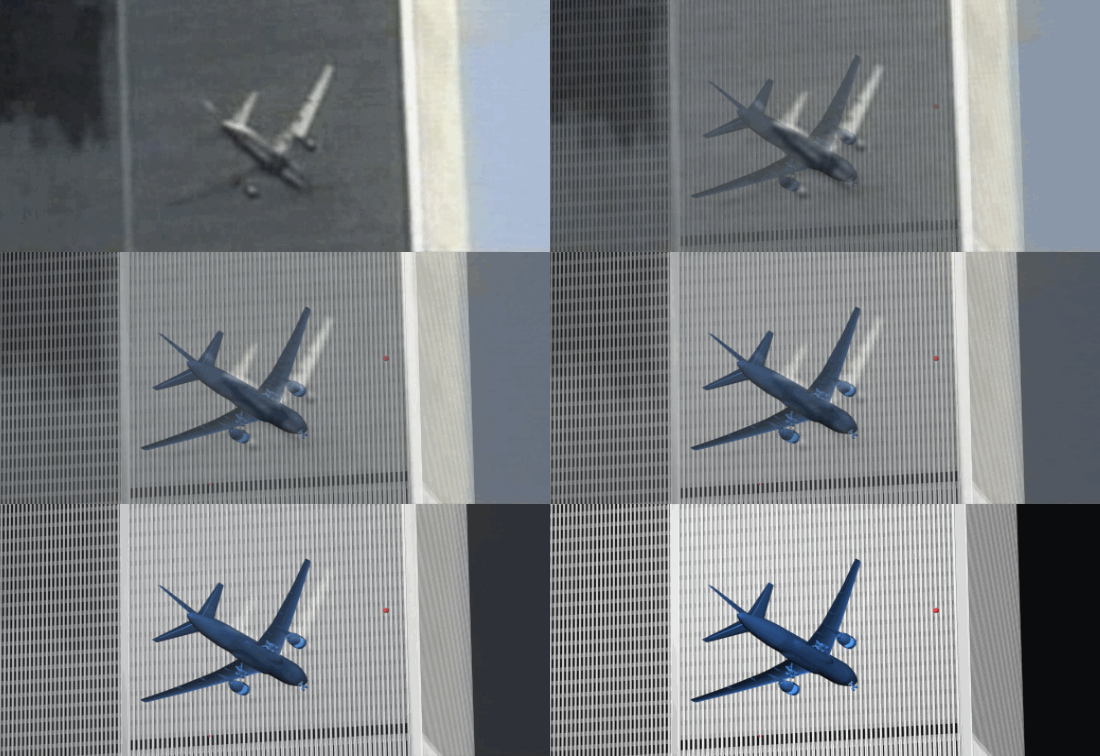
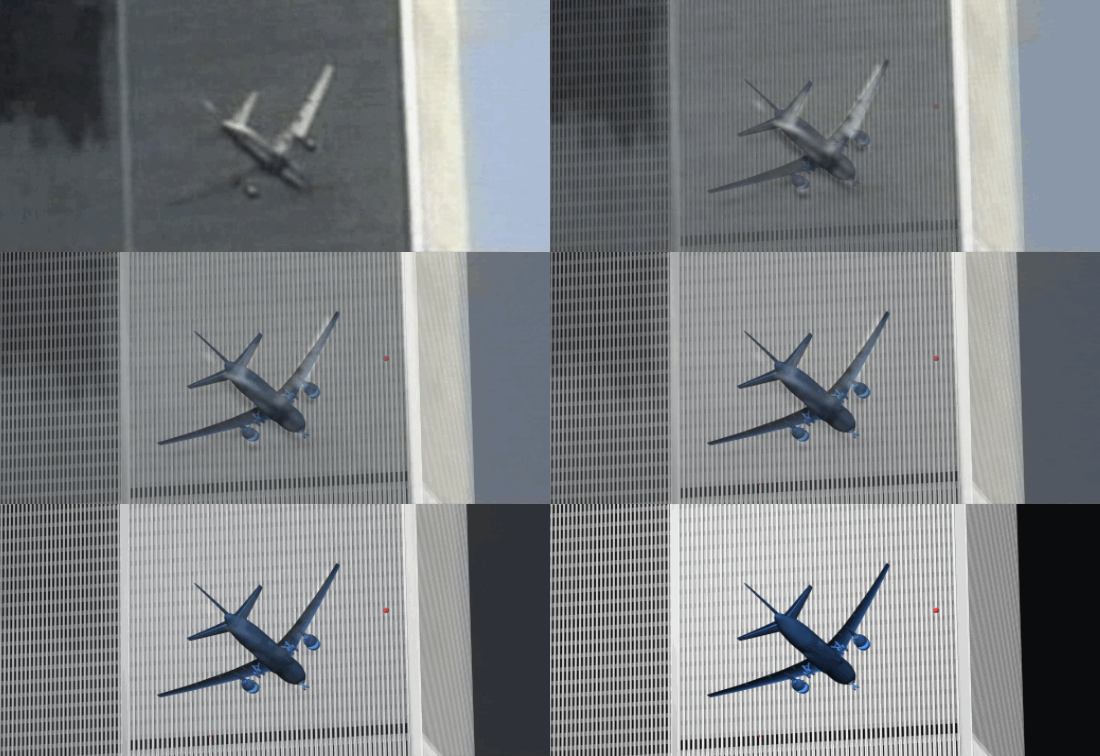
Oh good.Now, saving the best for last…
I said no such thing. I've clarified the point so many times, that there is only one response....data that you so proudly trumpeted as "disproving creep for all but the last 9.5 seconds"
Indeed.Yup, femr. It IS all written in stone.
One of us is a mechanical engineer. One is not.
One of us understands what creep really is. One does not.
One of us uses words carefully & precisely. One does not.
One of understands that deflection (even in a single element) is not creep. The other may or may not understand this, but repeatedly (& erroneously) conflates the two terms.


