Lockerbie: London Origin Theory

Okay, I had focused this part
those most likely to have been targeted or of some status that would make them a possible target
But I guess he did specify interline.
"first fifteen" of the interline passengers
So were there more? First in time, or in attention due to their special status?

This seems like maybe there were quite a few interline people, so maybe there was a second container at least. I dunno.

The main thing is 4041, and there's only space in Bedford's story for the bags of those four and about 3-5 other cases from someone or other on that full interline list. And perhaps, even though it was never dug up by anyone, another passenger who had a case like the one(s) Bedford saw.

Who else's were known to be in there? Wasn't Carlsson's bag blast-damaged? Or was that one of those unresolved issues?

I do think the Coyle bag mention is potentially quite relevant. Above or below would work with how it wound up, and I don't think it was below. Frankfurt luggage was loaded AFTER interline. Law of superposition.
 
No, I explained earlier my reasons for believing that these fifteen were the only interline passengers.

Rolfe.
 
I was thinking last night about the whole boiled frog thing. (In case anyone doesn't know, if you put a frog in boiling water it will jump out, but if you put it in a pan of cold water and slowly bring it to the boil it will cook, because it doesn't realise what's happening. Allegedly. I've never tried it.)

On 30th December 1988, someone high up in the inquiry (possibly Orr) decided to tell the press that the bomb had come from Frankfurt and Heathrow was in the clear. Or they decided that, and it was then leaked to the press, whatever. It appears this decision was taken based on two pieces of information only - the container containing the bomb had been identified as the one set aside for the Frankfurt transfer luggage, and there was a terrorist cell in Frankfurt known to be planning to blow up aeroplanes. It's possible (but not certain) that the investigators didn't even know at that early stage that the container also had a few Heathrow bags in it.

They then spent the next 12 years defending that assertion, hand-waving away one piece of evidence at a time.

What if they had been plunged into the boiling water in December? What if they had had all the evidence that eventually emerged, piecemeal, to suggest the opposite? How would the decision have gone?
  • There were about ten items of luggage already on the bottom of the container before the Frankfurt baggage was added, items which it was Heathrow's responsibility to ensure were safe.
  • One of these items was described as "a maroony-brown hardshell suitcase, the type Samsonite make".
  • Neither of the legitimate baggage staff remembers putting that item into the container, and the man whose specific job it was to load the container is adamant he did not put it there.
  • The explosion occurred only 10 inches from the floor of the container.
  • It is probable the baggage loader dealing with the tarmac transfer from the feeder flight would not have moved the original items very far, if at all, because the luggage was not sorted at this stage, and the transfer had to be done in less than 15 minutes because the feeder flight landed 45 minutes late.
  • The suitcase containing the bomb was a hardshell Samsonite, variously described by the forensic examiners as brown, maroon, burgundy and bronze.
  • No other luggage fitting the description of "a maroony-brown hardshell suitcase" was recovered at Lockerbie, damaged or undamaged.
  • None of the fifteen passengers whose luggage was or might have been in the container before the feeder flight landed was known to possess a brown or maroon hardshell case, and nobody who had had contact with these passengers before they boarded remembered seeing any of them with such a case.
  • A break-in into the airside area of Heathrow airport in question was reported as having occurred 16 hours before the mystery suitcase was sighted, with a padlock described as being "cut like butter".
  • The timing of the explosion, only 38 minutes into an on-time 7½-hour flight and well before reaching the open ocean, makes no rational sense in the context of its being triggered by an electronic timer, which might have been loaded anywhere. It is entirely consistent with the use of a barometric trigger, which would have had to have been loaded de novo at Heathrow.
We're not making any of this up.

If Orr, or whoever was making the decisions, had had all that information on 30th December 1988, would he have come to the conclusion that Heathrow could be ruled out?

Could anyone, looking at that pile of evidence, declare that a Heathrow introduction could be discounted? Could anyone, setting that pile of evidence against that single entry of tray B8849 on Bogomira's souvenir printout and the Malta provenance of the clothes, possibly maintain that a magically undetected Malta origin was more probable than a Heathrow introduction?

I'd like to see anyone try.

Rolfe.
 
I just double-checked the ten inches bit, and Claiden is adamant (page 1536 passim). He is the source of this figure, which remains fixed in spite of his acknowledging an error in one of the diagrams shown to the court (where the ten inches was measured from the bottom of the container instead of the surface of the floor).

I know some CTers distrust Claiden, but I don't. I think the AAIB is straight, and telling it like it is. So what I'm concluding is that the ten-inch measurement is indeed his well-considered best-guess figure, fudged neither up nor down. It is also the smallest estimate there is.

It seems to me as if everybody and his aunt is trying to fudge that estimate upwards. Twelve inches. Maybe 15 to 18, what the hell. But Claiden is sticking to the ten-inch figure. Interesting.

The thing is, ten inches is a funny height. As I said, it's pretty much the interstice between the first and second layer. You can just about fudge it to the second layer if you assume a relatively slim case on the bottom layer, but I'm not convinced Patricia's Tourister was a slim case (it's described as "large"). Everybody is trying to find that extra 2 or 3 inches that would point more definitely to the second layer.

It's the neither-one-thing-nor-the-other nature of that measurement that I think supports Mr. Taylor's theory about the bag being on the floor of the container but pushed a few inches to the left. That's the only explanation that takes the 10-inch figure and really nails it. It elevates the left-hand end of the case, which contained the bomb, above the height of the horizontal part of the floor, at the same time as providing the required horizontal position of about two inches into the overhang section.

It's also the most plausible scenario.

Bedford's description definitely puts the brown Samsonite (and I think there was only one brown one) on the left. If the bomb is also packed to the extreme left of the suitcase (and not as in the official mock-up, which is wrong in other respects anyway), that's pretty good from the terrorist's point of view. And there's another case on the right, to discourage any inboard repositioning. I think that was probably the plan, bomb successfully positioned.

So why would the terrorist have gone back while the container was unattended a second time? These guys were pros. Pushing their luck would not have been a high priority. It's there, nobody has suspected anything, leave it. (I'll leave CL with his dance of the two brown Samsonites, because I'm not really a fan.)

And then again, I've never been very enthusiastic about the idea that Sidhu, seeing two cases already in place more or less covering the floor of the container, and being in quite a hurry, was picky enough to remove the front two cases (or one of them) just to put a slightly bigger one there instead. The bomb suitcase wasn't that small. I've watched baggage handlers loading containers. They seldom move a case once they've placed it - it wastes energy and time. It's far more likely he would just have chucked the Tourister on top, and I think that's exactly what he did.

Pushing the case three or four inches to the side is a different matter though. That doesn't require the case to be lifted out of the container. If there was a bit of leeway on that bottom layer - which I think there was - and a small item showed up at the crucial moment, push the right-hand case an inch or two to the right, the left-hand case 3 or 4 inches to the left, and you could end up with an 8 or 10-inch gap. Just about right for a holdall.

The camera case is a nice idea, but it's purely a guess. We don't know anything about the camera case really, and it's not essential that it had to be that. The basic idea seems to me to be a runner.

I wish we knew what Sidhu would think about that theory. Did he remember anything about packing that container? Did anyone ask him? Is that the sort of thing he was at all likely to do? It's just typical of this bloody case that we have the witness, and nobody asks him. But he did move the Bedford suitcase at least a bit, everyone is agreed of that. And I think the push to the left is the least bad option, anyway.

Rolfe.
 
Blast height is a visual thing you could just map out, not that the ones I tried before did it very well at all. Words about different estimates won't figure it out, IMO. Claiden came up with that firm estimate by some ultimately spatial/visual/mechanical method, and as I gather it's lining the blast up with the puncture (several inches large, BTW) in the neighboring container.

The first clue there might be a problem with his estimate is if he gets firmly married to specific measurement. A weighted range, say 7.5-12", more likely above 9, seems more sound to me. (not my range, just an example).

It's a bit of project to set that up right, and I'm not a pro or anything anyway. But container distance has a small range, first-and-second-layer options should be shown, different case positions (forward-after/left-right in graphic), and different bomb positions within the case. The metal band issue has to be considered too, since pieces of that entered the neighboring container and ripped into Sophie Hudson's holdall.

It'll give you a range, I should say, in my informed non-expert opinion. Unless explosions briefly stopped being omni-directional and emitted strictly horizontal blast waves.

Now, for the tricky first-layer/second-layer issue, if I can turn it 'round another corner: what shielded the floor from pitting, except at the very edge, where the AAIB's lower case stopped? The bomb bag itself?
AVE4041F3A.jpg

I have to concur with them that that is a separate physical clue, far better than a frozen number estimate, that it was on the second level.

And that means it came in from Frankfurt. (Kidding, but don't fear. Reality is dynamic enough to still account for all of it with no need to go slumming there).
 
I just double-checked the ten inches bit, and Claiden is adamant (page 1536 passim). He is the source of this figure, which remains fixed in spite of his acknowledging an error in one of the diagrams shown to the court (where the ten inches was measured from the bottom of the container instead of the surface of the floor).

See above on firm estimates. I caught the error myself scaling this out the first time - it actually came through separately in two diagrams, I think, 7.5" above the floor labeled as 10". Sloppy work there, but sound enough in general.

I do have some questions about his alleged discovery of the radio bits AG/145, but on the container, he's fine. It's only the later interpretations of what it meant that were so negligent or worse.


It's the neither-one-thing-nor-the-other nature of that measurement that I think supports Mr. Taylor's theory about the bag being on the floor of the container but pushed a few inches to the left. That's the only explanation that takes the 10-inch figure and really nails it. It elevates the left-hand end of the case, which contained the bomb, above the height of the horizontal part of the floor, at the same time as providing the required horizontal position of about two inches into the overhang section.

That's yet another option that needs mapped out. It's a little harder to turn into a reliable 2-D image, but it's plausible enough to consider, if touching the floor makes sense otherwise. (see above)

You've made some points recently, echoed here, about which I have a question:
And there's another case on the right, to discourage any inboard repositioning. I think that was probably the plan, bomb successfully positioned.

So why would the terrorist have gone back while the container was unattended a second time? These guys were pros. Pushing their luck would not have been a high priority. It's there, nobody has suspected anything, leave it.

So we're agreeing that the suitcase and possibly two appeared at interline. Bedford wound up recalling this as two cases in addition to what had been there, but as suggested, it could have been only one new case, plus one he didn't notice had just been re-positioned. I'd take it further, and propose for logical fullness, that if that's possible, why not no new cases, and only two of the others re-positioned.

There is the issue of Bedford's claim of Kamboj's claim that he had x-rayed them. I wonder if they really spoke of this at all, and did they use plural or singular form if so? That would be a good clue if only we could be sure. Bedford used plural for both of them, is all we have.

But anyway, Okay, I can go with that, depending on where else it takes us. The big question is this:

Who do you suspect was doing the placement and/or re-positioning? I don't have enough detail on this shed, how it was accessed, who could or couldn't walk in and place bags, etc. Do you think Kamboj was circumvented? Did he handle them off-the-belt as normal, or just helped the other Pan Am man who came in? Or was he bribed? Were they x-rayed, do you think? Etc. I can see different ways it could make sense, and I'm open to hearing others.

But the answer will help figure out what makes most sense as far as re-visiting the container at Build-up. To re-visit, one first has to have visited, and that's got un-addressed complications I'm curious about.

(BTW: The Bedford's-story-was-made-up-to-cover-Walker-theory was simpler here, but I accept that there's no evidence to suggest the premise of it was reasonable to suspect)

That was sincere, and now I close with snark:
(I'll leave CL with his dance of the two brown Samsonites, because I'm not really a fan.)

If it's in the evidence, I try to account for it. Dancing with it is a good word. I enjoy dancing with the evidence. It's not always the simplest way, and can challenge one's pre-conceptions, but ... well, you get the idea, and I'll ride off on my verbal high horse into the sunset.
 
Blast height is a visual thing you could just map out, not that the ones I tried before did it very well at all. Words about different estimates won't figure it out, IMO. Claiden came up with that firm estimate by some ultimately spatial/visual/mechanical method, and as I gather it's lining the blast up with the puncture (several inches large, BTW) in the neighboring container.

The first clue there might be a problem with his estimate is if he gets firmly married to specific measurement. A weighted range, say 7.5-12", more likely above 9, seems more sound to me. (not my range, just an example).

It's a bit of project to set that up right, and I'm not a pro or anything anyway. But container distance has a small range, first-and-second-layer options should be shown, different case positions (forward-after/left-right in graphic), and different bomb positions within the case. The metal band issue has to be considered too, since pieces of that entered the neighboring container and ripped into Sophie Hudson's holdall.

It'll give you a range, I should say, in my informed non-expert opinion. Unless explosions briefly stopped being omni-directional and emitted strictly horizontal blast waves.

Now, for the tricky first-layer/second-layer issue, if I can turn it 'round another corner: what shielded the floor from pitting, except at the very edge, where the AAIB's lower case stopped? The bomb bag itself?
http://i133.photobucket.com/albums/q62/chainsawmoth/127-911/AVE4041F3A.jpg
I have to concur with them that that is a separate physical clue, far better than a frozen number estimate, that it was on the second level.

And that means it came in from Frankfurt. (Kidding, but don't fear. Reality is dynamic enough to still account for all of it with no need to go slumming there).


Q I see. And what information did you draw on in order to estimate how far up from the floor of the container the device would be located?
A Well, a lot of the information that went into the melting pot, so to speak, came from the adjacent container.


Well, it goes on and on. Peter Claiden was taken through his reasoning for choosing ten inches by more than one advocate, and he couldn't be shaken. I'm going to call argument from authority here, and I vote for Peter Claiden. It was his job, and he had the actual debris, not just photos, and he put the whole thing together in 3D.

You're going to have to go some if you want to persuade me that he was mistaken, and you're right, with no expertise or training, working just from photos and descriptions. You're also going to have to produce some good arguments to support him being dishonest and deliberately fudging the result. Apart from anything else, such a low measurement is unwelcome to the prosecution side and they keep trying to fudge it higher.

So there. :D

Rolfe.
 
So we're agreeing that the suitcase and possibly two appeared at interline. Bedford wound up recalling this as two cases in addition to what had been there, but as suggested, it could have been only one new case, plus one he didn't notice had just been re-positioned. I'd take it further, and propose for logical fullness, that if that's possible, why not no new cases, and only two of the others re-positioned.


We know the left-hand case wasn't a legitimate passenger case for all the reasons I've described. Henderson, Crawford and Marquise have all stated or implied that none of the "first fifteen" had a maroon or brown hardshell suitcase. So where did it come from, if it was one of the cases Bedford loaded in the normal way after they had been x-rayed?

There is the issue of Bedford's claim of Kamboj's claim that he had x-rayed them. I wonder if they really spoke of this at all, and did they use plural or singular form if so? That would be a good clue if only we could be sure. Bedford used plural for both of them, is all we have.


As I commented on your blog, I have a more-than-sneaking suspicion that they never spoke of it at all.

Rolfe said:
If we're considering whether anyone at Heathrow might have told a little porkie in order to cover his backside, my vote unhesitatingly goes to Bedford himself.

"I returned about 4.40 p.m. Camjob told me two further suitcases had arrived for PA 103 which he had put in the tin."

Kamboj had no recollection of doing or saying any such thing, even when interviewed very soon after the disaster. It wasn't his job to put cases into the container anyway - he usually just sat them on the floor for Bedfod to load.

If anyone was going to be in the line of fire for letting the bomb through at Heathrow, it was Bedford. He'd seen two cases in the container he hadn't put there. He knew someone else had interfered with his container while he was off drinking tea with Walker. But he didn't say anything, he just let the container go.

He wants to be a good citizen and help catch the terrorists, so he tells everything he saw in case it turns out to be helpful. (And boy, was it helpful!) But he realises he's open to criticism. If one of these cases turns out to be the bomb, he's the guy who could have stopped the Lockerbie disaster but didn't.

So he tells it all, just as he remembers it, but then he invents that one little extra detail. He wasn't suspicious, because Kamboj told him he'd screened the cases and put them there.


But anyway, Okay, I can go with that, depending on where else it takes us. The big question is this:

Who do you suspect was doing the placement and/or re-positioning? I don't have enough detail on this shed, how it was accessed, who could or couldn't walk in and place bags, etc. Do you think Kamboj was circumvented? Did he handle them off-the-belt as normal, or just helped the other Pan Am man who came in? Or was he bribed? Were they x-rayed, do you think? Etc. I can see different ways it could make sense, and I'm open to hearing others.


I actually think the terrorist had a uniform of some sort that made him look normal in the area, and simply put the suitcase in the container while it was unattended. Bedford didn't see him and Kamboj didn't see him.

However, the fact that the IED was disguised as a radio suggests the terrorists were guarding against the case either being x-rayed or hand-searched. If they planned simply to shove it in the container after the x-ray stage, they could have had 20kg of Semtex in there. So that's an oddity.

It may be as simple as the terrorist not having confidence that he could get to the container while it was unaccompanied. The best bet in that situation might then be to wait till Bedford wasn't there, and approach Kamboj with the case. Kamboj would want to x-ray it, but he'd probably let another baggage handler position it in the container because that's what he usually did - his job was to screen the luggage, not to stack the container.

However, either this happened and Kamboj forgot all about it, or the terrorist managed to get to the container when it was completely unattended. The terrorist would prefer the latter, obviously, because there was always a risk a security man might want to investigate an electronic item more closely even if he hadn't had the Autumn Leaves warning as Maier had had.

Obviously I'm speculating, but I think it's important to show that it was something that could have been achieved, and could have been predicted could be achieved, by someone who already had familiarity with the workings of the Heathrow baggage handling system.

Remember, Bedford said there were teams all over the interline shed, one for each airline, and they would each pull their own airline's luggage from the conveyor that brought items into the shed. And there was quite a high staff turnover. What could be simpler than someone in the uniform of a different airline coming over with a case he'd found for PA103 in with his own luggage, give it to Kamboj to x-ray, and then place it in the container himself in Bedford's absence?

Better still if the terrorist managed to find the container completely unattended for a few minutes though, and I think he'd have been hoping for that and watching for it, and I think he found it.

But the answer will help figure out what makes most sense as far as re-visiting the container at Build-up. To re-visit, one first has to have visited, and that's got un-addressed complications I'm curious about.


I wondered if the terrorist had been disturbed while loading the cases, hadn't got them exactly as he wanted them, and had had another go while the container was outside the build-up shed. To explain the bomb being on the second layer. However, I think the bomb bag was on the left when Bedford saw the container, which would surely count as "close enough". Why risk complicating the issue?

(BTW: The Bedford's-story-was-made-up-to-cover-Walker-theory was simpler here, but I accept that there's no evidence to suggest the premise of it was reasonable to suspect)


This is clearly some new definition of "simpler" I was previously unaware of....

If it's in the evidence, I try to account for it. Dancing with it is a good word. I enjoy dancing with the evidence. It's not always the simplest way, and can challenge one's pre-conceptions, but ... well, you get the idea, and I'll ride off on my verbal high horse into the sunset.


Indeed, that's why I said I was going to let you carry on dancing with it. It doesn't feel right to me, it never did. It's possible there is a version of this that gels, but I'm still not really seeing it.

The fact is that we're never going to know for sure exactly how the terrorist got the bomb into the container, and how it got into the position Claiden calculated. It's likely he was improvising, maybe choosing his actions from a set of pre-planned possibilities depending on exactly what circumstances met him on the ground.

The important thing is that there isn't just one but several possible ways it might have happened. Identifying the exact sequence of events isn't really necessary, and I suspect it's impossible anyway. So, you have your favoured theory, I have mine, and there's no real need to slug it out.

Rolfe.

 
Last edited:
I still wonder, a bit, about O'Connor's left-behind suitcase. If it's true it was left behind, that is.

All that stuff about "taggs". What better way to get genuine tags for a particular flight than to take them off a case that has been legitimately checked-in for that flight, and transfer them to the bomb suitcase? I'm sure it isn't that hard with the right tools and equipment, at least well enough not to be spotted by a casual glance.

I wish we knew if O'Connor's case still had its tags on when it was found in the baggage store. CL says it was brown, too.

I also wonder about security bands. Nowadays, it's quite common for a security band to be put round each case as it's x-rayed, to prevent it being opened and anything added at a later stage. I'm sure I've seen something about Kamboj having done something similar with the cases he x-rayed, but it isn't something that's gone into in detail and I can't find the reference. If there were security seals of any sort, these would surely have to be acquired too, again maybe from a legitimate suitcase.

I realise this thought isn't entirely compatible with some of my speculations above about the terrorist possibly planning to let Kamboj x-ray the case and load it in his presence. I'm just exploring possibilities, same way CL is.

Rolfe.
 
Well, this is the Lockerbie case, so authority=correct is not safe to presume. Claiden's not Feraday, but he was working with delicate science surrounding the #1 clue of London origin they weren't able to cover-up like Manly's report. So I'd prefer reasoning it out myself for comparison.

I would happily look at any supporting reasons (of the scientific and spatial types) you can give to accept the awkward 10" as the sure number, or for using as the top end of a range. You are still thinking this is the highest he could fudge it, right? Well, right there is a disonesty then - he's stating the hypothetical upper end as the precise height. If so, we both question him.

My own reasoning for questioning and suggesting a broader range, is explained - blasts go out in all directions, not just horizontal, so a 10" hole could be cause from a variety of blast heights. To insanely exaggerate the point, it would be unsound to take a bullet mark on the sidewalk at Dealy plaza as evidence the assassin of JFK was shooting from ground level.

Claiden can say whatever he likes, but until I see that problem resolved, I can't accept a set number. He did say there was a mix of other factors, which could help narrow the range, even to where 10" (maybe give or take half an inch, etc.) is close enough to decide on. I'm not sure what these other things were supposed to be.

The floor damage, again, un-addressed. But I had my own thought looking at it again. It's hard to make out what metal is or isn't pitted - all that shows up is general roughness vs. shininess. The beam at left is clearly blasted, burnt, broken, and app. well-pitted. The warped floor to the right is however shiny and smooth-looking. But the rest of the floor, especially foreward half (top here) has a general roughness of wear and tear. The whole aft-edge looks cleaner by comparison, but it almost looks like that one spot was buffed shiny relative the rest.

Is it possible the floor was pitted at one time, but then polished back down, to support the second-level idea? I'm not proposing that, but it did occur to me.

Next comment in a bit.
 
No, read what I said. After reading Claiden's evidence in detail, I came to the conclusion that he wasn't fudging anything, and that the ten-inch figure was his honestly-come-by best estimate. What we do see is a lot of people trying to fudge it higher.

I don't think you can do a better job without the actual reconstructed debris in front of you, and a background and experience in explosives and/or air accident investigation.

Rolfe.
 
Okay, I apologize. This is getting silly now and it's mostly my fault.

This whole issue is in essence a side-track for purists. Kudos to all of us willing and able to go there, but it can't distract from this basic things I think we can agree on about Bedford's evidence:
- His reference to a suitcase so completely consistent with the primary one is no coincidence.
- He reported one case of this style in an undeniable way, and may have specified somewhere that this was the one on the left, out of the two he thought both new, and of a very similar style.
- no passengers whose luggage should have been there matches this style, telling us this is most likely something other than passenger luggage. I dunno, that seems important to me.
- This case was in the relevant container an hour before the alleged Maltese version of it could possibly have been. No fudging - Bedford was gone at 5:02, and the feeder didn't even land until 35 (?) minutes later.
- It was in the lower outboard corner, first layer, almost in the outboard overhang section.
- the explosion happened in a case consistent with Bedford's description, that was clearly something other than passenger luggage.
- The blast center was just barely inside the overhang section, either at or near 10" above the floor, just barely higher than this case reported.

That could be argued to be something other than a smoking gun, but that's in isolation. Considered with the other London origin clues, as Rolfe has re-iterated above ... okay, it still can and has been argued that it's all coincidence. But people look pretty stupid going that far.

- cheez
 
We've been over a lot, and I confess I'm not reading it all carefully enough to be a top-notch commentator at the moment.

I'm still only skimming, for select points to respond to.

Rolfe said:
I wish we knew if O'Connor's case still had its tags on when it was found in the baggage store. CL says it was brown, too.
FWIW the E+D book has:
Airport tags hung like tinsel from the handle of the apparently well-traveled bag. The newest ones were "LHR" for London's Heathrow airport, and "JFK," for Kennedy.
It was Dec 22, not days later. Sounds nice and detailed, just like the "newspapers and food wrappers, the detritus of tired travelers" littering the empty terminal where it was found. Likely nothing but literary deduction based on the assumed fact that it appeared there somehow. If true. it's a decent deduction.

But as I said, Leppard has it staying in London. which suggests, maybe, it wasn't able to be forwarded. BUT, I'm a dunce here and was wrong. The erred report is that "one of McKee's suitcases had turned up at JFK airport, New York, four days later." [116] Sorry, my bad.

So, unless the earlier book is erred anyway, it would seem tags enough to get it NY were attached. I'd guess that stolen "taggs" wouldn't be much harder to locate than airside passes, uniforms, etc.

Buncrana said:
[Leppard] is also wholly unconvincing, and uncomfortable actually, in the Lockerbie Debate (which I still have on an old vhs tape) that was aired on C4 in 1994 immediately after TMDC when Leppard was questioned on some of his reporting, and conclusions, by Allan Francovich.

That sounds immensely interesting. Keep an eye out for a PM on this.

I'd also missed it until now, but I now note that not only was O'Connor on that flight from Cyprus, but he was accompanied by McKee and LaRiviere - with Abu Talbs wife Jamilla and her 3 Mograbi brothers on that very same flight. Coincidence? Well, perhaps.

Definitely weird, and I'm not the one to presume coincidences... unless... is it possible this was the original coincidence that then led them to consider Abu Talb and his Malta links, and what Malta could be re: Libya? Ah, never mind.

But we seem to agree there was all too likely a terrorist bombing from people of related rolodexes going on in that airport on that day. And we do have an allegation by presumably credible people (of which I'm quite leery anyway) that Abu Talb himself sailed to London at the same time (and left the date circled on his plain-view calendar, after carefully planning the bombing to coincide with his alibi - the expected delivery of a baby. It was the perfect plan, until...)

Sorry!

By the way, my floor-retouching idea wasn't facetious or anything. It is quite outside the box, and I have no idea who would have decided and just how early and so on. I'm sure it's pretty bonkers. Not sure, but I wouldn't be at all surprised. Rolfe, you just re-read that stuff. I don't even recall when Claiden's study was made.
 
"Airport tags hung like tinsel." This is a journalist making stuff up.

If you are silly enough to leave an airline tag on your luggage so that it is still there when you present it for check-in for another flight, the first thing the check-in clerk will do is rip it off and chuck it in the bin. Which is only common sense. Baggage handlers need to be constantly checking the tags to make sure every piece of luggage is headed in the right direction. They don't want to be sorting through half a dozen different tags to figure out which is the one relating to the current journey.

That journalist never saw the case. He's painting an evocative word-picture for his readers, and making a fundamental wrong assumption in the process. We have no idea whether the tags were still on it or not.

I think there's a danger in trying to figure out in detail exactly how the trick at Heathrow was pulled. We can easily see it was possible, and could have been planned in advance by someone with some inside knowledge of routine airport procedure. There are probably three or four ways it could have been done, including an initial plan being improvised on according to the particular circumstances on the ground that day. I don't think we can really expect to know which one actually happened.

I'm really just observing that if you want a genuine luggage tag, taking one off a genuine piece of pasenger luggage seems to be one rather good way of doing it. However, it's possible it would have been regarded as too risky, and the terrorist wouldn't have wanted to risk being seen doing something so suspicious.

Rolfe.
 
Could I say I'm not entirely convinced by the veracity of any of this. All we have are journalist's reports in newspapers. They're not consistent on whose suitcase was left behind, or on what then happened to it. I have found absolutely no mention of a suitcase left behind in the primary documentation.

I'm not saying it didn't happen, only that journalists do print tittle-tattle that later turns out to be complete horse-feathers, and I'd rather see some primary evidence that there's some reality behind this before making too much of it.

Rolfe.
 
Could I say I'm not entirely convinced by the veracity of any of this. All we have are journalist's reports in newspapers. They're not consistent on whose suitcase was left behind, or on what then happened to it. I have found absolutely no mention of a suitcase left behind in the primary documentation.

I'm not saying it didn't happen, only that journalists do print tittle-tattle that later turns out to be complete horse-feathers, and I'd rather see some primary evidence that there's some reality behind this before making too much of it.

Rolfe.

Nothing much to it anyway, likely. Do you mean no evidence for a bag left behind and found in London? Because the books don't say that either, on review. That was a bad reading. Or is there nothing about any items held back from 103 and sent to JFK by another route?

I've summarized a lot of the recent conversation here into a new article of some importance. I'm working on a summarized version taking the easier-to-grasp singular version, to try and get somewhere more prominent.

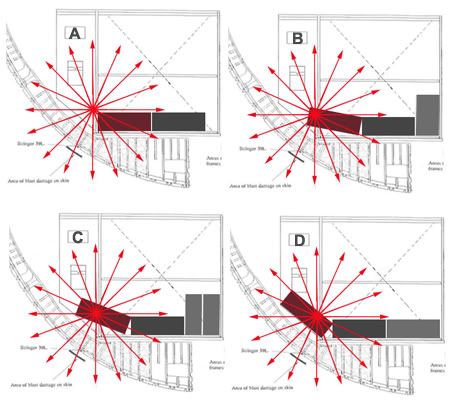
To chew over, some variations on a one-brown-case-only, first-level, non-stacked method of getting it to the blast center. "A" is as Bedford reported it, way down there a couple inches from the spot a case just like it blew up.
suitcase_positions_29.jpg


All but "D" raise problems with the floor damage seen, and D has a similar problem to my stacking option - if it was slid into this spot as you suspect, the bomb was in the inboard end, far from the hull. Unless it was flipped into that spot? Whaddyou think?
 
These are helluva good illustrations, CL.

I'm thinking B, or possibly C. I've never really bought the line about the floor damage, to be quite honest. And I doubt if Sidhu would have shoved the bag as far as is shown in D.

I was imagining the extra item placed between the two Bedford bags, by someone standing in the middle just pushing them apart. That's what Taylor suggested. Of course the extra item wouldn't be a suitcase. There were all sorts of sizes and shapes of luggage on there, including smaller holdalls and such, not to mention the photographer's case described by Sandhu.

Rolfe.
 
These are helluva good illustrations, CL.

I'm thinking B, or possibly C. I've never really bought the line about the floor damage, to be quite honest. And I doubt if Sidhu would have shoved the bag as far as is shown in D.

I was imagining the extra item placed between the two Bedford bags, by someone standing in the middle just pushing them apart. That's what Taylor suggested. Of course the extra item wouldn't be a suitcase. There were all sorts of sizes and shapes of luggage on there, including smaller holdalls and such, not to mention the photographer's case described by Sandhu.

Rolfe.

True, the gray things are just spacers here, really. I could see position C maybe working with the floor damage, actually. With that, it's just the cut off between outboard damage (sloped floor gone, beam broken and burnt), and the main floor. The main expanse was clearly not blasted directly, but perhaps a strip of that peeled back was (it's not visible). Something between "C" and "D" leaves only a strip of main floor exposed to the underside, with the rest shielded by the suitcase's length and its contents. Just follow the red lines - the closer to the blast middle, and the less resistance along the way, the more force at that point. Underside down to floor - not much protection in "B" or "C."
 
I've never understood what makes another case such great protection if the bomb suitcase and its own contents weren't. What's the difference between the bomb being right on the bottom of a case on the second layer, with another case under it, and being right on the top of a case on the bottom layer, with all its own contents under it?

I can see there's some difference of course, but to explain this all-or-nothing idea? I'm not so sure. I definitely got the impression Hayes was going with the idea it might have been on the bottom layer at one point.

Rolfe.
 
These are helluva good illustrations, CL.
Thanks, but FYI the proper usage in this context, least 'round here, is "hella."

I've never understood what makes another case such great protection if the bomb suitcase and its own contents weren't. What's the difference between the bomb being right on the bottom of a case on the second layer, with another case under it, and being right on the top of a case on the bottom layer, with all its own contents under it?

I can see there's some difference of course, but to explain this all-or-nothing idea? I'm not so sure. I definitely got the impression Hayes was going with the idea it might have been on the bottom layer at one point.

Rolfe.

I admit I've never studied explosives or anything, but this aspect is not too tricky. If you're visualizing the primary case being capable of shielding the floor, you've got part of the picture. Contents (clothes) and then had-case material (one layer). That'll slow and weaken the blast some.

But not much. At the outboard end, there was still force enough after that weakening to disintegrate the container metal and then rupture the hull. The underside facing the floor should have been about the same, depending - any metal just outside the case would be in trouble.

Now take that same blast wave just leaving the primary case, marginally weakened, and run it through another layer of suitcase material (I've been thinking hard-shell), another case's contents, and then the other side of the case, and then coming to the floor.

If the one case - half a case, really, could conceivably block the force well enough, then one and a half could do it far better. I think it's more than three times the protection, actually, given some exponential, not linear, decrease in power over distance.

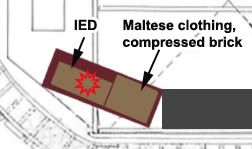
I was toying with an idea that the clothes might've been compressed, maybe squeezed in a vice and then bound. This might explain thhe survival of so much clothing, which might have been put there as a false lead it was hoped would survivee, and/or to lock the bomb to one side of the case more firmly than loose clothes would.

And I was looking at what a clothing brick would do for the floor. But at least arranged this way, it doesn't seem to help.

suitcase_positions_30.jpg
 

Back
Top Bottom