Building demolished from the top down.

The heat capacity of the columns is very relevant. If the core columns take longer to heat up the will inevitably suck heat from the warmer floor panels. In simple terms its a bigger heat sink. It also allows for a faster transfer of heat through the columns away from the fire afflicted area.


If steel is capable of conducting heat away quickly enough to prevent significant degradation of its strength, then what purpose does fireproofing serve?
 
Last edited:
Whew! Thanks to Java Man, the construction industry is poised to save billions of dollars by not having to fireproof the structural steel in their buildings. If only they would have known this a hundred years ago. All those expensive studies that were faked. I'm shocked. SHOCKED I say!

Hell, I think a thread in the main conspiracy theory subforum about the manufacturers of steel fireproofing is in order gentlemen. Those BASTARDS!
 
Last edited:
If steel is capable of conducting heat away quickly enough to prevent significant degradation of its strength, then what purpose does fireproofing serve?

You and the fireproof crew here just isn't getting it right? It's not an issue of preventing, but rather delaying. Since one is capable of sinking more heat than the other that should be taken into consideration in the time required to reach the degradation point. Please spare yourself the time of pointless ranting against things I have not claimed nor plan to claim.
 
You and the fireproof crew here just isn't getting it right? It's not an issue of preventing, but rather delaying. Since one is capable of sinking more heat than the other that should be taken into consideration in the time required to reach the degradation point. Please spare yourself the time of pointless ranting against things I have not claimed nor plan to claim.
What is your point? No point, no clue what steel is, or how it behaves in fire.


Steel is not a good heat sink, it fails in fire. Facts are not used by 911 truth.
 
Last edited:
You and the fireproof crew here just isn't getting it right? It's not an issue of preventing, but rather delaying. Since one is capable of sinking more heat than the other that should be taken into consideration in the time required to reach the degradation point. Please spare yourself the time of pointless ranting against things I have not claimed nor plan to claim.

If this were true the building would have either

A: Fell alot sooner because the heat from the fires would have been absorbed much faster

Or

B: Not fallen at all as the fires dissipated in certain sections and the heat rapidly radiated from the columns

Do you understand what thermal conductivity is?
 
So much stupidity i had to multi quote

That's exactly my point. The sagging is the cause of the pulling which leads to the collapse (according to the NIST report). The sagging does depend on the floor and not the amount of stories on top. It is false to claim that twice as many floors would reduce by half the amount of time needed for the collapse to occur.
No one claimed that,
North tower impact to time of collapse 1:01
South tower impact to time of collapse 1:42
And now you are avoiding the difference in capacity of the exterior columns for double their unsupported length, which I had already shown to you.

You and the fireproof crew here just isn't getting it right? It's not an issue of preventing, but rather delaying. Since one is capable of sinking more heat than the other that should be taken into consideration in the time required to reach the degradation point. Please spare yourself the time of pointless ranting against things I have not claimed nor plan to claim.
NO, one floor truss is definitely NOT capable of shedding more heat than the other one, There is insufficient thermal coupling at the connection. Sorry you lose.
 
No one claimed that,

Yes it was claimed by aggle-rithm " the building with damage lower in the structure, which had more mass above the damaged area, collapsed much more quickly than the one with the same damage higher up. Exactly as one would expect given the differences in the crashes. " (http://www.internationalskeptics.com/forums/showpost.php?p=6862449&postcount=177)

NO, one floor truss is definitely NOT capable of shedding more heat than the other one, There is insufficient thermal coupling at the connection. Sorry you lose.

Really? and you get your thermal coupling values from?
 
If this were true the building would have either

A: Fell alot sooner because the heat from the fires would have been absorbed much faster
...
Do you understand what thermal conductivity is?

Huh? "heat from the fires" absorbed faster? What are you taking about? It is you who doesn't seem to understand this. A thicker core is capable of absorbing more heat per each degree in temperature change and also has a wider channel to dissipate heat to floors above and below the fire zone.

Please explain to us your claim that heat from similar fires would have been absorbed (allow for such a term) faster in one building than the other if both are made of the same material. Take into consideration I'm talking about dissipating heat away from the fire zone and not about the rate the heat from the fire is transfered to the floor structure.
 
Huh? "heat from the fires" absorbed faster? What are you taking about? It is you who doesn't seem to understand this. A thicker core is capable of absorbing more heat per each degree in temperature change and also has a wider channel to dissipate heat to floors above and below the fire zone.

Please explain to us your claim that heat from similar fires would have been absorbed (allow for such a term) faster in one building than the other if both are made of the same material. Take into consideration I'm talking about dissipating heat away from the fire zone and not about the rate the heat from the fire is transfered to the floor structure.
sure...
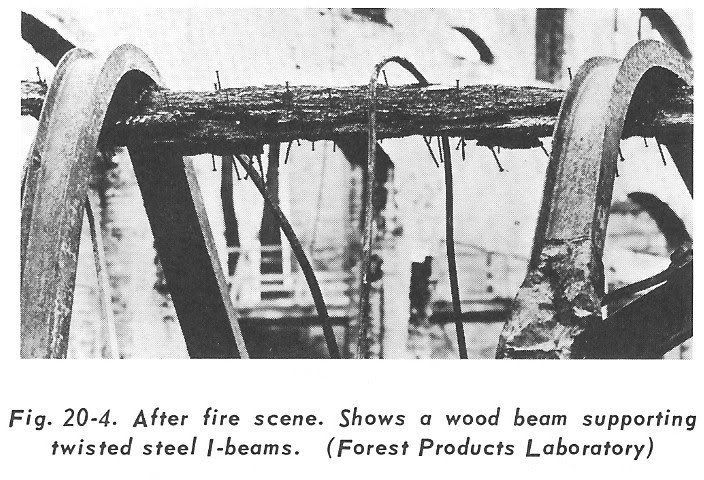
woodbeambentsteel-full.jpg

Got some science to go with your delusion? No
 
Yes it was claimed by aggle-rithm " the building with damage lower in the structure, which had more mass above the damaged area, collapsed much more quickly than the one with the same damage higher up. Exactly as one would expect given the differences in the crashes. " (http://www.internationalskeptics.com/forums/showpost.php?p=6862449&postcount=177)
liar, he did not say in half the time or any words to that effect.
Really? and you get your thermal coupling values from?
two 5/8 inch bolts, Where did you get yours?
http://www.google.com/m/url?ei=O65U...8QFjAE&usg=AFQjCNFN5qk-tQf2qOjVWIV2GKTlBXF9dg
 
Last edited:
Huh? "heat from the fires" absorbed faster? What are you taking about? It is you who doesn't seem to understand this. A thicker core is capable of absorbing more heat per each degree in temperature change and also has a wider channel to dissipate heat to floors above and below the fire zone.

Please explain to us your claim that heat from similar fires would have been absorbed (allow for such a term) faster in one building than the other if both are made of the same material. Take into consideration I'm talking about dissipating heat away from the fire zone and not about the rate the heat from the fire is transfered to the floor structure.

Absorbing more heat? Heat transfer is a function of time, hence the Watt unit.

If there was fire nearby, the steel would take the heat and would fluctuate rapidly depending on the condition of the fire. That is, if it is the amazing conductor you claim it is.
 
Last edited:
liar, he did not say in half the time or any words to that effect.

Oh really? What did he mean? If the north tower fell 102 minutes after impact and the south after 56 that's pretty much twice the time. Obviously he didn't explicitly state it, but what would you expect he meant but we saw that day! Or are you implying he meant different times from those that actually occurred?
 
Yes it was claimed by aggle-rithm " the building with damage lower in the structure, which had more mass above the damaged area, collapsed much more quickly than the one with the same damage higher up. Exactly as one would expect given the differences in the crashes. " (http://www.internationalskeptics.com/forums/showpost.php?p=6862449&postcount=177)

It doesn't matter. You have no evidence for any sort of "inside job" or cover-up or conspiracy, or whatever it is that you so dearly want to believe in. That is why you want to bog the discussion down with endless arguments about peripheral issues that have no bearing on the topic, which is:

"Building demolished from the top down" (disproving the truther claim that a building cannot collapse from gravity alone, but requires the use of explosives)
 
Last edited:
Yes, and since time didn't stop that day(although the hearts of many did) physics kept working to pull heat away from the area.

Why are you trying to stifle debate about 9/11 by yammering away on irrelevant topics?

WHO IS PAYING YOU TO DO THIS?!?
 
The connection between a laptops GPU to the heat sink is small compared to the overall chip of the GPU yet it works fine in preventing overheating.

Examples:

Laptop

[qimg]http://img341.imageshack.us/img341/5389/0626091824.jpg[/qimg]

XBox

[qimg]http://www.entertainment-electronics.org/wp-content/uploads/2009/07/Heat-Sink-for-Xbox360-YTC-X3-312-00012.jpg[/qimg]

Do you see what they use for that heat sink?

Hint: It's not steel. Its also what is used in electrical wiring, and for the same reason. That should help you out a little.
 
Wrong, see here your mixing reality with hypothesis. My contention that only a small amount of explosives would be required is valid. Had I claimed that a small amount of explosives was required, then yes you'd be correct.

As it stands and based on the report by NIST charges set to release just a few floors could bring down the whole structure. It seems not necessary to cut through pillars and structural elements. Just taking the small support struts that hold the floors in place should be enough to initiate a pancake collapse that then brings the outer walls and inner core collapsing on itself.

The small charges on my hypothesis would replace those long chains seen in the video. Obviously there were no such chains in the WTC

So how do you set up a "small quantity of explosives" and then
1. make sure the jets struck the exact floors you need to "cover" the explosives?
2. how do you guarantee these "small quantity of explosives" would withstand and survive the initial impacts of 100 ton jets moving 500ish MPH and not get destroyed?
3. how do you get explosive triggers/detonators which would then survive in a huge fire for about an hour? (even your own expert Danny J. says that the detonators will fail if in a fire over 300C (iirc) for any amount of time.)
4. how do you do all of this with no one noticing?
 
You and the fireproof crew here just isn't getting it right? It's not an issue of preventing, but rather delaying. Since one is capable of sinking more heat than the other that should be taken into consideration in the time required to reach the degradation point. Please spare yourself the time of pointless ranting against things I have not claimed nor plan to claim.

Yes, but the problem is here Java, is that steel heating to a certain temperature with a load of 100 pounds is going to collapse before something with only 50 pounds.

Fire: Something ELSE Java obviously doesn't understand.
 
It doesn't matter.

If it doesn't matter why did you bring it up? More important than that why are you pulling it out now? Just because you've been measured and found lacking? Were's the taunting now? Typical debunker tactic, what was that you were making fun of? That I was to dumb to realize the evident reasons for twice the time? All the name calling? Where is that now that you're recalling your ill though out statement? And what other ill founded arguments have you put forth or will put forth? Mhhh bad bad bad for you.
 

Back
Top Bottom