Building demolished from the top down.

But they are less damaged in the lower impact point than in the upper one. Which goes contrary to your assumption that that is the cause of the earlier collapse.

What you have to remember is that gravity is the main culprit in the collapse, as it is in every collapse. Factors like "less damage" and "thicker supports" are a burp in the wind compared to the HUGE forces exerted by the mass of the building above the damaged area, once it started to move.

Yes, but the floor sagging which would lead to the break away and the collapse is independent of the amount of floors on top of it. The floor sagging depends on the heat of the fire in the area and the weight of the floor which is the same in all the floors in the WTC. That is why you can't claim that one tower fell before the other because there were more stories on one than the other. Those added stories were loading on the outer columns and core that would not collapse until the floors sagged and buckled due to heat. Once again said floors are identical along the tower and there is no reason to believe one fire was particularly hotter than the other.

They didn't have to be. Once the outer columns lost their connection to the inner columns through one of the floors, then the inner columns are now supporting the entire weight of the outer columns above that point, through the connecting floors. We go from a situation where the different column groups are supporting EACH OTHER, to where one is supporting the weight of both of them, as well as the weight of the connecting floors.

This shifting of the burden was a gradual process as the structure became weakened by fire. The process was sped up not by the fire's temperature, but by the greater mass involved.

There were an additional 14 floors of free-handing building in the South tower. That brought it down much faster.
 
That's your interpretation, but it is in no way backed by facts that would support it as the cause for the earlier collapse.

Now you may come around and claim that the fact that it was the first to collapse is fact enough. But you can't use what you're trying to prove as a fact in the proof.

It is an ill methodology to say "oh I predict that the lower the damage the sooner it will collapse" and "oh see, it was hit lower and collapsed sooner".

You may be right. It could be that other forces were at work here. Such as the fact that the second plane crashed at a bank, resulting in more floors being damaged. However, it does make intuitive sense that 25 floors will exert more force on a damaged area of building than 11 floors.

Also however, none of this is relevant to the question of whether the generally accepted narrative of 9/11 is accurate.

It could have collapsed sooner for a variety of other reasons and it is particularly interesting to point out the cause of the pancake collapse detailed in the NIST report is independent of position. That is the floors are all the same at all levels and the fires would burn with the same intensity at all levels.

If those were the only two factors at work, then I would agree with you.

Anyway, it doesn't matter. This is all basically a semantics argument.

Let's get to the heart of the matter: What do you believe happened on 9/11?
 
Last edited:
So you claim that more steel takes less to heat up than less steel given the same heat source?

the floor trusses that heated up, sagged, and pulled in had the same cross section throughout the building,

other points,
The damage to the south tower was asymmetric compared ton the north tower which was a center hit.

A column with a given cross section "X" designed to support a load with fixed ends at 12 feet cannot support the same load when the unsupported fixed ends become 24 feet due to a floor collapse.

A column at much lower floor with a given cross section "2X" supporting twice the load with fixed ends at 12 feet cannot be compared linearly to the "X" column when the unsupported fixed ends become 24 feet

http://www.engineeringtoolbox.com/square-hollow-structural-sections-hss-d_1478.html

http://www.efunda.com/formulae/solid_mechanics/columns/calc_column_critical_load.cfm
 
Last edited:
By making excuses and running away, he can preserve the fiction, in his own mind at least, that he could change the world, but, like the rest of the truth movement, he just doesn't want to change it today.


Heh. "It is better to pretend that you can change the world than to try to change the world... and fail."
 
Irrelevant, since it was the exterior columns that initiated collapse. The interior columns were the last to fail.

The heat capacity of the columns is very relevant. If the core columns take longer to heat up the will inevitably suck heat from the warmer floor panels. In simple terms its a bigger heat sink. It also allows for a faster transfer of heat through the columns away from the fire afflicted area.
 
the floor trusses that heated up, sagged, and pulled in had the same cross section throughout the building,

Good so you're finally catching on to my point. The elements that caused the collapse (sagging floors) were the same across all floors. Except of course the ones in the lower floors were connected to a bigger heat sink, aka the thicker core columns.
 
Good so you're finally catching on to my point. The elements that caused the collapse (sagging floors) were the same across all floors. Except of course the ones in the lower floors were connected to a bigger heat sink, aka the thicker core columns.


The connection to your "heat sink" was two 5/8 inch bolts and a small bearing angle!!! ERGO NO connection!! jesus Christ it's not electricity!
 
The connection to your "heat sink" was two 5/8 inch bolts and a small bearing angle!!! ERGO NO connection!! jesus Christ it's not electricity!

The connection between a laptops GPU to the heat sink is small compared to the overall chip of the GPU yet it works fine in preventing overheating.

Examples:

Laptop

0626091824.jpg


XBox

Heat-Sink-for-Xbox360-YTC-X3-312-00012.jpg
 
The connection between a laptops GPU to the heat sink is small compared to the overall chip of the GPU yet it works fine in preventing overheating.

Examples:

Laptop

[qimg]http://img341.imageshack.us/img341/5389/0626091824.jpg[/qimg]

XBox

[qimg]http://www.entertainment-electronics.org/wp-content/uploads/2009/07/Heat-Sink-for-Xbox360-YTC-X3-312-00012.jpg[/qimg]

Did I miss something? What does this have to do with the price of fish in China?
 
The connection between a laptops GPU to the heat sink is small compared to the overall chip of the GPU yet it works fine in preventing overheating.

Examples:

Laptop

http://img341.imageshack.us/img341/5389/0626091824.jpg

XBox

http://www.entertainment-electronic...07/Heat-Sink-for-Xbox360-YTC-X3-312-00012.jpg


:dl: you know what? Not even close! The CPU chip is in full contact with the heat sink! And even requires thermal paste! What a reach!

here read the instructions, re-cpu cooling. Ive built several
http://www.squidoo.com/how-to-build-a-pc-installing-the-processor-chip-and-cpu-cooler-fan
 
Last edited:
The connection between a laptops GPU to the heat sink is small compared to the overall chip of the GPU yet it works fine in preventing overheating.

Examples:

Laptop

[qimg]http://img341.imageshack.us/img341/5389/0626091824.jpg[/qimg]

XBox

[qimg]http://www.entertainment-electronics.org/wp-content/uploads/2009/07/Heat-Sink-for-Xbox360-YTC-X3-312-00012.jpg[/qimg]

So you're saying copper has the same conductivity values as steel?
 
So you claim that more steel takes less to heat up than less steel given the same heat source?

Nope. I'm saying that you're taking a bunch of unknown values and trying to come to a conclusion based on those values.

You don't have any real numbers to work with. You are forgetting (or ignoring, which is probably worse) that the lower down the damage was, the more mass it was carrying.

Based on what we know about creep, it doesn't take particularly high steel temps to produce it if the stresses are sufficient. Without knowing what the stresses are, you cannot calculate the creep.

Now I'd like some lunch. If I had some eggs I could have eggs and ham if I had some ham. ;)
 
Good so you're finally catching on to my point. The elements that caused the collapse (sagging floors) were the same across all floors. Except of course the ones in the lower floors were connected to a bigger heat sink, aka the thicker core columns.

Wow, now you are clutching at straws.

The heat sink capability of the truss to core column connection is minimal compared to the heat being generated. That said its likely also irrellevent since the floors sagged NOT as a result of the truss connections or the columns themselves being heated. They sagged due to the spans themselves being heated, i.e. the heat in the center of each truss is more rellevent than the heat at either end of the truss.
The exterior columns did not vary as much as the core columns did and the same sagging on any floor would have caused similar inward pulling on the exterior columns.

The ability to carry a gravity load also is not soley dependant upon the absolute compressive strength of the column. The load is preferably also axial. In WTC 2 the load was more prominantly NOT axial due to tilt of the upper section. Core column on the side towards the tilt would be taking more load than those on the side away from the direction of tilt. 9/11 conspiractors often take this and say that the top then should have tilted over and off the structure but that would require that the pivot line remain the same. It does not. The columns towards the tilt fail first thus pushing that pivot towards the opposite side. At some point the line of columns along the pivot line are subject to greater compressive load than they can handle and they fail. Once initial collapse began this movement of the pivot line towards the opposite side of the building from the direction of tilt went very quickly. Since the center of mass of the upper section never even came close to being beyond the confines of the lower structure the upper mass fell primarily, and vastly so, on the lower structure.

Yes you had more mass and equally greater column thickness BUT you also had a more pronounced non-axial loading on those columns, well beyond anything they had been designed for.
 
Last edited:
Why did the Port Authority take forever to build the $1B basement excavation with Silverstein's money? Unless it did it with its own money in which case it could set its own timeline. Thus it seems by your words that Silverstein isn't putting his money into the hole, but rather the Port Authority's. Contrary of course to the contract. But we all know how these fellas love to jump loops and get away with it.

It would seem the Port Authority took forever because they hired incompetent contractors and Silverstein was plenty pissed about it.

Silverstein officials argue they have turned over $2 billion -- in monthly rental payments for the undeveloped space and a share of Sept. 11 insurance money -- to the Port Authority since 2001, and said the agency has failed to rebuild on time anything it is responsible for.

An elaborate, $3.2 billion transit hub sitting in the middle of Silverstein's towers has been under construction for four years, and is five years behind its original schedule.

Source
The Port Authority has to build the lower levels because they are all connected to the central transit hub and took way longer than they should have doing this. In the meantime Silverstein was forking over lease payments to them for what was only a huge construction site. As a result the whole thing ended up in court.

This is all discussed in this thread I started.
 
The heat capacity of the columns is very relevant. If the core columns take longer to heat up the will inevitably suck heat from the warmer floor panels. In simple terms its a bigger heat sink. It also allows for a faster transfer of heat through the columns away from the fire afflicted area.

HAAAH-HAHahahaha!!!!


No.
 
The connection between a laptops GPU to the heat sink is small compared to the overall chip of the GPU yet it works fine in preventing overheating.

Examples:

Laptop

[qimg]http://img341.imageshack.us/img341/5389/0626091824.jpg[/qimg]

XBox

[qimg]http://www.entertainment-electronics.org/wp-content/uploads/2009/07/Heat-Sink-for-Xbox360-YTC-X3-312-00012.jpg[/qimg]

Oooooh, my.

Now it's getting a little sad.
 
Oooooh, my.

Now it's getting a little sad.
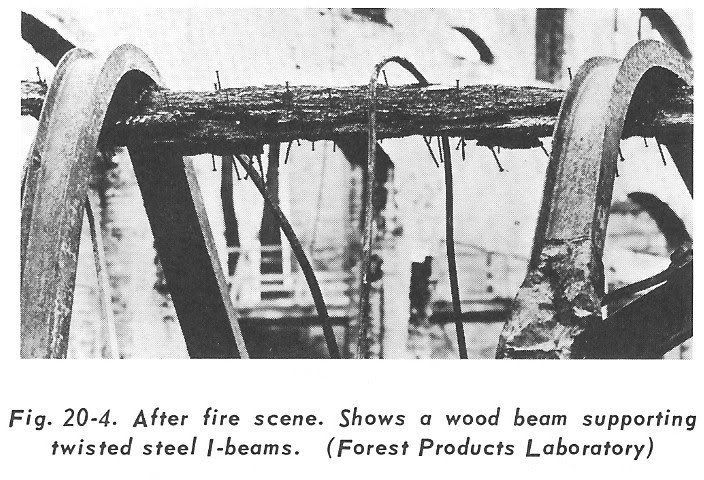
12447454a0f364d82f.jpg

If steel was such a great heat sink to prevent the failure of steel, there would be no insulation to keep steel from failing in fire quicker.

Where do these people come from.

The super heat sink steel, failed...
woodbeambentsteel-full.jpg

Why are heat sinks made of ... Fe Cu and Al???


Thermal conductivity
Steel 12-45 OOPS
Copper 401
Aluminum 120 - 237
Silver 429

Wonder why heat-sinks are not made of steel? Don't ask 911 truth.

Why is 911 truth stupid on heat-sinks? Since steel is so great, 911 truth needs to replace their heat-sinks with steel - that will stop the silly posts.
 
the floors sagged NOT as a result of the truss connections or the columns themselves being heated. They sagged due to the spans themselves being heated, i.e. the heat in the center of each truss is more rellevent than the heat at either end of the truss.
The exterior columns did not vary as much as the core columns did and the same sagging on any floor would have caused similar inward pulling on the exterior columns.

That's exactly my point. The sagging is the cause of the pulling which leads to the collapse (according to the NIST report). The sagging does depend on the floor and not the amount of stories on top. It is false to claim that twice as many floors would reduce by half the amount of time needed for the collapse to occur.
 
Last edited:

Back
Top Bottom