I can't believe you still do *NOT* understand the difference between a discharge and a current after yesterday's discussions! Oy Vey. The only two people (other than EU proponents) that I'm confident actually understand the difference are The Man (who *CLEARLY* explained it) and PS. When did you intend to get up to speed on this topic?
I was up to speed years before you wrote your paper on the CNO, getting a plasma astrophyscis degree.
Like I say, it is totally utterly unimportant what you or I or the Man or whoever want to call a discharge.
The fat huge letters were there to show that I did not care, and hoped to finish this futile discussion. Oy Vey indeed.
In another message, you wanted me to agree with you that an exploding double layer is a discharge. The question is WHAT FOR? Is exploding double layer not a lot more clear than discharge? Then at least you know what is being discussed.
The Man said:
How does this “PINCH effect” develop? What force or forces “evacuates the area around the filament” and confines the current to that reduced cross sectional area?
Michael Mozina said:
Essentially the currents running through the plasma creates a magnetic field that becomes aligned with the current. That magnetic field acts to "pinch" the plasma into "filaments", sometimes "tubular" filaments. The magnetic field around the filament acts to evacuate the regions around the filament, creating an insulating effect directly around the filament.
My god, can you get any more wrong?!?!?!
Take the tube, and let a current flow along the field (this would be aligned with the zero order magentic field). The current creates a toroidal magnetic field (you know, the left hand rule??). This makes the total field spiral like in the figure. The toroidal component of the field gets stronger as the current gets stronger. The current flowing experiences a
jx
B force which has a radial component (assuming the loop is a tube). Now, this force is opposed by the plasma pressure and searches an equilibrium. Bennett showed a long time ago that:
[latex]2 N k(T_e + T_i) = \frac{{\mu_0}} {4 \pi} I^2 [/latex]
is the threshold stability. If the current is greater then the the tube gets squeezed together by the
jx
B force.
As the plasma is magnetized, it has to move with the field and thus the current channel, when the Bennett relation is crossed, thins, leaving a a region where the field has been pulled away including the plasma.
However, I am not sure how it works if a loop would filament into several pinches and what effect that has on the loop and the the space inbetween the pinches.
Michael Mozina said:
The same process takes place inside of an ordinary plasma ball, although the process is somewhat different because it's not all ionized matter inside of a plasma ball, but the process is quite similar.
No, that is completely wrong, there is no plasma in a plasma ball outside of the conducting paths. It is a low pressure argon gas, with a voltage between the central ball and the glass that is greater than the break down electric field of the argon gas. Now, normaly it would only be one blitz, but because the electric field is modulated by a kHz AC the blitz can be continuous. I once gave the whole explanation here on the board, but I cannot find it.
Michael Mozina said:
Essentially the plasma reaches the limit of the amount of current it can carry before the plasma starts to become "noisy" due to collisions, the plasma heats up, the filament becomes unstable, and the resistivity of the filament jumps through the roof. The whole things then "explodes/discharges'.
A plasma is always noisy and it always has collionsion, how would you like to heat a plasma with a current without collisions. So there is no limit necessary to heat a plasma with a current, it is just basic current I times resistivity R.
Now, things get interesting when the current requires a particle velocity which is greater than the thermal velocity of the plasma particles. Then there needs to be extra acceleration of the particles, for example through the creation of a double layer. High velocities can lead to instabilities, however, there is no need for the resistivity to jump through the roof.
You want to pinch to create a gap in the current. However, what you forget is that higher current density in the pinch will lead to higher heating rate, so most likely it will never come to a catastrophy that the Bennett pinch will squeeze to zero thickness as the plasma pressure will increase too, if not because of the squeezing, then because of the heating.
Then again there is the Foukal & Hinata paper, that takes the experience from the laboratory with respect to double layers and they show that the one big exploding double layer will not happen.
the Man said:
Where was that energy stored? How is it released when discharged and to where?
Michael Mozina said:
The energy is stored in the "circuit' that goes though and under the photosphere, as well as high above the photosphere. Alfven has a pretty good single paragraph description of how this all works. I'll try to round it up again for you today. Be patient however, it's really busy again today
Of course the correct answer, that The Man wanted to get was that the energy is stored in the magnetic pressure and magnetic tension in the solar loop.



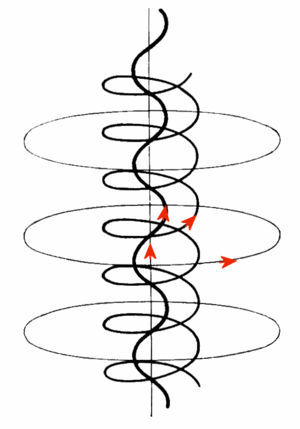
 ).
).


