JohnG
Pedantic Bore

The PBY became my favorite airplane after seeing that movie.


I just noticed that the Ingersoll photos on the pentacon site are the originals, with EXIF data. The camera was a Nikon D1x (with APS-C frame size), and the lens seems to be an 80-200mm zoom (equivalent to 120-300mm in a 35mm camera).
...
I just noticed that the Ingersoll photos on the pentacon site are the originals, with EXIF data. The camera was a Nikon D1x (with APS-C frame size), and the lens seems to be an 80-200mm zoom (equivalent to 120-300mm in a 35mm camera).
What I Ratant's photos show is that relative angular size is not affected by focal length, since light always travels in straight lines. "Depth compression" is really just a perception effect. If you are 50 feet away from a 6-foot-tall man and there is another 6-foot-tall man 100 feet away, the farther man will have an angular image size about half that of the closer man. That's true for the human eye and for a camera with any focal length lens. Our vision systems are pretty good at detecting that relative difference and judging that the second man is twice as far away as the first. What's changed by a wide-angle vs. "normal" vs. telephoto lens is how far away we would judge the camera to be from the first man. With a telephoto lens, we might judge that the camera was only 10 feet from the first man (which is the purpose of a telephoto), so it appears the the second man is only 20 feet away. With a wide-angle lens, we might judge that the camera was 100 feet away from the first man so the second man was 200 feet away. That's all that "depth compression" and "depth expansion" mean: perceptions of relative distances are altered by different focal lengths.
The images on that site are 1024x667 pixels. The D1x has a 3008×1960 sensor, and the EXIF-data contains the values ExifImageWidth=3008 and ExifImageHeight=1960.
Apparently, the images are not original but resized, maybe to make them more internet-friendly. Many imaging programs, for example IrfanView, can safe pictures after manipulation with original EXIF data. We can't know therefore if, besides resizing, any manipulation has been done on them. (Technical note: The moment the camera saves a JPEG, the image is already manipulated. Only RAW data would give us what the camera actually recorded)
You know one thing I find interesting is that Craig claims to have gotten the photos from a VDOT employee who is no longer with us. It just seems weird that this VDOT person would've had the photos. Of course Craig could just be lying. http://www.thepentacon.com/Topic7.htm
The PBY became my favorite airplane after seeing that movie.

You know one thing I find interesting is that Craig claims to have gotten the photos from a VDOT employee who is no longer with us. It just seems weird that this VDOT person would've had the photos. Of course Craig could just be lying. http://www.thepentacon.com/Topic7.htm
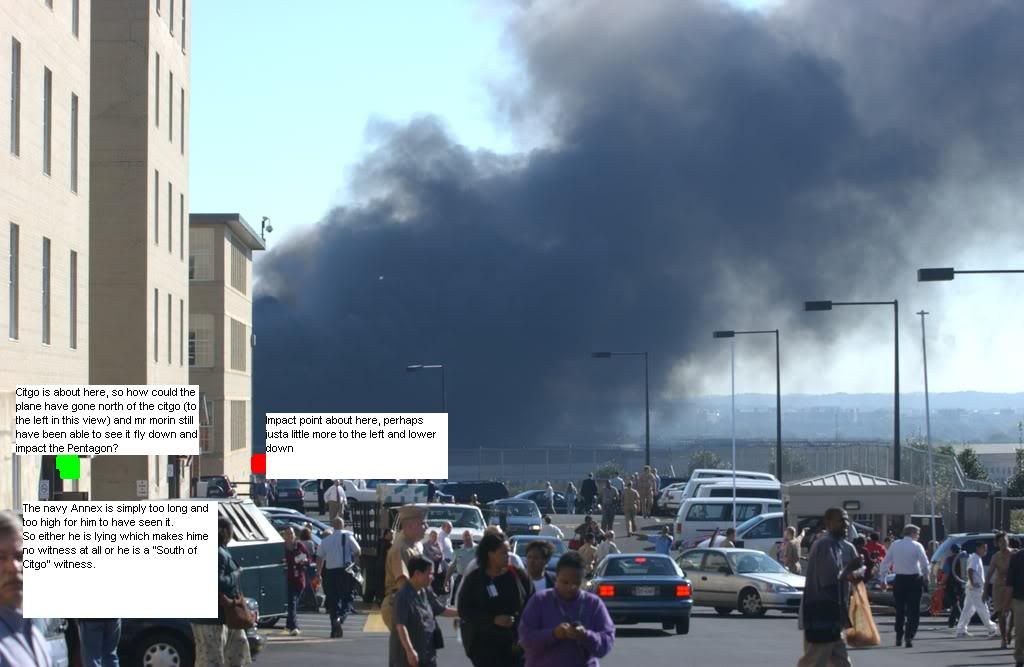

Looking at all images in http://www.thepentacon.com/Topic7.htm with an eye to the time stamps, we know the photrapher was walking away from the Navy Annex and uphill over the parking lots south of Columbia Pike.
These parking lots have black lampposts, with T-shaped tops, of which we see a number in DSC_0412.
My best quick estimate for the line of sight is this:
The black lines are roughly the edges of the photo
The red line goes throu the overhead sign support
The yellow star is the resulting location of the cab on the lane divider

.

.Because of the terrible accident involving that scuba diver who was sucked into the intake of one of these water-bombers (or was it a helicopter bucket?) a new sport called 'FireDiving' has emerged.
It is an NWO/Illuminati-sanctioned event, apparently also popular at Bilderberger meetings.
http://www.firediving.com/firewhat.html

I know. I've been trying to find other examples on the internet which could account for what I am seeing and have so far failed. But my research is probably like Hamilton's assessment of the 9/11 commission - set up to fail.
He did say that. He said he thought the commission was set up to failthere you go again. quote mine (he did not say that, and it was pointed to you OUT in another thread)
I'm an amateur photographer, and I know about these issues, especially when using a telephoto lens.

I just don't find foreshortening to be a credible explanation.
He did say that. He said he thought the commission was set up to fail
Just explain to me why pole B is in the wrong place in Photo #2. It just doesn't make sense to me. It seems the photographer is shooting out over the car towards the impact area. The bridge and pole B should be to the left of the car in that photo. I just don't find foreshortening to be a credible explanation.
Why not? There's alot of times that photo just don't "look right".
The big question here is how does what you have read in this thread effect your presentation? Do you plan on re-evaluating and making any changes?
Nope. Twinstead is right. You are wrong.You are misreading the quote again. Why is that truthers number one problem is reading comprehension?
as has been told to you many time, you continue to mislabel your landmarks in all your photos.
As has been asked of you. DRAW YOUR LINE OF SIGHT!!!


