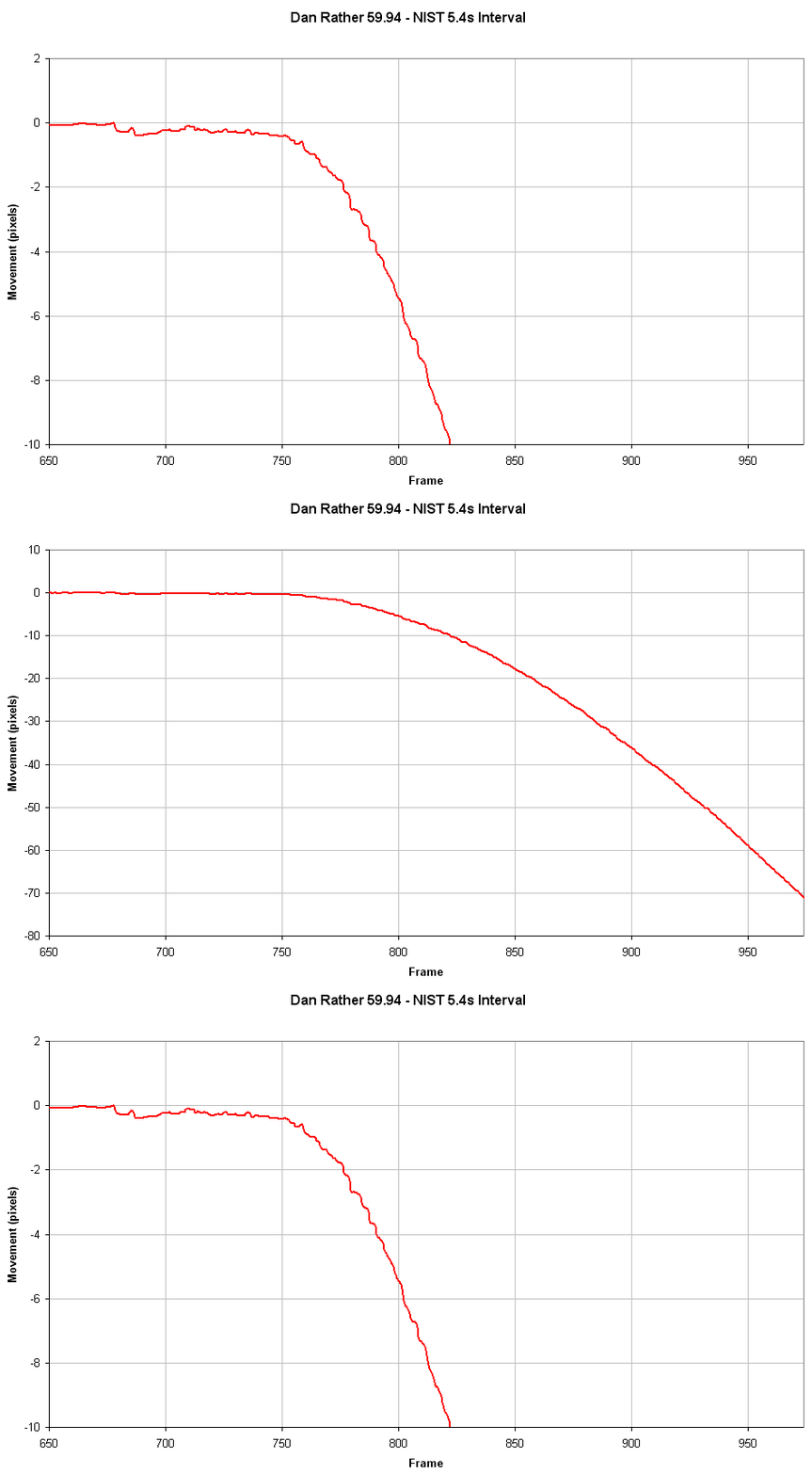
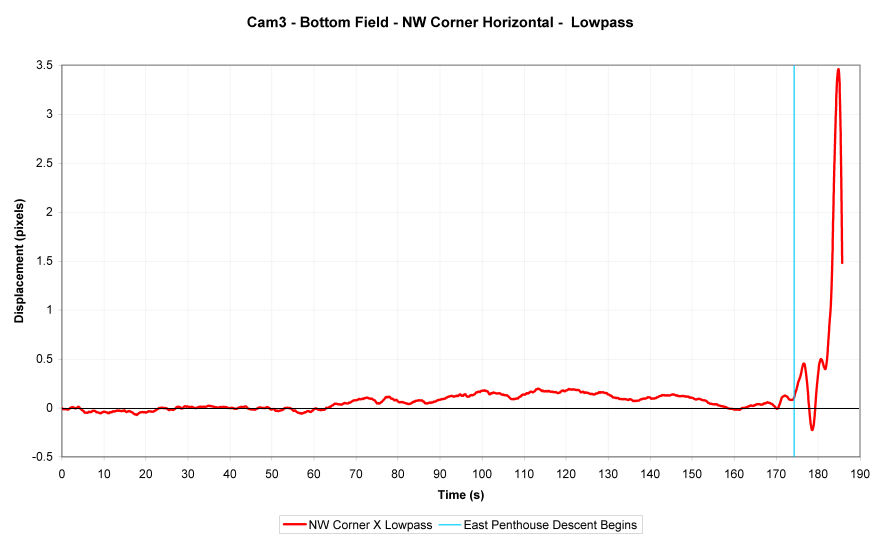
WTC7 and the NIST free fall failure

:rolleyes:


If you weren't trying to start a "*my vector math is better than yours* mud fight", then what was that about?

That was about tfk wading into the discussion about an inch away from demanding everyone else goes and performs a tfk certified vector analysis of the most trivially simple point. Very tedious. Stopping the imminent vector math mud-fight if you will.

I note no response to the rest of my post to you.
 
Last edited:
OK, let me try and help. Is the following statement an accurate representation of your position?

NIST measured the instant at which the drop began by monitoring the colour change of a pixel at the roofline of the building, and measuring the instant at which its colour started to change to the colour of the sky. However, the only points they could possibly have used were points on the top of the screenwall or the West Penthouse. These began to fall into the building before the facade collapse began, so NIST's timings start too early. This means that the early stages of collapse were at a greater acceleration than NIST claimed.

Near enough?

Dave
With the caveat that those are not my words, and the wee strikeouts, what you've said is fine.

That paragraph doesn't define my position, but hey ho.
 
With the caveat that those are not my words, and the wee strikeouts, what you've said is fine.

Right then. So a sensible course of action would be to contact NIST and ask them the location of the pixel used to determine the zero for their time axis, wouldn't it?

That paragraph doesn't define my position, but hey ho.

Does it, with struck out parts removed, define the problem in hand?

Dave
 
none of your arguments have proven that the collapse of WTC7 was caused by anything more than 7+ hours of unfought fires.
Were they supposed to ?

When are we going to address this?
Feel free to address whatever floats your boat, though I'm not sure this thread is the right place for you to do so.

Or are you just more concerned that NIST was might be wrong?
Confirming their mistakes, sure.
 
Right then. So a sensible course of action would be to contact NIST and ask them the location of the pixel used to determine the zero for their time axis, wouldn't it?
By all means feel free to do so.

I have my own trace data which superscedes theirs for my own purposes.

Does it, with struck out parts removed, define the problem in hand?
Items (1) and (2) of the quick list I posted here...
http://www.internationalskeptics.com/forums/showpost.php?p=6763560&postcount=246
...sure.
 
By all means feel free to do so.

:boggled: You're the one claiming they've made a critical error. Was there a point to making that claim, or are you just trying to look clever? If there was a point, you might actually want to check back with NIST. You may think you're perfect, but in the real world it's possible they know something you haven't figured out. Or vice versa, in which case you'd actually be doing something useful. But your present course of action seems to be calculated to maximise your own irrelevance.

Dave
 
Ye gads.

What point do you think NIST used to perform the full position/time trace Myriad ?

[qimg]http://femr2.ucoz.com/_ph/7/975319243.png[/qimg]


I don't know. The passage cited does not say. Why even assume they used a single point; why not multiple points, or a fit to an edge instead?

Do you know? Did you ask them?


Of course. They started the clock a bit early. Their timin does not relate to the parapet wall roofline. It's a combo between the West penthouse descent start time and the point at which the parapet wall roofline passes their stated marker.


How do you know this? They did not say they measured or used the west penthouse start time. Have you asked them, or are you guessing?

If they started the clock early, then the results should show a difference compared to your own measurement in which you start the clock at a different, more correct time. How did you measure and what were your results?


ETA: Oh, and of course the distance between the top of the West Penthouse and the lower marker is not 242ft.

Again, show your measurement and how your results differ.


Of course. Many-a graph of various drop curves for various locations on the upper section of WTC 7.

Try the numerous similar graphs from Achimspok first.

Knock off about 0.5s from the 5.4s NIST value.


I don't want a drop curve, since that necessarily requires position measurements based on vertical pixels in an image or re-scalings of same. So let's stick with the basic distance and time envelope. NIST's height measurements for the overall interval are based on the constructed height of building features. Have a different result? Let's see four data points: start time, end time (or elasped time), start height, end height, and how each was determined.

Note that the goal in determination of the start time is to detect the effects of column buckling (or any other hypothesized cause of fatal instability) on the facade at the earliest detectable moment. That effect is movement, but in the case of buckling it would not be expected to be rapid movement at first especially the downward component. Achimspok's efforts to disregard early movement as being due solely to horizontal or twisting movements amounts to an argument that such horizontal or twisting movement must mean the columns below had not yet started buckling. Given the geometry of buckling (vertical movement going as the cosine of the buckle angle which starts with a slope of zero while potential horizontal movement potentially goes as the sine of the buckle angle which starts with a slope of one) that is a very questionable argument.

Respectfully,
Myriad
 
Last edited:
That was about tfk wading into the discussion about an inch away from demanding everyone else goes and performs a tfk certified vector analysis of the most trivially simple point. Very tedious. Stopping the imminent vector math mud-fight if you will.
Perhaps your history with tfk has influenced your standard inch. In my opinion, tfk asked a relevant question, to which achimspok replied by performing a laughable calculation.

I note no response to the rest of my post to you.
Had I responded to the rest of your post, it would have gone something like this...

If you think we're boring you, imagine how much you've been boring us.

Tom was referring to the vector between vertical and horizontal (southward) motion...the proportion between both. Achimspok is not. Apples and oranges. Achimspok misinterpreted what tfk meant. No big deal.
I agree that achimspok had no idea what tfk was asking.

The important point, rather than begin a very tedious repetative *my vector math is better than yours* mud fight, is that those who have either participated in the recent vector/perspective discussions or are aware of the implications of such when dealing with the Cam#3 footage really should be posting how silly it is for the others here to be waving their hands around defending the NIST minor screw up.
If all of us were to post our opinions whenever silliness is perpetrated in this subforum, its signal/noise ratio would be even lower.

What's the end result ? At the simplest level it simply means they started the clock a bit early.

Big deal.

Simply admit the minor NIST botch and move on to the next point.
That remark would have evoked less laughter had it come from someone who's been more willing to state his point and move on.
 
femr,

alienentity said:
You are making an assumption (and generally you know how these turn out ) about the point NIST picked. First, you don't really know, you're simply guessing.
No. A simple deducement, determined by cross-referencing the information NIST themselves provide.

And, unsurprisingly, your "deducement" is wrong, Sherlock.

You don't have to deduce anything. You simply have to read very section of the document that you cited.

Here, let me help…

NIST said:
The chosen feature was the top of the parapet wall on the roofline aligned with the east edge of the louvers on the north face.

They traced the point that they said they traced.

Do you know how I know this?
Because, unlike you, engineers are precise when they write things.

To engineers:
"Parapet" does not mean "Penthouse".
"Aligned" does not mean "near".


To engineers:
"Parapet" means "Parapet".
"Aligned" means "Aligned".

and
"… top of the parapet wall on the roofline aligned with the east edge of the louvers … "

means this:

picture.php


[ETA: 2nd point that was NOT the tracked point.]

Just like it says.

I really hope you're not going to suggest that NIST traced a diagonal, as highlighted by Achimspok earlier in this thread...
http://img263.imageshack.us/img263/304/path2.png

No, Achimspok is just as agenda-driven as you are. Which means that he is on the same absurd Giant Nit Hunt that you are.

And, being as incompetent as you are, he constantly gets things, simple things, all bolluxed up, too.

Plus, NIST's engineers are not incompetent. So they know how to trace falling objects, to pull metrics off of images, to compensate for all manner of things, such as perspective & oblique views.

So a competent NIST engineer might notice that, while properly calculating fall distance, he's stuck at about the 34rd floor, when the roofline drops out of sight. But if he happens to shift his view to the right (being careful to shift parallel to the ground), then he can get all the way down to the 29th floor.

Such as
picture.php


Amazing what clever, competent people can do, no?

Now, while saying dumb things, you're not going to get all patronizing, are you?

Oh dear, you are.

Oh dear. You are.

How stundilicious.

You're *defending* NISTs method for what reason exactly ?

I'm not "defending" them.
I'm pointing out that they are competent professionals.
I've pointed out, for quite some time, that you are not.

NIST's report needs no defense, as far as I can see. Because there is nobody, with the slightest bit of gravitas, background or ability that has launched any competent attack.

What is it that makes you think it's a big deal ? It's pretty poor on their part, but it's pretty clear what they did. Here y'are...
http://femr2.ucoz.com/_ph/7/563913536.png
(And you know how fine a tooth-comb I've run through the NIST tracing methods )

You couldn't take a fine tooth comb to ANY analysis.
You still deny the fundamental cornerstone of ALL analyses: error analysis.

You think being dismissive of it is humorous, or patronizing.

To anybody in engineering or science, being dismissive of error analysis means that you are an abject technological clown.

You keep making fun of it for me, OK?

It's such a simple point that it's becoming increasingly funny at how many of you NISTians are frothing at the mouth defending them, but, hey, I have the physical video they used, and so might even give you traces of the points in question, comparing them 12 fig 12-75.

It is possible that you might have been competent at some of this.
Your motives, attitude & politics prohibit that.
Along with all the lying you do about your motives. (Whether it is lying to just us, or to both us & yourself, is immaterial.)

So, publish your precious, silly traces. Don't publish your precious, silly traces.
Construct a theory. Don't construct theory.

Who cares, femr?


You can then stop waving your hands around.

You say that you "might even give [us] traces of the points in question..."

And accuse us of "waving our hands around"??

:id:

Yes, I do, as otherwise they'd be attempting to trace along a diagonal, and their methods don't work that way.

Silly, silly boy.

No need. The point they traced was on the top of the West Penthouse. End of.

Just the last in a long, long line of "wrong".

 
Last edited:
I don't know. The passage cited does not say. Why even assume they used a single point; why not a fit to an edge instead?
Their trace methods do not use edges. Their trace methods are documented.

Do you know?
Yes.

Did you ask them?
No.

How do you know this?
Their position/time trace confirms it.

They did not say they measured or used the west penthouse start time.
Correct, yet that is the region that they used. That is where their error arises.

Have you asked them
Again, no.

or are you guessing?
Not guessing. Determining by cross-referencing provided information and my own traces.

If they started the clock early, then the results should show a difference compared to your own measurement in which you start the clock at a different, more correct time.
Yup.

How did you measure and what were your results?
Ye gads Myriad. I know you've followed the various trace data threads.

I'll drag out some old data for you, but in the meantime, here's a quick graph :D

842535832.gif

(Yeah, I know, inconvenient units. But can you spot the useful information ?)

Again, show your measurement and how your results differ.
I'll get round to it, though Achimspok has posted everything you need for the thread context in the OP, so am not sure why I should invest the time.

I don't want a drop curve
Can't define any T0 values without drop curves Myriad.

So let's stick with the basic distance and time envelope. NIST's height measurements for the overall interval are based on the constructed height of building features. Have a different result? Let's see four data points: start time, end time (or elasped time), start height, end height, and how each was determined.
I'll put some time aside.


Note that the goal in determination of the start time is to detect the effects of column buckling (or any other hypothesized cause of fatal instability) on the facade at the earliest detectable moment.
WTC 7 motion began much earlier...
212241494.png
 
Before I begin Tom...Tom, Tom, Tom...when are you going to learn eh ?

Here...
370825048.jpg

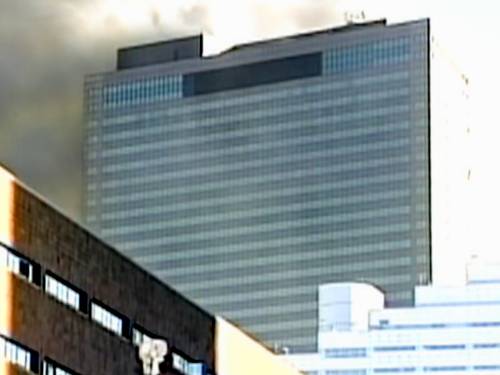
It is not possible to determine the location of the roofline from the Cam#3 viewpoint in terms of a pixel colour value transitioning to the colour of the sky.

Now then...
And, unsurprisingly, your "deducement" is wrong, Sherlock.
Yawn.

You don't have to deduce anything. You simply have to read very section of the document that you cited.
Read many times Tom. They made a mistake.

Here, let me help…
Uh oh, here we go...

They traced the point that they said they traced.
Nope.

Do you know how I know this?
You don't, you're making it up son ;)

Because, unlike you, engineers are precise when they write things.
They made a mistake.

To engineers:
"Parapet" does not mean "Penthouse".
"Aligned" does not mean "near".


To engineers:
"Parapet" means "Parapet".
"Aligned" means "Aligned".

and
"… top of the parapet wall on the roofline aligned with the east edge of the louvers … "

means this:

[qimg]http://www.internationalskeptics.com/forums/picture.php?albumid=553&pictureid=4207[/qimg]
Oh, that's funny.

Plus, NIST's engineers are not incompetent. So they know how to trace falling objects, to pull metrics off of images, to compensate for all manner of things, such as perspective & oblique views.

So a competent NIST engineer might notice that, while properly calculating fall distance, he's stuck at about the 34rd floor, when the roofline drops out of sight. But if he happens to shift his view to the right (being careful to shift parallel to the ground), then he can get all the way down to the 29th floor.
Hilarious Tom.

You believe that NIST used a split trace now ?

Priceless.

The lengths you will go to to defend **** quality work in the NIST report is amazing.

Trace data confirms their mistake. Got some ? lol.

As I said to Myriad above, I'll put some time aside soon and post a few details.

But Tom, you're a funny man ;)
 
Oh, the irony.

The *problem* in hand really is little more complex than simply looking at two photo's. It's really very, very simple. Thinking it's more complicated that that simply shows either a lack of comprehension or willful ignorance.

I will add "irony" to the list of things you don't appear to understand. The lack of comprehension or willful ignorance thing appears to be a bit of projection on your part. If a photo proves something, and it takes you thousands of words to say it, and I can't understand it, then you just might not be the best communicator. Really, I'm not stupid, not a primary school student. If you tell me your point, I might disagree, but I will understand it if you communicate clearly. Posting a blurry animated gif and saying "see" is no different from the bigfooter stuff.

Here's the closing point in the OP.
achimspok said:
I leave it up to you to decide if either NIST did several "beginners mistakes" in a row while being very aware of the higher screenwall or if NIST just tries to hide the facts. The measurement itself is unambiguous.
False DilemmaWP , and one that should have at least a third option:

- NIST made several (!) "beginners mistakes"
- NIST just tries to hide the facts
- achimspok and others mine the NIST report for anomalies and misinterpret something
 
Aha ! Mister brand new expert in vector-based motion. Purlease Tom. Your bow is becoming strung with so many faux strings, that I'd have to call it a scarf

Good enough that I taught it. Back about 25 years ago.

I've told you this before: that I taught college level Engineering Dynamics.

I would conclude from your statement that you are so utterly clueless that you have no concept what "engineering dynamics" involves.

Amusing...

Without getting pedantic about your terminology, sure.

In other words, I was right.
Thank you.
I knew that.
Now, we both know.

Who said it was earth shattering ?

If you've got zero arguments, I suppose nit-picking adjectives will have to do.

It adds inacuracy to their descent data as you surely know.

No, I don't know anything of the sort.
Neither, most especially, do you.

Because "adds inacuracy [sic]" implies that someone understand accuracy of measurement (i.e., error) in the first place.

You proudly proclaim your current - and future - ignorance in this matter.

You already know how far from actual their descent traces are and have even posted my data around town to make the point

Their data is quite good. Their data is right. They know the limits & resolution of their data.

You, on the other hand, don't seem to realize that:
1. the only difference between my (competent) analysis (taken from your raw data) & NIST's is resolution.

2. my analysis MUST converge to their data at coarse time resolution. And it does.
You clearly don't understand this even tho I told you specifically that this was one of the crucial checks that I did on my conclusions.

Your analysis? Well, I'll leave that up to you.
But I do love the fact that you've got the building jumping upwards about 12' before it starts to fall.

Charming...


Hey, I could post uncommented cartoons, too...
Lemme know when you grow the nads to actually say something conclusive about it.
 
Correct, yet that is the region that they used. That is where their error arises.


OK, some subsequent posts have filled in the details of what you're actually claiming here.

Your claim is that NIST must have used the exact same technique (pixel brightness relative to sky pixels) to perform the position measurements for the descent curve, as they used for the start time measurement.

(Which is not established by any evidence; they did not state the method(s) used for the position measurements for the descent curve.)

Therefore they must have used the same point along the roofline for the start time measurement as they used for the position measurements.

(Which does not follow, they could have used a different point despite the screenwall and penthouse since sufficiently accurate position measurements might not have required the sky contrast used for the much more critical inital time measurement, and once the screenwall and penthouse fell behind the parapet the sky contrast would be available again anyhow).

Therefore they must have used the top of the penthouse to make their initial time measurement.

(Despite that they specifically say otherwise in the report, and despite that this would be an absurdly obvious error.)

Therefore the initial time measurement is too early, and so underestimates the speed of the collapse.

Well, that chain of logic is... I can only say, pathetic. Invalid at every step, utterly implausible, and unconvincing to the point of being strongly persuasive toward the opposite conclusions.

But.. it's a trivial error anyhow? Then I agree with Dave Rogers. Let's ignore it, and talk about any nontrivial errors that might be present.

Respectfully,
Myriad
 
Last edited:
Oh, and by the way...

(Yeah, I know, inconvenient units. But can you spot the useful information ?)


I have to admit that I cannot. Inconvenient units is a bit of an understatement. Here is an unaltered (except for TIFF to JPG compression, and cropping for width) screenshot of how your graph appears in my browser (in one of its two alternating states; the other is just as bad):

130124d309871bb992.jpg


This is typical of your animated graphs and other animated gifs you post. Maybe it's some problem particular to my system (Mac/OS10/Safari), but if so, only the animated images (such as antenna porn and multi-pane graphs) you post in these threads seem to be affected.

This has been mentioned before by others, but I realized that you might be mistaking complaints like "blurry," "distorted," and "incoherent" as mere hyperbole rather than indicative of a technical problem.

I will point out that graphs and images that just sit there and don't move have sufficed to communicate breakthroughs in general relativity, quantum mechanics, astrophysics, genetics, computing and other abstruse, novel, and even revolutionary scientific and technical concepts for centuries. Perhaps you might make do with them too?

Respectfully,
Myriad
 
FYI, I have the same problem with both femr2 and Major Tom's graphs/animations/videos. I am also using Safari on Mac OS X 10.4.11.

Everyone else is fine.
 
I can just imagine the conversation between the Junior Engineer who calculated the fall time and his boss, who was pushing to get the over-due final report wrapped up & out the door.

Junior Engineer: "Well, in my initial analysis, I was only able to get about, let's see 47 - 33, about 14 floors of fall before it fell behind that building. And those are the numbers that I've got in my report. But then I was showing my results to Joe at lunch, and he pointed out that, if I shifted my reference point to the right at that moment my reference point disappeared, I could get another 4 stories of data. So I'm going to update my numbers."

Senior Engineer: "great".

Jr. Engineer: "But I need to rewrite my section to explain exactly how I did that."

Sr. Engineer: "Are your numbers right?"

Jr. Engr: "Of course."

Sr. Engr: "Will you explanation add anything to the story? Or will you just load people up with irrelevant details?"

Jr. Engr: "Well, suppose someone start to pick this thing apart, and they notice that I can only track this point for 14 floors. While the narrative says that I tracked it for 18. They might even conclude that I tracked the Penthouse roof instead of the building roof."

Sr. Engr: "Did you identify the point that you tracked?"

Jr. Engr: "Yup".

Sr. Engr: "Look, junior, it's long enough already. Get your info & data in there as simply & correctly as possible. Don't turn it into War & Peace. Or the the Boeing 747 tech manual."

Jr. Engr: "But some moron might conclude that we aren't technically astute enough to know that things fall downwards, rather than diagonally. Or that I tracked the Penthouse roof instead of the building roofline. They might even conclude that we're lying about all of this. Making up data.""

Sr. Engr: [Long pause. Withering look.] "We're not writing this thing for morons, are we."
 

Back
Top Bottom