Deeper than primes

Status
Not open for further replies.
The area is exactly 1/3 only if the given parabola is totally smooth (no points are found along it).

That's not what I asked. We're already well aware of the fact that you are completely against traditional mathematics and all of its tools (including the integral). I am asking you to apply Doronetics (your nonsensical gibberish) to solve the area under the curve problem. You are not allowed to rely on integrals to accomplish this of course, since integrals are ultimately defined using limits, which you claim to be incorrect.
 
That's not what I asked. We're already well aware of the fact that you are completely against traditional mathematics and all of its tools (including the integral). I am asking you to apply Doronetics (your nonsensical gibberish) to solve the area under the curve problem. You are not allowed to rely on integrals to accomplish this of course, since integrals are ultimately defined using limits, which you claim to be incorrect.
You don't get it.

If you are at the limit, then the parabola is totally smooth (no points are found along it). Only then the area under the totally smooth parabola is exactly 1/3.

EDIT:
The same principle holds in the case of length 1, it is not exactly length 1 as long as the convergent series of points to 1 is considered.

In other words, in both cases you have to go beyond the convergent series in order to reach the limit.

The same principle holds for Aleph0, you have to go beyond the natural numbers in order to get it.

If it is done, you are at the kingdom of non-locality.
 
Last edited:
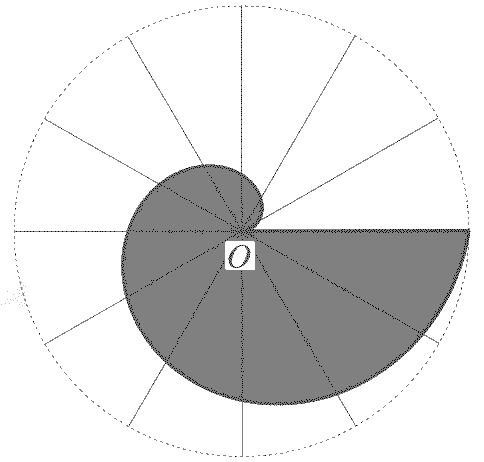
Please look at Archimedes spiral's area and the circle's area http://physics.weber.edu/carroll/archimedes/calculus.htm :

spiral.gif


Archimedes spiral's area is exactly 1/3 of the circle's area only if it is totally smooth (no points are defined along it).

This totally smooth spiral is non-local exactly as the circle is non-local (does not have points along it).

By the way, I use Archimedes spirals' self interference in order to represent Cybernetic Kernels:

4389327007_991e930b4a_z.jpg
 
Last edited:
Archimedes spiral's area is exactly 1/3 of the circle's area only if it is totally smooth (no points are defined along it).

Doronetics has such odd and unnecessary requirements. Since there are many points along the spiral, we can conclude that Doronetics is incapable of calculating the area.

Doron, we have plenty examples of things Doronetics cannot do. We didn't really need another one. We are, however, still curious if there is anything it can do that would be useful.

This totally smooth spiral is non-local exactly as the circle is non-local (does not have points along it).

Doesn't it have to be non-local with respect to something? Doron, you haven't changed what you mean by non-local, again, have you? Wouldn't it be non-local with respect to some point on the spiral? Oh, wait, that would mean Doronetics admits there is a point on the spiral. Oh, dear!

And what about the plane in which the circle and spiral lie? Is it non-local with respect to the circle and spiral? In terms of "at the context of", how does the circle with respect to some point qualify and the plane with respect to the circle not qualify?
 
You don't get it.

If you are at the limit, then the parabola is totally smooth (no points are found along it). Only then the area under the totally smooth parabola is exactly 1/3.

EDIT:
The same principle holds in the case of length 1, it is not exactly length 1 as long as the convergent series of points to 1 is considered.

In other words, in both cases you have to go beyond the convergent series in order to reach the limit.

The same principle holds for Aleph0, you have to go beyond the natural numbers in order to get it.

If it is done, you are at the kingdom of non-locality.

In other words, Doronetics cannot solve the area under the curve problem. What a useless, boxen in :boxedin: theory you have wasted your life developing.
 
Archimedes spiral's area is exactly 1/3 of the circle's area only if it is totally smooth (no points are defined along it).

No, I disagree. I will denote any point I like along Archimedes' Spiral, and that will not affect its area. If you don't like that, then :p.

You can have all the fun you want with your :boxedin: Doronetics. The rest of us will continue enjoying the luxury of being able to denote a point on a shape without affecting its area.
 
Archimedes spiral's area is exactly 1/3 of the circle's area...
That's what Archimedes claimed and only integral calculus of modern mathematics could prove Archimedes right or wrong.


archimedespiral.png


That Archimedes had to have a good eye to see the proportion of the area. No integration, no area under the curve, right? That was one of the great benefits of paganism: you could chose among variety of gods and please the one that was known later to the Romans as Calculus -- the god of smooth computations.
 
Last edited:
Oh, wait, that would mean Doronetics admits there is a point on the spiral. Oh, dear!
No, OM shows that in order to get the exact area, one goes beyond the collection of points and gets the totally smooth curve, which is totally smooth exactly because it enables to be at AND not at (beyond) any given point (which is the property of non-locality).
 
No, I disagree. I will denote any point I like along Archimedes' Spiral, and that will not affect its area. If you don't like that, then :p.

You can have all the fun you want with your :boxedin: Doronetics. The rest of us will continue enjoying the luxury of being able to denote a point on a shape without affecting its area.
The ability to denote a point on a curve without affecting its area, is derived from the non-local property of the curve w.r.t any given point or collection of points along it, because the curve itself is at AND not at (beyond) any given point or collection of points along it, because of a very simple reason: an addition of infinitely many 0 dimensional spaces is closed under 0 dimensional space (the result is exactly one and only one point).
 
The ability to denote a point on a curve without affecting its area, is derived from the non-local property of the curve w.r.t any given point or collection of points along it, because the curve itself is at AND not at (beyond) any given point or collection of points along it, because of a very simple reason: an addition of infinitely many 0 dimensional spaces is closed under 0 dimensional space (the result is exactly one and only one point).

Assuming you mean a "0 dimensional space" to correspond to a point/number (on the real line), you have made the novel discovery that the addition of infinitely many numbers results in a number.

:dl:
 
No, OM shows that in order to get the exact area, one goes beyond the collection of points and gets the totally smooth curve, which is totally smooth exactly because it enables to be at AND not at (beyond) any given point (which is the property of non-locality).
There is only one curve drawn with the help of polar co-ordinates that is smooth, and that's

Cardioid1.gif


This heart-shaped curve is the main body of the Mandelbrot set fractal. It was extensively studied by professor Carlos Santana who concluded that the curve is really totally smooth. See his comment Give me your heart, make it real, or let's forget about it.
 
Assuming you mean a "0 dimensional space" to correspond to a point/number (on the real line), you have made the novel discovery that the addition of infinitely many numbers results in a number.

:dl:

EDIT:

Call it whatever you like (you play with names instead of notions), the size of the curve > the addition of infinitely many 0 sizes (a collection of infinitely many points).

Take for example Aleph0, its size > any natural number or the addition of all natural numbers (if such a result is satisfied).

Again, it is easy to show that a collection of infinitely many distinct numbers is unsatisfied ( please see http://www.internationalskeptics.com/forums/showpost.php?p=6694118&postcount=13497 ).
 
Last edited:
Call it whatever you like, its size > the addition of infinitely many 0 sizes (a collection of infinitely many points).

Take for example Aleph0, its size > any natural number or the addition of all natural numbers.

The actual elements of a set have nothing to do with the cardinality of a set. Cardinality is a property of the set itself. Consider the sets {N} and {1} for example, where N denotes the set of natural numbers. Although the former contains an infinitely large element, {N} and {1} have exactly the same size.
 
The actual elements of a set have nothing to do with the cardinality of a set. Cardinality is a property of the set itself.
You do not distinguish between the cardinality of the set of the name of the set of natural numbers, denoted as |{N}|=1 and the cardinality of the set of natural numbers, denoted as |N|=Aleph0, where the size of Aleph0 > any natural number or the addition of all natural numbers (if such a result is satisfied).

EDIT:

Again, it is easy to show that a collection of infinitely many distinct numbers is unsatisfied ( please see http://www.internationalskeptics.com/forums/showpost.php?p=6694118&postcount=13497 ).
 
Last edited:
You do not distinguish between the cardinality of the set of the name of the set of natural numbers, denoted as |{N}|=1 and the cardinality of the set of natural numbers, denoted as |N|=Aleph0, where the size of Aleph0 > any natural number or the addition of all natural numbers (if such a result is satisfied).

Addition has NOTHING to do with cardinality. Addition is an operation defined upon a set that, given two elements a and b, associates a third element from the set c. How is it any great surprise that the cardinality of the set of natural numbers is greater than that of any of its elements or any addition of those elements given that such a proposition follows immediately from the definitions? And how is that relevant to area under a curve in any way?

A curve is a graph, which is defined as a collection of ordered pairs (when in 2 dimensions). The area under a curve (when no vertical line intersects it more than once) is defined as the definite integral from a to b of the function which associates the x coordinates with the y coordinates in that collection of ordered pairs. How is anything you say relevant in any way to this definition?

EDIT:

Again, it is easy to show that a collection of infinitely many distinct numbers is unsatisfied ( please see http://www.internationalskeptics.com/forums/showpost.php?p=6694118&postcount=13497 ).

And this is even more nonsensical than most of the gibberish you post. You're talking about the set of all irrational numbers, but none of the numbers you have listed in your example are even irrational. 0.1011... can be interpreted to mean 0.101110111011... repeated, which is rational. Or, it can be interpreted to mean 0.101111111111.... repeated, which is also rational. Doron, don't tell me you don't understand the difference between rationals and irrationals now. :rolleyes:
 
EDIT:

How is it any great surprise that the cardinality of the set of natural numbers is greater than that of any of its elements or any addition of those elements given that such a proposition follows immediately from the definitions? And how is that relevant to area under a curve in any way?
You do not understand that Aleph0 is a size > the size of a collection of distinct elements. Cantor did not understand that by defining Aleph0 he goes beyond the concept of collection.

A curve is a graph, which is defined as a collection of ordered pairs (when in 2 dimensions). The area under a curve (when no vertical line intersects it more than once) is defined as the definite integral from a to b of the function which associates the x coordinates with the y coordinates in that collection of ordered pairs. How is anything you say relevant in any way to this definition?
A curve is a dimensional space > collection of ordered pairs, exactly as Aleph0 size > the size of the collection of natural numbers, simply because the size of any collection of distinct objects (whether it is a collection of natural numbers, rational numbers or irrational numbers) is not satisfied (in order to get it, please read the last paragraph).


And this is even more nonsensical than most of the gibberish you post. You're talking about the set of all irrational numbers, but none of the numbers you have listed in your example are even irrational. 0.1011... can be interpreted to mean 0.101110111011... repeated, which is rational. Or, it can be interpreted to mean 0.101111111111.... repeated, which is also rational. Doron, don't tell me you don't understand the difference between rationals and irrationals now. :rolleyes:
If we define it as the set of all distinct irrational numbers then 0.101110111011... is not one of the members of this set (because irrational numbers do not have repetitions over scales as rational numbers have) so what you say is simply nonsense.

Furthermore, by using the diagonal method on the set of all real numbers, it is easy to define a new number that is not a member of this set.

In other words, the collection of all distinct real numbers is unsatisfied, by definition.

Please pay attention that no bijection has been used here in order to prove the incompetence of the collection of real numbers.
 
Last edited:
You do not understand that Aleph0 is a size > the size of a collection of distinct elements. Cantor did not understand that by defining Aleph0 he goes beyond the concept of collection.

No Doron, you are the one who does not understand, as always. Aleph-0 is defined in terms of collections. Hence, it does not "go beyond" the concept of collection. Have you ever even read a book on basic set theory?

A curve is a dimensional space > collection of ordered pairs, exactly as Aleph0 size > the size of the collection of natural numbers, simply because the size of any collection of distinct objects (whether it is a collection of natural numbers, rational numbers or irrational numbers) is not satisfied.

Nonsensical gibberish. A curve is a collection of ordered pairs (when in two dimensions). You are arguing with definitions again, like a fool.

If we define it as the set of all distinct irrational numbers then 0.101110111011... is not one of the members of this set (because irrational numbers do not have repetitions over scales as rational numbers have) so what you say is simply nonsense.

No, you are the one using rational numbers in your set of irrationals, not me. Quit trying to rub off your blunders and failures onto others. If you want to give decimal expansions of irrationals, you have to make it clear that it does not terminate or repeat.

And the highlighted term is nonsensical. If you want to introduce new terminology, you have to define it. I see that this is just ultimately a repeat of an old classic over at Physics Forums: http://www.physicsforums.com/showthread.php?t=10076

Furthermore, by using the diagonal method on the set of all real numbers, it is easy to define a new number that is not a member of this set.

:dl:

Add the diagonal method to the list of elementary analysis concepts that you don't understand.

EDIT: To be more precise from my previous wording, the diagonal method can only be applied between a known countable set (the natural numbers) and an uncountable set to prove that there is no bijection from the countable set to the uncountable one. One set MUST be countable, because the diagonal method relies on the ability to make a list. You are trying to apply the diagonal method from an uncountable set to another uncountable one, which is complete nonsense.

In other words, the collection of all distinct real numbers is unsatisfied, by definition.

You don't even understand the definitions, Doron.

Please pay attention that no bijection has been used here in order to prove the incompetence of the collection of real numbers.

I don't know about proving the "incompetence" of the real numbers, but you've certainly proved your own incompetence.

 
Last edited:
EDIT:

The collection of all distinct real numbers is innumerable. The only one who is unsatisfied with this fact is doronshadmi.
"innumerable" is another name for "unsatisfied".

Again, Please pay attention that no bijection has been used here in order to prove the incompetence of the collection of real numbers.

By adding the new diagonal number to the set of real numbers, we get a new diagonal number that has to be added to the set of real numbers, etc ... ad infinitum ... and we can conclude that the set of all real numbers is unsatisfied.

Since the set of natural numbers belongs to the set of real numbers (and so is the set of rational numbers), than the unsatisfied completeness is shown also in their case.
 
Last edited:
Status
Not open for further replies.

Back
Top Bottom