• Quick note - the problem with Youtube videos not embedding on the forum appears to have been fixed, thanks to ZiprHead. If you do still see problems let me know.

The Great Thermate Debate

Ouch! :eek: I suggest you read again! I'll quote US Patent with a different highlight:


It's contained in the section "Description of the Prior Art", which describes previous patents trying for the same or similar effect (2,587,243/4,693,181/4,815,384). Those did not introduce "thermitebased apparatus" or alleviate the hazards associated with explosives.

I stand corrected. I was assuming that when they are referring to "prior" art, it was speaking of the art from above in the paper. Not previous patents.
 
(...)HOWEVER, two problems you STILL have.

1- This type device would need to be fairly large, and almost impossible to conceal. Someone would certainly notice it.

2- The dogs around GZ would have detected the thermite residues, as well as the various FBI, ATF, and many other local, state, and national LE agencies who sifted through every piece of material. Not ONE of them noticed the obvious burns on the steel.

Imagine that..... (...)

at p.1 fairly large, like what? how many inches?
at p.2 we all know how to go around it, come on!!!

so, do I undestand you well? you just can not rule out this option (thermite charges), right?
 
at p.1 fairly large, like what? how many inches?
at p.2 we all know how to go around it, come on!!!

No, we don't. At least not those of us who have worked with thermite or welded or seen steel that has been exposed to fires.

so, do I undestand you well? you just can not rule out this option (thermite charges), right?

Actually, we can, in the absence of any piece of steel that looks even remotely as though it had been attacked by thermite.
 
No, we don't. At least not those of us who have worked with thermite or welded or seen steel that has been exposed to fires.
the reason why I have been asking for the size of cutters is that it would be quite easy to hide it in plasterboard casing ... we know that ... meaning we people doing in construction industry ...

leftysergeant said:
Actually, we can, in the absence of any piece of steel that looks even remotely as though it had been attacked by thermite.
you mean like the one that looked like swiss chease?
 
the reason why I have been asking for the size of cutters is that it would be quite easy to hide it in plasterboard casing ... we know that ... meaning we people doing in construction industry ...


you mean like the one that looked like swiss chease?
The plaster board is 3 inches think, the device is long it would be a few feet into the space of the WTC which once was air.

You failed to understand the way your delusion would come true, the device orientation would give it away. You lost this round.

Not a single device was found, plus zero themite was found. Oops, you are spewing lies, delusions and nonsense.

The swiss cheese steel was corroded, no thermite was fused to the steel; big failure.
 
Last edited:
I have one answer for you my friend: I do not think 3 inches ... in any considerable way
 
I have one answer for you my friend: I do not think 3 inches ... in any considerable way

The fire insulation on the core included 3 inches of wallboard, this is a fact. What is your point, you lack knowledge of the WTC and now you spew delusions? (wall board, 1.5 inches thick, two sections, equal 3 inches; I find 911 truth can't do math, can't do research, so they make up moronic claims based on idiotic lies.)

You bring up corroded steel as your smoking gun, only to fail.
 
Last edited:
I have one answer for you my friend: I do not think 3 inches ... in any considerable way

Some of it 2" , and 2.5" on some floors.

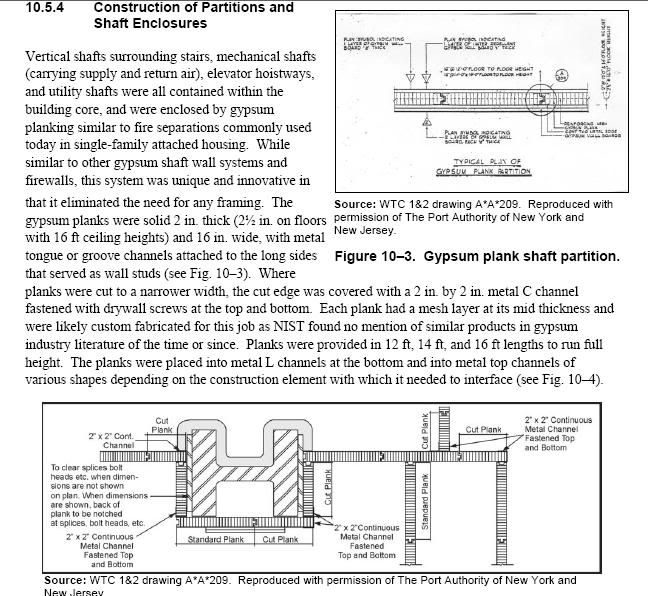
partitionwallsystem.jpg


The main point being that the drywall was both massive and close-fitting to the columns (see above). Fitting large devices inside the drywall was not an option. Which leaves holes in the drywall with devices sticking out into office space, store rooms, restrooms, corridors and so on. A ridiculous idea when you think about it.
 
Last edited:
so, do I undestand you well? you just can not rule out this option (thermite charges), right?


Even if that were true, not being able to rule out a specific possibility is certainly not an indication of that possibility's plausibility. You need to do a lot more work to convince others of it's likelihood.
 
the reason why I have been asking for the size of cutters is that it would be quite easy to hide it in plasterboard casing ... we know that ... meaning we people doing in construction industry ...

Well, considering the max this contraption could cut is stated at 2", it would have to be fairly large. And yet, it still has not be proven that this thing could actually work.


you mean like the one that looked like swiss chease?

Fail.

WPI, (The experts who studied this steel) concluded that this corrosion occured over a period of days, and did not reach a temperature of over 2,000 deg. F. So, that rules out therm*te.
 
WPI, (The experts who studied this steel) concluded that this corrosion occured over a period of days, and did not reach a temperature of over 2,000 deg. F. So, that rules out therm*te.

Could you point me to where in a report WPI says this. Thanks.
 
Could you point me to where in a report WPI says this. Thanks.
You did not read the report; you will be upset when you find out how low the temperature was. Your obsession with must be making you over look things.


Could you point to where in the WPI report it does not say this. It actually takes some connecting the dots to figure it out, all the data is in the report. Reading comprehension is required, as is reading the paper in the first place. Have you read the paper? Looks like you did not, or have problems figuring it out.
 
Last edited:
anyhow you did not address my point (for rule No12)

you lied, you loose :D


Grasping at straws are you ?


The video in the opening post proved that the concept is viable.
The patent was granted February 6 of 2001.


You need to learn how to follow links (and sublinks), read and comprehend.


You just need to learn how to remember and comprehend.


The patent was granted February 6 of 2001.
I posit that the "red/grey chips" are the residue.
The patent was granted February 6 of 2001.

For those too lazy to open that .pdf, here are the highlights :

[qimg]http://209.85.62.24/18/3/0/p376147/2001_patent.png[/qimg]

I read it. When you see how it's mounted and how big it is it's even a more ridiculous theory that anything like this wouldn't have survived (at least in part) the collapse.

Here is the side view of the charge carrier and nozzle. Notice this page includes the nozzle side view. (notice anything?)
thermcharge1sm.jpg


Here it is with the one section's side plates bolted on.
thermcharge2sm.jpg


So how is something so thin supposed to cut such a wide face? Easy, bolt several of them together.
thermcharge3sm.jpg


Sow how big and how many would you need to cut just one beam in the towers? You would need thousands of these units to take down the towers.

Have you ever seen Lose Change? lol
 
Last edited:
Could you point me to where in a report WPI says this. Thanks.

Here are the three that he wrote about the WTC Steel.

•R, R. Biederman, Erin Sullivan, G VanderVoort and R. D. Sisson, Jr. , "Microstructural Analysis of the Steels from Buildings 7, 1 and 2 from the World Trade Center", International Metallographic Society Meeting, August 3 - 7, 2003, San Antonio, TX and to be published in Materials Characterization.

***This is the one that I believe discusses the steel from 7WTC***

•R.D. Sisson, Jr., R.R. Biederman, " Metal Removal via Slag Attack of the Steel from Building 7 of the World Trade Center some Observations", Journal of Failure Analysis and Prevention, ASM International, Vol. 6, issue 5, pp. 17-19, October 2006.

ETA: Here is the abstract. I don't have the full text on my home computer. You may contact a local engineering school, to see if they have a copy.

"Abstract:

Microstructural examination of a beam from Building 7 showed that temperatures higher than 940 °C were experienced in localized regions. Concurrent examination of the beam surfaces and surface layers showed evidence of extensive metal removal, and the analysis suggests that this removal occurred while the beam was exposed to the fire in the rubble pile after the building had collapsed."

•J.R. Barnett, R. R. Biederman and R.D. Sisson, Jr., FEMA Report: World Trade Center Building Performance Study: Data Collection, Preliminary Observations and Recommendations - Appendix C: Limited Metallurgical Examination, April 2002.

This is the one (IIRC) that he states that the steel needed more study.
 
Last edited:
I have one answer for you my friend: I do not think 3 inches ... in any considerable way
Look at the drawing of that cutting device. It would have to be about two feet long, that would make it at least three inches thick.

The cutting charge I learned to make to cut through that much steel was about four inches thick. It would also have to be all the way around the column and it uses a chemical igniter. It would not be shelf-stable for more than a year or two. So it would have to have been rigged proximal to the attack. I don't see it happening at all, especially without attracting a lot of unwanted attention from the building engineering section.
 
the reason why I have been asking for the size of cutters is that it would be quite easy to hide it in plasterboard casing ... we know that ... meaning we people doing in construction industry ...

I have worked construction myself. There is no way in hell to install those devices without attracting attention. Had they been sitting there since the buildings went up, someone would have figured out that something was wrong. Had they been installed just prior to the attack, somebody would have remembered it. Not everybody who had worked on the effected floors died in the impact or collapse. They would have mentioned strange people tearing out drywall and the smell of fresh paint.

Not to mention the fact that the building's engineering section would have been raising hell about outsiders coming in and diddling with their walls. I take it you are non-union, right?


you mean like the one that looked like swiss chease?

As I have stated almost from the first day I heard of it, that looks nothing like anything I have seen associated with thermite. That doofus Cole thinks he reproduced the effect, but he ignores the fact that he left foreign matter all over his sample. There was no foreign iron slag on the Swiss cheese steel.

There WERE residues consistant with a steam bath in sulphuric acid in the presence of copper wires and pipes. The vermiculated pattern of the corrosion on one piece was a dead give-away to someone who has done artwork that involved acid-resist etching of metals of various sorts.

Now, you claim to be in the building trades, so here is something you might want to check out. Go into the stairwells of some older buildings. You will probably see, on each landing, an electrical box with a couple of lights on the top, each pointed along one of the stairs. There will be a little window on the side through which you can see a couple of colored beads. These are battery strength indicators. They are part of a lead-acid storage battery to provide emergency lighting in the case of a power outage.

There were probably a good several hundred of these in the WTC complex.

There were also back-up banks of batteries for a lot of the activities in all the buildings, including Rudy's bunker. Especially Rudy's bunker. "Emergency" Management kind of suggests a need for preparations for some kind of disruptions of normal services and ammenities, don't you think.

So there was obviously a lot of sulphuric acid in the buildings. This is something we KNOW was there, that we KNOW was capable of causing the Swiss cheese steel. None of us who have actually cut anything with thermite think that any of you people have shown us the slightest indication of thermite. The closest you all have come is some chips of what, to a rational person who has some knowledge of such things or a bit of industrial chemistry training, looks like and contains all of the ingredients of PAINT.

I would say, then, that sulphuric acid was a more likely cause of the Swiss chees phenomenon.
 
I argued that we should not declare engineering solutions to be "impossible". Seems nobody (ETA: with the possible exception of Cl1mH4224rd) picked up my opinion, so here is one bumped for all:

I think that debunkers should not invest too much time in trying to "prove" that no engineering solution could exist now or in 2001 that would cut steel columns like the WTC ones in a way that's appropriate for intentional demolition.
Please note:
  • When some eminent authority says that some engineering solution will come soon, he is usually right; when some eminent authority says that some engineering solution is impossible, he is almost certainly wrong
  • In the case of an act of terror, the demolition doesn't have to be so very much controlled like a usual CD. You don't necessarily have to time all your cuts in a certain pattern. Conceivably, you cold cut one by one until one too much has been cut and collapse commences.
  • To the extent that thermite, in its simplest form, could indeed be simply rust and aluminium, two substances that are abundant at the WTC, this does not have to alert any sniffing dogs. Igniters (magnesium...) would be a little bit more difficult to pass by, but don't assume it's impossible
  • You don't absolutely HAVE to apply such devices in a way that would get noticed. Sure, if you remove bathroom walls and attach devices there, that would catch someone's attention. But if you go to the spaces between cealings and the floor above, you could escape notice for a few days.

So in general, I'd advice not to try to prove the negative too much.

If the other side has a theory, they should spell it out to a degree of detail that allows for testable predictions, and then we can see if we find positive evidence.

We can lean back and wait. The red-grey chips are not evidence, and the lack of slags and previously melted column ends is a pretty strong reason to assume that the thermite theory is not true.

Any thoughts?
 
Last edited:
I argued that we should not declare engineering solutions to be "impossible". Seems nobody (ETA: with the possible exception of Cl1mH4224rd) picked up my opinion, so here is one bumped for all:


Any thoughts?

I've taken the stance before that pretty much any scenario is possible, and that the plausibility is a matter mainly of evidence and a solid justification of what said evidence represents. This is why I no longer focus on questions like "how did explosives get inside the buildings" or the like, so yes I agree.
 
WPI, (The experts who studied this steel) concluded that this corrosion occured over a period of days, and did not reach a temperature of over 2,000 deg. F. So, that rules out therm*te.


:shocked: no, it rules them out of serious debate ... to bad you have not heard UL report concerning subject steel ...
 
:shocked: no, it rules them out of serious debate ...

Bull flops. Everything I know about fires, acid etching, steel, copper sulphate, pyrites and thermite (and i am sure, from the quality of arguemnets you offer regarding subjects which involve these things, that I know a great deal more than do you) tells me that the steel was just buried in a hot, wet environment with a lot of acid fumes and some copper. Can you prove that it was not? Can you prove that there is a form of thermite that leaves that sort of marks? It would surprise the bejeebus out of me if you could, because it violates every bit of the science that applies.

...to bad you have not heard UL report concerning subject steel ...

What UL report? Link it, and it had better be good if you want your credibility back.

And if that whacktard Kevin Ryan's name is in the link you provide, you get five of these:

:dl:
 

Back
Top Bottom