• Quick note - the problem with Youtube videos not embedding on the forum appears to have been fixed, thanks to ZiprHead. If you do still see problems let me know.

Merged Discussion of femr's video data analysis

Originally Posted by jaydeehess
The effect of fire weakening of columns, beams and girders on the fire floors.

Keep in mind YOU are asking for speculation.

A large floor area sags and pulls on columns causing the structure to shift slightly. This occurs 25% up the height of the building and you have that floor moving first. This sets up a standing wave in the structure. You measure movement of a top corner and yes it is osscillating.
I suggest you take more care when speculating, to refrain from using stuff like *This occurs*. *If* and *may* are handy in that context, as you do later in your post.

My bad then, I thought that the preceeding "If" was understood. A problem of text based conversation. 25% of course being the approximate location of the initial failure in the actual WTC 7. But if you prefer then it would be more like 23.40425531914%)

So you think yet more floor sagging (of an entirely different floor structure to that in WTC1/2) *is* the base cause ?

You did notice that I made note of the fact that YOU asked for speculation, right?

Quote:
Too bad there are no other high rise structures that did not collapse while on fire to compare their motions to those of WTC 7. Ones in which a significant portion of the floor at one level sagged and perhaps collapsed.
Again sagging floors. Is that speculation, or are you referring to NIST based suggestion of WTC 7 sagging floor structures ?

I am stating the obvious, that in order for any significance to be placed on these oscillations one needs to examine a larger sample of large structures reacting to major office fires.

Quote:
Such motions would of course be greatly affected by construction type
Indeed.

I had assumed you would agree to that.

Quote:
but if in any type one finds periods of osscillation then one can definitively place cause on the effects of heat on the steel.
Definitively ? No. Possibly, perhaps.

I'll meet you halfway and say 'probably'. If one tends to find similar oscillations in office structures reacting to large fires then one can presume that since the most significant common parameter in all of them is the fire, that it is the fire which is responsible for the oscillations.

Quote:
To not have these comparisons and then jump to the insinuation that another, unseen, condition (explosives or incindiary devices perhaps) caused the osscillation is simply illogical.
Who is that comment directed at ?

Anyone trying to insinuate or conclude that something other than the fire is the cause. I believe that you know a few people to whom this might apply.

Quote:
There is also the senario that NIST posits in that a collapse at the 11th floor caused further collapses AFTER col 79 failed. However when the girder came off its column seats what occured next and how long did it take? NIST shows a rapid progression to col 79 failure but it could have instead lead first to further floor failures along the 10th and 11th floors first. This causes a few minutes of relatively larger osscillations and then col 79 fails.
If that was so, it would make the NIST simulation grossly inaccurate, yes ?

Grossly?, No, in detail yes.
Quote:
Several hundred posts and a year gone by and very little to show for it other than to confirm NIST's calculations it seems.
Far from it. Much useful information has resulted.

Please try to specifically explain what significant information has been garnered by this exercise.

Quote:
No new knowledge, nothing to hang a new mechanisim of collapse on, at least nothing particularily significant.
You just suggested an entirely different one...

You asked for speculation on one minute aspect that is found in the data.
I have suggested what really must be done before any minutely significant knowledge would be forthcoming. Examine a large sample number of office structures on fire.
(you understand why I keep saying 'office' structures, right?)

Now I certainly learned a few details I did not know before but that's besides the point.
Why ? ?

Why is it besides the point? Because what I learned is merely technical. I see nothing particularily new or interesting about this specific collapse having come from this exercise.
 
Last edited:
Femr2 is full of wonder at my speculation that the collapse sequence might not have been EXCATLY as NIST's FEA showed and that this difference may explain the oscillations for a few minutes prior to collapse initiation.


OK here's a senario I came up with. Its just speculation but what the hell, its not like its any worse than speculating explosives or thermite or space-a-beams.

Several minutes before the penthouse is seen falling the girder comes off its seat under floor 13 causing the failure of a portion of floor 13. Col 79 is left unbraced for several floor's height and begins to buckle and push against the rest of floor 13 which arrests the further buckling bu severly damages the portion of floor 13 that is now all that prevents complete col 79 failure. This has resulted in a large mass shifting at floor 13 creating an oscillation in the structure. This oscillation combined with further fire damage to floor 11, 12, or 13 then causes a futher floor failure a few minutes later that now allows col 79 to continue buckling and complete failure. Until this time the penthouse has moved little but now that col 79 is completely failed the penthouse falls in and with the addition of 47 floors of falling debris smashing into the heavy supports at the east end of the core, the core begins to fail from east to west.

So why would NIST's FEA not be able to 'see' that col 79's buckling was arrested for a short period?

Because it very nearly did not. The ability of the rest of floor 13 to support the now bent col 79 was very precarious to begin with.

This is a speculation but does serve to illustrate how minor fluctuations in how this chaotic situation played out could affect the details of the progression of collapse. Remember that the FEA assumes that all similar connections, beams , trusses, columns, seats, concrete floor pans, floor loading will be exactly alike but in real life that is never the case. (especially that last one, floor loading)

yet al of this is a moot point if one does the grunt work and finds that office structures on fire tend to demonstrate an oscillation not attributable to wind conditions. Probably a subject for an engineering student's paper.
 
Look at the fundamental oscillation frequency of a tuning fork. What happens to the frequency when the tines get shorter?

Look at the fundamental frequency of the 110 story WTC tower. What was it?
Look at the fundamental frequency of the 47 story WTC7 building. What was it?

Does that relationship (height vs frequency) make sense to you?

How does a building oscillate at less than its fundamental frequency?

How would anyone shift a 47 story building's fundamental frequency from 1/3.5 Hz (IIRC) to 1/("several" x 60) Hz?
 
yet al of this is a moot point if one does the grunt work and finds that office structures on fire tend to demonstrate an oscillation not attributable to wind conditions. Probably a subject for an engineering student's paper.

It seems to me that if oscillations of any sort occur in a normal office building fire of any magnitude, it would be expected that such oscuillations occurring in an alrerady-compromised structure would tend to increase the likelihood of global failure.
 
Look at the fundamental oscillation frequency of a tuning fork. What happens to the frequency when the tines get shorter?

Look at the fundamental frequency of the 110 story WTC tower. What was it?
Look at the fundamental frequency of the 47 story WTC7 building. What was it?

Does that relationship (height vs frequency) make sense to you?

How does a building oscillate at less than its fundamental frequency?

How would anyone shift a 47 story building's fundamental frequency from 1/3.5 Hz (IIRC) to 1/("several" x 60) Hz?

I was looking at femr's graph that shows one sway starting about 5 seconds prior to collapse that has a frequency of about 1/7 Hz.
I admit I did not look through the thread to find what oscillations he is talking about when he refers to a period of a few minutes during which time the building 'oscillated'.
Does he mean an (single) oscillation with a frequency of 1/(several times 60 seconds), or a period of time lasting several minutes during which the structure swayed with a frequency much closer to 1 Hz? (that later is what I had read into his recent post)
 
Femr2 is full of wonder at my speculation that the collapse sequence might not have been EXCATLY as NIST's FEA showed
Nonsense. I suggest you descend from your soap-box.

and that this difference may explain the oscillations for a few minutes prior to collapse initiation.
Something specific explains the building motion, that's for sure. Speculating about what that may be is a good thing. Comparing the factual behaviour with the overtly accepted NIST report is also a good thing, and it is of course useful to understand it's limitations, omissions and errors.

OK here's a senario I came up with.
Okey dokey.

Its just speculation but what the hell, its not like its any worse than speculating explosives or thermite or space-a-beams.
Okey dokey.

Several minutes before the penthouse is seen falling the girder
Which one ?

comes off its seat under floor 13 causing the failure of a portion of floor 13. Col 79 is left unbraced for several floor's height and begins to buckle and push against the rest of floor 13 which arrests the further buckling bu severly damages the portion of floor 13 that is now all that prevents complete col 79 failure. This has resulted in a large mass shifting at floor 13 creating an oscillation in the structure.
Why an oscillation and not a non-recovering displacement ?

So why would NIST's FEA not be able to 'see' that col 79's buckling was arrested for a short period?
So the simulation should not, in your opinion, be able to predict that floor failure ? What happened to the sagging floor you suggested earlier ?

Because it very nearly did not. The ability of the rest of floor 13 to support the now bent col 79 was very precarious to begin with.
Again, I advise caution in phrasiology. The ability you mention is indeed very precarious, it being, as you put it, just speculation.

This is a speculation
Of course.

but does serve to illustrate how minor fluctuations in how this chaotic situation played out could affect the details of the progression of collapse.
Think you are getting well ahead of yourself there. You've provided speculative behaviour, but are now stating how that minor fluctuation is illustrative. It's not, it's still speculation. Failure of floor 13 could have zero effect.

The bottom line is that there IS a definitive cause. Speculation is fine, and I'm inviting suggestions. Suggesting me being *full of wonder* at your response is silly. Speculation has a purpose, and if you or others are prepared to follow through each speculation in more detail, it becomes either more or less probable.

Questioning speculation is fine.

From your speculation thus far, there is clear divergence between your speculative behaviour and that present within the NIST simulated model... which dropped immediately after application of damage estimated following 4 hours of fire simulation...

43690010.png
 
I did not look through the thread to find what oscillations he is talking about when he refers to a period of a few minutes during which time the building 'oscillated'.
Oh. What timeframe were you referencing when stating *then causes a futher floor failure a few minutes later* in your prior post then ?

Does he mean an (single) oscillation with a frequency of 1/(several times 60 seconds), or a period of time lasting several minutes during which the structure swayed with a frequency much closer to 1 Hz? (that later is what I had read into his recent post)
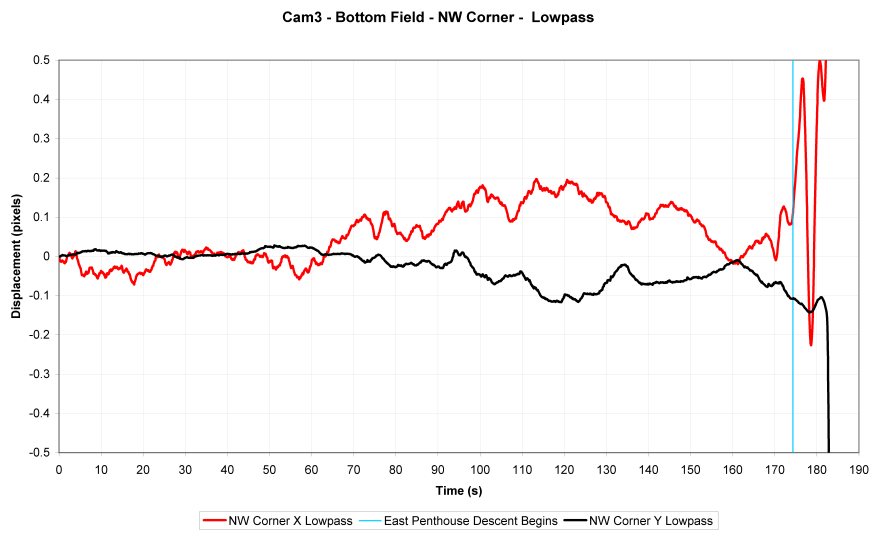
I mean the period between ~60s and ~160s in the following graph...
666377698.png


(I should add that I have also posted a draft graph of the preceeding 4.5 minutes, which also shows movement)
 
Last edited:
It seems to me that if oscillations of any sort occur in a normal office building fire of any magnitude, it would be expected that such oscuillations occurring in an alrerady-compromised structure would tend to increase the likelihood of global failure.

All buildings are designed of course to sway in the wind but if they sway for any reason while suffering the effects of fire compromising their integrity then I agree, that would not bode well for the structure.
 
So you are speaking about an 'oscillation' with a half period of about 100 seconds then?
A frequency of approx. 0.005 Hz?

I would hardly characterize that as 'oscillation' though technically I suppose it is since it starts at one value proceeds to another and back again.

Pretty heavy damping there.

Why not a non-recovering displacement? That may well occur at the level of the displacement but we are not talking about a point at that level , we are talking about a point 30+ storeys above it.
Take a rope and tie it to a tree. Stretch it out and now quickly move(displace) the end you are holding and leave it at that position. The wave travels to the tree, reflects and comes back to your hand but you would have to be holding on very weakly to have that wave move your hand, and thus the position of the rope at that end.
The structure is of course not constrained at the top. It is however constrained at the bottom and more to the point, at the 8th floor(IIRC).

So if we are talking about a displacement of a portion of floor 13 (where NIST puts the initial failure do they not? I was perusing the technical brief and such was what was shown in my quick look) about 100 seconds prior to the east penthouse sinking.

So its Even less curious then if one accepts the possibility that col79's buckling was arrested for a short time. At 100 sec before the penthouse begins moving there is a floor failure over several floors, col 79 begins to slowly buckle and it is arrested. This shift in mass occurs over 50 sec causing the NW corner to heave and sway. This motion is reflected back due to the elasticty of the upper structure, 50 sec later that motion is passing through floor 13 again and the precarious support for the already bent col 79 fails, col 79 drops, penthouse drops.......
 
Last edited:
Nonsense. I suggest you descend from your soap-box.
hyperbole on my part.


Something specific explains the building motion, that's for sure. Speculating about what that may be is a good thing. Comparing the factual behaviour with the overtly accepted NIST report is also a good thing, and it is of course useful to understand it's limitations, omissions and errors.
Big point is that we simply have too many complete unknowns. Speculating one can come up with somewhat viable senarios but there is really absolutly no way to determine if one was what actually happened.

But speculating is a good mental exercise.

So the simulation should not, in your opinion, be able to predict that floor failure ? What happened to the sagging floor you suggested earlier ?

Operating on a new understanding of what you were referring to by 'oscillation'

Yes, in fact Nist did predict the floor failure as a result of the grider (I forget the number, 44 rings a bell, but you certainly know hat I am refering to)

Again, I advise caution in phrasiology. The ability you mention is indeed very precarious, it being, as you put it, just speculation.

Yep but I have seen similar happen when felling trees. A large tree is cut down only to have it hang up on a much smaller tree. No one wants to go near it because its support is so precarious, and the smaller tree should not have been able to arrest the fall of the multi-ton trunk that hit it.
$41T happens


Think you are getting well ahead of yourself there. You've provided speculative behaviour, but are now stating how that minor fluctuation is illustrative. It's not, it's still speculation. Failure of floor 13 could have zero effect.


It is well known that minor changes can have much greater effect than one would off-handly anticipate. In this case all that is required is that the buckling of col 79 take place more slowly than the FEA shows. One possibility is that the col was not as hot as NIST had it, or conversly, hotter, or differentially heated. One could in theory eliminate or zero in on senarios that more closely match the minute details of the observed collapse by re-running the FEA and changing a few parameters and combinations of parameters but the exercise would cost millions and to what end benefit?
 
JD,

Does he mean an (single) oscillation with a frequency of 1/(several times 60 seconds), or a period of time lasting several minutes during which the structure swayed with a frequency much closer to 1 Hz? (that later is what I had read into his recent post)

Who the hell knows what he means.

He's the master of saying ... nothing.

I mean the period between ~60s and ~160s in the following graph...
http://femr2.ucoz.com/_ph/7/666377698.png

(I should add that I have also posted a draft graph of the preceeding 4.5 minutes, which also shows movement)

See what I mean.

He could have answered your question.

1 hz or .005 hz.

But nooooo.....


tom
 
Who the hell knows what he means.

He's the master of saying ... nothing.

Your problem is that you are either too lazy to actually follow a thread of discussion, are not capable of doing so without your own little private world-view scrambling the words up in there somewhere, or just like being a grumpy old (insert appropriate term).

Here y'are...

DGM said:
So the building started shifting almost two minutes before global collapse?
femr2 said:
At least.
DGM said:
I would think that would be expected.
femr2 said:
Expected ? What would you suggest as being the cause of the several minute period of oscillation ?

DGM was responding to the posting of the graph data I reposted above. Really not difficult to follow you know :rolleyes:
 
So you are speaking about an 'oscillation' with a half period of about 100 seconds then?
A frequency of approx. 0.005 Hz?
Of course. See repost of the simple dialogue leading up to where you jumped in. Always useful to read threads in full. Context is kinda useful.

technically I suppose it is since it starts at one value proceeds to another and back again.
Yes.

we are not talking about a point at that level , we are talking about a point 30+ storeys above it.
Correct, though similar behaviour is evident throughout the visible height, specifically down to the lowest visible portion of the NW edge.

col79's buckling
I'll get around to that fairly soon, via tracing of the externally visible bottom-up progression of facade distortions.
 
Of course. See repost of the simple dialogue leading up to where you jumped in. Always useful to read threads in full. Context is kinda useful.

Yeah, 20 pages. If I have trouble sleeping some night I may actually do that to ease the insomnia problem.

I have many avenues for this though. I am part of our Health and Safety committe at work and could solve insomnia by reading Labour Dept regulations concerning H&S committes. I also work in a federally regulated industry and could solve insomnia by reading through CRTC briefs(some of which are far from 'brief") and regulations.

This thread has even less relevence to my life or for that matter to anything. You have found nothing of much significance at all and reading through the entire discourse would be about as informative as reading the dictionary or the phone book.

So, if you are going to make statements about a detail, 'oscillation' for eg., try to be a little more specific. Your later description of 'between 60 and 160 seconds' in the graph still did not do that. Only once I characterized it as the 0.005 Hz long fluctuation and you then said "Of Course" was the point truly made. So your orginal reference could have been to the "0.005 Hz oscillation between 60 and 160 seconds shown in the graph." I am not a great typist and yet it pains me not to type a few extra words to attempt clarity.


Correct, though similar behaviour is evident throughout the visible height, specifically down to the lowest visible portion of the NW edge.


I'll get around to that fairly soon, via tracing of the externally visible bottom-up progression of facade distortions.

Great, how about that, my above senario might have some backing. Would there be a point to this examination of minute detail? If so then please, its been asked before and I do not recall your reply, explain what significant information might be garnered?
Should NIST go back and re-run the FEA a couple hundred more times adjusting parameters and combinations of parameters to see if they can get more detailed agreement with observed collapse? Hell, I'm not an American taxpayer so its not my money.

Even a better idea, and I know you are not claiming other causes in this thread but obviously this topic has an undercurent,,,, have S.Jones, Fetzer, Gage and the 1300 A&E as well as the 'scholars', lawyers and pilots for 911 truth pool their funds and run a series of FEAs using their favorite senarios, thermite, explosives, and see if they can make the building behave exactly as it did. That runs to say , over 2000 professionals in positions that pay qute well. How much would they have to pony up to carry out such a detailed examination?
 
Last edited:
This thread has even less relevence to my life or for that matter to anything.
Yet you seem compelled to spend precious life time whining on it. Good plan ;)

Your later description of 'between 60 and 160 seconds' in the graph still did not do that.
Oh yawn. Providing the graph and the timespan in question is by far the most appropriate means of clarifying the scope of the pre-existing discussion you jumped into.

what significant information might be garnered?
Let me look into my crystal ball eh :rolleyes:

Should NIST go back and re-run the FEA a couple hundred more times adjusting parameters and combinations of parameters to see if they can get more detailed agreement with observed collapse?
Obviously, given the number of lives lost at the time and since, money is the very least of considerations, so if you think there's a problem they should rectify or issues to address, sure, why not. You're free to ask them if y'like.
 
How much time have you spent scrutinizing every pixel that you have?
Ooh, fair bit.

What exactly have you done with this?
Well, read this thread, several others here utilising the trace data, and quite a few over at the911forum. If you actually mean video analysis as a whole, rather than simply video feature tracing, then add a whole raft of additional threads.

When I've finished the tracing process for WTC 7, I'll probably made a few additional conclusions on WTC 7 itself, then move over to WTC 1. I'm in no rush.
 
Ooh, fair bit.


Well, read this thread, several others here utilising the trace data, and quite a few over at the911forum. If you actually mean video analysis as a whole, rather than simply video feature tracing, then add a whole raft of additional threads.

When I've finished the tracing process for WTC 7, I'll probably made a few additional conclusions on WTC 7 itself, then move over to WTC 1. I'm in no rush.
And these "conclusions" are being noticed by whom? Do you ever plan to contact the agency that you so adamantly claim is wrong?
 
Yet you seem compelled to spend precious life time whining on it. Good plan ;)


Oh yawn. Providing the graph and the timespan in question is by far the most appropriate means of clarifying the scope of the pre-existing discussion you jumped into.

I am compelled to spend time on something that I do not follow closely. I am sure there is a logical contradiction there somewhere.:rolleyes:


Let me look into my crystal ball eh :rolleyes:

Hmmm, given the number, and content, of posts by you in this thread it is quite obvious that you certainly are compelled to spend a grteat deal on time on this and yet you have no clear purpose at all to do so.
What is keeping you from buying an old horse and charging at windmills?


Obviously, given the number of lives lost at the time and since, money is the very least of considerations, so if you think there's a problem they should rectify or issues to address, sure, why not. You're free to ask them if y'like.

Ok, looky there you have a reason for spending time on this,,,, except it still begs the question about what significant information could possibly be garnered by spending all this time and money?
I do no believe there is a significant 'problem' so I am content to not have millions more spent on insignificant details. You on the other hand seem quite of the opposite view so I asked YOU if YOU think NIST should (ie. is there a particularily compelling arguement to be made for, and if so what is it) re-run the FEA hundreds of times adjusting combinations of parameters to come up with a collapse sequence that aligns in more detail with what was observed.

You did not answer the question, did you?
 
Ooh, fair bit.
Quantity of posts, words and graphs does not constitute quality of arguement or even establish that there is a point to all of it.


Well, read this thread, several others here utilising the trace data, and quite a few over at the911forum. If you actually mean video analysis as a whole, rather than simply video feature tracing, then add a whole raft of additional threads.

When I've finished the tracing process for WTC 7, I'll probably made a few additional conclusions on WTC 7 itself, then move over to WTC 1. I'm in no rush.

Hey looky there, an allusion to a possible reason for doing all of this. Is there any hint that it will be particularily significant? One could also investigate the detailed surface undulations of one's umbilicus and declare that the commonly accepted description of 'inny' is not precise. However its hardly a significant finding.
 

Back
Top Bottom