jaydeehess
Penultimate Amazing

I suggest you take more care when speculating, to refrain from using stuff like *This occurs*. *If* and *may* are handy in that context, as you do later in your post.Originally Posted by jaydeehess
The effect of fire weakening of columns, beams and girders on the fire floors.
Keep in mind YOU are asking for speculation.
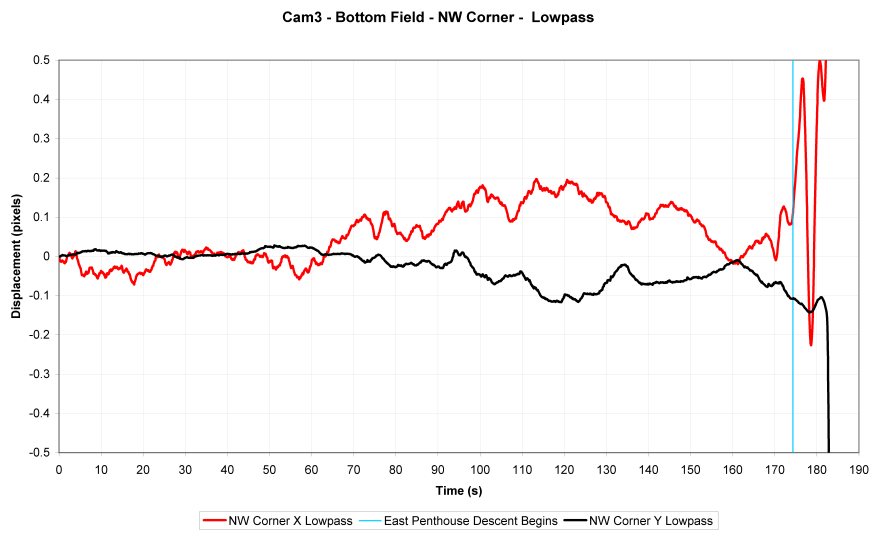
A large floor area sags and pulls on columns causing the structure to shift slightly. This occurs 25% up the height of the building and you have that floor moving first. This sets up a standing wave in the structure. You measure movement of a top corner and yes it is osscillating.
My bad then, I thought that the preceeding "If" was understood. A problem of text based conversation. 25% of course being the approximate location of the initial failure in the actual WTC 7. But if you prefer then it would be more like 23.40425531914%)
So you think yet more floor sagging (of an entirely different floor structure to that in WTC1/2) *is* the base cause ?
You did notice that I made note of the fact that YOU asked for speculation, right?
Again sagging floors. Is that speculation, or are you referring to NIST based suggestion of WTC 7 sagging floor structures ?Quote:
Too bad there are no other high rise structures that did not collapse while on fire to compare their motions to those of WTC 7. Ones in which a significant portion of the floor at one level sagged and perhaps collapsed.
I am stating the obvious, that in order for any significance to be placed on these oscillations one needs to examine a larger sample of large structures reacting to major office fires.
Indeed.Quote:
Such motions would of course be greatly affected by construction type
I had assumed you would agree to that.
Definitively ? No. Possibly, perhaps.Quote:
but if in any type one finds periods of osscillation then one can definitively place cause on the effects of heat on the steel.
I'll meet you halfway and say 'probably'. If one tends to find similar oscillations in office structures reacting to large fires then one can presume that since the most significant common parameter in all of them is the fire, that it is the fire which is responsible for the oscillations.
Who is that comment directed at ?Quote:
To not have these comparisons and then jump to the insinuation that another, unseen, condition (explosives or incindiary devices perhaps) caused the osscillation is simply illogical.
Anyone trying to insinuate or conclude that something other than the fire is the cause. I believe that you know a few people to whom this might apply.
If that was so, it would make the NIST simulation grossly inaccurate, yes ?Quote:
There is also the senario that NIST posits in that a collapse at the 11th floor caused further collapses AFTER col 79 failed. However when the girder came off its column seats what occured next and how long did it take? NIST shows a rapid progression to col 79 failure but it could have instead lead first to further floor failures along the 10th and 11th floors first. This causes a few minutes of relatively larger osscillations and then col 79 fails.
Grossly?, No, in detail yes.
Far from it. Much useful information has resulted.Quote:
Several hundred posts and a year gone by and very little to show for it other than to confirm NIST's calculations it seems.
Please try to specifically explain what significant information has been garnered by this exercise.
You just suggested an entirely different one...Quote:
No new knowledge, nothing to hang a new mechanisim of collapse on, at least nothing particularily significant.
You asked for speculation on one minute aspect that is found in the data.
I have suggested what really must be done before any minutely significant knowledge would be forthcoming. Examine a large sample number of office structures on fire.
(you understand why I keep saying 'office' structures, right?)
Why ? ?Now I certainly learned a few details I did not know before but that's besides the point.
Why is it besides the point? Because what I learned is merely technical. I see nothing particularily new or interesting about this specific collapse having come from this exercise.
Last edited: