• Quick note - the problem with Youtube videos not embedding on the forum appears to have been fixed, thanks to ZiprHead. If you do still see problems let me know.

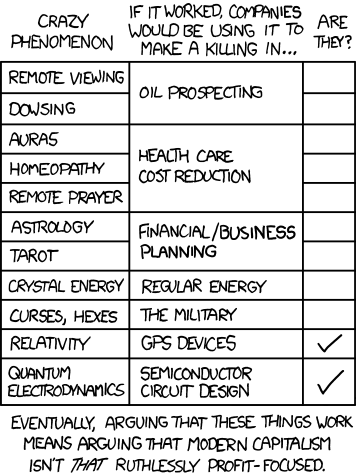
Merged xkcd nails the paranormal

But the people doing genuine research don't go promise that a $5 pill will cure your illness and replace that lifetime treatment for, say, diabetes, before actually testing it.

What you're trying to present there as equivalent, and more than once is (A) some guy selling a miracle solution as working _now_, and (B) someone doing research. I don't see how that's equivalent at all.

I'm not saying they're equivalent.

You've misunderstood my analogy.

My point is that argument from business practice is a fallacy.
 
I guess it's worthwhile to point out the actual wording on the comic. That has been said, but some have not paid attention to that.

Let's pick one example: Homeopathy.

The wording of the comic reads: "If it [homeopathy] worked, companies would make a killing in health care cost reduction. Are they? [No]."

The whole point here is not that people and companies do not sell homeopathy and make money with it (they do), but that they do not reduce health care cost in doing so. If homeopathy actually worked, the health care 'industry' would not have to pay for the R&D of drugs, which would drive the cost down, but the opposite happens. Health care insurers pay for homeopathy, which actually drives health care costs UP.
 
Last edited:
I guess it's worthwhile to point out the actual wording on the comic. That has been said, but some have not paid attention to that.

Let's pick one example: Homeopathy.

The wording of the comic reads: "If it [homeopathy] worked, companies would make a killing in health care cost reduction. Are they? [No]."

The whole point here is not that people and companies do not sell homeopathy and make money with it (they do), but that they do not reduce health care cost in doing so. If homeopathy actually worked, the health care 'industry' would not have to pay for the R&D of drugs, which would drive the cost down, but the opposite happens. Health care insurers pay for homeopathy, which actually drives health care costs UP.

I know what he said. I think the argument has a questionable hidden premise, that's all:

P: If [paranormal] worked, companies would make a killing using it.

It is possible that [paranormal] could work, but companies would not be making a killing using it.

Lots of amazing tech works, but the business world is competitive, and the application of tech may just keep a company's head above water, rather than generate windfall profits.
 
I know what he said. I think the argument has a questionable hidden premise, that's all:

P: If [paranormal] worked, companies would make a killing using it.

It is possible that [paranormal] could work, but companies would not be making a killing using it.

Lots of amazing tech works, but the business world is competitive, and the application of tech may just keep a company's head above water, rather than generate windfall profits.

Then I think you have a different definition of "works" than most paranormal purveyors.
 

When he said

"To use your silly joke, if I see a $100 note on the sidewalk _now_, ok, I can believe it just fell. But if someone were to tell me that a $100 note has been under a bench in the park for 30 years, then exactly that economist's objection would apply. Someone _would_ have taken it."
 
Then I think you have a different definition of "works" than most paranormal purveyors.

It's hard to generalize, is what I said. Asserting that paranormalists are aligned in their claims could very well be a strawperson.

When I deal directly with people in businesses who are using paranormal services - and this is mostly oil exploration plays in Alberta, but also includes investors who consult astrologers - they are quite convinced that this gives them a competitive edge.

This doesn't suddenly prove that psi works.
I would advise using a different proxy to evaluate claims than profitability.
 
When he said

"To use your silly joke, if I see a $100 note on the sidewalk _now_, ok, I can believe it just fell. But if someone were to tell me that a $100 note has been under a bench in the park for 30 years, then exactly that economist's objection would apply. Someone _would_ have taken it."

Maybe. Who knows. I'm not big on beating an illustration to death. It seems like intentionally avoiding the point.

I wasn't sure why this is referred to as a 'silly joke' - it's simply used to illustrate a fallacy in its simplist form. I have others for different fallacies. I find humour is a good vehicle for explaining reasoning errors.

It's usually used to refute the efficient market assumption. First year economics, basically. Missed opportunities are not convincing evidence that the opportunity did not exist.
 
Last edited:
More on topic, I agree with Blutoski. While we like to think that the xkcd cartoon represents reality, it really doesn't. In the UK, the NHS provides homeopathic care. The military (both US and UK I think) have used dowsing to search for landmines. ...

Who can forget the Dowsing Rod Bomb Detector and all the lives it cost (and still costs) ?

It's one way of 'making a killing'...
 
Last edited:
It's hard to generalize, is what I said. Asserting that paranormalists are aligned in their claims could very well be a strawperson.

When I deal directly with people in businesses who are using paranormal services - and this is mostly oil exploration plays in Alberta, but also includes investors who consult astrologers - they are quite convinced that this gives them a competitive edge.

This doesn't suddenly prove that psi works.
Nor does it contradict the cartoon. They may think that the paranormal services give them an edge, but they don't. They are not making a killing by using those services. If the paranormal services worked as advertised then the advantage should be quite clear.
I would advise using a different proxy to evaluate claims than profitability.
Well, yes, it's possible to be profitable despite wasting money on paranormal services, but one will be less rather than more profitable as a result, in general.
 
Cartoon == joke

It's just playing with preconceptions and prejudices to make you laugh, and to trigger discussion. Which it has achieved.

Whoah, whoah: are you suggesting we stop critiqing Chick Tracts now?

Or those medium shows that are intended for entertainment?
 
Last edited:
Nor does it contradict the cartoon. They may think that the paranormal services give them an edge, but they don't. They are not making a killing by using those services. If the paranormal services worked as advertised then the advantage should be quite clear.

Hey! It sounds like you're making a claim? Do you have their company books to show this?

You might word it better by saying you suspect they're wrong about their accounting. So am I, of course. But the point is that there are plenty of businesses that say they're doing it. This is the bane of skepticism: nobody learns.

Other examples (not business) would be:

  • if [paranormal] worked, people would say they're getting rich off it (like celebrities... oh, wait, they do)
  • if [paranormal] worked, people in important positions would say they're using it to assist with important decisions (like presidents - oh, wait, they do)


Well, yes, it's possible to be profitable despite wasting money on paranormal services, but one will be less rather than more profitable as a result, in general.

No, this is the fallacy I'm trying to highlight. In an competitive market, profits do not indicate whether a deployed technology works. For example: if two competitors are using psi succesfully, they could engage in a price war and suffer continuous losses. Or: the price of psi could be so high that it cuts into or negates the windfall profits they produce.

ie: it's a false premise, and thus a poor argument. That's all.
 
Except for the little fact that, you know, it wasn't an argument from business practices, it was an argument from whether it works as advertised or not.

Frankly, you're asking me to believe what? That something could be working, but we only don't see the results because business practices don't include doing that? Or what? Because that idea seems to me like essentially a CT.

You keep returning to some vague "you can't judge by business practices", but short of a CT, those business practices are not something everyone does the same way. There is no one thing that every MBA does, except maybe breathe and eat. For each of those domains, you have people who do and people who don't. You have people who hire their peons by tarot, and people who don't. You have people who pay dowsers to find oil, and people who stick to sonar and drilling. You have people who pay Feng Shui consultants to optimize chi flow in the cubicle farm (or even, I'm not kidding, in their HTML layout), and people who don't. Etc.

Where is that difference between those who do and those who don't? Simple question, no?
 
Except for the little fact that, you know, it wasn't an argument from business practices, it was an argument from whether it works as advertised or not.

Whose advertisements? (That's the strawperson I'm trying to tease out)


Frankly, you're asking me to believe what? That something could be working, but we only don't see the results because business practices don't include doing that? Or what? Because that idea seems to me like essentially a CT.

I don't understand this question. I'm not asking you to believe anything.

I'm using critical thinking to examine the argument in the cartoon in the original post.
I believe one of the premises is incorrect, for reasons I have listed in previous posts.


You keep returning to some vague "you can't judge by business practices", but short of a CT, those business practices are not something everyone does the same way. There is no one thing that every MBA does, except maybe breathe and eat. For each of those domains, you have people who do and people who don't. You have people who hire their peons by tarot, and people who don't. You have people who pay dowsers to find oil, and people who stick to sonar and drilling. You have people who pay Feng Shui consultants to optimize chi flow in the cubicle farm (or even, I'm not kidding, in their HTML layout), and people who don't. Etc.

Business practices vary. I agree, but don't understand what you're getting at.


Where is that difference between those who do and those who don't? Simple question, no?

I'm not understanding this question.
 
XKCD nails it. Again.

http://xkcd.com/808/

the_economic_argument.png


Note to mods: Site permits embedding.
 

Back
Top Bottom