CME's, active regions and high energy flares

FYI, it looks like that dark filament around the 4:00 position also erupted (is erupting), however it looks to be pretty directional and looks to be more of a flare that is dumping it's mass into an active discharge channel rather than a larger scale CME event. It's a big filament however.
 
FYI, that filament eruption around the 4:00 position looks to be a large scale Birkeland current type of flare that produces twisted helix like filaments that discharge toward the heliosphere. The mass flow from that eruption should be interesting to watch in LASCO and it should also show up in the 1-4 hour window.
 
EM flare prediction is *MUCH* more complicated to be honest, but I'd say I'm getting pretty good at it now. Any real "scientist" would have to sit up and take notice that I PREDICTED (real prediction) that large flare within an hour window, and with plenty of time for astronauts on the ISS to seek shelter *BEFORE* the flare even occurred. If that's not enough to make you sit up and take notice, what is?


You did contact those folks over at NASA about this, didn't you? And the real scientists working on the SDO project, you aren't leaving them out of the loop, are you? After all, you said yourself, any real scientist would have to sit up and take notice. Or does the word "scientist", in quote marks, mean something other than the commonly accepted use of the term? Or do you think maybe real scientists don't take much interest in science by looking at pictures and guessing?

And let's not get too far ahead of ourselves. You made two explicit claims, one being that dark filaments cause CMEs, and the other being that you have a scientific, quantitative, objective method for "predicting" CMEs. You've admitted that the first claim was wrong. About that second, your claim to have a method for "predicting" CMEs. Can we take your silence on that issue to mean that you're abandoning that claim, too?
 
FYI, that filament eruption around the 4:00 position looks to be a large scale Birkeland current type of flare that produces twisted helix like filaments that discharge toward the heliosphere. The mass flow from that eruption should be interesting to watch in LASCO and it should also show up in the 1-4 hour window.


Apparently you've abandoned your claim to have a method other than guessing to "predict" CMEs. It was pretty much inevitable.
 
FYI, that filament eruption around the 4:00 position looks to be a large scale Birkeland current type of flare that produces twisted helix like filaments that discharge toward the heliosphere. The mass flow from that eruption should be interesting to watch in LASCO and it should also show up in the 1-4 hour window.


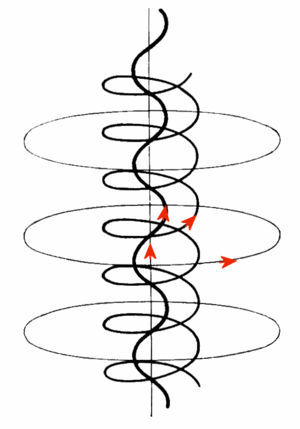
Apparently you're making a claim that there is something called, or something that can be realistically described as a "Birkeland current type of flare". Are you prepared to demonstrate that claim is true, or are you willing to admit you've made up that term and that there is no such thing?
 
Apparently you're making a claim that there is something called, or something that can be realistically described as a "Birkeland current type of flare". Are you prepared to demonstrate that claim is true, or are you willing to admit you've made up that term and that there is no such thing?

I'm afraid you're pretty much in hard core denial.
http://en.wikipedia.org/wiki/Birkeland_current

300px-Magnetic_rope.png


Did you think I personally wrote the page or something?

When I have some time I'll have to round up an example of such a thing, but I've seen them in the past. The filament is winding around like a tornado vortex as it leaves the surface. The "current flow" through the filament keeps the filament tightly wound enough as it moves toward the heliosphere that the actual helix shape remains. There are some pretty spectacular LASCO images of such events. I'm not sure this one will fall into that category, but it has all the earmarks of such an event.
 
FYI, the filament eruptions are not necessarily directly related to active regions, and that is especially true of the last filament that erupted. It's certainly possible that the shock wave from the filament eruption could have some effect on that active region due to proximity, but other than that, 11113 looks pretty stable to me. In other words, you can have your active region. I personally doubt that particular active region is going to produce anything of any significance. You *MIGHT* get a B flare out of it, but that specific active regions look pretty stable to me. I'd be surprised if it actually produced even one C class flare or better over the next 48 hours.
FYI I know.
 
Apparently you've abandoned your claim to have a method other than guessing to "predict" CMEs. It was pretty much inevitable.

You aren't even making any sense. I'm sitting here actively (day after day) making 'predictions" that you can see for yourself in LASCO and COR. I'm not hiding anything. I've clearly stated that anyone that is willing to carefully observe what's going on can do this for themselves. There's no "guessing" involved, there are direct (physical) cause effect processes in play. You can't call it "guessing" and also blame me for "seeing" that it's raining. You'll have to pick one argument or the other, but it can't be both!

I've already explained the cause/effect connection between the mass inside the erupting filament and the mass flows observed in LASCO. There's not "guess" involved, there are statical correlations of up to 95 percent with little or no other "categorizing" required other than simply to note which filaments erupt and which "fizzle out". With very little refinement its possible to hit 100 percent in terms of determining which mass flows will be "big enough" to actually be seen in LASCO.

SDO offers me the opportunity to "refine" that categorization process so that I'm comfortable discussing the events real time. You can hide your head in the sand all you like, but the results will speak for themselves as it relates to dark filament eruptions. I'm getting comfortable with them. The "tough' predictions are the EM flare events. Those are much more difficult IMO. If and when I you're ready to duplicate that successful prediction of a large flare to within a half hour of the main event, you let me know. :)
 
FYI I know.

To be honest, I'm curious how that particular prediction is going to turn out. I realized when you made that prediction that it was a "clever" prediction if one believes that shock wave will destabilize the active region. I'm thinking that's probably not likely, or if so, it's likely to produce only B type flares. It's still a "clever" prediction to some degree, and you might be right. We'll have to wait and see. I personally have my eye on an active region coming over the horizon in terms of predicting EM flares. No active region on this side looks unstable to me.
 
So I'm not "guessing" eh?
Yes you were - until I found the science that you did not know about, i.e.
On the Relation between Filament Eruptions, Flares, and Coronal Mass Ejections


From then on you have just been almost following the known statistical correlation , i.e.
  • 55% of filament eruptions result in a CME that is detected by LASCO within 2 hours.
    You have decided that you are less able to determine the erruption tim or the the time at LASCO and so have lately been using 1 - 4 hours.
  • 95% of filament eruptions result in a flare.
You are not adding anythig to the actual science.
 
Michael Mozina, Please give your citations to solar Birkeland currents

I'm afraid you're pretty much in hard core denial.
I'm afraid you're pretty much in hard core strawman mode, Michael Mozina.
I am sure that GeeMack knows that Birkeland currents exist.
You were smart enough to read the Birkeland current article. You should be smart enough to understand that it states that Birkeland currents happen in planetary magnetospheres. There is a suggestion that they happen on cosmic scales.


Michael Mozina
First asked 22 Oct 2010
Magnetic fileds twist. Plasma following magnetic files twist. This is are not a Birkeland current.
Saying that twisty filaments on the Sun are Birkeland currents because you think that they look like a cartton in a Wikipedia article is not smart.
There is no evidence that there are Birkeland currents on the Sun. If there were then you would be able to give citations to the literature on them and so:
Please give your citations to solar Birkeland currents
 
Yes you were - until I found the science that you did not know about, i.e.
On the Relation between Filament Eruptions, Flares, and Coronal Mass Ejections

No RC, it was never a matter of guessing. You'd have to be a complete idiot to come to this forum and "guess" at when we might observe solar flares and CME's. The only reason I'm willing to do this real time is because I've studied the sun for over 15 years in satellite imagery. I'm comfortable with the processes in play.

http://stereo-ssc.nascom.nasa.gov/browse/2010/10/22/behind_20101022_cor2_512.mpg
http://stereo-ssc.nascom.nasa.gov/browse/2010/10/22/ahead_20101022_cor2_512.mpg

That's one successful prediction under my belt today and one more directional flare to go. :)

From then on you have just been almost following the known statistical correlation , i.e.
  • 55% of filament eruptions result in a CME that is detected by LASCO within 2 hours.
    You have decided that you are less able to determine the erruption tim or the the time at LASCO and so have lately been using 1 - 4 hours.
  • 95% of filament eruptions result in a flare.
You are not adding anythig to the actual science.

First you complained because I actually "predicted' the filament eruption before it actually occurred, but the timing of that eruption was hard to pin down. Now you seem to be complaining because it was already known that after an eruption it typically takes about 2 hours to be seen in LASCO. I can't win. :)

The bottom line is that there is a way to "predict" the eruption of the filament before it actually occurs based on a number of factors. It's also possible to "predict" EM flare events *BEFORE* they occur as I have also demonstrated.

My original purpose in starting this thread was simply to educate anyone that wanted to "learn" about flares and CME's. I also wanted to put my own methods to the test so to speak. I wasn't concerned then, and I'm not concerned now about what you personally believe I'm "adding to science". My purpose was simply to discuss this specific topic and "explain' the physical processes that are involved in flares and CME's.
 
Last edited:
I'm afraid you're pretty much in hard core denial.
http://en.wikipedia.org/wiki/Birkeland_current

[qimg]http://upload.wikimedia.org/wikipedia/commons/thumb/7/79/Magnetic_rope.png/300px-Magnetic_rope.png[/qimg]

Did you think I personally wrote the page or something?


No. Your qualifications to understand solar physics have been challenged. Please demonstrate by citing legitimate scientific reference that a "Birkeland current type of flare" is actually an accepted phenomenon of solar physics.
 
No. Your qualifications to understand solar physics have been challenged.

And while you've been throwing stones from the peanut gallery, I've been *PUBLICLY* predicting solar flares and CME's and *EXPLAINING* how it works. I've nailed a big EM flare to within a half hour of the main event, and five minutes before even the first B class flare from that active region. That's the first big x ray flare in something like 3 months. My qualifications in solar predictions will speak for themselves in this thread. I "challenge" you to duplicate that EM flare prediction GM. Will your rise to the challenge?
 
To be honest, I'm curious how that particular prediction is going to turn out. I realized when you made that prediction that it was a "clever" prediction if one believes that shock wave will destabilize the active region. I'm thinking that's probably not likely, or if so, it's likely to produce only B type flares. It's still a "clever" prediction to some degree, and you might be right. We'll have to wait and see. I personally have my eye on an active region coming over the horizon in terms of predicting EM flares. No active region on this side looks unstable to me.
I do not believe that shock waves can destabilize any active region. I'm thinking that's has nothing to do with the production of B class flares or other classes of flares.
I personally have my eye on any active region coming over the horizon in terms of predicting activity in an active region. No active region on this side looks stable to me - they all have activity in them and are constantly changing (are unstable).

N.B. Like your post it is a statement of personal belief. In my case this is based on a small knowledge of solar physics and a lot of general physics knowledge.
 
http://www.thesurfaceofthesun.com/solar_flare.htm

FYI, here's a link to an example of a large scale Birkeland current type of flare. The helix filament retains it's shape during the discharge because the filament is conducting current toward the heliosphere.

Again, I'm not sure if that last flare was such an event, but it does have a number of similarities in terms of the way it left the surface. We'll have to wait and see. I doubt it will be of the kind of scale (intensity) as the flare shown on my website, but it may have some of the same twisted helix features.
 
Last edited:
You aren't even making any sense. I'm sitting here actively (day after day) making 'predictions" that you can see for yourself in LASCO and COR. I'm not hiding anything. I've clearly stated that anyone that is willing to carefully observe what's going on can do this for themselves. There's no "guessing" involved, there are direct (physical) cause effect processes in play. You can't call it "guessing" and also blame me for "seeing" that it's raining. You'll have to pick one argument or the other, but it can't be both!


I do call it guessing because despite being asked many times to do so, you have never demonstrated that you are using a method other than guessing to make your "predictions". You see activity and guess it will continue. See? Both. You are wrong again.

I've already explained the cause/effect connection between the mass inside the erupting filament and the mass flows observed in LASCO. There's not "guess" involved, there are statical correlations of up to 95 percent with little or no other "categorizing" required other than simply to note which filaments erupt and which "fizzle out". With very little refinement its possible to hit 100 percent in terms of determining which mass flows will be "big enough" to actually be seen in LASCO.


You can observe mass flows and guess, with 100% accuracy, that they are mass flows. Big deal. What do the scientists at NASA have to say about your "predictions"?

SDO offers me the opportunity to "refine" that categorization process so that I'm comfortable discussing the events real time. You can hide your head in the sand all you like, but the results will speak for themselves as it relates to dark filament eruptions. I'm getting comfortable with them. The "tough' predictions are the EM flare events. Those are much more difficult IMO. If and when I you're ready to duplicate that successful prediction of a large flare to within a half hour of the main event, you let me know.)


You're looking at pictures of solar activity which already exists and guessing that the activity will continue. You have been asked to demonstrate scientifically that there is a better explanation for your "predictions" than guessing. You've refused to provide one.
 
And while you've been throwing stones from the peanut gallery, I've been *PUBLICLY* predicting solar flares and CME's and *EXPLAINING* how it works. I've nailed a big EM flare to within a half hour of the main event, and five minutes before even the first B class flare from that active region. That's the first big x ray flare in something like 3 months. My qualifications in solar predictions will speak for themselves in this thread. I "challenge" you to duplicate that EM flare prediction GM. Will your rise to the challenge?


The burden of proof for your claim is yours. This is grade school science. Is there something about that concept which you find difficult to understand?
 

Back
Top Bottom