Never any rush as far as I'm concerned.
This one then...
[qimg]http://femr2.ucoz.com/_ph/7/2/626148965.gif[/qimg] rather than [qimg]http://femr2.ucoz.com/nmrc2.gif[/qimg]
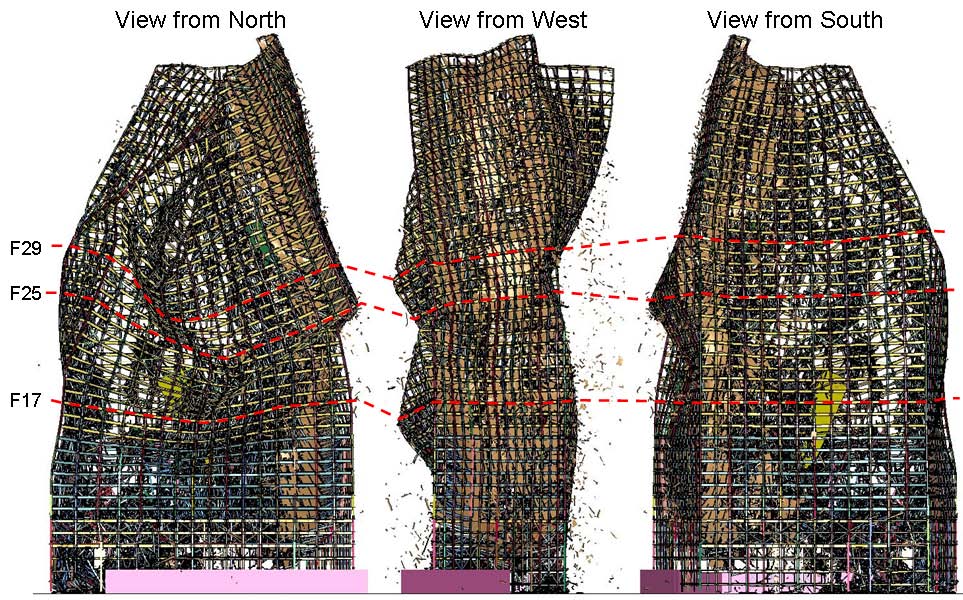
I'll note at this point, that NIST did not model the full extent of the *gash*...
[qimg]http://femr2.ucoz.com/_ph/7/158844021.jpg[/qimg][qimg]http://femr2.ucoz.com/_ph/7/265352478.png[/qimg]
Don't get me wrong, I'm fully aware of the details in the report. My point is the tendency of FEA to behave in such a manner when scale is increased. The second animation also suffers from the same thing, though to a lesser degree.
I quite agree. It's not even possible to model accurate element end-point locations resulting from knocking over a virtual shelf full of virtual books.
That sounds better

Again, my point is that the system has been used to simulate a number of actual building descents, lending some credence to it's capabilities.
The correlation between the numerous simulated descents and the actual video footage of the real event are remarkably similar. (The stadium demolition correlation was very good indeed)
The bespoke modifications to the AnSys system are AFAIK untested in any other environment, and being *of unprecedented scale* there's no other NIST/ANSYS building descent simulation to use as a control.
Kinda the other way around. I'm always hesitant to assume NIST is doing it right...if that makes sense. (Maybe that I'll do it myself thing). I've found lots of, imo, significant problems with the report (regardless of whether others think they are relevant). (And also validated/replicated some of their measurements via tracing, which folk are also not happy about, which is a bit odd)
This stems from...
...so I'm basically questioning whether saying that *the NIST FEA proves 8-storeys of buckling* is an *end of story* statement.





 It's from over 18 months ago, and the context is a bunch of folk over at YT who were repeatedly claiming *jet fuel burning at 1800F softened the *steal** LOL.


