Hence why I never specified linear kinetic energy. I just said kinetic energy. And given that my point was that the ball wouldn't be accelerating linearly at g, you're saying the exact same thing I am. Just with more words. So I really don't see the purpose.
Exactly where on wtc.nist.gov is the evidence the 2.25 seconds of WTC 7's free fall was caused by buckling? I have been searching for years. If you have no evidence you have a crackpot faith-based theory not science.
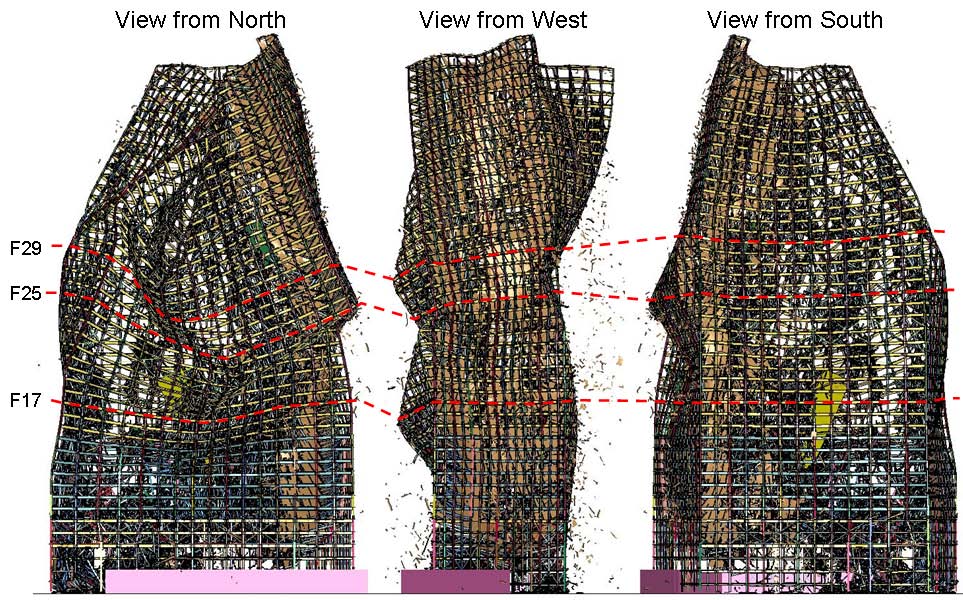
See NCSTAR 1-9 Vol. 2 p. 586 (248 of the pdf). It outlines how the columns behaved in the model. You'll notice that they state that all columns from floor 7 to 14 buckled. When this occurs, there is no vertical support from floor 7 to 14. Free-fall will ensue.
For very small scale behaviour, it's been proven reliable, however, as scale increases the validity drops off rapidly.
The NIST global model behaves like a stack of soggy linguini. (As most FEA tend to do as scale is increased)
Progressive Collapse is utterly unsuited to FEA.
Could you direct me to control studies NIST applied their bespoke system modifications to, to valide the output ?
Systems such as Extreme Loading, utilising AEM (Applied Element Method) rather than FEA would seem to be, by far, the better choice for determining global behaviour, and has been tested against numerous actual builing descents with good correlation between modelled and actual behaviour...
All the evidence includes the eutectic reactions ("intergranular melting capable of turning a solid steel girder into Swiss cheese.") and nano-thermite particles in the dust. How does that evidence support fire?
The eutectic reactions support temperatures in the region of 1000ºC over long periods of time, are clearly incompatible with brief exposure to very high temperatures, and are therefore evidence of fire in the rubble pile following collapse. The "nano-thermite particles" in the dust are quite obviouisly misidentified by poor-quality analysis carried out by biased studies with a preconceived agenda, and don't therefore support anything because they're not credible evidence.
As I said, all the evidence supports collapse due primarily to fire and gravity, and none supports any other cause; this may be assumed to mean all the evidence that exists. Your suggestion that specific items of evidence do not exist, whether true or false, is simply another intellectually dishonest attempt to obscure that fact.
Exactly. Not only do they not support explosived demolitions, they outright contradict incendiaries. How many times does it have to be pointed out to these folks that a thermite or thermate reaction would've destroyed eutectic remains?
Hence why I never specified linear kinetic energy. I just said kinetic energy. And given that my point was that the ball wouldn't be accelerating linearly at g, you're saying the exact same thing I am. Just with more words. So I really don't see the purpose.
For very small scale behaviour, it's been proven reliable, however, as scale increases the validity drops off rapidly.
The NIST global model behaves like a stack of soggy linguini. (As most FEA tend to do as scale is increased)
Progressive Collapse is utterly unsuited to FEA.
Could you direct me to control studies NIST applied their bespoke system modifications to, to valide the output ?
Systems such as Extreme Loading, utilising AEM (Applied Element Method) rather than FEA would seem to be, by far, the better choice for determining global behaviour, and has been tested against numerous actual builing descents with good correlation between modelled and actual behaviour...
I think you've been reading too much of ASI's marketing. AEM is about adding break-points to a stiffness matrix created with FEA. NIST did this. It has nothing to do with the actual stiffness matrix of the model. The idea that FEA becomes a "soggy linguini" is both a bare assertion fallacy and incorrect.
500 posts since I pointed ergo at the cirical issue.
Thanks to R Mackey and W D Clinger for their most recent contributions - respectively clarifying the basic physics and providing a summary of this discussion.
The point is that the weakening of steel is a function of the temperature it reaches rather than the rate at which heat is supplied to it, therefore your comment in post #771 was irrelevant.
We don't expect you to understand that, though. There have only been a few hundred posts since then, and some of them weren't attempts to explain it to you.
There are plenty of images of the south side inferno. For some reason, you've decided to pretend there aren't, but why should that trouble anyone honest?
I'm certainly not pretending that there aren't. Do you want me simply to believe this on faith? Because I have asked to see even one of these many images several times in this thread.
The point is that the weakening of steel is a function of the temperature it reaches rather than the rate at which heat is supplied to it, therefore your comment in post #771 was irrelevant.
The temperature it reaches. Yes. Thank you. I wonder why ozeco had such difficulties clarifying what he meant.
And how was this distinction even being argued against in the first place? We hadn't even got to the point of arguing heat output of smoky versus roaring fires.
So you really need the temperature argument for your smoky fires, huh?
Again, AEM is about node disconnection. NIST modeled the building with releases based on connection capacities. What you're seeing is those connections not failing.
And how was this distinction even being argued against in the first place? We hadn't even got to the point of arguing heat output of smoky versus roaring fires.
This site uses cookies to help personalise content, tailor your experience and to keep you logged in if you register.
By continuing to use this site, you are consenting to our use of cookies.