• Quick note - the problem with Youtube videos not embedding on the forum appears to have been fixed, thanks to ZiprHead. If you do still see problems let me know.

Merged Discussion of femr's video data analysis

Oh, give me a break femr2!

You are only interested in where the points on the building were at a various times during the collapse?
WTF does that get you? NOTHING. Are you now spinning the wheels faster in an attempt to fool anyone into thinking you are getting somewhere?

Its been 25 years or so since I was a physics undergrad but I DO KNOW for certain that if I had handed in any lab report with NO, none, nada, zip treatment of errors for the points on any graph, direct measurements or derived values, I would have received a big fat zero for a grade on it. In fact they made quite a point of having us treat our errors seriously. The calculations of errors constituted(remember this is at a time when at best all you had was a calculator) easily 80% of the written report. (in pen only , no pencils, all calculations written down, no short cuts allowed and a justification for every assumption)
 
The behaviour of the global model bears no resemblance to the actual behaviour.

Absolutely false.

And on top of it you don't know what was going on internally, so you have no grounds to make that statement.

I sometimes think you guys would be happier (not that you'd ever be happy with anything ;)) if NIST had just created a phony animation which looked exactly like the videos.

Of course then you'd accuse NIST of fudging the data. They can't win either way, you see. Y'all know better, without engineering degrees - go figure:boggled:
 
You are only interested in where the points on the building were at a various times
That's right, pretty much. Not particularly interested in velocities or acceleration of the various points at all.

WTF does that get you?
A very clear picture of motion.

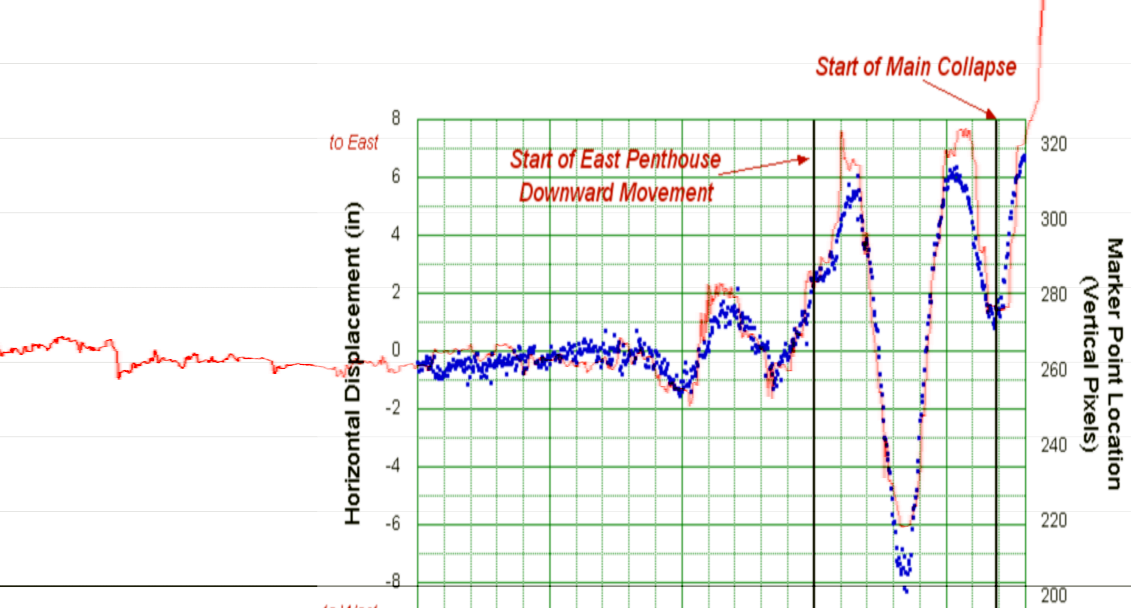
A very simple metric was posted yesterday...initial movement ~7s in advance of East penthouse descent.

Incorrect.

Are you now spinning the wheels faster in an attempt to fool anyone into thinking you are getting somewhere?
What wheels ?

Here y'are...
http://www.internationalskeptics.com/forums/showpost.php?p=6235551&postcount=45
*freefall* was determined a long time ago, and is not really my focus. I'm more interested in what *else* can be determined by looking at early building motion. The current focus on descent rate has simply evolved out of bits of discussion about the validity of the tracing methods.

That was August 17th. My viewpoint has not changed.

I DO KNOW for certain that if I had handed in any lab report with NO, none, nada, zip treatment of errors for the points on any graph, direct measurements or derived values, I would have received a big fat zero for a grade on it. In fact they made quite a point of having us treat our errors seriously.
I've repeatedly suggested +/- 0.2 pixel error for positional data.

I assume you disagree. If so, why, and what error do you suggest ?

Also, I'm not at school, not handing in any lab reports, and bearing in mind that most of the metrics I'm interested in are points in time relative to other points, it's a rather moot topic anyway.

For example...
655929457.png


In what sense do you see positional error analysis critical in stating that NW corner movement preceeds East penthouse movement by ~7s ?
 
Absolutely false.
I don't agree.

And on top of it you don't know what was going on internally, so you have no grounds to make that statement.
I'm referring to the well known global model animation, as I am sure you know. Clearly internal behaviour is unknown, and that applies to NIST too.
 
That's right, pretty much. Not particularly interested in velocities or acceleration of the various points at all.


A very clear picture of motion.

hmm, is not 'motion' defined as a change in position over time which is exactly the same definition as that for 'velocity' and in fact 'acelleration'.

A very simple metric was posted yesterday...initial movement ~7s in advance of East penthouse descent.

Congradulations. IIRC NIST put initial column failure at around 6 seconds.
Yep, you really are getting somewhere.
Incorrect.
So far all you seem to have done is prove NIST correct. Perhaps, just perhaps you have managed a greater precision and have minute details that differ from what NIST had. So, yeah its maybe not nothing but its the next best thing to nothing then.

What wheels ?
metaphor, surely not lost on you.
Here y'are...
http://www.internationalskeptics.com/forums/showpost.php?p=6235551&postcount=45


That was August 17th. My viewpoint has not changed.
See above paragraph

I've repeatedly suggested +/- 0.2 pixel error for positional data.

I assume you disagree. If so, why, and what error do you suggest ?

I do believe you are being unduly optimistic about your 1/5th pixel positional error and nothing you have shown to date convinces me otherwise. Frankly, I'd double that but pixel error is only one source of error. Sow's ears simply do not metamorphize into silk purses.

Also, I'm not at school, not handing in any lab reports, and bearing in mind that most of the metrics I'm interested in are points in time relative to other points, it's a rather moot topic anyway.

I simply know that, as I said, that your conclusions would be unaccepted, with the treatments you show, in my undergrad physics lab. Why should I be influenced more by what you claim is proper, over the physics Ph.D and two masters degree lab assistants I had then?
 
I'm referring to the well known global model animation, as I am sure you know. Clearly internal behaviour is unknown, and that applies to NIST too.

Which is why NIST ran the FEA. IT is a given that with the enormous number of variables that the FEA will not perfectly mimic reality but it will give an accurate approximation of what actually happened internally.

Hell, you could rebuild WTC 7 20 times and re-enact the events of Sept 11 on such full scale models and you would still get 20 different collapses. The FEA's imaging of what would be seen externally matches quite well with what was observed lending credence to the modelling of the internal collapses.
 
hmm, is not 'motion' defined as a change in position over time which is exactly the same definition as that for 'velocity' and in fact 'ac(c)elleration'.
Motion in this context is intended to imply moving or not moving. As in 'in motion' or not 'in motion, time between various points beginning to move, relative scales.

Congradulations. IIRC NIST put initial column failure at around 6 seconds.
You don't need to recall, it's clear from their graph and stated on this thread several times recently. The urban dictionary entry for 'Congradulations' is great btw.

Yep, you really are getting somewhere.
Why thank-you. The metric was provided to answer a question by DGM.

So far all you seem to have done is prove NIST correct.
And you would have a problem with that because...?

Perhaps, just perhaps you have managed a greater precision and have minute details that differ from what NIST had.
As my methods can be applied at many points, a much clearer picture of movement can be determined, errors highlighted and observations affirmed

So, yeah its maybe not nothing but its the next best thing to nothing then.
I have no problem with you having that personal opinion. I don't agree.

I do believe you are being unduly optimistic about your 1/5th pixel positional error and nothing you have shown to date convinces me otherwise. Frankly, I'd double that but pixel error is only one source of error. Sow's ears simply do not metamorphize into silk purses.
What you believe is not particularly relevant. But you can double it if you like. What difference does that make to the rather pertinent question you snipped from the end of the post ? I'll ask again...

In what sense do you see positional error analysis critical in stating that NW corner movement preceeds East penthouse movement by ~7s ?

You may also want to consider the following post of 26th Sep...
http://www.internationalskeptics.com/forums/showpost.php?p=6377195&postcount=438
As a prelude to the forthcoming new NIST Cam #3 trace data, here is a sample of the vertical position data for a static region trace...

943943983.png

Do you think it's reasonable to state positional accuracy of +/- 0.2 pixels for that trace ? ;)

I simply know that, as I said, that your conclusions would be unaccepted, with the treatments you show, in my undergrad physics lab.
Again, in what sense do you see positional error analysis critical in stating that NW corner movement preceeds East penthouse movement by ~7s ?

A more appropriate question would be error analysis in terms of time...7s +/- Xs ;)
 
jaydeehess said:
So, given that velocity and acelleration ARE the important quantities here

No. Far from it. Personally I'm not particularly interested in the derived metrics (velocity/acceleration). It is the limited focus of others that may lead you to that incorrect assumption.


LMAO.
"Far from it"??
"… not particularly interested in … velocity / acceleration… "??

That must mean that you've not been interested in, not participated in, the discussions of velocity or acceleration that used the data you generated.

Oh … wait …

As stated, the problem is the never-ending objection to suggested positional accuracy and methods for determining velocity and acceleration.

It is "never ending" because you have never made your case.

And it is YOUR case to make. Nobody else's.

You dribble out little factoids, one at a time.
You misdirect. You mislead. You evade issues.

Allow me to illustrate: do you still claim that your data represents 60 frame/sec info?

Please explain how, if the data was recorded at 30 frames/sec.

If you're okay with +/- 0.2 pixels for the positional data,

Not knowing how to establish your errors, you are reduced to "assuming the consequent".

Pretty poor technique.

and the stated variance for scaling metric,

Not knowing how to establish your errors ...

there's not too much problem suggesting velocity and acceleration accuracy,

Except that you don't know how to quantify them.

So you resort to "suggesting" instead.

Except you don't bother to suggest anything at all. Except that "there's not too much problem suggesting [them]".

Would that be English suggestion units or metric suggestion units?

Utterly unconvincing.

though I'll be using smoothing methods of course, so the likes of tfk will probably have a bee in their bonnet...

No bee. Just a finger & a hearty laugh.

There are techniques, you know, for establishing errors due to noise reduction filtering. Here's a start that you might want to look up:

Estimating Filtering Errors Using the Peano Kernel Theorem
Jerome Blair
http://www.osti.gov/bridge/servlets/purl/948003-dQP7s7/948003.pdf

Abstract: "The Peano Kernel Theorem is introduced and a frequency domain derivation is given. It is demonstrated that the application of this theorem yields simple and accurate formulas for estimating the error introduced into a signal by filtering it to reduce noise."

Of course, this only addresses the error that you've introduced by multipoint averaging. It doesn't do anything about all the other possible sources of error. You know, the ones that you've chosen to assume don't exist.

Nor does this paper help you in estimating how the position errors propagate into the velocity & acceleration calculations.

But "you're not interested in that, anyway".

My focus is more upon metrics using the positional data only, which includes things like the ability to state (with data) accurate timing for initial movement, relative inter-feature initial movements, ...that sort of thing.

Yeah sure.

… if you say so …
 
Last edited:
That must mean that you've not been interested in
Not particularly.

not participated in
Have clearly participated in tom, more to appease your endless trivial quibbling than because I weely weely wanna. lol.

It is "never ending" because you have never made your case.
Case for what...? ;)

You misdirect. You mislead. You evade issues.
Incorrect, and note #1 :)

Allow me to illustrate: do you still claim that your data represents 60 frame/sec info?
Dan Rather footage...Absolutely (~60. See correct calc below).

A nod to note #1 here. Why you'd choose to start that merry-go-round again is beyond me. If you don't understand when it's not only the simplest of details, but has been explained to you repeatedly, well, I suggest you give up.

Please explain how, if the data was recorded at 30 frames/sec.
It wasn't. It was recorded at 60*1000/1001 frames per second.

Stop wasting my time.

Not knowing how to establish your errors, you are reduced to "assuming the consequent".
Incorrect.

It doesn't do anything about all the other possible sources of error. You know, the ones that you've chosen to assume don't exist.
Have stated quite a lengthy list of error sources. Nod to Note #1 again.

It's probably time to list all the places you've cited my data, and all the places you've used your own velocity and acceleration derivatives of it with no method details, no error estimation, ...

Pot. Kettle. LOL.

Now then, perhaps you could specify in what sense you see positional error analysis critical in stating that NW corner movement preceeds East penthouse movement by ~7s ?
 
A very simple metric was posted yesterday...initial movement ~7s in advance of East penthouse descent.

How long have you been at this? 3 years? 4 years? And the only thing that you've definitively accomplished is "NIST was right about this one little factoid".

Wow...

femr said:
*freefall* was determined a long time ago, and is not really my focus.
That was August 17th. My viewpoint has not changed.

LMAO.

You don't even know how to interpret your own results.

You've posted your (over filtered) acceleration vs time graph. (Wow, you seemed "interested in acceleration" back then. How convenient that that interest has somehow waned when you're asked to produce your error bands...)

Your own data & conclusions unequivocally show (correctly) that the north wall was NEVER in "free fall".

"In free fall" means "falling at a constant 32.2 ft/sec^2". Your own data shows that it was NEVER falling at a constant 32 ft/sec^2.

But you assert that "this was determined a long time ago", and "your viewpoint hasn't changed".

Far be it from something as insignificant as hard data to change a twoofer's opinion.

I've repeatedly suggested +/- 0.2 pixel error for positional data.
I assume you disagree. If so, why, and what error do you suggest ?

Ain't nobody else's job to "suggest" anything.

It's your job to prove your accuracy, or to toss in the towel & say "I don't know how to do this".

You do know that collaboration is an option, don't you? I'd suggest that you find someone rigorous. That pretty much eliminates the, uh, "gentlemen" at the911forum.


tk
 
Again, in what sense do you see positional error analysis critical in stating that NW corner movement preceeds East penthouse movement by ~7s ?

Do you have a definitive assessment of the various video compression algorithms to which this video has been subject?

Do you know that none of those compression algorithms have employed earlier versions of "static motion elimination" thresholding, similar to h.264?

A more appropriate question would be error analysis in terms of time...7s +/- Xs ;)

In order to determine "X ±Y seconds", you first need to know "A ±B foot" positional accuracy.

You've got your cart before your horse.
 
It wasn't. It was recorded at 60*1000/1001 frames per second.

You've said this.
Now prove it.

It was recorded by a US camera, broadcast on US TV, per NTSC standards.
Standards which use 30 frames/sec.
Not 60 frames/sec.

Only one definition of "frame" to a customer ...
 
How long have you been at this? 3 years? 4 years?
Nope.

And the only thing that you've definitively accomplished is "NIST was right about this one little factoid".
Nope.

You don't even know how to interpret your own results.
Care to provide an example ?

You've posted your (over filtered) acceleration vs time graph.
Which one ?

you seemed "interested in acceleration" back then. How convenient that that interest has somehow waned when you're asked to produce your error bands...
From the man who wrote...
tfk said:
Using difference equations,

v = (h2 - h1) / (t2 - t1).

the error in t2 - t1 is insignificant compared to the height error. (a good, real approximation, in this case).

If you have two points that are taken 1 second apart, and they measure equal heights, with an error of ±1 foot, then the error in the calculated velocity is

v = 0 ft/sec
V error = ± 1 ft/sec

If you maintain the very same height error, but your sampling rate is now 60 frames per second, then then

v = 0 ft/sec
V error = (±1 foot) / .0167 sec = ± 60 ft/sec.

+/- 60 ft/sec. Priceless.

Your own data & conclusions unequivocally show (correctly) that the north wall was NEVER in "free fall".
And the reason the word was in stars. Yawn. Wait for it...

"In free fall" means "falling at a constant 32.2 ft/sec^2". Your own data shows that it was NEVER falling at a constant 32 ft/sec^2.
No **** sherlock. And you managed to state such without even a mention of error analysis. Astounding.

Far be it from something as insignificant as hard data to change a twoofer's opinion.
Hmm, Someone is showing their true colours methinks...
tfk said:
I'd like to request that everyone (including me) keep this thread to the engineering. There are plenty of other places that we can express our dissatisfaction with each of our perceptions of the other side's politics, agendas, etc.
Seems you've forgotten that you started a thread to discuss my *video data analysis*, and yet your only purpose seems to be to offload your personal frustrations. You want a tfk certified error analysis, go to it. Get workin' jack.

It's your job to prove your accuracy, or to toss in the towel & say "I don't know how to do this".
Incorrect.

You do know that collaboration is an option, don't you? I'd suggest that you find someone rigorous. That pretty much eliminates the, uh, "gentlemen" at the911forum.
What I find interesting is that you went quiet for a while, started using the data quite regularly, but are now throwing your toys out of the cot following me calling you on use of it. Pretty funny really.

tfk error analysis... +/- 60ft/s for velocity. Great job Tom.

femr2

PS I assume you'll not be using the data any more. That's fine. I assume you don't ascribe any validity to the graphs you've created from it. That's fine. I assume you'll be removing them and using data from Chandler instead. That's fine. Enjoy.

As the thread *has my name on it*, I'll be posting the new Cam#3 data here as-and-when, and I'm sure you'll be looking forward to it.
 
You've said this.
Now prove it.

It was recorded by a US camera, broadcast on US TV, per NTSC standards.
Standards which use 30 frames/sec.
Not 60 frames/sec.

Only one definition of "frame" to a customer ...

Yawn. Already have, numerous times. Re-read the thread.

If you still don't understand, given the ridiculous amount of detail already provided to you, there is no hope for you.

If you think your TV displays 30fps...lol :jaw-dropp
 
You've said this.
Now prove it.

It was recorded by a US camera, broadcast on US TV, per NTSC standards.
Standards which use 30 frames/sec.
Not 60 frames/sec.

Only one definition of "frame" to a customer ...

IIRC, femr2 says this because he believes he can utilize each feild as a full frame and thus refers to feilds as frames. Odd!

In what sense do you see positional error analysis critical in stating that NW corner movement preceeds East penthouse movement by ~7s

Well in that NIST puts this at 6 seconds and you have it at 7 seconds I see a potential difference in this of a full second which could either be because you have managed to deduce motion much more presisely than NIST OR you are out to lunch with your +/- 0.2 pixels OR your placement of t=0

However what does it matter? What are you trying to establish? That NIST was correct within a certain degree of accuracy in their FEA?
As I already said I , and every engineer worth the title, would already KNOW that the FEA will not be able to exactly mimic the actual collapse.

So, again, where are you going with this?
 
Yawn. Already have, numerous times. Re-read the thread.

If you still don't understand, given the ridiculous amount of detail already provided to you, there is no hope for you.

If you think your TV displays 30fps...lol :jaw-dropp

29.97
tfk is rounding up

,,,and PAL is 25 fps and cinema is 24 fps
 
Last edited:
IIRC, femr2 says this because he believes he can utilize each feild as a full frame and thus refers to feilds as frames. Odd!
How many times...:jaw-dropp

Try...

http://www.100fps.com/

Well in that NIST puts this at 6 seconds and you have it at 7 seconds I see a potential difference in this of a full second which could either be because you have managed to deduce motion much more presisely than NIST
Not much more but a bit more, sure. I've suggested ~7s. Could be a bit less. I'll be stating a more precise value once I've released the new Cam#3 data.

OR you are out to lunch with your +/- 0.2 pixels
Again, tell me how vertical position accuracy relates to the suggested ~7s metric ? You should, of course, already be aware that you are talking about two entirely different datasets. The +/- 0.2 pixel variance applies to the Dan Rather data, not the Cam#3 data. Who is out to lunch here ?

OR your placement of t=0
Which t=0 are you referring to ?
 

Back
Top Bottom