Can any of the 'truthers' here answer my questions.
Why WTC7?
What was special about it?
Why did it have to be destroyed?
They won't so I will...
Insurance
Sekrit documents and Hard Drives
Insurance
Sekrit documents and Hard Drives
Insurance....
TAM


Can any of the 'truthers' here answer my questions.
Why WTC7?
What was special about it?
Why did it have to be destroyed?

It implies nothing of the kind. My question wasn't even serious, I was being sarcastic about the question I was responding to.
Of course fireproofing doesn't make steel totally impervious to fire. I just think it should work a lot better than allowing a total collapse in a building that had the fire condition that 7 had.
No, it really is called "fireproofing." That is what they call it in the real world.
I am not allowed to be specific.
MM


I just think it should work a lot better than allowing a total collapse in a building that had the fire condition that 7 had.

Can't? or Won't?
Big difference.
It would be interpreted as a violation of the JREF rules of conduct.
So the answer is "can't".
MM

I am serious, I do not know. I could guess you mean either Gravy or Mackey, but they would be guesses based on the respect they have earned here, and your paranoid assumptions of their ignoring habits.
TAM

Interesting that you didn't correct Thunder when he said it was called thermal insulation.
It is commonly referred to as fireproofing.
Where did I claim it was literal?
I simply used the common term of fireproofing to describe SFRM. I made no claim that it was actually fireproof.
No, it really is called "fireproofing." That is what they call it in the real world.
It implies nothing of the kind. My question wasn't even serious, I was being sarcastic about the question I was responding to.
Of course fireproofing doesn't make steel totally impervious to fire. I just think it should work a lot better than allowing a total collapse in a building that had the fire condition that 7 had.

It's what a layman would call it. Just like bullet proof vests. They are NOT bullet proof, but they are RESISTANT.

I love that so many debunked canards are still around.
Ordinary office fires. There's no such thing as all fires are pretty extraordinary. I mean can you melt a cast iron wood stove using just "ordinary" wood?
You bet. I've done it. Lots of things that are considered "ordinary" burn quite spectacularly. And when there's no water to fight the fire.....well what do you think should have happened?
In fact I think that's a good to-the-point question for Cooperman and friends. What do you think should have happened if it was just an "ordinary office fire" without water to fight it if not cause an eventual collapse? What should it have looked like?
No pressure? Firemen killed and you make fun of fire. How much water did they put on the building to keep it from collapsing? On WTC7? Questions?Perhaps it could have looked like the One Meridian Plaza fire
http://www.interfire.org/res_file/pdf/Tr-049.pdf
This was a 38 storey building that burned for 18 hours over several floors. There was no pressure to fight the fire and it only burned out when it reached the 30th floor and the sprinklers there put it out. It was described as the fire of the century and 3 fireman died trying to tackle it. Eventually they abandoned firefighting efforts and let it burn.
It didn't collapse. After EIGHTEEN hours of uncontrolled fire.
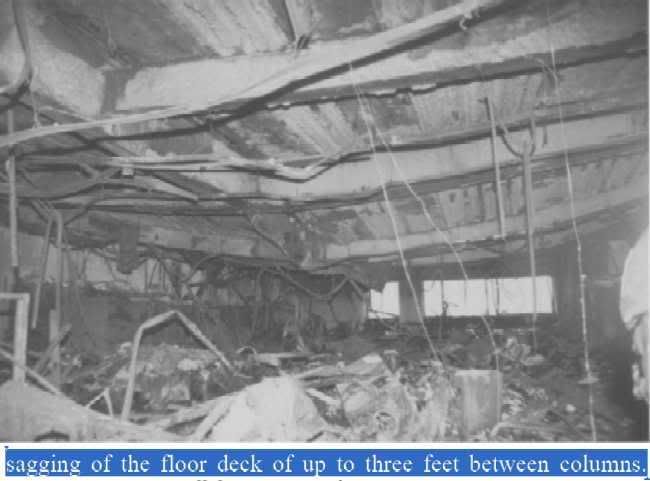
Out of 19 hours, 11 were spent fighting the fire.After more than 11 hours of uncontrolled fire growth and spread, interior firefighting efforts were abandoned due to the risk of structural collapse.
Structual collapse.interior firefighting efforts were abandoned due to the risk of structural collapse
Office fires.Fire-resistance rated construction features, particularly floor-ceiling assemblies and shaft enclosures (including stair shafts), failed when exposed to continuous fire of unusual intensity and duration

There was no pressure to fight the fire and it only burned out when it reached the 30th floor and the sprinklers there put it out. [...] Eventually they abandoned firefighting efforts and let it burn.
As the fire was going into its sixth hour it had spread up to the 26th floor. With inadequate water pressure coming from the standpipes, firefighters stretched hoses up the building's stairwells to help fight the fire. While hoses were being taken up to the fire a sprinkler technician arrived to fix the water pressure. This improved the hose streams, but the fire had engulfed several floors and could not be contained with just hoses. By 7:00 AM, almost eleven hours into the fire, firefighters were able to get control of the fire on the 22nd through 24th floors, but the fire was still out of control on the 25th and 26th floors and was spreading upwards. [...] After the evacuation, the only fire suppression efforts left were water streams being directed to the building from the neighboring Girard Trust Building and One Centre Square.

